Lycopene for Skin & Sun Protection
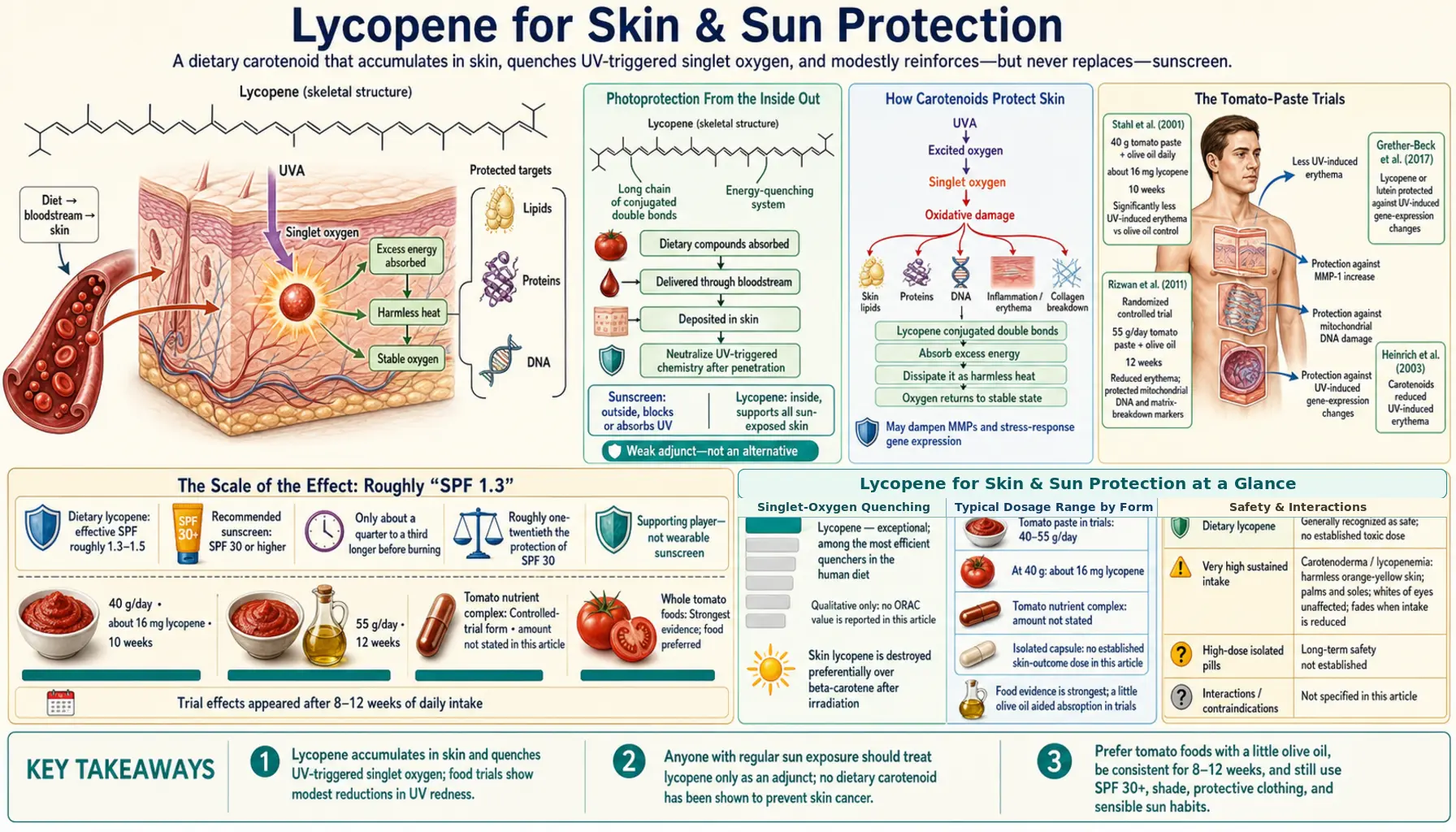
Lycopene, the red carotenoid of tomatoes, is deposited in the skin. Several small controlled human trials have tested whether eating tomato paste, or taking lycopene or tomato-extract supplements, for 10–12 weeks changes how the skin reacts to ultraviolet (UV) light. Most reported less UV-induced redness on at least one measure, and some found no significant difference on others, such as the minimal erythema dose. A 2012 review by Stahl and Sies concluded that the photoprotective efficacy of these carotenoids “is not comparable to the use of a sunscreen.” This page describes what the trials measured, what they found and where the evidence stops.
Table of Contents
- Photoprotection From the Inside Out
- How Carotenoids Protect Skin
- The Tomato-Paste and Supplement Trials
- The Scale of the Effect
- Protection Against Photoaging
- UV Light Depletes Skin Lycopene
- Supplements vs Tomato Foods
- Carotenoderma and Safety
- What the Research Does Not Show
- Key Research Papers
- Connections
- Featured Videos
Photoprotection From the Inside Out
Sunscreen is applied to the skin surface. “Systemic” or nutritional photoprotection refers to compounds taken in with the diet that reach the skin from the inside: in the words of Stahl and Sies (2007), carotenoids and flavonoids “are distributed into light-exposed tissues, such as skin or the eye where they provide systemic photoprotection.” In the trials below, total skin carotenoids rose after 12 weeks of lycopene or mixed-carotenoid supplementation (Heinrich and colleagues, 2003; Aust and colleagues, 2005), and Ribaya-Mercado and colleagues (1995) found skin lycopene levels comparable to or greater than those of beta-carotene.
Sies and Stahl (2004) point out that most of the erythemal annual UV dose is received under non-vacation conditions, when no sunscreen is applied, and that skin protection then depends on the body's own defences; their review lists carotenoids, tocopherols, ascorbate, flavonoids and n-3 fatty acids as dietary contributors. The same authors' 2012 review states that the photoprotective efficacy of beta-carotene and lycopene is not comparable to the use of a sunscreen.
How Carotenoids Protect Skin
Carotenoids are efficient antioxidants capable of scavenging the reactive oxygen species generated under photooxidative stress (Stahl and colleagues, 2001). Singlet oxygen is one such species. In a 1989 laboratory study, Di Mascio, Kaiser and Sies measured a physical quenching rate constant with singlet oxygen of 31 × 109 M−1 s−1 for lycopene, the highest of the carotenoids tested, against 14 × 109 for beta-carotene and 0.3 × 10⁹ for alpha-tocopherol (vitamin E). These are test-tube rate constants. The authors also noted that the compounds with low rate constants circulate at higher plasma levels, and that once this is taken into account the singlet-oxygen quenching capacities of lycopene, beta-carotene, albumin-bound bilirubin and alpha-tocopherol in plasma are of comparable magnitude.
Stahl and Sies (2012) describe carotenoids as having specific antioxidant activity but also as influencing signalling and gene expression at the cellular level. Two of the trials below measured such effects in human skin biopsies: after tomato paste, UV-induced matrix metalloproteinase-1 (MMP-1) was lower than in controls (Rizwan and colleagues, 2011), and a tomato nutrient complex blocked UV-induced increases in the messenger RNA of heme oxygenase-1, ICAM-1 and MMP-1 (Grether-Beck and colleagues, 2017). Balić and Mokos (2019) list direct light absorption, scavenging of reactive oxygen species, regulation of UV-induced gene expression, modulation of stress signalling and suppression of inflammation as proposed mechanisms.
The Tomato-Paste and Supplement Trials
The human evidence comes from small controlled trials that measured skin redness (erythema) about 24 hours after a measured dose of simulated sunlight, and in some cases took skin biopsies:
- Stahl and colleagues (2001): nine volunteers ate 40 g of tomato paste (about 16 mg lycopene a day) with 10 g of olive oil daily for 10 weeks; ten controls received olive oil only. At week 10, erythema measured by chromatometry was 40% lower in the tomato-paste group than in controls (P = 0.02). At week 4 there was no significant difference between the groups.
- Rizwan and colleagues (2011): in a randomized controlled trial, 20 healthy women with phototype I/II skin took 55 g of tomato paste (16 mg lycopene) in olive oil, or olive oil alone, daily for 12 weeks. An instrument-measured index of erythemal sensitivity (D30) was significantly higher after tomato paste than after control (P = 0.03), but the visually assessed minimal erythema dose (MED) did not differ significantly between the groups. Biopsies showed less UV-induced MMP-1 (P = 0.04), more procollagen I deposition (P = 0.05) and fewer UV-induced mitochondrial DNA deletions (P = 0.01) after tomato paste; the UV-induced fall in fibrillin-1 was prevented similarly in both groups.
- Aust and colleagues (2005): volunteers took about 10 mg of lycopene a day for 12 weeks from one of three sources — synthetic lycopene, a tomato extract, or a drink containing solubilized tomato extract. Erythema intensity at week 12 was lower than at week 0 in all groups: by 25% with synthetic lycopene, 38% with the tomato extract and 48% with the drink. These are before-and-after comparisons within each group; the abstract reports no placebo group.
- Heinrich and colleagues (2003): volunteers with skin type II (12 per group) received 24 mg/day of beta-carotene, 24 mg/day of a mix of beta-carotene, lutein and lycopene (8 mg each), or placebo for 12 weeks. Erythema 24 hours after irradiation was diminished in both carotenoid groups and significantly lower than baseline at week 12; the mix's effect was comparable to that of beta-carotene alone.
- Grether-Beck and colleagues (2017): in a double-blind, placebo-controlled crossover study in 65 volunteers with two 12-week treatment phases, a lycopene-rich tomato nutrient complex completely inhibited UVA1- and UVA/B-induced upregulation of heme oxygenase-1, ICAM-1 and MMP-1 messenger RNA in skin biopsies, whichever order the treatments were taken in. Lutein gave complete protection only when taken in the first period. This study measured gene expression, not redness.
- Groten and colleagues (2019): in a double-blind, randomized, placebo-controlled multicentre trial, 149 healthy volunteers took a tomato-extract supplement (15 mg lycopene and 5.8 mg phytoene and phytofluene a day, with smaller amounts of beta-carotene and tocopherols and 4 mg carnosic acid from rosemary) or placebo for 12 weeks. There was no significant difference in minimal erythema dose between the groups on visual grading by expert assessors, but the supplement significantly reduced UVB-induced erythema measured by chromametry and the UVB-induced rise in the inflammatory messengers IL-6 and TNF-α.
In these trials the differences appeared after 10–12 weeks; Stahl 2001 found none at week 4, and a 2006 review by Stahl and colleagues summarises the decrease in sensitivity to UV-induced erythema as observed after 10–12 weeks of intervention. Results depended on the measure used: instrument-measured erythema scores changed more consistently than the minimal erythema dose, which did not differ significantly in two trials (Rizwan 2011; Groten 2019).
The Scale of the Effect
None of the trial abstracts listed on this page reports an equivalent sun protection factor (SPF) for lycopene, so none is given here. What the trials report are the figures above: an erythema score 40% lower than in controls after 10 weeks of tomato paste (Stahl 2001); within-group reductions of 25–48% after 12 weeks of lycopene or tomato extract (Aust 2005); and no significant difference in minimal erythema dose in two trials (Rizwan 2011; Groten 2019). All of these were measured under laboratory doses of simulated sunlight, not during ordinary sun exposure. Stahl and Sies (2012) conclude that the photoprotective efficacy of dietary beta-carotene and lycopene “is not comparable to the use of a sunscreen.”
Protection Against Photoaging
Sies and Stahl (2004) name UV radiation as the major cause of skin disorders such as sunburn, photodamage and nonmelanoma skin cancer. In the Rizwan 2011 trial, tomato paste reduced UV-induced MMP-1 and mitochondrial DNA deletions and increased procollagen I deposition; the authors concluded that tomato paste containing lycopene “provides protection against acute and potentially longer-term aspects of photodamage.” No trial on this page measured wrinkles after lycopene alone.
Heinrich and colleagues (2006) gave 39 volunteers one of two antioxidant mixtures (3 or 6 mg/day of lycopene with beta-carotene, vitamin E and selenium, one of them also with lutein) or placebo for 12 weeks. Skin density and thickness increased and roughness and scaling improved in the two active groups, with no changes in the placebo group; because the mixtures contained several nutrients, the effect cannot be assigned to lycopene. Palombo and colleagues (2007) tested lutein and zeaxanthin, not lycopene, given orally, topically or both, and reported that the combined route gave the highest degree of antioxidant protection across five skin measures. Balić and Mokos (2019) summarise intervention studies of carotenoid-rich diets as showing improvements in skin elasticity, hydration, texture, wrinkles and age spots.
UV Light Depletes Skin Lycopene
Ribaya-Mercado and colleagues (1995) exposed a small area of the forearm in healthy women to three times their individual minimal erythema dose of solar-simulated light. Skin lycopene in the exposed area was 31–46% lower than in adjacent unexposed skin, while the same dose did not significantly change skin beta-carotene. The authors concluded that more skin lycopene than beta-carotene is destroyed under UV stress, “suggesting a role of lycopene in mitigating oxidative damage in tissues.” The study measured a single exposure; it did not test whether a higher lycopene intake changes this.
Supplements vs Tomato Foods
The skin trials used several forms: tomato paste with olive oil (Stahl 2001; Rizwan 2011), tomato-extract supplements (Aust 2005; Grether-Beck 2017; Groten 2019), synthetic lycopene (Aust 2005) and a carotenoid mixture (Heinrich 2003). Only Aust and colleagues compared forms directly at a similar lycopene intake (about 10 mg/day): erythema fell by 25% with synthetic lycopene, against 38% and 48% with the two tomato-extract products. Phytofluene and phytoene rose in serum only in the two tomato-extract groups; both absorb light at UV wavelengths, and the authors suggest they may explain the larger effect. Isolated lycopene was therefore not without effect in that trial, but its effect was smaller. None of the trials listed here compared a whole tomato food with a supplement.
Carotenoderma and Safety
Excessive intake of carotenoid-rich foods can cause carotenoderma, a yellow-orange colouring of the skin typically seen on the palms, soles and nasolabial folds; when lycopene is the cause it is called lycopenaemia. Case reports describe it as benign. A 2022 report linked one case to excessive intake of lycopene-rich vegetables and fruits and found carotenoid deposition particularly pronounced in the stratum corneum (Tanaka and colleagues, 2022), and a 2007 report describes red-orange palms and soles in a woman eating about 1 kg of kaki fruit daily, which disappeared after her diet changed (Caroselli and colleagues, 2007).
For supplements, a 2006 risk assessment, whose authors were affiliated with a supplement-industry trade association, identified 75 mg/day as the intake up to which the evidence of safety for lycopene is strong, and stated that the data for intakes above that level are not sufficient for a confident conclusion of long-term safety (Shao and Hathcock, 2006).
What the Research Does Not Show
- No equivalence to sunscreen. Stahl and Sies (2012) state that the photoprotective efficacy of dietary carotenoids is not comparable to the use of a sunscreen. The trials measured redness after controlled doses of simulated sunlight, not outcomes during ordinary sun exposure.
- No shown skin-cancer prevention. Balić and Mokos (2019) conclude that available studies could not confirm a protective role of carotenoids in skin photocarcinogenesis. Skin-cancer topics are covered in the Dermatology section.
- No quick effect. Stahl 2001 found no significant difference at week 4; the differences reported in the trials appeared after 10–12 weeks of daily intake.
- Not every measure changed. The minimal erythema dose did not differ significantly between groups in two trials (Rizwan 2011; Groten 2019), and the abstracts report no equivalent SPF.
Key Research Papers
- Stahl W, Heinrich U, Wiseman S, et al. (2001). Dietary tomato paste protects against ultraviolet light-induced erythema in humans. Journal of Nutrition — PubMed PMID: 11340098
- Rizwan M, Rodriguez-Blanco I, Harbottle A, et al. (2011). Tomato paste rich in lycopene protects against cutaneous photodamage in humans in vivo: a randomized controlled trial. British Journal of Dermatology — PubMed PMID: 20854436
- Grether-Beck S, Marini A, Jaenicke T, et al. (2017). Molecular evidence that oral supplementation with lycopene or lutein protects human skin against ultraviolet radiation. British Journal of Dermatology — PubMed PMID: 27662341
- Heinrich U, Gärtner C, Wiebusch M, et al. (2003). Supplementation with beta-carotene or a similar amount of mixed carotenoids protects humans from UV-induced erythema. Journal of Nutrition — PubMed PMID: 12514275
- Ribaya-Mercado JD, Garmyn M, Gilchrest BA, Russell RM (1995). Skin lycopene is destroyed preferentially over beta-carotene during ultraviolet irradiation in humans. Journal of Nutrition — PubMed PMID: 7616301
- Stahl W, Sies H (2007). Carotenoids and flavonoids contribute to nutritional protection against skin damage from sunlight. Molecular Biotechnology — PubMed PMID: 17914160
- Sies H, Stahl W (2004). Nutritional protection against skin damage from sunlight. Annual Review of Nutrition — PubMed PMID: 15189118
- Stahl W, Sies H (2012). Photoprotection by dietary carotenoids: concept, mechanisms, evidence and future development. Molecular Nutrition & Food Research — PubMed PMID: 21953695
- Palombo P, Fabrizi G, Ruocco V, et al. (2007). Beneficial long-term effects of combined oral/topical antioxidant treatment with the carotenoids lutein and zeaxanthin on human skin. Skin Pharmacology and Physiology — PubMed PMID: 17446716
- Balić A, Mokos M (2019). Do we utilize our knowledge of the skin protective effects of carotenoids enough? Antioxidants (Basel) — PubMed PMID: 31370257
- Rao AV, Agarwal S (2000). Role of antioxidant lycopene in cancer and heart disease. Journal of the American College of Nutrition — PubMed PMID: 11022869 (background review of lycopene as an antioxidant; its abstract does not discuss singlet-oxygen quenching)
- Aust O, Stahl W, Sies H, et al. (2005). Supplementation with tomato-based products increases lycopene, phytofluene, and phytoene levels in human serum and protects against UV-light-induced erythema. International Journal for Vitamin and Nutrition Research — PubMed PMID: 15830922
- Stahl W, Heinrich U, Aust O, et al. (2006). Lycopene-rich products and dietary photoprotection. Photochemical & Photobiological Sciences — PubMed PMID: 16465309
- Groten K, Marini A, Grether-Beck S, et al. (2019). Tomato phytonutrients balance UV response: results from a double-blind, randomized, placebo-controlled study. Skin Pharmacology and Physiology — PubMed PMID: 30836363
- Heinrich U, Tronnier H, Stahl W, et al. (2006). Antioxidant supplements improve parameters related to skin structure in humans. Skin Pharmacology and Physiology — PubMed PMID: 16679825
- Di Mascio P, Kaiser S, Sies H (1989). Lycopene as the most efficient biological carotenoid singlet oxygen quencher. Archives of Biochemistry and Biophysics — PubMed PMID: 2802626
- Tanaka A, Miyauchi T, Kitamura S, et al. (2022). Carotenoderma due to lycopenemia: a case report and evaluation of lycopene deposition in the skin. Journal of Dermatology — PubMed PMID: 35938228
- Caroselli C, Bruno G, Manara F (2007). A rare cutaneous case of carotenosis cutis: lycopenaemia. Annals of Nutrition and Metabolism — PubMed PMID: 18227626
- Shao A, Hathcock JN (2006). Risk assessment for the carotenoids lutein and lycopene. Regulatory Toxicology and Pharmacology — PubMed PMID: 16814439