Beta-Carotene Food Sources and Absorption
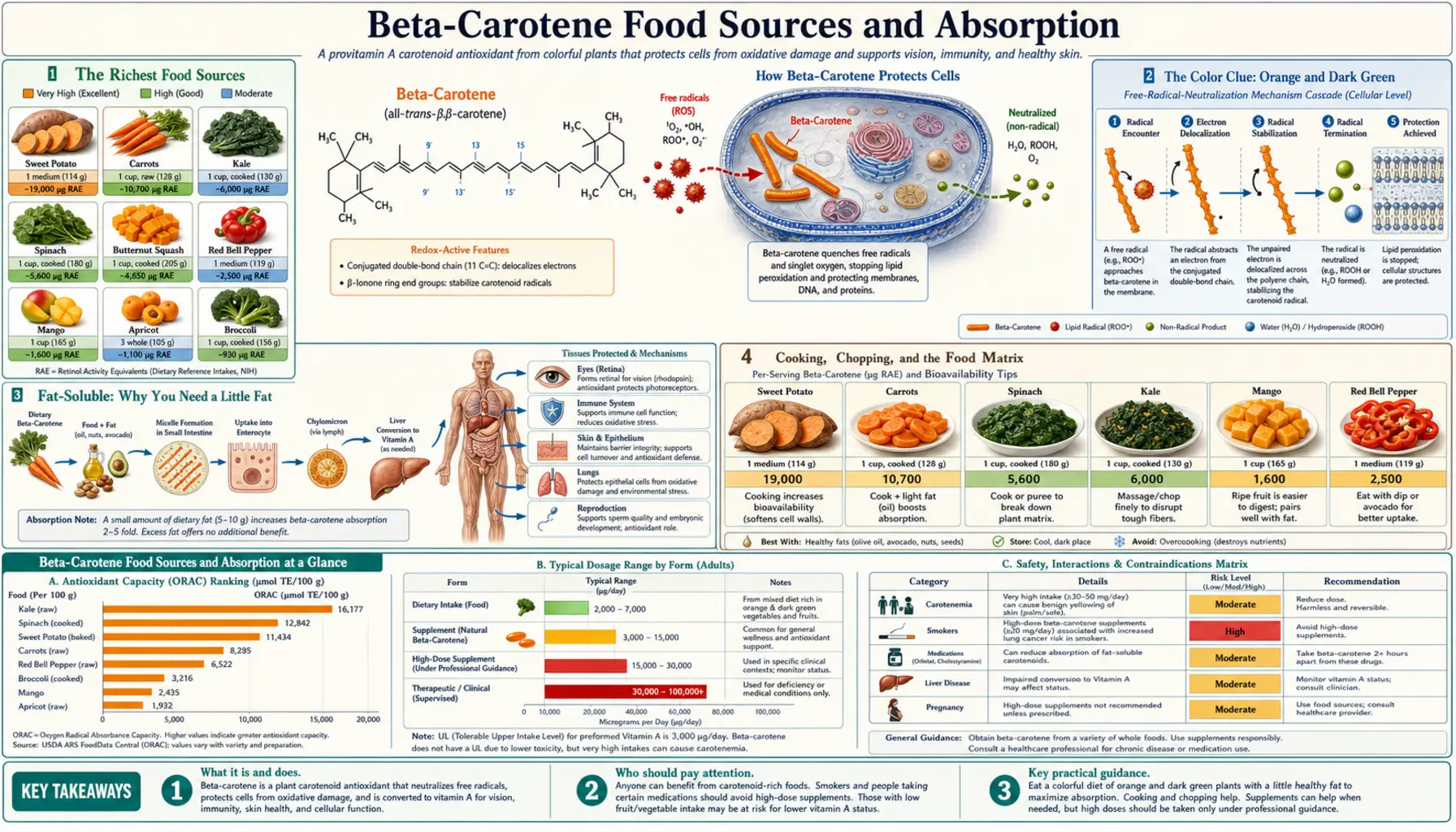
The safest and most beneficial way to get beta-carotene is from food — and how you prepare and eat that food dramatically changes how much you actually absorb. Beta-carotene is fat-soluble, tightly bound inside plant cell walls, and much better absorbed from cooked, chopped vegetables eaten with a little fat. This page maps the richest sources, explains the cooking and fat rules that can multiply absorption several-fold, and gives practical meal ideas — the honest, food-first approach that avoids the supplement pitfalls entirely.
Table of Contents
- The Richest Food Sources
- The Color Clue: Orange and Dark Green
- Fat-Soluble: Why You Need a Little Fat
- Cooking, Chopping, and the Food Matrix
- What Helps and What Hurts Absorption
- From Plate to Retinol: Conversion Factors
- Can You Eat Too Much? Carotenemia Explained
- Building Beta-Carotene-Rich Meals
- Key Research Papers
- PubMed Topic Searches
- External Resources
- Connections
- Featured Videos
The Richest Food Sources
Beta-carotene is concentrated in deeply pigmented orange, yellow, and dark-green vegetables and fruits. The standouts, roughly in order of concentration in a normal serving, include:
- Sweet potato (especially cooked, with skin) — one of the densest common sources.
- Carrots — the vegetable beta-carotene is literally named after (from the Latin carota).
- Pumpkin and winter squash (butternut, kabocha).
- Dark leafy greens — kale, spinach, collards, and turnip greens (the green chlorophyll masks the orange pigment, but it is there).
- Red and orange bell peppers.
- Cantaloupe, mango, and apricots among fruits.
Because the pigment is what you are after, a simple rule works well: the more intense the orange or the darker the green, the more beta-carotene, all else equal.
The Color Clue: Orange and Dark Green
Beta-carotene is an orange pigment, so orange foods advertise their content directly. In dark-green vegetables, abundant green chlorophyll hides the orange color, but leafy greens are genuinely rich in beta-carotene. This is why both a carrot and a handful of spinach are good sources despite looking nothing alike. Pale vegetables (potatoes, cauliflower, iceberg lettuce) contain little. Using color as a first-pass guide — and deliberately including something orange and something dark-green each day — is a reliable way to keep intake high.
Fat-Soluble: Why You Need a Little Fat
Beta-carotene cannot be absorbed without dietary fat. It must dissolve into the mixed micelles that carry fat-soluble nutrients across the intestinal lining, and that process requires fat in the same meal to stimulate bile release and provide the lipid vehicle. Human studies make the size of this effect vivid: carotenoid absorption from a salad was far higher when eaten with full-fat dressing than with fat-free dressing, and adding avocado or avocado oil to salsa and salad substantially increased carotenoid uptake.
The practical rule is simple and cheap: never eat your carotenoid vegetables completely fat-free. A drizzle of olive oil, a pat of butter, a few slices of avocado, a handful of nuts, or a whole-egg component in the meal can multiply absorption several-fold. This is one of the highest-yield, lowest-effort nutrition tips there is.
Cooking, Chopping, and the Food Matrix
Raw vegetables lock beta-carotene inside tough, indigestible cell walls. Cooking and mechanical disruption — chopping, pureeing, juicing — break those walls and release the pigment, making it far more available for absorption. Controlled studies have shown that beta-carotene bioavailability is higher from cooked and processed carrots and spinach than from the raw vegetables.
This does not mean raw vegetables are bad — they carry other benefits — but for maximizing beta-carotene specifically, gentle cooking (steaming, roasting, sauteing) plus some fat is the winning combination. Overcooking at very high heat for very long can eventually degrade carotenoids, so the sweet spot is “cooked until tender,” not incinerated. Pureeing (soups, mashes) is especially effective because it maximally ruptures the cell matrix.
What Helps and What Hurts Absorption
Helps:
- Dietary fat in the same meal (the biggest lever).
- Cooking, chopping, and pureeing to break the food matrix.
- Adequate overall nutrition — absorption is a coordinated process.
Hurts:
- Very-low-fat or fat-free meals.
- Fat substitutes and some cholesterol-lowering agents (e.g., plant sterols, olestra, bile-acid sequestrants) that reduce carotenoid absorption.
- An intact raw plant matrix (whole raw vegetables release less).
- Fat malabsorption conditions, which impair all fat-soluble nutrient uptake.
Reviews of the dietary factors affecting carotenoid bioavailability summarize these as the “SLAMENGHI” factors — species of carotenoid, molecular linkage, amount, matrix, effectors like fat, nutrient status, genetics, and host factors — a useful reminder that absorption is multi-factorial.
From Plate to Retinol: Conversion Factors
Once absorbed, dietary beta-carotene is converted to vitamin A with the demand-regulated efficiency described on the Eye Health page. US dietary guidance assigns a conversion factor of 12:1 (12 mcg dietary beta-carotene ≈ 1 mcg retinol activity equivalent) for beta-carotene in food, and 24:1 for the other provitamin A carotenoids. Poor preparation (raw, fat-free) pushes the effective ratio even higher.
The practical implication: to rely on plants for vitamin A, eat carotenoid vegetables generously, cooked, and with fat. This is entirely achievable — provitamin-A-biofortified staple crops have been shown to improve vitamin A status in feeding trials — but it requires attention to quantity and preparation, especially for people who eat little or no animal food.
Can You Eat Too Much? Carotenemia Explained
You cannot overdose on vitamin A by eating beta-carotene, thanks to the demand-regulated conversion. The only consequence of very high intake is carotenemia — a harmless yellow-orange discoloration of the skin, most visible on the palms and soles, that appears when a lot of unconverted beta-carotene circulates and deposits in the skin. It is benign and fully reversible: reduce intake and the color fades over weeks.
Carotenemia is easy to distinguish from jaundice: carotenemia spares the whites of the eyes, while jaundice yellows them. It is most often seen in people (including infants and enthusiastic juicers) who eat very large amounts of carrots, sweet potato, or squash. It requires no treatment beyond moderation and is, if anything, a visible marker of a vegetable-rich diet.
Building Beta-Carotene-Rich Meals
- Roasted sweet potato with olive oil — cooked, fat-paired, high-density; a near-ideal beta-carotene meal.
- Carrot-ginger soup pureed with a swirl of cream or coconut milk — the puree ruptures the matrix and the fat drives absorption.
- Sauteed kale or spinach in olive oil and garlic — cooking plus fat unlocks the greens.
- Salad with a full-fat or avocado-based dressing — not fat-free, which sharply cuts absorption.
- Butternut squash roasted with butter, or added to stews.
- Mango or cantaloupe with a few nuts or full-fat yogurt for a fruit-based option.
The unifying principle across every one of these is the same: cooked or broken-down vegetables, eaten with a little fat. Get that right and food alone supplies beta-carotene safely and effectively — no supplement required.
Key Research Papers
- Brown MJ, Ferruzzi MG, Nguyen ML, et al. (2004). Carotenoid bioavailability is higher from salads ingested with full-fat than with fat-reduced salad dressings. American Journal of Clinical Nutrition. — PubMed PMID: 15277161
- Unlu NZ, Bohn T, Clinton SK, Schwartz SJ (2005). Carotenoid absorption from salad and salsa by humans is enhanced by the addition of avocado or avocado oil. Journal of Nutrition. — PubMed PMID: 15735074
- van het Hof KH, West CE, Weststrate JA, Hautvast JG (2000). Dietary factors that affect the bioavailability of carotenoids. Journal of Nutrition. — PubMed PMID: 10702576
- Castenmiller JJ, West CE (1998). Bioavailability and bioconversion of carotenoids. Annual Review of Nutrition. — PubMed PMID: 9706217
- Tang G (2010). Bioconversion of dietary provitamin A carotenoids to vitamin A in humans. American Journal of Clinical Nutrition. — PubMed PMID: 20200262
- dela Seña C, Riedl KM, Narayanasamy S, et al. (2014). The human enzyme that converts dietary provitamin A carotenoids to vitamin A is a dioxygenase. Journal of Biological Chemistry. — PubMed PMID: 24668807
- Haskell MJ (2012). The challenge to reach nutritional adequacy for vitamin A: beta-carotene bioavailability and conversion — evidence in humans. American Journal of Clinical Nutrition. — PubMed PMID: 23053560
- Tang G, Qin J, Dolnikowski GG, Russell RM, Grusak MA (2009). Golden Rice is an effective source of vitamin A. American Journal of Clinical Nutrition. — Search PubMed
- Weber D, Grune T (2012). The contribution of beta-carotene to vitamin A supply of humans. Molecular Nutrition & Food Research. — PubMed PMID: 21957049
- Grune T, Lietz G, Palou A, et al. (2010). Beta-carotene is an important vitamin A source for humans. Journal of Nutrition. — PubMed PMID: 20980645
- Krinsky NI, Johnson EJ (2005). Carotenoid actions and their relation to health and disease. Molecular Aspects of Medicine. — PubMed PMID: 16309738
PubMed Topic Searches
- Beta-carotene absorption and dietary fat
- Carotenoid bioavailability, cooking, food matrix
- Beta-carotene conversion (RAE) in humans
- Carotenoid absorption with avocado/oil
- Carotenemia (benign carotenoid skin coloration)
External Resources
- NIH Office of Dietary Supplements — Vitamin A & Carotenoids (Health Professional Fact Sheet)
- Linus Pauling Institute — Carotenoids
- Linus Pauling Institute — Vitamin A
- National Cancer Institute — Antioxidants and Cancer Prevention
- USDA FoodData Central — carotenoid content of foods
- PubMed — all research on beta-carotene
Connections
- Beta-Carotene (Main Page)
- Beta-Carotene Benefits Hub
- Vitamin A & Eye Health
- The Supplement Paradox
- Antioxidant & Skin
- Sweet Potatoes
- Kale
- Spinach
- Organ Meats (Beef Liver)
- Vitamin A
- Vitamin A Deficiency
- Beta-Carotene vs Preformed Retinol
- All Antioxidants
- Lutein
- Lycopene