Apigenin — Benefits Deep Dive
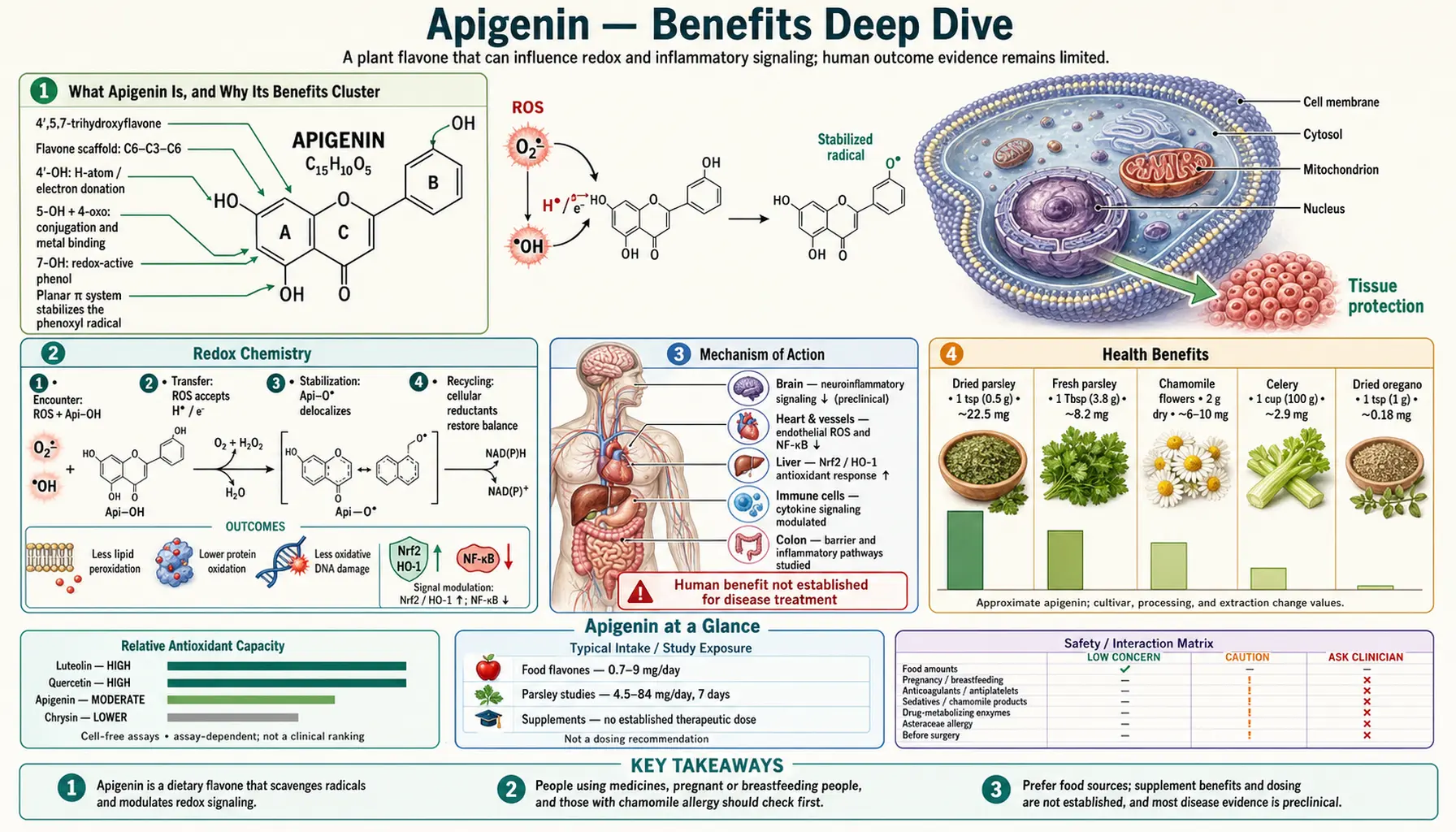
Apigenin is a plant flavone — a bright, pale-yellow pigment found in chamomile flowers, parsley, celery, and many everyday herbs. It is the compound most often credited for the gentle calm of a cup of chamomile tea, and in the last decade it has drawn fresh scientific attention as one of the most studied dietary inhibitors of the NAD-consuming enzyme CD38. The four pages below separate what is genuinely established from what remains promising laboratory research. Apigenin has a real, reproducible mechanism at the brain's benzodiazepine site (mild anxiolytic and sleep effects), a broad and well-characterized antioxidant and anti-inflammatory profile, and an active preclinical literature on cellular aging and cancer chemoprevention that has not yet translated into proof that it treats cancer or extends human lifespan. We keep that distinction front and center on every page.
Deep-Dive Articles
Calm & Sleep
The chamomile connection. Apigenin binds the benzodiazepine site on the GABA-A receptor, producing mild anxiolytic and sedative effects in animal models. We walk through the mechanism, the human chamomile trials for generalized anxiety and sleep, and an honest accounting of how modest the direct human evidence for isolated apigenin actually is.
Antioxidant & Anti-Inflammatory
How apigenin's flavone backbone scavenges free radicals, activates the Nrf2 antioxidant-response pathway, and dampens the NF-κB inflammatory cascade, COX-2, and pro-inflammatory cytokines. A mechanism-first tour of the most reproducible arm of apigenin biology — with clear limits on what has been shown in humans versus cell and animal models.
Cellular & Longevity Research
Apigenin as a CD38 inhibitor that raises intracellular NAD+, its effects on cellular senescence and the SIRT1–NAD–CD38 axis, and the large preclinical cancer-chemoprevention literature. Strictly framed as research: apigenin does not treat cancer and has not been shown to extend human lifespan.
Dietary Sources
Where apigenin actually comes from: parsley (by far the richest common source), chamomile tea, celery and celery seed, and dried herbs such as oregano and thyme. Realistic content figures, why apigenin's oral bioavailability is low, and how food preparation and the gut microbiome change how much you absorb.
Table of Contents
- Deep-Dive Articles
- What Apigenin Is, and Why Its Benefits Cluster
- Research Papers: Calm, Sleep & GABA
- Research Papers: Antioxidant & Anti-Inflammatory
- Research Papers: Cellular Aging, CD38/NAD+ & Chemoprevention
- Research Papers: Dietary Sources & Bioavailability
- Research Papers: Reviews & Cross-Cutting
- External Authoritative Resources
- Connections
- Featured Videos
What Apigenin Is, and Why Its Benefits Cluster
Apigenin (4′,5,7-trihydroxyflavone) is a member of the flavone subclass of flavonoids — the same broad family as its close cousins luteolin and chrysin. Chemically it is a small, flat, three-ring molecule with three hydroxyl groups. In plants it usually exists as a glycoside (bound to sugars, most commonly as apigenin-7-O-glucoside, also called cosmosiin, or as apiin in parsley and celery); the sugars are cleaved during digestion to release the free "aglycone" apigenin that the body absorbs.
Unlike a vitamin, apigenin is not an essential nutrient — there is no deficiency disease and no established daily requirement. It is a bioactive food compound: something plants make for their own purposes that happens to interact with human biology when we eat it. Its benefits cluster into three mechanistically distinct groups, and each maps to one of the deep-dive pages below.
- Neuroactive (the GABA-A / benzodiazepine site) — apigenin fits into the same receptor pocket on the GABA-A receptor that diazepam and other benzodiazepine drugs use, but binds weakly and without full agonist activity. This is the mechanism behind chamomile's traditional reputation for calm and sleep, explored on the Calm & Sleep page.
- Redox and immune signaling — the trihydroxyflavone structure directly quenches reactive oxygen species and, more importantly, tunes cellular signaling: it activates the Nrf2 antioxidant-response pathway and suppresses the master inflammatory switch NF-κB, COX-2, and downstream cytokines. This is the Antioxidant & Anti-Inflammatory arm.
- Enzyme inhibition affecting cellular aging — apigenin is a well-characterized inhibitor of CD38, an enzyme that consumes NAD+. By slowing NAD+ breakdown it can raise intracellular NAD+ and support sirtuin activity in laboratory models, and it interacts with the machinery of cellular senescence and tumor-cell survival. This is the strictly-preclinical Cellular & Longevity Research.
A practical thread runs through all three: apigenin's oral bioavailability is low. It is poorly water-soluble, extensively metabolized in the gut and liver, and cleared relatively quickly, which is why the dramatic concentrations used in a petri dish rarely correspond to what circulates after a cup of tea or a plate of parsley. The Sources page covers what real foods deliver and why absorption is the central caveat for every claim.
Research Papers: Calm, Sleep & GABA
- Viola H et al. (1995). Apigenin, a component of Matricaria recutita flowers, is a central benzodiazepine receptors-ligand with anxiolytic effects. Planta Medica. — PubMed 7617761
- Marder M, Paladini AC (2002). GABA(A)-receptor ligands of flavonoid structure. Current Topics in Medicinal Chemistry. — PubMed 12171576
- Kim JW et al. (2012). Enhancement of pentobarbital-induced sleep by apigenin through chloride ion channel activation. Archives of Pharmacal Research. — PubMed 22370792
- Mao JJ et al. (2016). Long-term chamomile (Matricaria chamomilla L.) treatment for generalized anxiety disorder: a randomized clinical trial. Phytomedicine. — PubMed 27912875
- Hieu TH et al. (2019). Therapeutic efficacy and safety of chamomile for anxiety and insomnia: a systematic review and meta-analysis. Phytotherapy Research. — PubMed 31006899
Research Papers: Antioxidant & Anti-Inflammatory
- Zheng YZ et al. (2018). The substituent effect on the radical scavenging activity of apigenin. Molecules. — PubMed 30103379
- Park CH et al. (2020). Effects of apigenin on RBL-2H3, RAW264.7, and HaCaT cells: anti-allergic, anti-inflammatory, and skin-protective activities. Int. J. Molecular Sciences. — PubMed 32610574
- Li H et al. (2023). Apigenin attenuates inflammatory response in allergic rhinitis mice by inhibiting the TLR4/MyD88/NF-κB pathway. Environmental Toxicology. — PubMed 36350155
- Tang QQ et al. (2024). Apigenin ameliorates H₂O₂-induced oxidative damage through the Nrf2 and PI3K/Akt/mTOR pathways. Pharmaceuticals (Basel). — Search PubMed
- Ji X et al. (2023). Apigenin inhibits the progression of osteoarthritis by mediating macrophage polarization. Molecules. — PubMed 37049677
Research Papers: Cellular Aging, CD38/NAD+ & Chemoprevention
- Escande C et al. (2013). Flavonoid apigenin is an inhibitor of the NAD+ ase CD38: implications for cellular NAD+ metabolism, protein acetylation, and treatment of metabolic syndrome. Diabetes. — PubMed 23172919
- Ogura Y et al. (2020). CD38 inhibition by apigenin ameliorates mitochondrial oxidative stress through restoration of the NAD+/NADH ratio and Sirt3 activity. Aging (Albany NY). — PubMed 32507768
- Li BS et al. (2021). Apigenin alleviates oxidative stress-induced cellular senescence via modulation of the SIRT1–NAD–CD38 axis. American Journal of Chinese Medicine. — PubMed 34049472
- Zhang H et al. (2025). Targeting senescence with apigenin improves chemotherapeutic efficacy and ameliorates age-related conditions in mice. Advanced Science. — PubMed 40265973
- Shankar E et al. (2017). Plant flavone apigenin: an emerging anticancer agent. Current Pharmacology Reports. — PubMed 29399439
Research Papers: Dietary Sources & Bioavailability
- Wang M et al. (2019). A review on flavonoid apigenin: dietary intake, ADME, antimicrobial effects, and interactions with human gut microbiota. BioMed Research International. — PubMed 31737673
- Borges G et al. (2022). Absorption, distribution, metabolism and excretion of apigenin and its glycosides in healthy male adults. Free Radical Biology and Medicine. — PubMed 35452808
- Tang D et al. (2017). Pharmacokinetic properties and drug interactions of apigenin, a natural flavone. Expert Opinion on Drug Metabolism & Toxicology. — PubMed 27766890
- Nováková L et al. (2010). UHPLC-MS/MS determination of phenolic compounds in chamomile flowers and chamomile tea extracts. Talanta. — PubMed 20801328
- Hang NT et al. (2022). Green extraction of apigenin and luteolin from celery seed using deep eutectic solvent. J. Pharmaceutical and Biomedical Analysis. — PubMed 34653746
Research Papers: Reviews & Cross-Cutting
- Salehi B et al. cited within — Al-Khayri JM et al. (2022). Flavonoids as potential anti-inflammatory molecules: a review. Molecules. — PubMed 35566252
- Kramer DJ, Johnson AA (2024). Apigenin: a natural molecule at the intersection of sleep and aging. Frontiers in Nutrition. — PubMed 38476603
- Olasehinde TA, Olaokun OO (2024). The beneficial role of apigenin against cognitive and neurobehavioural dysfunction: a systematic review of preclinical investigations. Biomedicines. — PubMed 38255283
- Waheed A et al. (2023). Insights into pharmacological potential of apigenin through various pathways on a nanoplatform in a multitude of diseases. Current Pharmaceutical Design. — PubMed 37254541
- Cai H et al. (2007). Tissue distribution in mice and metabolism in murine and human liver of apigenin and tricin, flavones with putative cancer chemopreventive properties. Cancer Chemotherapy and Pharmacology. — PubMed 17089164
External Authoritative Resources
- PubChem — Apigenin (CID 5280443) — authoritative chemistry, properties, and safety data
- NIH Office of Dietary Supplements — Fact Sheets (flavonoids and dietary bioactives context)
- USDA FoodData Central — searchable food composition, including flavone content of parsley, celery, and herbs
- MedlinePlus — German Chamomile (the primary dietary source of apigenin)
- PubMed — all research on apigenin
Connections
- Apigenin (Main Page)
- Apigenin for Calm & Sleep
- Apigenin: Antioxidant & Anti-Inflammatory
- Apigenin: Cellular & Longevity Research
- Apigenin: Dietary Sources
- All Antioxidants
- Luteolin (sister flavone)
- Quercetin
- NAD+ / NMN
- Fisetin (senolytic flavonoid)
- Chamomile
- Celery
- L-Theanine
- Anxiety
- Insomnia