Taurine: History and Discovery
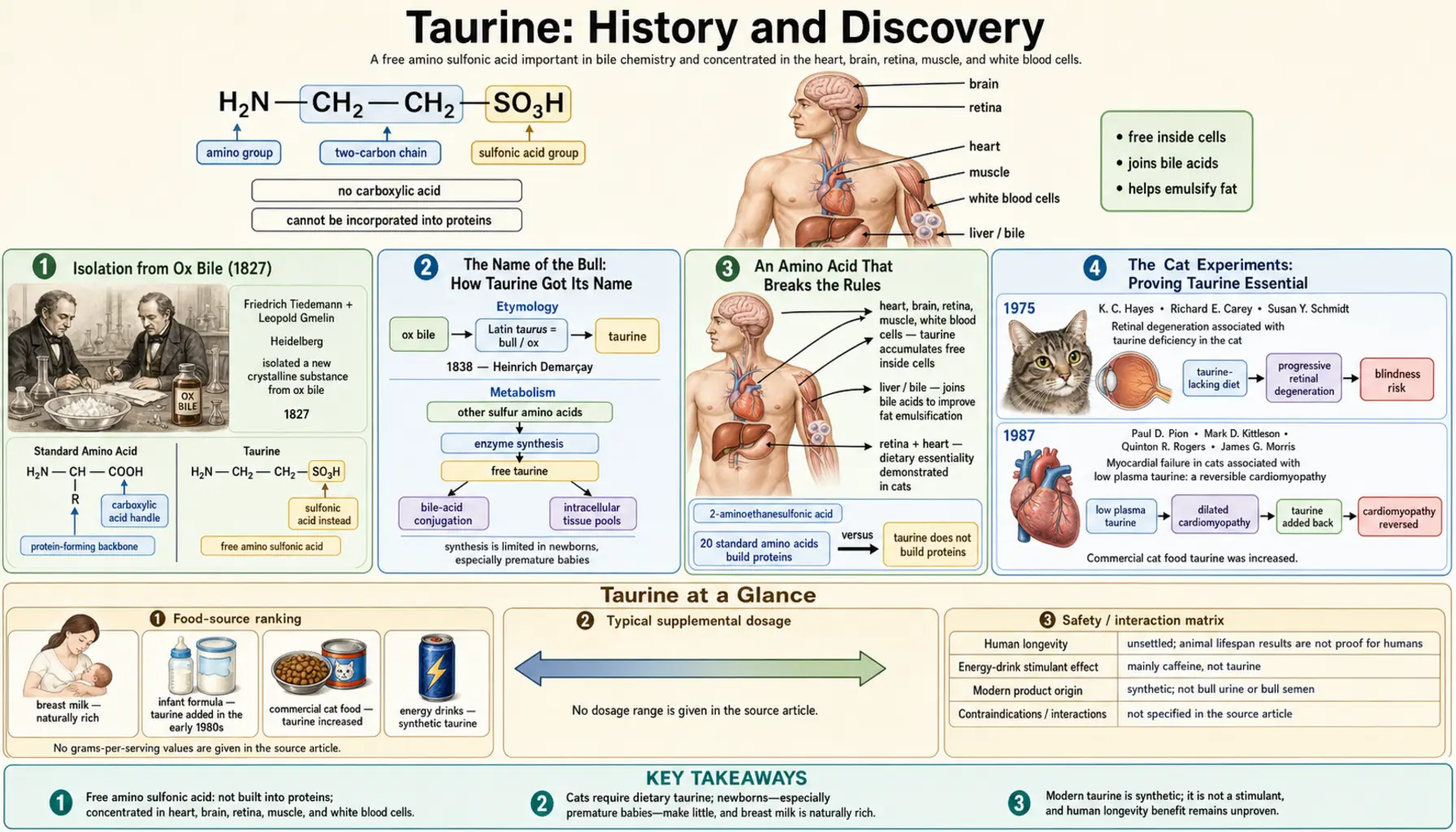
Taurine owes its very name to an ox. In 1827, two German scientists, Friedrich Tiedemann and Leopold Gmelin, isolated a previously unknown substance from the bile of an ox, and the molecule was later christened after the Latin word taurus — bull. For more than a century afterward it was treated as little more than a curiosity of bile chemistry. Only in the second half of the twentieth century — through an unexpected discovery in cats — did taurine reveal itself as a substance the body genuinely cannot do without, a finding that reshaped pet food, infant formula, and our whole picture of what this odd, protein-shunning amino acid is for. This article traces that documented record: who isolated it and from what, how it got its name, why it stands apart from the ordinary amino acids, the feline experiments that proved it essential, and the modern research that has made taurine one of the most talked-about molecules in the science of aging. Where the history is firmly recorded we say so plainly; where a detail is less certain we flag it.
Table of Contents
- Isolation from Ox Bile (1827)
- The Name of the Bull: How Taurine Got Its Name
- An Amino Acid That Breaks the Rules
- The Cat Experiments: Proving Taurine Essential
- From Kittens to Cribs: Taurine in Infant Formula
- A Curious Detour: Taurine and Energy Drinks
- The Longevity Question: Taurine and Aging
- Research Papers and References
- Connections
- Featured Videos
Isolation from Ox Bile (1827)
The documented story of taurine begins in 1827, when the German physiologist Friedrich Tiedemann and the chemist Leopold Gmelin, working in Heidelberg, isolated a new crystalline substance from the bile of an ox. This origin is the single best-established fact in taurine's history and is repeated consistently across the scientific and reference literature. Bile — the greenish fluid the liver makes to help digest fat — turned out to be unusually rich in this compound, which is fitting, because one of taurine's central jobs in the body is to join with bile acids and make them better at emulsifying fat.
Tiedemann and Gmelin were not looking for a dietary nutrient; they were doing the painstaking analytical chemistry of their era, breaking down a biological fluid to see what it was made of. The substance they pulled out of ox bile was, in modern terms, an unusually simple molecule for something the body keeps in such large amounts. It is worth being plain about what this discovery was and was not. The two chemists did not understand taurine's biological role — that would take another century and a half — nor did they invent the molecule, which is made by animals (including humans) and concentrated in tissues throughout the body. What they did was specific and real: they were the first to isolate and describe it as a distinct chemical substance. Everything that follows in taurine's history rests on that 1827 starting point.
The Name of the Bull: How Taurine Got Its Name
The name taurine comes straight from where it was found. It is derived from the Latin taurus, meaning bull or ox (a cousin of the Ancient Greek tauros) — a direct nod to the ox bile from which it was first isolated. According to the standard accounts, the common chemical name "taurine" was put into use in 1838 by the German chemist Heinrich Demarçay, who also carried out early elemental analysis of the compound. In other words, the molecule was discovered in 1827 but did not acquire its familiar name until about a decade later.
This is the place to clear up a stubborn myth. Because the name evokes a bull and because taurine is famously an ingredient in energy drinks, a widespread rumour holds that taurine is extracted from bull urine or bull semen. That is false. The name honours the ox bile of the original 1827 isolation, but the taurine sold today — in supplements, energy drinks, infant formula, and pet food — is synthetic, manufactured by chemical processes and not harvested from any animal. The etymology is a historical fingerprint, not a recipe; the connection to bulls is in the Latin dictionary, not in the modern bottle.
An Amino Acid That Breaks the Rules
Part of what kept taurine in the scientific background for so long is that it does not behave like the amino acids most people learn about. The twenty "standard" amino acids — the ones with names like glycine, leucine, and lysine — are the building blocks that the body strings together to make proteins. Each carries a carboxylic acid group, which is the chemical handle that lets them link into the long chains we call proteins.
Taurine is different. Chemically it is 2-aminoethanesulfonic acid, and in place of the usual carboxylic acid group it carries a sulfonic acid group built around a sulfur atom. That single structural difference has a large consequence: taurine cannot be incorporated into proteins. Instead of being knitted into the body's scaffolding, it floats free inside cells — a so-called free amino acid — and it does so in remarkable abundance, piling up in the heart, brain, retina, muscle, and white blood cells. Strictly speaking, this makes taurine an amino sulfonic acid rather than a classical amino acid, though by long convention it is still called an amino acid.
This quirk helps explain the long gap between taurine's 1827 isolation and the recognition of its importance. Early biochemists naturally focused their attention on the amino acids that build proteins, the obvious machinery of life. A free-floating molecule that refused to join a protein looked, for decades, like a metabolic leftover — an end product of sulfur chemistry rather than a worker with a job. The discovery that this "leftover" was in fact indispensable came not from human studies but from an entirely unexpected direction, taken up in the next section.
The Cat Experiments: Proving Taurine Essential
The turning point in taurine's history arrived in the 1970s and 1980s, and the heroes of the story are house cats. In 1975, the researchers K. C. Hayes, Richard E. Carey, and Susan Y. Schmidt published a landmark paper in the journal Science titled "Retinal degeneration associated with taurine deficiency in the cat." They had found that cats fed a diet lacking taurine developed a progressive degeneration of the retina — the light-sensing tissue at the back of the eye — that could lead to blindness. Crucially, this showed that for cats, taurine was not optional: their bodies could not make enough of it, so it had to come from the diet. It was a true dietary essential.
The second shoe dropped in 1987, when Paul D. Pion, Mark D. Kittleson, Quinton R. Rogers, and James G. Morris — veterinary researchers at the University of California, Davis — published another Science paper, "Myocardial failure in cats associated with low plasma taurine: a reversible cardiomyopathy." They reported that taurine-deficient cats were developing dilated cardiomyopathy, a serious weakening and enlargement of the heart muscle that was killing pet cats — and, remarkably, that simply supplementing taurine reversed it. Cats with failing hearts recovered when taurine was added back to their food.
The practical impact was immediate and enormous. Pet-food manufacturers increased the taurine content of commercial cat food, and taurine became a required ingredient in feline diets — a regulatory and industry change that has saved countless cats from blindness and heart failure ever since. Just as importantly for human science, these feline studies forced a reappraisal of the molecule itself. A compound long dismissed as a metabolic afterthought had been shown, in a living mammal, to be essential for the eye and the heart. The obvious next question was whether the same logic might apply, at least in part, to people — and that question pointed straight at the most vulnerable humans of all: newborns.
From Kittens to Cribs: Taurine in Infant Formula
The cat discoveries landed at the same time that researchers were learning something important about human infants: newborns, and especially premature babies, have a limited ability to make their own taurine. The enzyme machinery that synthesises taurine from other sulfur amino acids is not yet fully mature in early life, which makes a baby far more dependent on what arrives in the diet. And here nature had already left a strong hint — human breast milk is naturally rich in taurine, supplying it in generous amounts to the nursing infant.
Cow's-milk–based infant formulas, by contrast, historically contained much less taurine than breast milk. Put together, the evidence was hard to ignore: cats went blind and developed heart failure without dietary taurine; human infants make little of their own; and human milk delivers it abundantly. As a measure of prudence, manufacturers began adding taurine to infant formula in the early 1980s, so that formula-fed babies would receive amounts closer to what breastfed babies get. This is one of the clearest examples in nutritional history of a finding in animals reshaping a product used by millions of human babies. It is worth stating the logic honestly: the move was made as a sensible precaution to make formula resemble breast milk, in the wake of the dramatic animal data, rather than because formula-fed infants had been shown to suffer the same dramatic deficiency seen in cats.
A Curious Detour: Taurine and Energy Drinks
For most of the public, the word "taurine" is associated less with bile chemistry or cat food than with energy drinks — and that, too, is a real part of its modern history. When Red Bull launched in 1987 (the same year as the feline cardiomyopathy paper, by coincidence), it included taurine among its ingredients, and the wave of energy drinks that followed kept the molecule on ingredient labels worldwide. This is how a compound first pulled out of ox bile in a Heidelberg laboratory ended up printed on cans in convenience stores everywhere.
A couple of honest clarifications belong here. First, the taurine in these drinks is synthetic — the same lab-made compound used in supplements and infant formula — not anything derived from bulls, despite the marketing imagery and the bovine name. Second, energy drinks combine taurine with substantial caffeine and sugar, so any stimulant "kick" they deliver comes overwhelmingly from the caffeine, not from taurine, which is not a stimulant. The popularity of these products did, however, have one genuine scientific side effect: it helped drive interest and funding into studying what taurine actually does in the body — the question that the next section shows has produced some of the most striking recent findings.
The Longevity Question: Taurine and Aging
The most recent chapter in taurine's long history is also the most headline-grabbing. In June 2023, a large international team led by senior author Vijay K. Yadav (then at Columbia University), with first authors Parminder Singh and Kishore Gollapalli, published a study in Science titled "Taurine deficiency as a driver of aging." The researchers reported that blood taurine levels decline markedly with age across multiple species — mice, monkeys, and humans — and that giving extra taurine to middle-aged mice extended their healthy lifespan, with the animals also showing improvements in measures such as bone density, muscle strength, and markers of inflammation and cellular aging. The work landed taurine on front pages and made "taurine and longevity" a major research talking point.
Here a careful, honest note is essential. The dramatic lifespan results were obtained in animals, chiefly mice, not in long-term human trials, and a single striking study — however large and well-conducted — is a reason to investigate further, not proof that taurine extends human life. The scientific conversation since 2023 has been an active back-and-forth: some later analyses have questioned whether taurine truly declines with human age in the way first reported, underscoring that this is a live, unsettled area of research rather than a closed case. The most accurate summary is that taurine's possible role in human aging is a genuinely exciting and intensely studied question whose answer is not yet in.
It is a fitting place for this history to end. The molecule that nineteenth-century chemists pulled from ox bile and then largely ignored, that mid-twentieth-century cat studies proved to be quietly essential, now sits at the centre of one of the liveliest questions in modern biology. For the detailed evidence on taurine's effects, mechanisms, food sources, and supplementation, see the companion Taurine Benefits articles and the main Taurine page; this article has been concerned only with how taurine came to be discovered, named, and understood.
Research Papers and References
The list below combines the key historical and peer-reviewed sources behind this article with curated PubMed topic-search links. The original 1827 isolation by Friedrich Tiedemann and Leopold Gmelin is described in the article as a historical event; the milestone modern papers that established taurine's essentiality and its possible role in aging are cited below with their stable identifiers. Author names, titles, and journals are given as plain text; only the stable DOI, PMID, or archive link is hyperlinked, and each opens in a new tab.
- Hayes KC, Carey RE, Schmidt SY. Retinal degeneration associated with taurine deficiency in the cat. Science. 1975;188(4191):949-951. — doi:10.1126/science.1138364 · PMID: 1138364
- Pion PD, Kittleson MD, Rogers QR, Morris JG. Myocardial failure in cats associated with low plasma taurine: a reversible cardiomyopathy. Science. 1987;237(4816):764-768. — doi:10.1126/science.3616607 · PMID: 3616607
- Huxtable RJ. Physiological actions of taurine. Physiological Reviews. 1992;72(1):101-163. — doi:10.1152/physrev.1992.72.1.101 Search PubMed
- Singh P, Gollapalli K, Mangiola S, et al. Taurine deficiency as a driver of aging. Science. 2023;380(6649):eabn9257. — doi:10.1126/science.abn9257 Search PubMed
- Taurine — history, discovery, and metabolism PubMed: taurine history and metabolism
- Taurine deficiency, essentiality, and aging PubMed: taurine deficiency and aging