⚠ Evidence warning: Clinical trials or other evidence do not support the claim that L-serine at 2 to 5 grams a day supports memory and thinking. This page keeps it as a report of what people, websites or other media say.
D-Serine and N-Methyl-D-Aspartate (NMDA) Receptor Co-Agonism
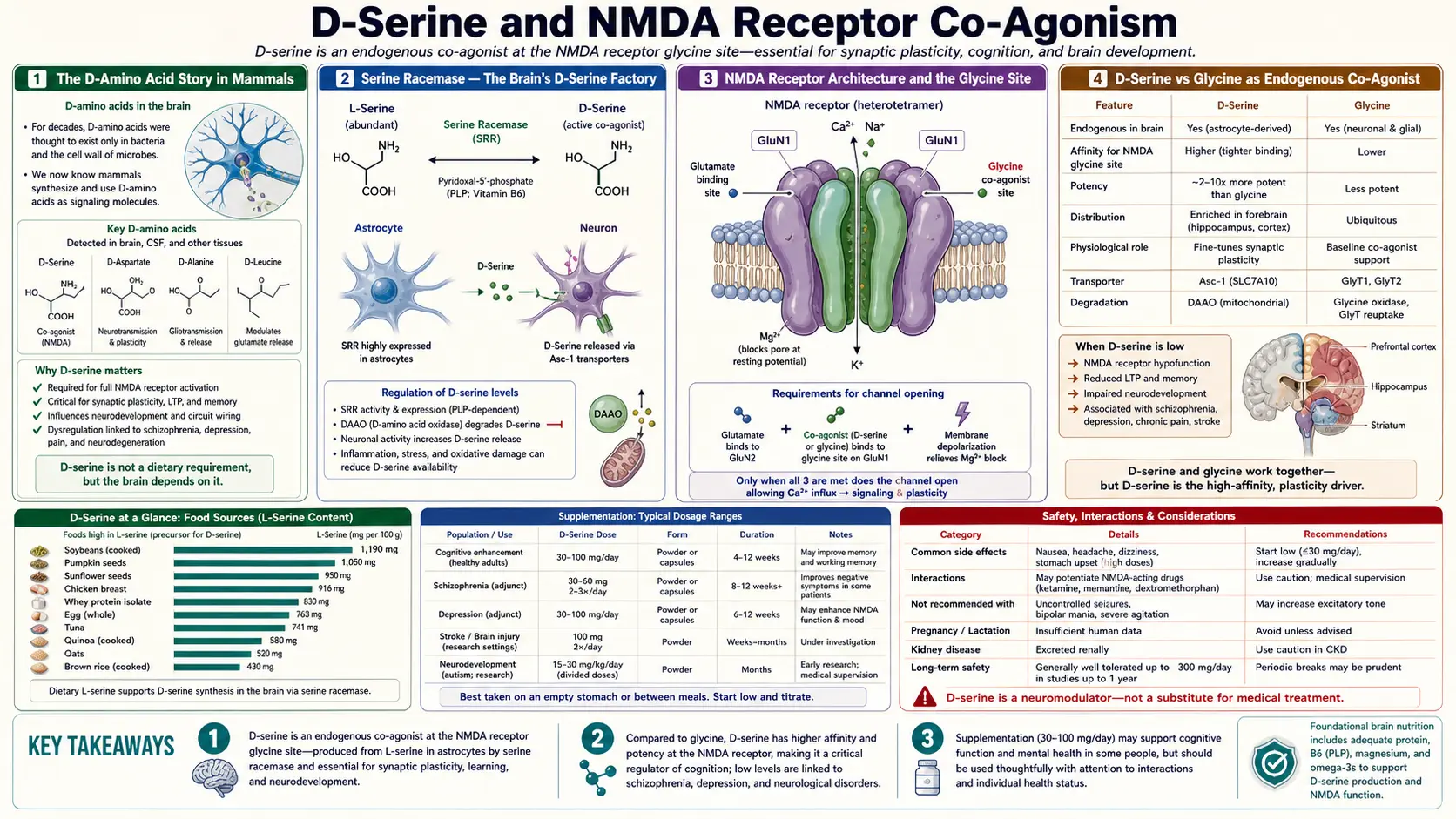
For most of the twentieth century, biochemists taught that mammalian proteins use only L-amino acids and that D-amino acids exist only in bacterial cell walls. That view was wrong. D-serine, the dextrorotary enantiomer of the otherwise familiar serine molecule, is synthesized in mammalian brain by an enzyme called serine racemase, is present in glutamatergic synapses at concentrations of tens of micromolar, and serves as the principal endogenous co-agonist at the glycine-binding site of the N-methyl-D-aspartate (NMDA) glutamate receptor. The N-methyl-D-aspartate receptor cannot open in response to glutamate alone — co-binding of either glycine or D-serine to the GluN1 subunit is required. This molecular discovery, made between 1992 and 2000, has transformed the understanding of synaptic plasticity, the genetics of schizophrenia, the pathobiology of amyotrophic lateral sclerosis (ALS), and the search for antipsychotic drugs that work differently from the four-decade-old dopamine D2 antagonist class.
Table of Contents
- The D-Amino Acid Story in Mammals
- Serine Racemase — The Brain's D-Serine Factory
- N-Methyl-D-Aspartate Receptor Architecture and the Glycine Site
- D-Serine vs Glycine as Endogenous Co-Agonist
- D-Serine in Schizophrenia — Tsai 1998 and Heresco-Levy 2005
- Sarcosine, D-Amino Acid Oxidase, and the Therapeutic Pipeline
- Parkinson's Disease and Alzheimer's Disease
- Amyotrophic Lateral Sclerosis — The Sasabe 2007 Finding
- Cognitive Aging and Memory
- Dosing, Sources, and Cautions
- Key Research Papers
- Connections
- Featured Videos
The D-Amino Acid Story in Mammals
For decades, biochemistry textbooks taught that proteins are built exclusively from the twenty L-amino acids, and that free D-amino acids in mammals are vanishingly rare — trace contaminants from gut bacteria at most. D-amino acids were assumed to belong to the bacterial world, where they are conspicuous components of peptidoglycan cell walls (D-alanine, D-glutamate) and of bacterial signaling peptides.
That worldview began to crack in the 1980s. Hashimoto and colleagues at the National Center of Neurology and Psychiatry in Tokyo, using gas chromatography on a chiral column with mass spectrometry, reported in 1992 that free D-serine is present in adult rat brain at about 0.27 µmol per gram of wet tissue, with D-serine making up about 23% of total serine. Subsequent work showed that D-serine concentration was highest in forebrain regions enriched in N-methyl-D-aspartate glutamate receptors — cortex, hippocampus, striatum — and lowest in cerebellum and brainstem. The distribution did not match dietary sources or bacterial contamination; D-serine was endogenously synthesized.
The enzyme responsible was identified in 1999 by the Snyder laboratory at Johns Hopkins. Serine racemase (SRR) converts L-serine to D-serine in a pyridoxal-5'-phosphate-dependent reaction. The enzyme is enriched in the same forebrain regions where D-serine accumulates, and is expressed predominantly in glutamatergic neurons (a 2005 finding that overturned an initial assumption that astrocytes were the source). Subsequent work has established that D-serine is the principal endogenous co-agonist at synaptic N-methyl-D-aspartate receptors in the forebrain, while glycine plays the equivalent role at extrasynaptic N-methyl-D-aspartate receptors and at N-methyl-D-aspartate receptors in the spinal cord and brainstem.
The discovery of mammalian D-serine biology was unexpected enough that it took roughly a decade for the field to incorporate it. The textbook claim that "mammals use only L-amino acids" survived in updated form — D-serine and a smaller amount of D-aspartate are now recognized as the exceptions, and the assertion is correct that no D-amino acids are incorporated into mammalian proteins. But the free D-amino acid pool in the brain is a real, regulated, functionally important system.
Serine Racemase — The Brain's D-Serine Factory
Serine racemase (SRR, encoded by the SRR gene on human chromosome 17p13) is a 36-kDa pyridoxal-5'-phosphate-dependent enzyme that catalyzes two reactions:
- Racemization — L-serine ⇌ D-serine. This is the canonical reaction and the source of brain D-serine.
- α,β-elimination — L-serine or D-serine → pyruvate + ammonia. This is a side reaction that degrades serine.
The two reactions are catalyzed at the same active site, and the partitioning between racemization and elimination is regulated by cofactors. Adenosine triphosphate (ATP) and Mg2+ favor racemization, while glycine and other modulators shift toward elimination. The result is a tightly regulated supply of D-serine to the extracellular synaptic space, where it can engage N-methyl-D-aspartate receptors.
The cellular expression of serine racemase has been a point of revision. Initially (Snyder 1999), SRR was reported as astrocyte-localized. By 2005-2010, a series of careful studies (Wolosker, Coyle, others) using cell-specific markers and conditional knockout mice showed that SRR is in fact expressed predominantly in glutamatergic neurons, not astrocytes. The corrected model is that neurons synthesize D-serine intracellularly and release it through volume-regulated anion channels or by serine-driven export mechanisms in response to neuronal activity, producing tonic and phasic D-serine signaling at synapses.
D-serine breakdown is catalyzed by D-amino acid oxidase (DAO/DAAO), a flavin-adenine-dinucleotide-dependent enzyme that oxidizes D-serine to the corresponding α-keto acid and hydrogen peroxide. DAO is highly expressed in cerebellum and brainstem (regions with low D-serine), and at much lower levels in cortex and hippocampus. This complementary distribution — SRR high where DAO is low — explains the regional D-serine concentration map and is the source of considerable therapeutic interest, as DAO inhibitors would raise synaptic D-serine.
N-Methyl-D-Aspartate Receptor Architecture and the Glycine Site
The N-methyl-D-aspartate glutamate receptor is a heterotetrameric ion channel composed of two obligatory GluN1 subunits and two regulatory subunits drawn from the GluN2A, GluN2B, GluN2C, GluN2D, GluN3A, or GluN3B families. Each subunit has a large amino-terminal domain, a ligand-binding domain (LBD), three transmembrane domains, and a C-terminal cytoplasmic tail.
The critical architectural feature for understanding D-serine is that the N-methyl-D-aspartate receptor has two agonist binding sites:
- The glutamate-binding site on the GluN2 subunit — binds glutamate released into the synapse by the presynaptic terminal during normal excitatory neurotransmission.
- The glycine/D-serine binding site on the GluN1 subunit — binds either glycine or D-serine, both of which serve as co-agonists.
Both sites must be occupied simultaneously for the channel to open and allow the characteristic sodium, potassium, and calcium currents that distinguish N-methyl-D-aspartate receptors from other glutamate receptors. Glutamate alone produces no response. This dual-agonist requirement makes the N-methyl-D-aspartate receptor a coincidence detector — it opens only when presynaptic glutamate release coincides with adequate co-agonist availability, which provides a regulatory layer absent from other glutamate receptors.
The receptor also requires postsynaptic depolarization to release a magnesium ion that blocks the channel at resting membrane potential. The combination of these three requirements — glutamate, co-agonist, depolarization — means that N-methyl-D-aspartate receptors only conduct when a postsynaptic neuron is already partially excited and the synapse is actively firing. This is the molecular basis for Hebbian "neurons that fire together wire together" synaptic plasticity, and underlies long-term potentiation (LTP), the cellular correlate of learning.
The co-agonist binding site was discovered in 1987 by Johnson and Ascher, who reported that glycine at submicromolar concentrations was required for N-methyl-D-aspartate receptor activity. For roughly a decade, glycine was assumed to be the sole endogenous co-agonist. The 1990s-2000s revision of that view — D-serine is the dominant synaptic co-agonist in forebrain — rewrote a substantial fraction of N-methyl-D-aspartate receptor pharmacology.
D-Serine vs Glycine as Endogenous Co-Agonist
Both D-serine and glycine bind the same site on the GluN1 subunit with similar affinity (low micromolar for both). The current understanding of why both exist and how their roles differ:
- Synaptic vs extrasynaptic — in the forebrain (cortex, hippocampus, striatum), D-serine is the dominant co-agonist at synaptic N-methyl-D-aspartate receptors, while glycine dominates at extrasynaptic N-methyl-D-aspartate receptors. The molecular basis of this distinction relates to the distribution of glycine transporters (GlyT1, expressed on astrocytes around the synapse) that keep synaptic glycine low.
- Subunit composition — D-serine has slightly higher relative potency at GluN2A-containing receptors (mature, synaptic), while glycine is relatively more potent at GluN2B-containing receptors (developmental, extrasynaptic, perisynaptic).
- Regional — D-serine signaling dominates in forebrain; glycine signaling dominates in cerebellum, brainstem, and spinal cord. This matches the regional expression of serine racemase (forebrain-enriched) and DAO (hindbrain-enriched).
- Developmental — glycine is the dominant co-agonist during early development, while D-serine takes over progressively during postnatal maturation as serine racemase expression rises.
The clinical implication is that interventions targeting "the N-methyl-D-aspartate co-agonist site" need to be regionally and functionally precise. Raising whole-body glycine with an oral glycine supplement primarily increases extrasynaptic N-methyl-D-aspartate tone in spinal cord and brainstem (which is part of why glycine has the well-established sleep-promoting and muscle-relaxant effects). Raising D-serine, either directly via supplementation or indirectly via DAO inhibition, has more selective effects on forebrain synaptic N-methyl-D-aspartate receptors and the cognitive functions that depend on them.
D-Serine in Schizophrenia — Tsai 1998 and Heresco-Levy 2005
The clinical relevance of the N-methyl-D-aspartate co-agonist site was sharpened by a long-standing pharmacological observation: N-methyl-D-aspartate receptor antagonists such as phencyclidine (PCP) and ketamine produce a schizophrenia-like psychosis in healthy volunteers and exacerbate symptoms in patients with established schizophrenia. The N-methyl-D-aspartate hypofunction hypothesis of schizophrenia proposed that the disorder reflects reduced N-methyl-D-aspartate receptor signaling, and that boosting that signaling (via the glycine/D-serine site, which is safer than direct glutamate-site agonism that causes excitotoxicity) could produce antipsychotic effects.
Tsai et al. 1998, Biological Psychiatry. The first randomized, double-blind, placebo-controlled trial of D-serine in schizophrenia. Thirty-one Taiwanese patients with schizophrenia on stable antipsychotic medication enrolled (28 completed) and received D-serine 30 mg/kg per day (roughly 2 grams for a 70-kg adult) or placebo for 6 weeks. Results:
- Significant improvement in negative symptoms (apathy, social withdrawal, anhedonia — the symptoms that conventional D2-antagonist antipsychotics treat least well)
- Significant improvement in cognitive function on the Wisconsin Card Sorting Test (a measure of executive function and cognitive flexibility)
- Significant improvement in positive symptoms as well; D-serine blood levels at weeks 4 and 6 predicted the improvement
- Well tolerated, with no significant side effects noted
Heresco-Levy et al. 2005, Biological Psychiatry. Double-blind, placebo-controlled, 6-week crossover trial in 39 patients with treatment-refractory schizophrenia who were taking the newer antipsychotics risperidone or olanzapine, using the same dose as Tsai 1998 (30 mg/kg per day). D-serine produced significant improvement in negative, positive, cognitive and depression symptoms as measured by the Positive and Negative Syndrome Scale (PANSS); in about one third of patients the Brief Psychiatric Rating Scale total score fell by more than 20%. D-serine was well tolerated, with no harmful changes in laboratory tests.
The two trials, together with several smaller replication studies, established D-serine as a proof-of-concept that the N-methyl-D-aspartate co-agonist site is a therapeutic target in schizophrenia. The largest add-on trial that followed (Weiser 2012; 195 patients, D-serine 2 g a day for 16 weeks) found no difference from placebo on negative symptoms (11.4% vs 14.8% improvement) or on thinking tests (6.8% vs 6.1%); its authors noted a relatively large placebo response and lower achieved doses than in earlier trials. The two head-to-head trials against sarcosine also found no benefit from D-serine 2 g a day: in 65 inpatients with an acute relapse, D-serine added to risperidone did not differ from risperidone alone in any area measured (Lane 2005), and in 60 people with chronic schizophrenia, D-serine added to antipsychotics did not differ from placebo on any measure, while sarcosine did better than placebo in both trials (Lane 2010). An open-label dose study (Kantrowitz 2010) gave 42 patients 30, 60 or 120 mg/kg a day for 4 weeks: thinking-test (MATRICS) scores improved clearly only at 60 mg/kg or more, and blood D-serine rose with dose. A 2015 pilot randomized trial in 44 young people at clinical high risk of schizophrenia (Kantrowitz 2015; 60 mg/kg a day for 16 weeks) reported a 35.7% improvement in negative symptoms with D-serine, significantly more than with placebo. The early trials did not, however, immediately produce a marketed antipsychotic drug. The reasons are practical: D-serine is a free amino acid with limited brain penetration (the blood-brain barrier transports it but inefficiently), and the doses required (2-4 grams) approach the upper end of acceptable oral amino acid loads. Subsequent pharmaceutical development has focused on alternative approaches: DAO inhibitors that raise endogenous D-serine, glycine transporter 1 (GlyT1) inhibitors that raise synaptic glycine (bitopertin was the most advanced of these and reached Phase III before failing on the primary endpoint), and direct prodrugs of D-serine with better brain penetration.
For more on the broader schizophrenia treatment landscape, see our Schizophrenia page.
Sarcosine, D-Amino Acid Oxidase, and the Therapeutic Pipeline
The D-serine schizophrenia signal opened up an entire pharmacological research program. The principal targets and their lead compounds:
- Glycine itself — high-dose oral glycine (30-60 grams/day) was studied in schizophrenia from the late 1990s with mixed results. A 2011 pooled analysis of 29 trials found that glycine added to antipsychotics other than clozapine improved positive and total symptoms, but that glycine added to clozapine made positive symptoms worse (Singh 2011). The largest glycine trial (CONSIST, 157 patients, 16 weeks) found no difference from placebo on negative symptoms or on thinking tests (Buchanan 2007). The doses required are at the limit of palatability and produce significant gastrointestinal (GI) side effects.
- Sarcosine (N-methylglycine) — a glycine transporter (GlyT1) inhibitor that raises synaptic glycine (see the Sarcosine page). In small randomized trials in schizophrenia, sarcosine at 2 g/day added to antipsychotics other than clozapine reduced positive, negative, cognitive and general symptoms more than placebo (Tsai 2004; Lane 2005; Lane 2010); added to clozapine, it did no better than placebo (Lane 2006). A 2021 meta-analysis of six randomized trials (234 adults, all at 2 g/day) found no significant overall effect because results varied widely between trials, but found symptom reductions in the subgroups with chronic schizophrenia and with no treatment resistance (standardized mean differences of −0.36 and −0.31 after 6 weeks). Sarcosine is available as a dietary supplement.
- Bitopertin (RG1678) — a high-affinity GlyT1 inhibitor developed by a pharmaceutical company. Phase II results were promising, but its Phase III program did not meet its goals in 2014-2015, dampening enthusiasm for this approach.
- D-amino acid oxidase (DAO) inhibitors — small molecules that block DAO and raise endogenous D-serine. Sodium benzoate (a generic and inexpensive food preservative that happens to be a weak DAO inhibitor) showed positive results in a 2013 trial in chronic schizophrenia (Lane et al., JAMA Psychiatry): 52 patients took 1 g/day or placebo for 6 weeks on top of their antipsychotic, and benzoate produced a 21% improvement in PANSS total score and better scores on several thinking tests. A 2021 safety review describes D-serine as still under active study for schizophrenia, both directly and through DAO inhibitors (Meftah 2021).
- Direct D-serine prodrugs — modified forms of D-serine with improved blood-brain barrier penetration are in preclinical development.
The active research and the U.S. Food and Drug Administration (FDA) approval of pimavanserin (a serotonin 5HT2A inverse agonist) for Parkinson's psychosis — an antipsychotic with no dopaminergic activity at all — reflect the broader shift away from the D2-antagonist paradigm that dominated antipsychotic pharmacology from the 1950s through the 2000s. N-methyl-D-aspartate co-agonist site interventions are one of the principal alternative strategies.
Parkinson's Disease and Alzheimer's Disease
D-serine and the N-methyl-D-aspartate co-agonist system have been investigated in other neurological conditions:
Parkinson's disease. N-methyl-D-aspartate receptor signaling in the basal ganglia contributes both to normal motor control and to the dyskinesias that develop in advanced Parkinson's disease on long-term levodopa therapy. D-serine cerebrospinal fluid levels have been reported as reduced in people with Parkinson's disease in some studies, raising the possibility that D-serine deficiency contributes to the cognitive impairment and dementia that develop in many of them. A small pilot trial (Gelfin 2012) gave ten people with Parkinson's disease D-serine 30 mg/kg a day in a 6-week double-blind, placebo-controlled crossover design on top of their usual treatment; D-serine lowered total scores on the Unified Parkinson's Disease Rating Scale (a movement-symptom scale), the Simpson-Angus scale for drug-related stiffness and the PANSS behavioural scale. No large randomized trials have been completed.
Alzheimer's disease. The relationship between N-methyl-D-aspartate signaling and Alzheimer's is complex. Excessive N-methyl-D-aspartate signaling contributes to amyloid-beta-mediated synapse loss and excitotoxicity (the rationale for memantine, a N-methyl-D-aspartate receptor antagonist approved for moderate-to-severe Alzheimer's). At the same time, reduced synaptic N-methyl-D-aspartate tone with preserved extrasynaptic N-methyl-D-aspartate activity may contribute to cognitive decline. D-serine cerebrospinal fluid (CSF) levels have been reported as altered in Alzheimer's disease, but whether they are increased or decreased depends on the study and on disease stage. The therapeutic implications are not clear, and D-serine supplementation has no established use in Alzheimer's disease.
Amyotrophic Lateral Sclerosis — The Sasabe 2007 Finding
Amyotrophic lateral sclerosis (ALS), the progressive motor neuron disease known as Lou Gehrig's disease, has a glutamate-excitotoxicity component — riluzole, the first amyotrophic lateral sclerosis-modifying drug, works in part by reducing glutamate release. The D-serine connection emerged through a striking finding in 2007.
Sasabe et al. 2007, EMBO Journal. The Sasabe group reported that in mutant SOD1 mice (a model of amyotrophic lateral sclerosis), levels of D-serine and of its producing enzyme, serine racemase, rose progressively in the spinal cord as the disease advanced, mainly in glial cells. In laboratory cell work, serine racemase was switched on by an inflammatory signal and by the mutant SOD1 protein in microglial cells. Spinal-cord nerve cells from the mice were more vulnerable to N-methyl-D-aspartate toxicity, in a D-serine-dependent way. Raised D-serine was also found in the spinal cords of people with both familial and sporadic amyotrophic lateral sclerosis. The authors proposed that excess D-serine made by glia drives N-methyl-D-aspartate-mediated excitotoxicity on motor neurons, accelerating their death.
This was a paradigm shift in two ways. First, it identified D-serine as a pathological agent in a major neurodegenerative disease (in contrast to schizophrenia, where the issue is too little D-serine signaling). Second, it suggested that DAO activation, rather than DAO inhibition, might be the therapeutic strategy for amyotrophic lateral sclerosis.
Subsequent work has confirmed the D-serine accumulation in amyotrophic lateral sclerosis spinal cord and the contribution of excess D-serine signaling to motor neuron death. In 2010, Mitchell and colleagues reported a single DAO mutation (R199W) linked to disease in one three-generation family with familial amyotrophic lateral sclerosis; nerve cells and motor neurons expressing the mutant enzyme survived less well in culture. Drug development for DAO activators (the opposite of the schizophrenia approach) is at an early stage, and no amyotrophic lateral sclerosis-modifying drug currently targets this pathway clinically. But the finding established that the D-serine system has bidirectional therapeutic relevance — too little is bad for schizophrenia, too much is bad for motor neuron survival.
Because D-serine is raised in amyotrophic lateral sclerosis spinal cord (Sasabe 2007), researchers regard raising D-serine in amyotrophic lateral sclerosis as a theoretical concern. L-serine, the precursor, has been tested directly. The researchers' rationale was that the cyanobacterial toxin beta-N-methylamino-L-alanine (BMAA) is misincorporated into nerve-cell proteins and that L-serine inhibits this misincorporation. In a phase I trial (Bradley 2018), 20 people with amyotrophic lateral sclerosis took L-serine at 0.5 to 15 g twice a day. Two withdrew because of gastrointestinal side effects and three died during the study, about the expected number; the authors judged doses up to 15 g twice daily safe, exploratory analyses suggested a slower decline (a 34% reduction in the slope of the ALSFRS-R disability score), and a phase II trial was planned. For more on amyotrophic lateral sclerosis, see our amyotrophic lateral sclerosis page.
Cognitive Aging and Memory
Beyond the specific psychiatric and neurodegenerative applications, the D-serine system has been implicated in normal cognitive aging. N-methyl-D-aspartate receptor function declines with age, and reduced synaptic D-serine availability may contribute to that decline. In a 2016 randomized, double-blind, placebo-controlled crossover trial in 50 healthy older adults (Avellar 2016), D-serine improved performance on one test of spatial memory, learning and problem solving (the Groton Maze Learning test), and those whose blood D-serine rose most improved most; it did not change the other cognitive tests or mood. The literature remains sparse.
The mechanism would parallel the schizophrenia rationale: restoring N-methyl-D-aspartate co-agonist tone supports the synaptic plasticity that underlies new memory formation. There is preliminary evidence from animal studies that chronic D-serine supplementation can reverse age-related decline in long-term potentiation in the hippocampus.
L-serine from food is the substrate for the body's own D-serine synthesis. L-serine at 2-5 g/day is described in supplement use for cognitive complaints; no trial of that use was found. The L-form has more human safety data than D-serine (see the amyotrophic lateral sclerosis trial above), and D-serine itself has been studied mainly in specific clinical conditions.
Dosing, Sources, and Cautions
L-serine supplementation (the substrate for endogenous D-serine synthesis):
- 2 to 5 grams per day, divided, is the dose described in supplement use for cognitive support (no trial of this use was found)
- Well-tolerated and broadly available as a dietary supplement
- Crosses the blood-brain barrier and supplies D-serine synthesis in neurons and glia
D-serine direct supplementation:
- Used in research trials at 2 g/day or 30 mg/kg per day (roughly 2 g for a 70-kg adult), and at 60 and 120 mg/kg per day in later studies; 120 mg/kg is the highest dose tested in humans
- Sold by a small number of specialty supplement sellers
- Amyotrophic lateral sclerosis — D-serine is raised in the spinal cord in this disease (Sasabe 2007), which researchers regard as a concern for raising D-serine there and in any setting where N-methyl-D-aspartate-mediated excitotoxicity may be active
- Kidneys — high-dose D-serine has produced nephrotoxicity in rodent studies, mediated by DAO-generated hydrogen peroxide in the renal tubule. A 2021 cross-species safety review (Meftah 2021) found kidney damage (acute tubular necrosis) common in rats above 500 mg/kg but not reported in mice or rabbits; across all published human studies, only one person had abnormal kidney values linked to D-serine, and these returned to normal within a few days of stopping.
Indirect approaches — raising endogenous D-serine through DAO inhibition (sodium benzoate 1 g/day has the most clinical evidence) or through glycine transporter inhibition (sarcosine 2 g/day) are the other routes researchers have studied for raising N-methyl-D-aspartate co-agonist tone. In the trials described above they were given as add-ons to antipsychotic medication in people under psychiatric care.
Key Research Papers
- Hashimoto A et al. (1992). The presence of free D-serine in rat brain. FEBS Letters. — PubMed PMID: 1730289
- Wolosker H, Blackshaw S, Snyder SH (1999). Serine racemase: a glial enzyme synthesizing D-serine to regulate glutamate-N-methyl-D-aspartate neurotransmission. PNAS. — PubMed PMID: 10557334
- Tsai G et al. (1998). D-serine added to antipsychotics for the treatment of schizophrenia. Biological Psychiatry. — PubMed PMID: 9836012
- Heresco-Levy U et al. (2005). D-serine efficacy as add-on pharmacotherapy to risperidone and olanzapine for treatment-refractory schizophrenia. Biological Psychiatry. — PubMed PMID: 15780844
- Sasabe J et al. (2007). D-serine is a key determinant of glutamate toxicity in amyotrophic lateral sclerosis. EMBO Journal. — PubMed PMID: 17762863
- Mothet JP et al. (2000). D-serine is an endogenous ligand for the glycine site of the N-methyl-D-aspartate receptor. PNAS. — PubMed PMID: 10781100
- Lane HY et al. (2013). Add-on treatment of benzoate for schizophrenia: a randomized, double-blind, placebo-controlled trial of D-amino acid oxidase inhibitor. JAMA Psychiatry. — PubMed PMID: 24089054
- Tsai G, Lane HY, Yang P, Chong MY, Lange N (2004). Glycine transporter I inhibitor, N-methylglycine (sarcosine), added to antipsychotics for the treatment of schizophrenia. Biological Psychiatry. — PubMed PMID: 15023571
- Johnson JW, Ascher P (1987). Glycine potentiates the NMDA response in cultured mouse brain neurons. Nature. — PubMed PMID: 2433595
- Wolosker H et al. (2008). D-amino acids in the brain: D-serine in neurotransmission and neurodegeneration. FEBS Journal. — PubMed PMID: 18564180
- Coyle JT, Balu DT (2018). The role of serine racemase in the pathophysiology of brain disorders. Advances in Pharmacology. — PubMed PMID: 29413527
- Mitchell J et al. (2010). Familial amyotrophic lateral sclerosis is associated with a mutation in D-amino acid oxidase. PNAS. — PubMed PMID: 20368421
- Weiser M, Heresco-Levy U, Davidson M, et al. (2012). A multicenter, add-on randomized controlled trial of low-dose d-serine for negative and cognitive symptoms of schizophrenia. Journal of Clinical Psychiatry, 73(6):e728-34. — PubMed PMID: 22795211
- Kantrowitz JT, Malhotra AK, Cornblatt B, et al. (2010). High dose D-serine in the treatment of schizophrenia. Schizophrenia Research, 121(1-3):125-30. — PubMed PMID: 20541910
- Kantrowitz JT, Woods SW, Petkova E, et al. (2015). D-serine for the treatment of negative symptoms in individuals at clinical high risk of schizophrenia: a pilot, double-blind, placebo-controlled, randomised parallel group mechanistic proof-of-concept trial. Lancet Psychiatry, 2(5):403-412. — PubMed PMID: 26360284
- Marchi M, Galli G, Magarini FM, Mattei G, Galeazzi GM (2021). Sarcosine as an add-on treatment to antipsychotic medication for people with schizophrenia: a systematic review and meta-analysis of randomized controlled trials. Expert Opinion on Drug Metabolism & Toxicology, 17(4):483-493. — PubMed PMID: 33538213
- Gelfin E, Kaufman Y, Korn-Lubetzki I, et al. (2012). D-serine adjuvant treatment alleviates behavioural and motor symptoms in Parkinson's disease. International Journal of Neuropsychopharmacology, 15(4):543-9. — PubMed PMID: 21733283
- Bradley WG, Miller RX, Levine TD, Stommel EW, Cox PA (2018). Studies of Environmental Risk Factors in Amyotrophic Lateral Sclerosis (ALS) and a Phase I Clinical Trial of L-Serine. Neurotoxicity Research, 33(1):192-198. — PubMed PMID: 28527102
- Meftah A, Hasegawa H, Kantrowitz JT (2021). D-Serine: A Cross Species Review of Safety. Frontiers in Psychiatry, 12:726365. — PubMed PMID: 34447324
- Avellar M, Scoriels L, Madeira C, et al. (2016). The effect of D-serine administration on cognition and mood in older adults. Oncotarget, 7(11):11881-8. — PubMed PMID: 26933803
- Lane HY, Chang YC, Liu YC, Chiu CC, Tsai GE (2005). Sarcosine or D-serine add-on treatment for acute exacerbation of schizophrenia: a randomized, double-blind, placebo-controlled study. Archives of General Psychiatry, 62(11):1196-204. — PubMed PMID: 16275807
- Lane HY, Huang CL, Wu PL, Liu YC, Chang YC, Lin PY, Chen PW, Tsai G (2006). Glycine transporter I inhibitor, N-methylglycine (sarcosine), added to clozapine for the treatment of schizophrenia. Biological Psychiatry, 60(6):645-9. — PubMed PMID: 16780811
- Lane HY, Lin CH, Huang YJ, Liao CH, Chang YC, Tsai GE (2010). A randomized, double-blind, placebo-controlled comparison study of sarcosine (N-methylglycine) and D-serine add-on treatment for schizophrenia. International Journal of Neuropsychopharmacology, 13(4):451-60. — PubMed PMID: 19887019
- Singh SP, Singh V (2011). Meta-analysis of the efficacy of adjunctive NMDA receptor modulators in chronic schizophrenia. CNS Drugs, 25(10):859-85. — PubMed PMID: 21936588
- Buchanan RW, Javitt DC, Marder SR, Schooler NR, Gold JM, McMahon RP, Heresco-Levy U, Carpenter WT (2007). The Cognitive and Negative Symptoms in Schizophrenia Trial (CONSIST): the efficacy of glutamatergic agents for negative symptoms and cognitive impairments. American Journal of Psychiatry, 164(10):1593-602. — PubMed PMID: 17898352
PubMed Topic Searches
Connections
- All Amino Acids
- Serine Overview
- Serine Benefits Hub
- Phosphatidylserine and Brain
- Glycine Source (SHMT)
- Sphingolipid Synthesis (SPT)
- Glycine
- Glutamic Acid
- Schizophrenia
- Amyotrophic Lateral Sclerosis
- Parkinson's Disease
- Alzheimer's Disease
- Vitamin B6 (Pyridoxal Phosphate)
- Magnesium (N-Methyl-D-Aspartate Channel Block)
- N-Acetylcysteine & Glutathione
- History
- Sources