Lysine to Arginine Ratio in Diet and Supplements
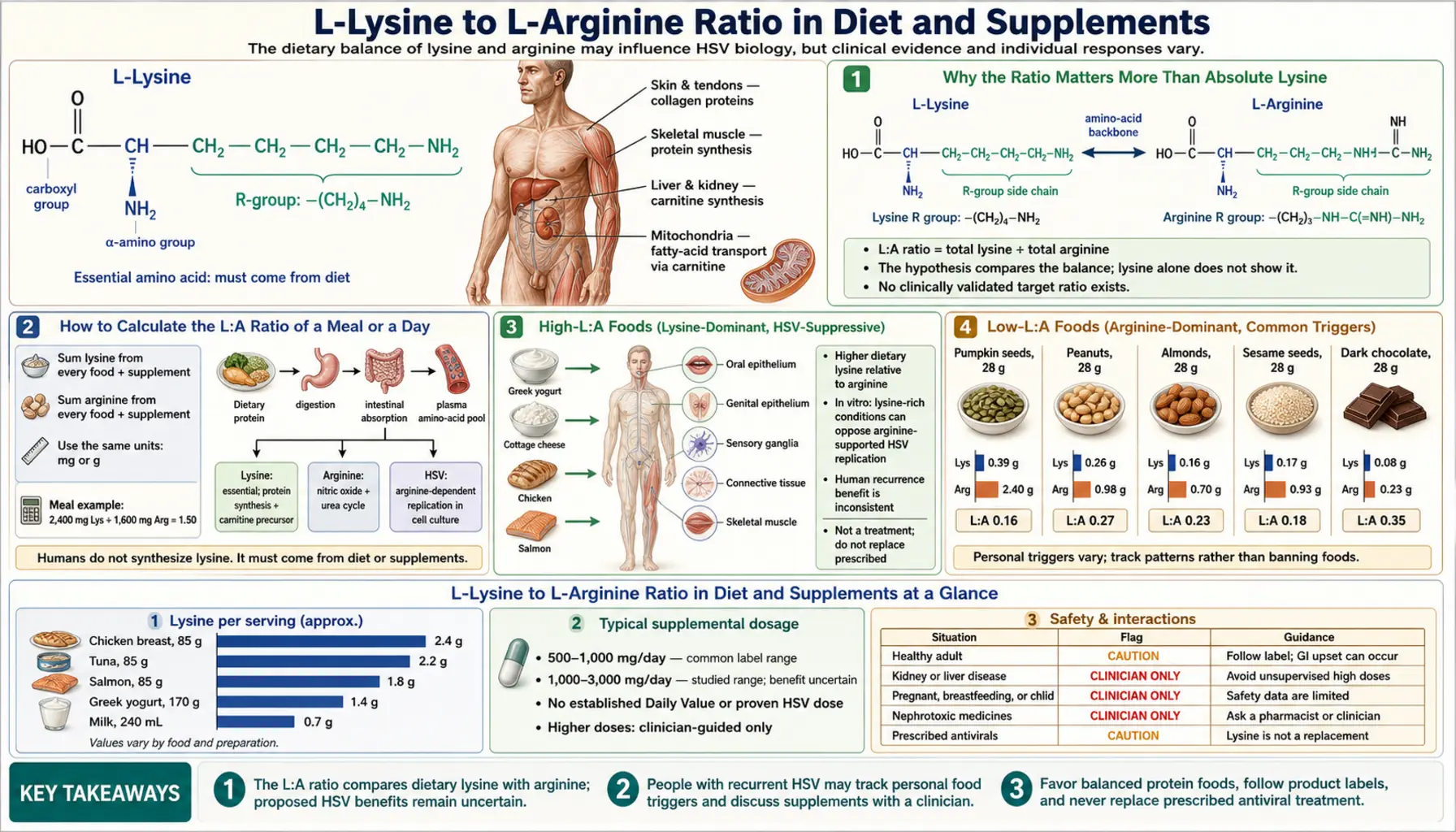
The lysine-to-arginine (L:A) ratio is the idea that, for herpes simplex virus (HSV), the balance between the two amino acids in the diet matters more than the amount of lysine alone. The idea comes from cell-culture work: in human cells in tissue culture, HSV did not replicate when arginine was withheld, and lysine partly inhibited its multiplication (Tankersley 1964; Griffith, DeLong and Nelson 1981). The human trials of lysine supplements for cold sores are small and their results are mixed, and a 2015 Cochrane review found no evidence of efficacy for lysine in preventing cold sores. No trial was found that tested a dietary lysine-to-arginine ratio against herpes recurrence. This page sets out where the ratio idea comes from, what USDA food-composition data list for lysine and arginine in common foods, and what is and is not known.
Table of Contents
- Why a Ratio, Rather Than Lysine Alone, Is Proposed
- Where Food Lysine and Arginine Figures Come From
- Foods in Which Lysine Exceeds Arginine (USDA Data)
- Foods in Which Arginine Exceeds Lysine (USDA Data)
- Chocolate, Nuts, Seeds and Gelatin
- Vegetarian and Vegan Eating Patterns
- What Popular Low-Arginine Diet Plans Describe
- Arginine, Nitric Oxide and the Cardiovascular Question
- Lysine and Arginine Outside Herpes
- Key Research Papers
- Connections
- Featured Videos
Why a Ratio, Rather Than Lysine Alone, Is Proposed
In 1964 Tankersley reported that in human cells in tissue culture, HSV produced neither cytopathic effects nor new virus when arginine was withheld, and that a prompt and extensive infection followed once arginine was replaced; lysine was not required by the virus and partially inhibited its multiplication. In 1981 Griffith, DeLong and Nelson reported that arginine deficiency suppressed HSV replication in tissue culture and that lysine, as an arginine analogue, antagonised arginine's growth-promoting effect. Those authors proposed that the in-vitro data may be the basis for the observation that people prone to herpes lesions should abstain from arginine excess and may also require supplemental lysine. A 2022 narrative review describes lysine as interfering mainly with the formation of viral capsid proteins and DNA through competitive antagonism with arginine, and as increasing arginase, the enzyme that breaks arginine down; it concludes that more studies are needed (Pedrazini 2022).
Because the effect in cell culture is a competition, proponents frame the relevant dietary variable as the ratio of lysine to arginine rather than lysine intake alone. These are cell-culture findings, not human results.
Lysine and arginine are both dibasic (positively charged) amino acids, and in the gut and kidney they share transport. In the inherited disorder cystinuria, mutations in the SLC3A1 or SLC7A9 gene impair the transport of cystine, lysine, ornithine and arginine in the proximal renal tubule and in the epithelial cells of the gastrointestinal tract (Dello Strologo 2006). A 2008 review of epithelial amino acid transport notes that, with very few exceptions, each amino acid is carried by more than one transporter (Bröer 2008).
Whether the arginine and lysine in ordinary meals change how much arginine reaches HSV-infected cells in a person was not measured in any study found for this page. No study was found that compared taking lysine with or without meals, or at different times relative to meals, for plasma amino acid levels or for herpes outcomes.
Where Food Lysine and Arginine Figures Come From
The US Department of Agriculture's FoodData Central database lists lysine and arginine, in grams per 100 g of food, for many foods in its SR Legacy dataset. The figures and tables on this page give those values exactly as the database lists them, with each food's FDC ID linked to its record. Ratios are not given here: the database lists the two amounts, not a ratio.
The amounts change with preparation, because cooking removes or adds water. Atlantic cod, for example, is listed at 1.64 g lysine and 1.07 g arginine per 100 g raw (FDC 171955) and 2.1 g lysine and 1.37 g arginine per 100 g cooked by dry heat (FDC 171956).
In the USDA figures used here, lysine is higher than arginine in the fish, poultry, meat, eggs and dairy foods listed, and in natto and cooked black beans. Arginine is higher than lysine in every nut and seed listed, and in gelatin, cocoa powder, chickpeas, quinoa, brown rice and whole-wheat pita bread. In cooked lentils the two amounts are close.
Foods in Which Lysine Exceeds Arginine (USDA Data)
Popular lysine-for-herpes diet lists name mostly animal proteins as foods in which lysine is abundant relative to arginine. The USDA FoodData Central (SR Legacy) values for some of these foods, per 100 g:
| Food (USDA description, shortened) | Lysine (g per 100 g) | Arginine (g per 100 g) | FDC ID |
|---|---|---|---|
| Cod, Atlantic, cooked, dry heat | 2.1 | 1.37 | 171956 |
| Salmon, sockeye, cooked, dry heat | 2.57 | 1.72 | 173692 |
| Tuna, light, canned in water, drained | 2.34 | 1.53 | 171986 |
| Chicken breast, meat only, roasted | 2.64 | 1.87 | 171477 |
| Beef, composite of retail cuts, cooked | 2.63 | 1.92 | 170609 |
| Egg, whole, hard-boiled | 0.904 | 0.755 | 173424 |
| Yogurt, plain, whole milk | 0.311 | 0.104 | 171284 |
| Milk, whole, 3.25% milkfat | 0.264 | 0.09 | 171265 |
| Cheese, cheddar, sharp | 2.04 | 1.08 | 170899 |
| Cheese, parmesan, hard | 3.31 | 1.32 | 170848 |
| Natto (fermented soybeans) | 1.14 | 0.909 | 172443 |
| Black beans, cooked, boiled | 0.608 | 0.549 | 175237 |
No trial was found showing that eating more of these foods prevents herpes outbreaks. The lysine content of individual foods is also covered on the Lysine Sources page (see Connections).
Foods in Which Arginine Exceeds Lysine (USDA Data)
The foods most often named in popular low-arginine diet lists for herpes are chocolate, nuts, seeds, gelatin and grains. The USDA FoodData Central (SR Legacy) values for some of these foods, per 100 g, with two legumes in which arginine is also the higher of the two:
| Food (USDA description, shortened) | Lysine (g per 100 g) | Arginine (g per 100 g) | FDC ID |
|---|---|---|---|
| Almonds | 0.568 | 2.46 | 170567 |
| Walnuts, English | 0.424 | 2.28 | 170187 |
| Cashew nuts, raw | 0.928 | 2.12 | 170162 |
| Peanuts, raw | 0.926 | 3.08 | 172430 |
| Peanut butter, smooth, without salt | 0.681 | 2.77 | 172470 |
| Pumpkin and squash seed kernels, dried | 1.24 | 5.35 | 170556 |
| Sunflower seed kernels, dried | 0.937 | 2.4 | 170562 |
| Sesame seeds, whole, dried | 0.569 | 2.63 | 170150 |
| Chia seeds, dried | 0.97 | 2.14 | 170554 |
| Cocoa, dry powder, unsweetened | 0.983 | 1.11 | 169593 |
| Gelatin, dry powder, unsweetened | 3.46 | 6.62 | 169599 |
| Lentils, cooked, boiled | 0.63 | 0.697 | 175254 |
| Chickpeas, cooked, boiled | 0.593 | 0.835 | 173799 |
| Quinoa, cooked | 0.239 | 0.34 | 168917 |
| Brown rice, long-grain, cooked | 0.099 | 0.196 | 169704 |
| Pita bread, whole-wheat | 0.265 | 0.455 | 174916 |
No trial was found showing that eating less of these foods prevents herpes outbreaks.
Chocolate, Nuts, Seeds and Gelatin
Four groups of foods come up again and again in popular low-arginine lists:
Chocolate and cocoa. Chocolate is the food most often named in these lists. USDA lists unsweetened dry cocoa powder at 0.983 g lysine and 1.11 g arginine per 100 g (FDC 169593), so the two amounts listed for cocoa powder are closer together than those listed for the nuts and seeds below. Chocolate bars were not among the USDA entries used for this page.
Nuts and seeds. In every nut and seed in the table above, arginine is listed well above lysine — for example almonds at 0.568 g lysine and 2.46 g arginine, and dried pumpkin and squash seed kernels at 1.24 g lysine and 5.35 g arginine per 100 g. Peanuts, botanically a legume, are listed at 0.926 g lysine and 3.08 g arginine per 100 g raw.
Gelatin and collagen. Gelatin is made from collagen. USDA lists unsweetened dry gelatin powder at 3.46 g lysine and 6.62 g arginine per 100 g (FDC 169599). Hydrolysed collagen peptide supplements are not among the SR Legacy entries used here, and no study was found that measured whether gelatin or collagen intake affects herpes recurrence. Collagen itself is covered on the Collagen Synthesis page (see Connections).
Grains. Cooked brown rice (0.099 g lysine, 0.196 g arginine per 100 g), cooked quinoa (0.239 g and 0.34 g) and whole-wheat pita bread (0.265 g and 0.455 g) all list more arginine than lysine, but much less of either per 100 g than nuts, seeds or animal proteins.
Vegetarian and Vegan Eating Patterns
Plant foods supply about 65% of the world's protein per person and about 32% in North America, and a 1994 review concluded that mixtures of plant proteins can serve as a complete and well-balanced source of amino acids for meeting human requirements (Young and Pellett 1994). The joint WHO/FAO/UNU expert report of 2007 sets out human protein and amino acid requirements, lysine included.
In the USDA figures used here, the plant foods in which lysine is listed above arginine are natto, a fermented soybean food (1.14 g lysine, 0.909 g arginine per 100 g), and cooked black beans (0.608 g and 0.549 g). Cooked lentils and chickpeas list slightly more arginine than lysine, and nuts, seeds and grains list more arginine than lysine. Eggs and dairy foods, which many vegetarians eat, are listed with more lysine than arginine.
No study was found that compared herpes recurrence in vegetarians or vegans with that in people eating other diets, or that tested a plant-based low-arginine diet against herpes.
What Popular Low-Arginine Diet Plans Describe
Popular lysine-for-herpes diet plans usually combine three elements: eating more of the animal and dairy foods in the first table, eating less chocolate, nuts and seeds (often only around outbreaks or stressful periods rather than year-round), and taking lysine supplements apart from meals. None of these elements was found to have been tested in a controlled trial against herpes recurrence.
What the clinical literature does report:
- Trials of lysine supplements. The human trials, from 1978 to 1987, gave oral lysine at doses from 312 mg a day to 1,000 mg three times a day; some reported fewer or milder recurrences and others found no benefit. Each trial and its dose is described on the Lysine for Herpes Prevention page.
- Diet in the reviews. Mailoo and Rampes (2017), a literature review, concluded that lysine supplementation appears ineffective for preventing or treating herpes simplex lesions at doses below 1 g a day without low-arginine diets, and that doses above 3 g a day appear to improve patients' subjective experience of the disease. They called for longer controlled studies of doses above 1.2 g a day.
- The 2015 Cochrane review. A review of 32 randomized trials with 2,640 participants, covering 19 treatments for preventing cold sores, found no evidence of efficacy for lysine; it found that long-term oral antiviral drugs can prevent cold sores but that the clinical benefit is small (Chi 2015).
- The 1981 proposal. The suggestion that people prone to herpes lesions abstain from arginine excess comes from Griffith, DeLong and Nelson's tissue-culture paper, as the authors' interpretation of in-vitro data.
Decisions about supplements and about managing herpes belong with a clinician.
Arginine, Nitric Oxide and the Cardiovascular Question
Arginine is not only a factor in herpes biology. It is the substrate that endothelial nitric oxide synthase (eNOS) uses to make nitric oxide in the lining of blood vessels (Bode-Böger 2007), and it is also a precursor for creatine, polyamines, agmatine and urea (Morris 2007). In humans and most other mammals arginine is made from glutamine, glutamate and proline through an intestinal-renal pathway (Wu 2009).
A 2007 review reports that in most studies arginine given acutely or long-term improved endothelial function in animal models of high cholesterol and atherosclerosis; it states that large randomized clinical trials might be needed to identify which patients are most likely to benefit from arginine, and proposes measuring the ratio of arginine to asymmetric dimethylarginine (ADMA), the body's own nitric oxide synthase inhibitor (Bode-Böger 2007).
Mailoo and Rampes (2017) write that patients with cardiovascular or gallbladder disease should be cautioned and warned of the theoretical risks of lysine supplementation. No study was found that measured whether lysine supplements, or a lower-arginine diet, change nitric oxide production or blood vessel function in people.
Lysine and Arginine Outside Herpes
- Other viruses. The 2022 narrative review discusses lysine-arginine antagonism across viral infections more broadly and concludes that more studies are needed (Pedrazini 2022). No controlled trial of a dietary lysine-to-arginine approach for shingles, Epstein-Barr virus or canker sores was found.
- Anxiety and stress. Two small human trials gave lysine and arginine together. In a one-week trial in 108 healthy Japanese adults, 2.64 g a day of each was reported to lower trait and state anxiety (Smriga 2007). In a 10-day trial in 29 people with high trait anxiety, 3 g a day of each led to higher, not lower, ACTH, cortisol, adrenaline and noradrenaline during a public-speaking stress test than placebo (Jezova 2005). These describe the combination, not a dietary ratio; both are covered on the Anxiety and Stress page.
- Calcium. In cultured human skin fibroblasts, removing lysine from the growth medium raised intracellular calcium while removing arginine had no effect — a cell-culture finding described on the Calcium Absorption page.
- Blood vessels. Arginine's role in nitric oxide production is described in the section above; no trial was found that tested a lysine-to-arginine ratio for cardiovascular outcomes.
Key Research Papers
- Griffith RS, DeLong DC, Nelson JD (1981). Relation of arginine-lysine antagonism to herpes simplex growth in tissue culture. Chemotherapy 27(3):209-13. — PubMed PMID: 6262023
- Tankersley RW Jr (1964). Amino acid requirements of herpes simplex virus in human cells. Journal of Bacteriology 87(3):609-13. — PubMed PMID: 14127578
- Bröer S (2008). Amino acid transport across mammalian intestinal and renal epithelia. Physiological Reviews 88(1):249-86. — PubMed PMID: 18195088
- Flodin NW (1997). The metabolic roles, pharmacology, and toxicology of lysine. Journal of the American College of Nutrition 16(1):7-21. — PubMed PMID: 9013429
- US Department of Agriculture, Agricultural Research Service. FoodData Central — SR Legacy dataset (amino acid composition; food records cited on this page by FDC ID). — fdc.nal.usda.gov
- Mariotti F (2019). Animal and Plant Protein Sources and Cardiometabolic Health. Advances in Nutrition 10(Suppl 4):S351-S366. — PubMed PMID: 31728490
- Young VR, Pellett PL (1994). Plant proteins in relation to human protein and amino acid nutrition. American Journal of Clinical Nutrition 59(5 Suppl):1203S-1212S. — PubMed PMID: 8172124
- Joint WHO/FAO/UNU Expert Consultation (2007). Protein and amino acid requirements in human nutrition. World Health Organization Technical Report Series 935:1-265. — PubMed PMID: 18330140
- Wu G (2009). Amino acids: metabolism, functions, and nutrition. Amino Acids 37(1):1-17. — PubMed PMID: 19301095
- Morris SM Jr (2007). Arginine metabolism: boundaries of our knowledge. Journal of Nutrition 137(6 Suppl 2):1602S-1609S. — PubMed PMID: 17513435
- Bode-Böger SM, Scalera F, Ignarro LJ (2007). The L-arginine paradox: importance of the L-arginine/asymmetrical dimethylarginine ratio. Pharmacology & Therapeutics 114(3):295-306. — PubMed PMID: 17482266
- Singh BB, Udani J, Vinjamury SP, Der-Martirosian C, Gandhi S, Khorsan R et al. (2005). Safety and effectiveness of an L-lysine, zinc, and herbal-based product on the treatment of facial and circumoral herpes. Alternative Medicine Review 10(2):123-7. — PubMed PMID: 15989381 (Editorial note, 2026-10-14: this entry previously gave the journal as Alternative Therapies; corrected against PubMed.)
- Mailoo VJ, Rampes S (2017). Lysine for Herpes Simplex Prophylaxis: A Review of the Evidence. Integrative Medicine (Encinitas) 16(3):42-46. — PubMed PMID: 30881246
- Chi CC, Wang SH, Delamere FM, Wojnarowska F, Peters MC, Kanjirath PP (2015). Interventions for prevention of herpes simplex labialis (cold sores on the lips). Cochrane Database of Systematic Reviews (8):CD010095. — PubMed PMID: 26252373
- Pedrazini MC, da Silva MH, Groppo FC (2022). L-lysine: Its antagonism with L-arginine in controlling viral infection. Narrative literature review. British Journal of Clinical Pharmacology 88(11):4708-4723. — PubMed PMID: 35723628
- Dello Strologo L, Rizzoni G (2006). Cystinuria. Acta Paediatrica Supplement 95(452):31-3. — PubMed PMID: 16801163
- Wu G, Bazer FW, Davis TA, Kim SW, Li P, Rhoads JM, Satterfield MC, Smith SB, Spencer TE, Yin Y (2009). Arginine metabolism and nutrition in growth, health and disease. Amino Acids 37(1):153-68. — PubMed PMID: 19030957
- Smriga M, Ando T, Akutsu M, Furukawa Y, Miwa K, Morinaga Y (2007). Oral treatment with L-lysine and L-arginine reduces anxiety and basal cortisol levels in healthy humans. Biomedical Research 28(2):85-90. — PubMed PMID: 17510493
- Jezova D, Makatsori A, Smriga M, Morinaga Y, Duncko R (2005). Subchronic treatment with amino acid mixture of L-lysine and L-arginine modifies neuroendocrine activation during psychosocial stress in subjects with high trait anxiety. Nutritional Neuroscience 8(3):155-60. — PubMed PMID: 16117182