Cysteine for Glutathione Synthesis
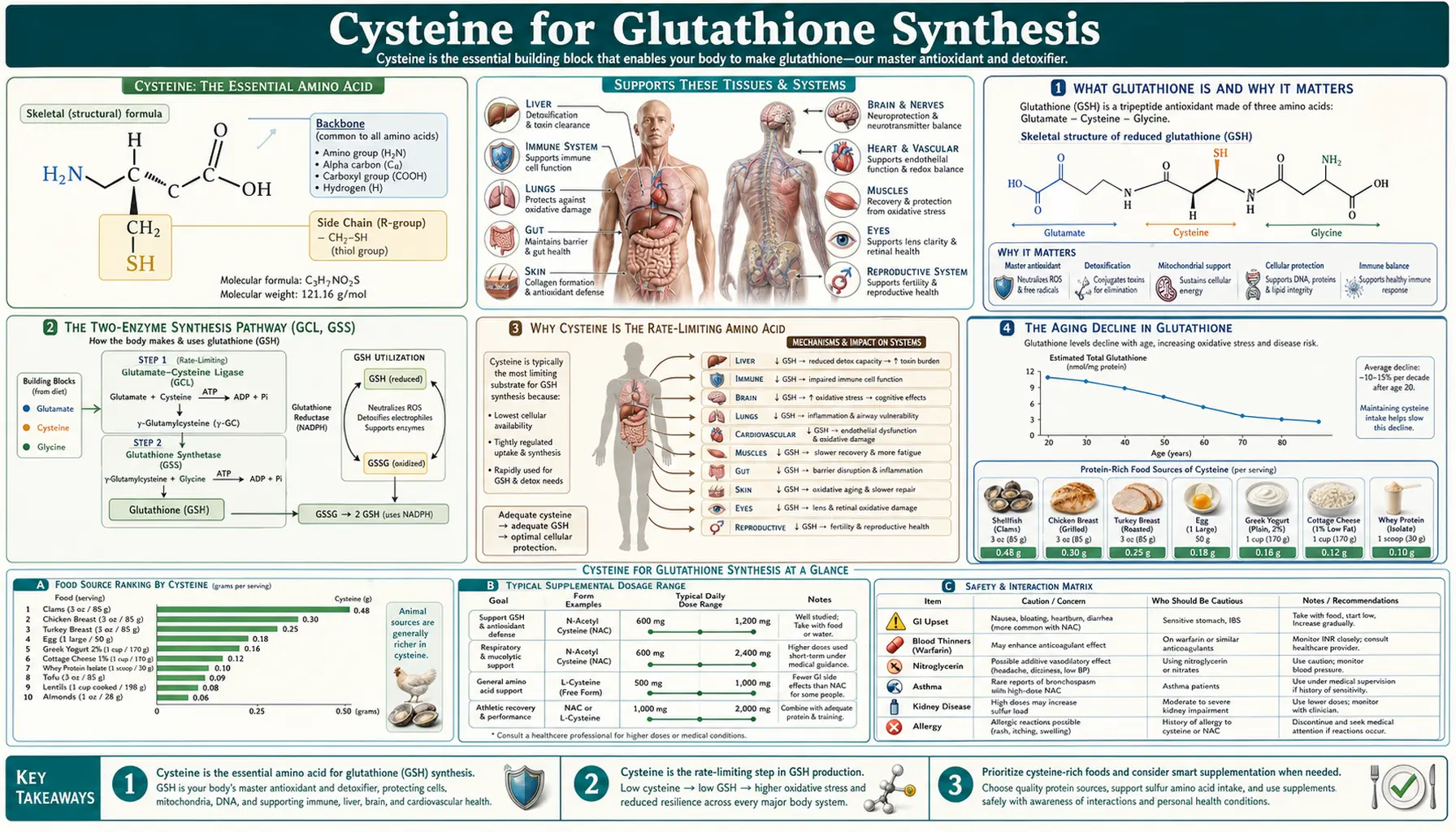
Glutathione (gamma-glutamyl-cysteinyl-glycine, or GSH) is the most abundant non-protein thiol in mammalian tissues, present at about 1–10 mM, and a central antioxidant inside cells. The standard biochemical account names two key determinants of its synthesis: the availability of cysteine and the activity of the first enzyme, glutamate-cysteine ligase (GCL), which glutathione itself feedback-inhibits. Small studies from one research group at Baylor College of Medicine reported lower red-blood-cell glutathione in older adults and reported that oral glycine plus N-acetylcysteine (“GlyNAC”) raised it, with reported changes in oxidative stress, mitochondrial function, insulin resistance, strength and gait speed; an independent randomized trial in healthy older adults did not find a rise in glutathione on its primary endpoint. This page reports what the biochemistry and the trials found.
Table of Contents
- What Glutathione Is and Why It Matters
- The Two-Enzyme Synthesis Pathway (GCL, GSS)
- Why Cysteine Availability Limits Synthesis
- The Aging Decline in Glutathione
- The Sekhar GlyNAC Trials at Baylor
- NAC vs Free Cysteine vs Oral Glutathione
- Liposomal and Acetylated Glutathione Forms
- Whey Protein as a Cysteine Source
- Measuring Glutathione Status
- Clinical Research by Condition
- Safety Findings and Drug Interactions
- Key Research Papers
- Connections
- Featured Videos
What Glutathione Is and Why It Matters
Glutathione is a tripeptide assembled from three amino acids in this specific order: glutamate, cysteine, and glycine. The peculiarity is that the bond between glutamate and cysteine is a gamma-peptide bond — formed between the side-chain carboxyl group of glutamate rather than its alpha-carboxyl — which is why glutathione is not assembled by the ribosome like an ordinary protein. It is synthesized in the cytosol by two dedicated enzymes acting one after the other (Lu 2013).
The functional center of the glutathione molecule is the thiol (–SH) group on the cysteine residue. This thiol can give up an electron (or a hydrogen atom) to a reactive oxygen species, neutralizing it. Two oxidized glutathione molecules then pair via a disulfide bond to form GSSG (glutathione disulfide), which is reduced back to two GSH molecules by the NADPH-dependent enzyme glutathione reductase. The ratio of reduced glutathione (GSH) to oxidized glutathione (GSSG) is widely used as an indicator of cellular redox status; in the cytosol the ratio stays very high even during oxidative stress (Forman 2009).
Beyond direct radical scavenging, glutathione has several other functions described in the standard reviews (Forman 2009; Lu 2013). It is the cosubstrate for the glutathione-S-transferase (GST) family of Phase II detoxification enzymes, which conjugate glutathione to electrophilic toxins so they can be excreted. It helps keep vitamin C (ascorbate) and vitamin E (tocopherol) in their reduced forms. It maintains the reduced state of protein thiols, including the active-site cysteines of many enzymes. And it is the electron donor for the glutathione peroxidase family of enzymes that detoxify hydrogen peroxide and lipid peroxides, including GPX4, which protects cells from the iron-dependent cell-death pathway called ferroptosis.
The Two-Enzyme Synthesis Pathway (GCL, GSS)
Glutathione is built by two enzymes acting sequentially in the cytosol (Lu 2013). The first, described as the rate-limiting enzyme, is glutamate-cysteine ligase (GCL, also historically called gamma-glutamylcysteine synthetase, gamma-GCS). GCL has a catalytic subunit (GCLC) and a modifier subunit (GCLM). It joins glutamate and cysteine via the gamma-peptide bond to produce gamma-glutamylcysteine, using ATP.
Under physiological conditions, the review by Lu (2013) describes GCL as regulated by two things: non-allosteric feedback inhibition by glutathione itself, which competes with glutamate at the enzyme (inhibition constant Ki about 2.3 mM), and the availability of cysteine. The modifier subunit lowers the enzyme's Km for glutamate and raises its Ki for glutathione, so the complete enzyme is more efficient and less sensitive to feedback. Glutathione is present in mammalian tissues at about 1–10 mM, with the highest concentration in the liver; most cells hold about 1–2 mM, and liver cells up to about 10 mM (Lu 2013; Forman 2009).
The second enzyme, glutathione synthetase (GSS, also written GS), adds glycine to gamma-glutamylcysteine to complete the tripeptide, again using ATP. GSS is not subject to feedback inhibition by glutathione, and because gamma-glutamylcysteine is present at very low concentrations when GSS is present, GCL rather than GSS is considered the rate-limiting step (Lu 2013). A series of studies from one group at Baylor College of Medicine has argued that glycine supply can also become limiting in older adults and in some chronic diseases; that work is described below and on the Glycine page.
Loss-of-function mutations in either enzyme cause rare inherited disorders (Ristoff 2007). Gamma-glutamylcysteine synthetase (GCL) deficiency is associated with hemolytic anemia, and some patients also show defects of neuromuscular function and generalized aminoaciduria. Glutathione synthetase deficiency is the most frequently recognized inborn error of glutathione metabolism; in its severe form it is associated with hemolytic anemia, metabolic acidosis, 5-oxoprolinuria, central nervous system damage and recurrent bacterial infections. The acidosis arises because the gamma-glutamylcysteine that accumulates is converted to 5-oxoproline (pyroglutamate) (Lu 2013).
Why Cysteine Availability Limits Synthesis
The phrase "rate-limiting" is used loosely in supplement writing. The standard review account (Lu 2013) is that the two key determinants of glutathione synthesis are the availability of cysteine and the activity of GCL. Several biochemical points underlie the cysteine side of that statement.
- Intracellular cysteine sits near the enzyme's half-saturating concentration. The Km values of GCL are about 1.8 mM for glutamate and 0.1–0.3 mM for cysteine. Intracellular glutamate is about ten-fold above its Km, while intracellular cysteine is close to its apparent Km (Lu 2013), so changes in cysteine supply change the rate of the first step.
- Free cysteine is unstable. Cysteine rapidly auto-oxidizes to cystine outside cells, a reaction that can generate potentially toxic oxygen free radicals; the gamma-glutamyl cycle, in which glutathione released from cells is broken down and its amino acids taken back up, lets glutathione serve as a continuous source of cysteine (Lu 2013).
- Cysteine comes from the diet or from methionine. Glutamate and glycine are made by the body; cysteine comes from dietary protein or is made from methionine through the transsulfuration pathway. In cultured human liver-cancer cells, about half of the intracellular glutathione pool was derived from homocysteine via transsulfuration (Mosharov 2000, a cell study).
- Human data on dietary sulfur amino acids. In a controlled metabolic study of 7 healthy men, 10 days of a diet free of sulfur amino acids (methionine and cysteine) slowed the rate of whole-blood glutathione synthesis, while whole-blood glutathione concentration was maintained (Lyons 2000). The authors noted that the view of cysteine as the rate-limiting factor was based on studies in rodents.
For this reason, raising cysteine supply is the usual research strategy for raising glutathione. NAC is the most studied vehicle; whey protein, a cysteine-rich dairy protein, has also been studied (see the whey protein section below).
The Aging Decline in Glutathione
The Sekhar 2011 American Journal of Clinical Nutrition study compared 8 elderly and 8 younger adults using a stable-isotope glycine tracer. The elderly subjects had lower red-blood-cell glutathione (1.12 vs 2.08 mmol/L of red cells), lower red-blood-cell glycine and cysteine, slower fractional and absolute glutathione synthesis, and higher plasma oxidative stress and F2-isoprostanes. After 2 weeks of cysteine (given as NAC) plus glycine, the elderly subjects had a 94.6% higher glutathione concentration, a 78.8% higher fractional synthesis rate and a 230.9% higher absolute synthesis rate, with lower oxidative stress; no differences remained between them and the younger subjects. The study was small and short.
Proposed mechanisms for the decline come partly from animal work. In the aging rat liver, levels of both GCL subunits and GCL activity were about half those of young rats, alongside an approximately 50% age-related loss of the transcription factor Nrf2, which governs GCL expression (Suh 2004, an animal study). In humans, the Sekhar group attributes the deficit to reduced synthesis driven by lower availability of the precursors glycine and cysteine. The review by Lu (2013) lists aging, diabetes mellitus, fibrotic lung diseases and several liver disorders among conditions in which decreased glutathione synthesis has been described.
Whether the glutathione deficit causes the functional declines of aging, or simply accompanies them, is not settled. The Sekhar group's intervention trials, described in the next section, are the main human evidence offered that restoring glutathione precursors changes functional outcomes; they are small and come from one research group.
The Sekhar GlyNAC Trials at Baylor
Rajagopal V. Sekhar at Baylor College of Medicine has led a series of studies of oral glycine plus N-acetylcysteine, a combination the group calls "GlyNAC". The two main trials in older adults are:
- Kumar et al. 2021, Clinical and Translational Medicine (open-label pilot). A 36-week trial in 8 older and 8 young adults; the young adults were studied once at baseline, and the older adults took GlyNAC for 24 weeks and then stopped for 12 weeks. The authors reported that GlyNAC corrected red-blood-cell glutathione deficiency, oxidative stress and mitochondrial dysfunction, and improved inflammation, endothelial dysfunction, insulin resistance, genomic damage, cognition, strength, gait speed and exercise capacity, and lowered body fat and waist circumference. The benefits declined after supplementation stopped for 12 weeks.
- Kumar et al. 2023, Journals of Gerontology: Medical Sciences (randomized trial). 24 older adults were randomized to GlyNAC (12) or an isonitrogenous alanine placebo (12) for 16 weeks; 12 young adults took GlyNAC for 2 weeks for comparison. The authors reported that GlyNAC, and not placebo, improved or corrected glutathione deficiency, oxidative stress, mitochondrial dysfunction, inflammation, endothelial dysfunction, insulin resistance, multiple aging hallmarks, gait speed, muscle strength, 6-minute walk, waist circumference and systolic blood pressure. It was described as safe and well tolerated.
The 2023 trial is the group's first placebo-controlled randomized trial of GlyNAC in older adults, and it is small (12 people per arm). An independent randomized controlled trial run by a nutrition-industry research institute (Lizzo 2022) gave 114 healthy older volunteers GlyNAC at 2.4, 4.8 or 7.2 g/day or placebo for 2 weeks; GlyNAC was well tolerated but did not increase the reduced-to-oxidized glutathione ratio or total glutathione, the primary endpoint. In a post-hoc analysis, a subgroup with high oxidative stress and low baseline glutathione who took the medium or high dose showed higher glutathione than placebo.
None of these trials included an arm given NAC alone or glycine alone, so they do not show how much of the reported effect comes from each precursor.
Doses used: the 2021 pilot gave glycine at 1.33 mmol per kg body weight per day and cysteine at 0.81 mmol per kg per day as NAC (the Glycine page reports the same doses for the 2011 studies); the abstract of the 2023 randomized trial does not state the dose. The Lizzo 2022 trial used fixed daily totals of 2.4, 4.8 or 7.2 g of glycine and NAC in a 1:1 ratio.
NAC vs Free Cysteine vs Oral Glutathione
Three supplemental strategies have been studied for raising glutathione: N-acetylcysteine (NAC), free L-cysteine, and oral glutathione itself. They are not interchangeable.
N-acetylcysteine (NAC) is a cysteine prodrug that replenishes intracellular glutathione; it is best known as the antidote for acetaminophen (paracetamol) poisoning, and a 2007 review described it as safe and well tolerated, noting that over two-thirds of 46 placebo-controlled trials of oral NAC reported beneficial effects (Atkuri 2007). Its oral bioavailability as intact NAC is low: in 10 healthy volunteers given single 600 mg doses, oral availability ranged from 6 to 10% depending on the formulation (Borgström 1986). Doses in the trials cited on this page ranged from 600 mg twice daily to 2,400 mg per day. See the dedicated NAC page and the NAC and Lung Health deep-dive for more.
Free L-cysteine is less stable than NAC because it auto-oxidizes to cystine (Lu 2013). One clinical setting where cysteine itself is used is parenteral (IV) nutrition for newborns: a Cochrane review found that short-term cysteine supplementation of cysteine-free parenteral nutrition in preterm infants improved nitrogen balance, while evidence on risks such as metabolic acidosis was insufficient, and a large trial did not support routine NAC supplementation of cysteine-containing parenteral nutrition in extremely low birth weight infants (Soghier 2006).
Oral glutathione has long been considered poorly bioavailable in humans, on the reasoning that it is broken down in the gut into its amino acids. In a 6-month randomized, double-blind, placebo-controlled trial in 54 non-smoking adults, oral glutathione at 250 or 1,000 mg/day raised glutathione levels in blood; at 6 months the high-dose group had 30–35% higher glutathione in erythrocytes, plasma and lymphocytes and 260% higher levels in buccal cells, and levels returned to baseline after a 1-month washout (Richie 2015).
Liposomal and Acetylated Glutathione Forms
Two other oral glutathione formulations are designed to deliver intact glutathione past digestion.
Liposomal glutathione packages GSH inside phospholipid vesicles. In a 1-month pilot study in 12 healthy adults given 500 or 1,000 mg per day, glutathione rose after 1 week, with maximum increases of 40% in whole blood, 25% in erythrocytes, 28% in plasma and 100% in peripheral blood mononuclear cells at 2 weeks; oxidative-stress markers fell, natural killer cell cytotoxicity rose by up to 400% and lymphocyte proliferation by up to 60%. No difference was seen between the two doses, though the study had little statistical power (Sinha 2018). The study was funded by, and used a product supplied by, a supplement company.
S-acetyl glutathione carries an acetyl group on the cysteine sulfur. In a cell study, adding it to the culture medium raised intracellular glutathione in fibroblasts from patients with glutathione synthetase deficiency (Okun 2004, a cell study). Human pharmacokinetic or clinical trial data for S-acetyl glutathione were not found for this page.
No head-to-head trial comparing NAC, liposomal glutathione, S-acetyl glutathione and standard oral glutathione for raising body glutathione was found for this page.
Whey Protein as a Cysteine Source
Whey, the protein fraction of milk left after cheese-making, is rich in cysteine. Gustavo Bounous, a researcher associated with a whey-supplement manufacturer, described whey protein concentrate in a 2000 review as an effective and safe cysteine donor for glutathione replenishment in immune-deficiency states, and reported animal experiments and case reports in cancer (Bounous 2000, a review). Proponents describe "undenatured" whey, processed to preserve the native protein structure, as the form that delivers cysteine most effectively; no trial comparing processing methods was found for this page.
In a randomized double-blind trial in 30 patients with advanced HIV infection and low plasma glutathione, 45 g/day of one of two cysteine-rich whey protein formulas for 2 weeks raised plasma glutathione by 44% with one formula, while the 24.5% rise with the other formula was not statistically significant; inflammatory markers and routine clinical parameters did not change (Micke 2001). The authors noted that a long-term trial would be needed to see whether this biochemical effect translates into a better course of disease.
Measuring Glutathione Status
Research studies assess glutathione status in several ways, each with limitations (Forman 2009).
- Red-blood-cell glutathione — the measure used in the Sekhar studies, where younger adults averaged 2.08 and elderly adults 1.12 mmol/L of red cells (Sekhar 2011, AJCN). Red cells are easy to sample, but how well they reflect glutathione in other tissues varies.
- Whole-blood glutathione and the reduced-to-oxidized (GSH:GSSG) ratio — captures both the size of the pool and its redox state. Samples need careful handling because GSH can oxidize after collection, which lowers the measured ratio. The Lizzo 2022 trial used this ratio as its primary endpoint.
- Plasma cysteine and cystine — not a direct glutathione measure, but an indication of precursor supply.
- Glutathione synthesis rate — measured in research settings with stable-isotope tracers of glycine or cysteine (Sekhar 2011; Lyons 2000); it is not a routine clinical test.
No standard reference range for glutathione is in routine clinical use, and studies use different methods and units, so values are not directly comparable between laboratories.
Clinical Research by Condition
Clinical research on cysteine and glutathione precursors has focused on conditions in which glutathione depletion is thought to play a role. Findings by condition:
- Aging — the Sekhar GlyNAC trials described above (small, one research group), and the independent Lizzo 2022 trial that did not meet its primary glutathione endpoint.
- Acetaminophen (paracetamol) poisoning — the established clinical use, in which NAC restores hepatic glutathione so the toxic metabolite NAPQI can be neutralized. The US labels describe a 21-hour intravenous regimen (300 mg/kg in total, as three infusions: 150 mg/kg over 1 hour, 50 mg/kg over 4 hours and 100 mg/kg over 16 hours, or a two-infusion alternative over 20 hours) and an oral regimen of a 140 mg/kg loading dose followed by 70 mg/kg every 4 hours for 17 doses. More on NAC is on the NAC and Lung Health page.
- Non-alcoholic fatty liver disease (NAFLD) — in a small trial in 30 patients randomized to NAC or vitamin C, NAC lowered serum ALT after 3 months compared with vitamin C and reduced spleen size (Khoshbaten 2010). Larger trials were not found for this page.
- COPD — in the PANTHEON trial in 1,006 Chinese patients with moderate-to-severe COPD, NAC 600 mg twice daily for 1 year lowered the annual exacerbation rate (1.16 vs 1.49 per patient-year; risk ratio 0.78) (Zheng 2014; funded by a manufacturer). See the NAC and Lung Health page.
- Polycystic ovary syndrome (PCOS) — a 2015 meta-analysis of 8 trials (910 women) found higher odds of ovulation and pregnancy with NAC than with placebo, but lower odds than with metformin, and no significant change in insulin, testosterone or body mass index versus placebo; the authors called for better-designed trials (Thakker 2015). The NAC Fertility and PCOS page has details.
- Psychiatric conditions — in a 12-week placebo-controlled trial in 50 adults with trichotillomania, NAC 1,200–2,400 mg/day reduced hair-pulling (56% much or very much improved vs 16% on placebo) (Grant 2009). In 24-week placebo-controlled trials of NAC 1 g twice daily added to usual medication, depressive symptoms improved in bipolar disorder, with no effect on time to a mood episode (Berk 2008, bipolar), and PANSS total and negative scores improved in chronic schizophrenia, with no change in positive symptoms (Berk 2008, schizophrenia). The proposed mechanisms are glutamate modulation and glutathione restoration.
- HIV — HIV infection is associated with systemic glutathione deficiency; NAC has been used to treat glutathione deficiency in HIV (Atkuri 2007), and short-term whey protein raised plasma glutathione in one small trial (Micke 2001). The Sekhar group's GlyNAC studies in HIV are described on the Glycine page.
- Cystic fibrosis — NAC is labeled in the US as an inhaled mucolytic for pulmonary complications of cystic fibrosis. In a 24-week placebo-controlled trial of oral NAC in 70 people with CF, lung function (FEV1) stayed stable or rose slightly with NAC while it fell with placebo, but sputum neutrophil elastase, the primary endpoint, and other inflammation markers did not change (Conrad 2015).
Safety Findings and Drug Interactions
- Nitroglycerin and other organic nitrates — NAC potentiates the vasodilator effect of nitroglycerin. In a trial in unstable angina, symptomatic hypotension occurred in 7 of 24 patients given intravenous nitroglycerin plus intravenous NAC vs none of 22 given nitroglycerin alone (Horowitz 1988). The research raises a concern for people using nitrates.
- Asthma — the US label for inhaled acetylcysteine reports that bronchospasm occurs infrequently and unpredictably, even in patients with asthmatic bronchitis, and that most cases are relieved by a nebulized bronchodilator. The label for intravenous acetylcysteine reports hypersensitivity reactions, including fatal anaphylaxis and bronchospasm, and calls for close monitoring of patients with asthma during infusion.
- Gastrointestinal bleeding risk — the US label for oral acetylcysteine in acetaminophen overdose states that patients at risk of gastric hemorrhage (for example, esophageal varices or peptic ulcers) are to be evaluated for the risk of upper gastrointestinal bleeding versus the risk of liver toxicity.
- Cystinuria — in this inherited disorder of cystine transport, cystine (two linked cysteine molecules) forms kidney stones. No trial data on supplemental cysteine or NAC in people with cystinuria was found for this page.
- Anticoagulants — no trial data on NAC combined with warfarin or DOACs was found for this page.
- Acetaminophen — no study was found showing that routine oral NAC supplement use protects against an acetaminophen overdose; the antidote regimens are the weight-based label regimens described above, given under medical care.
- Side effects — the US oral label states that oral acetylcysteine, especially in the large doses used for acetaminophen overdose, may cause nausea, vomiting and other gastrointestinal symptoms, and that rash with or without mild fever has been observed rarely. In the PANTHEON trial, adverse events at 600 mg twice daily for 1 year occurred in 29% of NAC and 26% of placebo patients (Zheng 2014).
- Pregnancy — the intravenous label states that published case reports and case series of pregnant women exposed to acetylcysteine are not sufficient to inform drug-associated risk, and that delaying treatment of acetaminophen overdose may increase maternal and fetal risk. High-dose GlyNAC regimens have not been studied in pregnancy.
Decisions about supplements and medicines belong with a clinician.
Key Research Papers
- Kumar P, Liu C, Hsu JW, Chacko S, Minard C, Jahoor F, Sekhar RV (2021). Glycine and N-acetylcysteine (GlyNAC) supplementation in older adults improves glutathione deficiency, oxidative stress, mitochondrial dysfunction, inflammation, insulin resistance, endothelial dysfunction, genotoxicity, muscle strength, and cognition: results of a pilot clinical trial. Clinical and Translational Medicine, 11(3), e372. — PubMed PMID: 33783984
- Sekhar RV, McKay SV, Patel SG, et al. (2011). Glutathione synthesis is diminished in patients with uncontrolled diabetes and restored by dietary supplementation with cysteine and glycine. Diabetes Care, 34(1), 162–167. — PubMed PMID: 20929994
- Sekhar RV, Patel SG, Guthikonda AP, et al. (2011). Deficient synthesis of glutathione underlies oxidative stress in aging and can be corrected by dietary cysteine and glycine supplementation. American Journal of Clinical Nutrition, 94(3), 847–853. — PubMed PMID: 21795440
- Atkuri KR, Mantovani JJ, Herzenberg LA, Herzenberg LA (2007). N-Acetylcysteine — a safe antidote for cysteine/glutathione deficiency. Current Opinion in Pharmacology, 7(4), 355–359. — PubMed PMID: 17602868
- Wu G, Fang YZ, Yang S, Lupton JR, Turner ND (2004). Glutathione metabolism and its implications for health. Journal of Nutrition, 134(3), 489–492. — PubMed PMID: 14988435
- Lu SC (2013). Glutathione synthesis. Biochimica et Biophysica Acta, 1830(5), 3143–3153. — PubMed PMID: 22995213
- Richie JP Jr, Nichenametla S, Neidig W, et al. (2015). Randomized controlled trial of oral glutathione supplementation on body stores of glutathione. European Journal of Nutrition, 54(2), 251–263. — PubMed PMID: 24791752
- Sinha R, Sinha I, Calcagnotto A, et al. (2018). Oral supplementation with liposomal glutathione elevates body stores of glutathione and markers of immune function. European Journal of Clinical Nutrition, 72(1), 105–111. — PubMed PMID: 28853742
- Bounous G (2000). Whey protein concentrate (WPC) and glutathione modulation in cancer treatment. Anticancer Research, 20(6C), 4785–4792. — PubMed PMID: 11205219
- Lyons J, Rauh-Pfeiffer A, Yu YM, et al. (2000). Blood glutathione synthesis rates in healthy adults receiving a sulfur amino acid-free diet. Proceedings of the National Academy of Sciences, 97(10), 5071–5076. — PubMed PMID: 10792033
- Townsend DM, Tew KD, Tapiero H (2003). The importance of glutathione in human disease. Biomedicine and Pharmacotherapy, 57(3–4), 145–155. — PubMed PMID: 12818476
- Forman HJ, Zhang H, Rinna A (2009). Glutathione: overview of its protective roles, measurement, and biosynthesis. Molecular Aspects of Medicine, 30(1–2), 1–12. — PubMed PMID: 18796312
- Sastre J, Pallardó FV, Viña J (2003). The role of mitochondrial oxidative stress in aging. Free Radical Biology and Medicine, 35(1), 1–8. — PubMed PMID: 12826250
- Kerksick C, Willoughby D (2005). The antioxidant role of glutathione and N-acetyl-cysteine supplements and exercise-induced oxidative stress. Journal of the International Society of Sports Nutrition, 2(2), 38–44. — PubMed PMID: 18500954
- Kumar P, Liu C, Suliburk J, et al. (2023). Supplementing glycine and N-acetylcysteine (GlyNAC) in older adults improves glutathione deficiency, oxidative stress, mitochondrial dysfunction, inflammation, physical function, and aging hallmarks: a randomized clinical trial. Journals of Gerontology Series A: Biological Sciences and Medical Sciences, 78(1), 75–89. — PubMed PMID: 35975308
- Lizzo G, Migliavacca E, Lamers D, et al. (2022). A randomized controlled clinical trial in healthy older adults to determine efficacy of glycine and N-acetylcysteine supplementation on glutathione redox status and oxidative damage. Frontiers in Aging, 3, 852569. — PubMed PMID: 35821844
- Mosharov E, Cranford MR, Banerjee R (2000). The quantitatively important relationship between homocysteine metabolism and glutathione synthesis by the transsulfuration pathway and its regulation by redox changes. Biochemistry, 39(42), 13005–13011. (Cell study.) — PubMed PMID: 11041866
- Ristoff E, Larsson A (2007). Inborn errors in the metabolism of glutathione. Orphanet Journal of Rare Diseases, 2, 16. — PubMed PMID: 17397529
- Suh JH, Shenvi SV, Dixon BM, et al. (2004). Decline in transcriptional activity of Nrf2 causes age-related loss of glutathione synthesis, which is reversible with lipoic acid. Proceedings of the National Academy of Sciences, 101(10), 3381–3386. (Animal study.) — PubMed PMID: 14985508
- Borgström L, Kågedal B, Paulsen O (1986). Pharmacokinetics of N-acetylcysteine in man. European Journal of Clinical Pharmacology, 31(2), 217–222. — PubMed PMID: 3803419
- Soghier LM, Brion LP (2006). Cysteine, cystine or N-acetylcysteine supplementation in parenterally fed neonates. Cochrane Database of Systematic Reviews, (4), CD004869. — PubMed PMID: 17054219
- Okun JG, Sauer S, Bähr S, Lenhartz H, Mayatepek E (2004). S-Acetylglutathione normalizes intracellular glutathione content in cultured fibroblasts from patients with glutathione synthetase deficiency. Journal of Inherited Metabolic Disease, 27(6), 783–786. (Cell study.) — PubMed PMID: 15617191
- Micke P, Beeh KM, Schlaak JF, Buhl R (2001). Oral supplementation with whey proteins increases plasma glutathione levels of HIV-infected patients. European Journal of Clinical Investigation, 31(2), 171–178. — PubMed PMID: 11168457
- Khoshbaten M, Aliasgarzadeh A, Masnadi K, et al. (2010). N-acetylcysteine improves liver function in patients with non-alcoholic fatty liver disease. Hepatitis Monthly, 10(1), 12–16. — PubMed PMID: 22308119
- Zheng JP, Wen FQ, Bai CX, et al. (2014). Twice daily N-acetylcysteine 600 mg for exacerbations of chronic obstructive pulmonary disease (PANTHEON): a randomised, double-blind placebo-controlled trial. Lancet Respiratory Medicine, 2(3), 187–194. — PubMed PMID: 24621680
- Thakker D, Raval A, Patel I, Walia R (2015). N-acetylcysteine for polycystic ovary syndrome: a systematic review and meta-analysis of randomized controlled clinical trials. Obstetrics and Gynecology International, 2015, 817849. — PubMed PMID: 25653680
- Grant JE, Odlaug BL, Kim SW (2009). N-acetylcysteine, a glutamate modulator, in the treatment of trichotillomania: a double-blind, placebo-controlled study. Archives of General Psychiatry, 66(7), 756–763. — PubMed PMID: 19581567
- Berk M, Copolov DL, Dean O, et al. (2008). N-acetyl cysteine for depressive symptoms in bipolar disorder — a double-blind randomized placebo-controlled trial. Biological Psychiatry, 64(6), 468–475. — PubMed PMID: 18534556
- Berk M, Copolov D, Dean O, et al. (2008). N-acetyl cysteine as a glutathione precursor for schizophrenia — a double-blind, randomized, placebo-controlled trial. Biological Psychiatry, 64(5), 361–368. — PubMed PMID: 18436195
- Conrad C, Lymp J, Thompson V, et al. (2015). Long-term treatment with oral N-acetylcysteine: affects lung function but not sputum inflammation in cystic fibrosis subjects. A phase II randomized placebo-controlled trial. Journal of Cystic Fibrosis, 14(2), 219–227. — PubMed PMID: 25228446
- Horowitz JD, Henry CA, Syrjanen ML, et al. (1988). Combined use of nitroglycerin and N-acetylcysteine in the management of unstable angina pectoris. Circulation, 77(4), 787–794. — PubMed PMID: 3127076
- US National Library of Medicine, DailyMed. Acetylcysteine injection, prescribing information (intravenous regimen for acetaminophen overdose; hypersensitivity; pregnancy). — DailyMed label
- US National Library of Medicine, DailyMed. Acetylcysteine solution (inhalation and oral use), prescribing information (oral regimen for acetaminophen overdose; bronchospasm; adverse reactions). — DailyMed label
PubMed Topic Searches
Connections
- All Amino Acids
- Cysteine Overview
- Cysteine Benefits Hub
- NAC and Lung Health
- Cysteine for Hair and Nails
- Cysteine for Detoxification
- NAC (N-Acetylcysteine)
- NAC and Glutathione
- NAC for Fertility and PCOS
- Glycine (GlyNAC Partner)
- Methionine (Transsulfuration)
- Glutamic Acid (GSH Precursor)
- Taurine (Cysteine Downstream)
- Selenium (GPX Cofactor)
- Sulfur
- Oxidative Stress
- Fatty Liver (NAFLD)
- Homocysteine
- History
- Sources