N-acetyl-cysteine (NAC), Fertility & PCOS
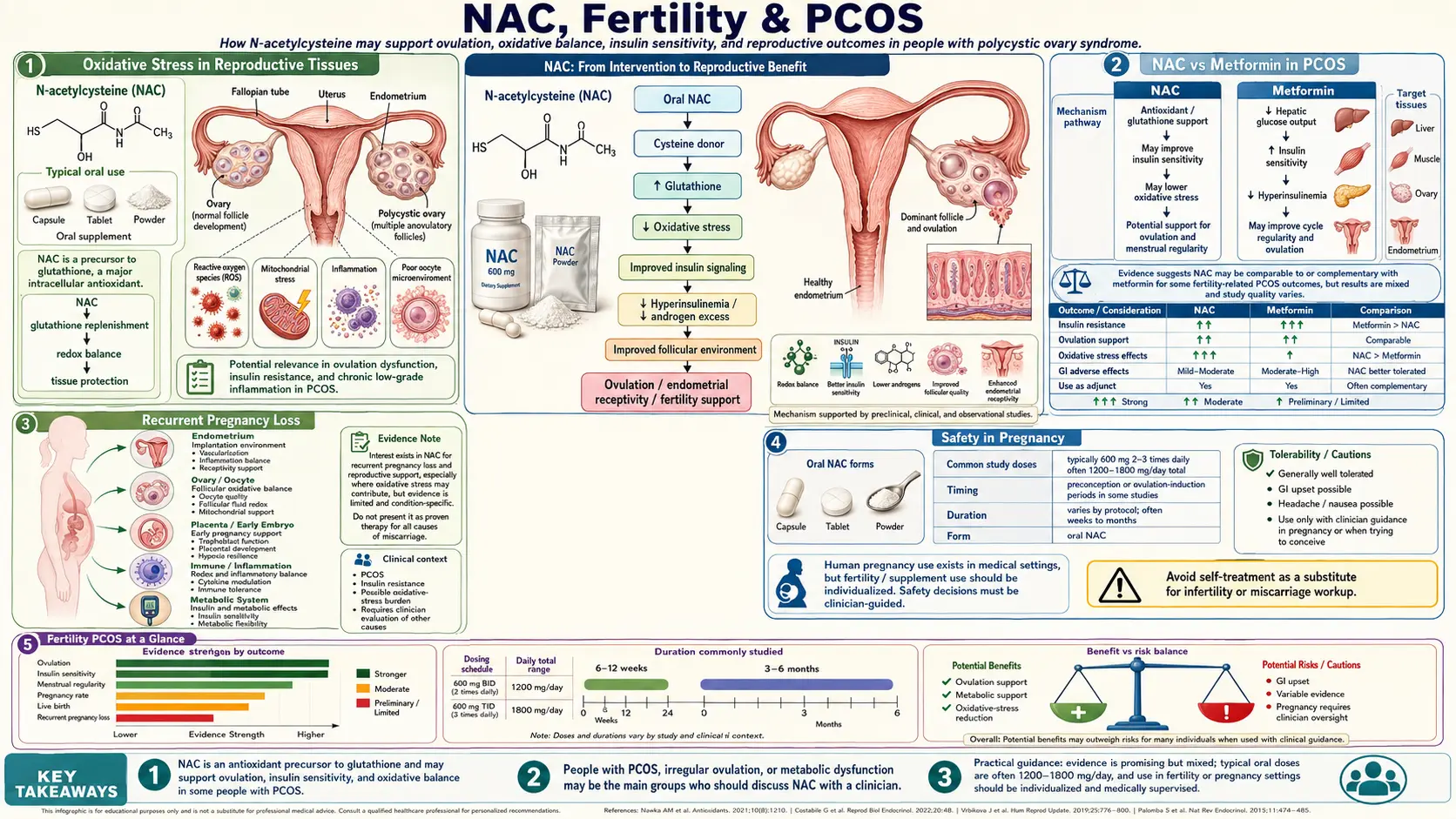
Reproductive medicine is one of the most studied areas for NAC — and one where several trials have since been retracted. In polycystic ovary syndrome (PCOS), a 2015 meta-analysis of 8 trials (910 women) found higher odds of ovulation and pregnancy with NAC than with placebo, but lower odds than with metformin, and no significant change in insulin, testosterone or body mass index versus placebo (Thakker 2015); its largest effect sizes, in clomiphene-resistant PCOS, pooled two trials, one of which was retracted in 2025. In male infertility, studies of 600 mg/day NAC for 3 months to 26 weeks report improvements in some semen measures: a 2021 meta-analysis of three randomized trials (431 men) found better sperm concentration, motility and morphology than with placebo, although one 120-man placebo-controlled trial found no difference in sperm count or morphology (Ciftci 2009). And in recurrent pregnancy loss, a 2008 controlled study (Amin 2008) reported a higher take-home-baby rate (RR 1.98) when NAC was added to folic acid. This article surveys the full reproductive literature.
Interactive Visualization Free Radicals & Your Antioxidant Network Follow one superoxide radical down the whole relay — SOD, catalase, glutathione, vitamin E, vitamin C, NADPH — then release free iron and watch a membrane tear itself apart. Launch →Table of Contents
- Oxidative Stress in Reproductive Tissues
- Male Fertility: Sperm Parameters and DNA Integrity
- Female Ovarian Reserve and Egg Quality
- PCOS: Metabolic and Ovulatory Findings
- NAC vs Metformin in PCOS
- Clomiphene-Resistant PCOS
- IVF and ART Outcomes
- Recurrent Pregnancy Loss
- Endometriosis
- Unexplained Infertility and Premature Ovarian Failure
- How Good Is This Evidence, Really?
- Doses Used in Studies
- Safety in Pregnancy
- Key Research Papers
- Connections
- Featured Videos
Oxidative Stress in Reproductive Tissues
Reactive oxygen species (ROS) at physiological levels are essential for sperm capacitation, acrosome reaction, oocyte maturation, ovulation, implantation, and luteolysis. Problems arise when ROS production exceeds antioxidant defenses. In sperm, polyunsaturated membrane fatty acids are peroxidized, impairing motility. In oocytes, mitochondrial DNA mutates and meiotic spindles fragment. In the endometrium, oxidative stress impairs implantation and placentation. A 2005 review by Agarwal and colleagues (Reprod Biol Endocrinol) describes a role for oxidative stress in female infertility and assisted reproduction, with some evidence in endometriosis, tubal and peritoneal factor infertility, and unexplained infertility.
NAC is a glutathione precursor; in studies described below it raised follicular-fluid glutathione (Li 2022) and total antioxidant capacity in infertile men (Jannatifar 2019). Its free thiol also directly scavenges hydroxyl radicals, hypochlorous acid, and hydrogen peroxide, and chelates Fenton-reaction transition metals.
Male Fertility: Sperm Parameters and DNA Integrity
Safarinejad 2009 — NAC + Selenium Combination
468 men with idiopathic oligo-asthenoteratozoospermia randomized to placebo, selenium 200 mcg, NAC 600 mg, or selenium + NAC daily for 26 weeks, followed by a 30-week treatment-free period (Journal of Urology). The authors report that semen parameters improved with selenium and with NAC, that the combination had additive effects, and that serum FSH fell while testosterone and inhibin B rose. The abstract does not give the size of the changes.
The journal issued an Expression of Concern on this paper in 2023 (notice PMID 36626340), so its figures are uncertain. Other studies (Ciftci, Jannatifar, Barekat) and the Zhou 2021 meta-analysis report improvements in some of the same measures.
Ciftci 2009 — Placebo-Controlled Trial
120 men with idiopathic infertility randomized to NAC 600 mg/day or placebo for 3 months (Urology). NAC improved semen volume, motility and viscosity and raised serum total antioxidant capacity, but sperm count and morphology did not differ between the groups.
Jannatifar 2019 — DNA Fragmentation
50 asthenoteratozoospermic men receiving NAC 600 mg/day for 3 months, each compared with his own pre-treatment values (no control group) (Reprod Biol Endocrinol). Sperm count and motility rose and abnormal morphology fell. DNA fragmentation and protamine deficiency decreased; MDA fell and total antioxidant capacity rose. FSH and LH fell and testosterone rose.
Barekat 2016 — Post-Varicocelectomy
35 infertile men with varicocele were randomized after varicocelectomy to NAC for 3 months (15) or no NAC (20) (Int J Fertil Steril). Semen measures improved in both groups after surgery; compared with controls, only the improvements in protamine deficiency and DNA fragmentation were significantly greater with NAC. Clinical pregnancy occurred in 5 of 15 men in the NAC group and 2 of 20 controls, a difference the authors did not test statistically.
Zhou 2021 Meta-Analysis
Meta-analysis of three randomized trials of daily oral NAC in 431 men with idiopathic infertility (Andrologia). Compared with placebo, NAC improved sperm concentration, ejaculate volume, motility and normal morphology; there was no significant difference in testosterone, LH, FSH or prolactin. The authors called for more high-quality trials.
Female Ovarian Reserve and Egg Quality
Oocyte aging is driven by mitochondrial dysfunction and ROS accumulation. NAC raised follicular-fluid glutathione in a randomized IVF trial (Li 2022, below), and in animal studies it protected the mouse ovary against radiation damage (Gao 2017). Human data on NAC and markers of ovarian reserve such as AMH or antral follicle count are limited.
Li 2022 — Advanced Maternal Age IVF
Randomized study of 200 women of advanced reproductive age undergoing GnRH-antagonist IVF/ICSI (Frontiers in Medicine). NAC 600 mg three times daily from the menstrual phase of the previous cycle for about 45 days, compared with no NAC, raised follicular-fluid glutathione, lowered the total gonadotrophin dose used and increased the number of high-quality blastocysts (1.82 vs 1.43). The number of oocytes collected and the clinical pregnancy rate did not differ between the groups.
PCOS: Metabolic and Ovulatory Findings
PCOS combines insulin resistance, hyperandrogenism, and anovulation — all amplified by systemic oxidative stress. An early study of NAC's effect on insulin in PCOS was Fulghesu 2002 (Fertility and Sterility).
Fulghesu 2002 — Early Insulin Study
A prospective study of 37 women with PCOS, 6 of whom received placebo. NAC 1.8 g/day (3 g/day in massively obese women) for 5–6 weeks reduced the insulin response to an oral glucose load, increased peripheral insulin sensitivity measured by clamp, and lowered testosterone and the free androgen index; fasting glucose and fasting insulin did not change. The improvement was seen in women with high insulin responses, not in those with normal insulin or on placebo. Its comparison with the insulin-sensitizer metformin came in later trials, below.
Thakker Meta-Analysis 2015
8 RCTs, 910 PCOS women (Obstet Gynecol Int):
- NAC vs placebo: ovulation OR 3.13 (p=0.002); pregnancy OR 3.58 (p<0.0001); live birth OR 3.00 (p=0.04) — but the live-birth figure came from a single 60-woman trial (Nasr 2010), which was retracted in 2025 (notice PMID 41206153)
- In clomiphene-resistant subgroup: ovulation OR 8.40 (CI 4.50–15.67); pregnancy OR 4.83 (CI 2.30–10.13), each from 2 trials and 210 women. The review’s study tables list only two placebo-controlled trials in this group — Rizk 2005 and the since-retracted Nasr 2010 — so these pooled estimates rest partly on retracted data.
- No significant change versus placebo in insulin, testosterone or body mass index
- NAC vs metformin: metformin superior for ovulation and pregnancy, but NAC produced greater BMI reduction (-1.00 kg/m2) and lower testosterone (-0.19)
NAC vs Metformin in PCOS
Oner and Muderris 2011
100 PCOS women, 24 weeks: metformin 500 mg TID vs NAC 600 mg TID (1,800 mg/day) (Eur J Obstet Gynecol Reprod Biol). Equivalent reductions in BMI, hirsutism, fasting insulin, HOMA-IR, free testosterone, and menstrual irregularity. Lipids: NAC significantly reduced total cholesterol and LDL; metformin reduced total cholesterol only.
Cheraghi 2016
Pilot randomized trial of 60 women with PCOS undergoing ICSI, 15 per arm: metformin 1,500 mg/day, NAC 1,800 mg/day, both, or placebo for about 6 weeks (Reprod Fertil Dev). Compared with placebo, the NAC group had fewer immature and abnormal oocytes and more good-quality embryos; the authors proposed NAC as an alternative to metformin.
The pooled data point in different directions. In Thakker 2015, women on NAC had lower odds than women on metformin of ovulation (OR 0.13) and pregnancy (OR 0.40). A 2020 meta-analysis of 10 trials comparing the two (Song 2020) reported that NAC significantly reduced BMI and total testosterone, with no significant difference in pregnancy rate, serum LH, fasting insulin or LH/FSH ratio; its authors called for large randomized trials.
Clomiphene-Resistant PCOS
Clomiphene resistance — anovulation despite 150 mg/day clomiphene (CC) x 3 cycles — affects a minority of women with PCOS. NAC has been tested as an add-on to clomiphene both in clomiphene-resistant women (Rizk 2005) and in women with PCOS in general (Badawy 2007, Salehpour 2012).
Rizk 2005 — Placebo-Controlled Trial
150 CC-resistant PCOS women in a double-blind randomized trial (Fertility and Sterility): NAC 1.2 g/day or placebo, each with CC 100 mg/day for 5 days from cycle day 3. Ovulation: 49.3% (NAC) vs 1.3% (placebo). Pregnancy: 21.3% vs 0%.
Badawy 2007 — Cross-Over
573 women with PCOS took clomiphene alone for one cycle; 470 of them then took clomiphene plus NAC 1,200 mg/day for another cycle (prospective cross-over design, Acta Obstet Gynecol Scand). Ovulation: 52.1% (CC+NAC) vs 17.9% (CC alone). Endometrial thickness, mid-luteal progesterone, and estradiol at the time of the hCG injection were significantly higher with NAC; the pregnancy rate in the NAC cycles was 11.5%.
Salehpour 2012
Double-blind placebo-controlled RCT, 180 infertile women with PCOS (not limited to clomiphene-resistant women), NAC 1.2 g/day or placebo with CC 100 mg/day (J Obstet Gynaecol Res). Ovulation and pregnancy rates, the number of follicles over 18 mm, and endometrial thickness were significantly higher in the NAC arm.
Badawy 2007 and Salehpour 2012 both reported a thicker endometrium with NAC added to clomiphene; the mechanism behind this has not been established.
Three further NAC trials in this group have been retracted: a 2010 pilot trial of NAC after ovarian drilling (retracted 2025, notice PMID 41206153), a 2015 trial of metformin plus NAC added to clomiphene (retracted 2025, notice PMID 41391099), and a 2019 trial of NAC versus L-carnitine, which the journal retracted in 2023 citing “continued concerns regarding the integrity of the data” (notice PMID 37422702).
IVF and ART Outcomes
- Cheraghi 2016 (Reprod Fertil Dev): 60 Iranian PCOS women undergoing ICSI in four arms (placebo, metformin, NAC 1,800 mg/day, NAC+metformin). Compared with placebo, the NAC arm had fewer immature and abnormal oocytes and more good-quality embryos; malondialdehyde in follicular fluid fell.
- Li 2022 advanced-age IVF/ICSI (200 women, randomized): more high-quality blastocysts and higher follicular-fluid glutathione with NAC; oocyte numbers and clinical pregnancy rates did not differ.
Recurrent Pregnancy Loss
Amin 2008 — The RPL Trial
Assiut University, Egypt. A prospective controlled study in women with unexplained recurrent pregnancy loss: NAC 600 mg/day + folic acid 500 mcg (n=80) vs an age-matched group given folic acid alone (n=86) (Reprod Biomed Online).
- Continuation of pregnancy beyond 20 weeks: RR 2.9 (95% CI 1.5–5.6, p<0.002)
- Take-home baby rate: RR 1.98 (95% CI 1.3–4.0, p=0.047)
The authors' rationale: pregnancy may involve oxidative stress that can contribute to pregnancy loss, which NAC's antioxidant effect might suppress.
Endometriosis
Porpora 2013 — Italian Observational Cohort
92 women with ultrasound-confirmed ovarian endometriomas scheduled for laparoscopy, who chose NAC (47) or no treatment (45); treatment was not randomized (Evid Based Complement Alternat Med). Protocol: NAC 600 mg x 3 per day, for 3 consecutive days per week, for 3 months (pulsed dosing, not continuous daily).
- Cyst mean diameter change: -1.5 mm (NAC) vs +6.6 mm (untreated), p=0.001
- 24 of 47 NAC-treated patients cancelled laparoscopy due to cyst shrinkage / disappearance / pain resolution / spontaneous pregnancy (vs 1 of 45 controls)
Anastasi 2023 — Single-Cohort Follow-Up
A study from the same Rome group (Anastasi and colleagues, with Porpora as senior author) gave 120 women with endometriosis the same 3-days-a-week schedule for 3 months, with no control group (Int J Environ Res Public Health 20:4686). Pain scores, analgesic use, endometrioma size and CA-125 fell; 39 of the 52 women wishing to conceive became pregnant within 6 months of starting.
Unexplained Infertility and Premature Ovarian Failure
Oxidative stress has been proposed as one contributor to infertility that has no anatomical or hormonal explanation; the Agarwal 2005 review describes some evidence for this.
The one dedicated randomized trial cited here — 804 women with unexplained infertility given clomiphene plus NAC 1,200 mg/day or clomiphene plus placebo, which reported no benefit — was retracted by Fertility and Sterility in 2023 (notice PMID 37517847); the Retraction Watch database lists concerns about the data, unreliable data and an investigation by the journal as the reasons (Fertil Steril. 2006;86(3):647–650; PMID 16831439 — Retracted (retraction notice: PMID 37517847)). Its results can no longer be relied on, and no other randomized trial of NAC in unexplained infertility is cited on this page, so reliable trial evidence for this use is currently lacking in either direction.
Premature ovarian failure / diminished ovarian reserve data are limited. In a mouse study (Gao 2017), NAC given for 7 days before X-irradiation preserved follicle development, hormone levels and fertility. No adequately powered randomized trial in humans is cited on this page.
How Good Is This Evidence, Really?
The trials above are reported as published. Taken together, the evidence is more uncertain than the individual results suggest.
- The strongest positive results come from a small number of centres, and several trials have been retracted. Most of the clomiphene-adjunct trials come from a small number of centres, mainly in Egypt and Iran. At least four NAC trials in PCOS or infertility have since been retracted (2006 unexplained-infertility trial, 2010 post-drilling trial, 2015 metformin-plus-NAC trial, 2019 NAC-versus-L-carnitine trial), and the 2015 meta-analysis pooled one of them. A finding that has not been reproduced across independent groups is weaker than the same finding replicated widely.
- One comparison-arm figure is very low. In Rizk 2005, women already known not to ovulate on clomiphene ovulated in 1.3% of cases on clomiphene plus placebo, against 49.3% with NAC added. A comparison rate that low makes the relative effect look very large.
- Systematic reviews rate the evidence low quality. A 2020 Cochrane review of antioxidants for female subfertility (63 trials, 7,760 women, NAC among them) rated the evidence low to very low quality, citing poor reporting of methods, imprecision and inconsistency; only 13 of its trials contributed live-birth data. In 2026 Cochrane’s editors added a note that seven of the included studies had since been retracted and two carry expressions of concern, and judged that removing them did not change the review’s conclusions (Showell 2020). The Thakker 2015 authors likewise wrote that their findings need confirmation in trials measuring live birth.
- What that adds up to. The trials described NAC as well tolerated at these doses, and it has a plausible mechanism in the conditions where oxidative stress and insulin resistance are established drivers. The non-retracted trials in PCOS report benefit as a clomiphene adjunct, the pooled data show metformin outperforming it for ovulation and pregnancy, and no reliable trial in unexplained infertility remains. On this evidence it is an adjunct under study, not an established treatment.
Doses Used in Studies
The doses below are those reported by the studies on this page, not dosing guidance.
| Indication | Dose used in studies | Duration |
|---|---|---|
| Male infertility | 600 mg once daily | 3 months to 26 weeks |
| PCOS metabolic | 1,800 mg/day (600 mg three times daily in Oner 2011) | 5–6 weeks (Fulghesu 2002) to 24 weeks (Oner 2011) |
| PCOS ovulation + clomiphene | 1,200 mg/day for 5 days from cycle day 3, with clomiphene | per cycle |
| Recurrent pregnancy loss | 600 mg/day + folic acid 500 mcg | not stated in the abstract |
| Endometriosis (Porpora protocol) | 600 mg three times a day, 3 consecutive days a week | 3 months |
| IVF/ICSI adjunct | 1,800 mg/day (Cheraghi 2016; Li 2022) | about 6 weeks before oocyte retrieval |
Safety in Pregnancy
- FDA Pregnancy Category B under the former letter system — a category meaning animal reproduction studies had not shown fetal risk and adequate studies in pregnant women were lacking.
- NAC is the antidote for acetaminophen overdose (intravenously 150 mg/kg, then 50 mg/kg over 4 h, then 100 mg/kg over 16 h), and it is given in pregnancy. In a US poison-centre series of 60 pregnant women with acetaminophen overdose (Riggs 1989), later NAC treatment was associated with more spontaneous abortion and fetal death.
- In Amin 2008, the authors describe NAC taken with folic acid in early pregnancy as well tolerated.
- NAC crosses the placenta: in mothers with chorioamnionitis given intravenous NAC, umbilical-cord levels often exceeded maternal levels (Wiest 2014), and a small randomized trial of 22 mothers reported no adverse events related to NAC (Jenkins 2016).
- Common side effects: mild nausea, dyspepsia, sulfurous odor. Rare bronchospasm (inhaled), rash.
Key Research Papers
- Safarinejad MR, Safarinejad S. Efficacy of selenium and/or N-acetyl-cysteine for improving semen parameters in infertile men: a double-blind, placebo controlled, randomized study. J Urol 2009;181(2):741–751. PubMed PMID: 19091331 — Expression of concern (notice: PubMed PMID: 36626340)
- Ciftci H, Verit A, Savas M, Yeni E, Erel O. Effects of N-acetylcysteine on semen parameters and oxidative/antioxidant status. Urology 2009;74(1):73–76. PubMed PMID: 19428083
- Jannatifar R, Parivar K, Roodbari NH, Nasr-Esfahani MH. Effects of N-acetyl-cysteine supplementation on sperm quality, chromatin integrity and level of oxidative stress in infertile men. Reprod Biol Endocrinol 2019;17(1):24. PubMed PMID: 30771790
- Barekat F, Tavalaee M, Deemeh MR, et al. A preliminary study: N-acetyl-L-cysteine improves semen quality following varicocelectomy. Int J Fertil Steril 2016;10(1):120–126. PubMed PMID: 27123209
- Zhou Z, Cui Y, Zhang X, Zhang Y. The role of N-acetyl-cysteine (NAC) orally daily on the sperm parameters and serum hormones in idiopathic infertile men: a systematic review and meta-analysis of randomised controlled trials. Andrologia 2021;53(2):e13953. PubMed PMID: 33405232
- Rizk AY, Bedaiwy MA, Al-Inany HG. N-acetyl-cysteine is a novel adjuvant to clomiphene citrate in clomiphene citrate-resistant patients with polycystic ovary syndrome. Fertil Steril 2005;83(2):367–370. PubMed PMID: 15705376
- Badawy A, State O, Abdelgawad S. N-Acetyl cysteine and clomiphene citrate for induction of ovulation in polycystic ovary syndrome: a cross-over trial. Acta Obstet Gynecol Scand 2007;86(2):218–222. PubMed PMID: 17364286
- Salehpour S, Akbari Sene A, Saharkhiz N, et al. N-Acetylcysteine as an adjuvant to clomiphene citrate for successful induction of ovulation in infertile patients with polycystic ovary syndrome. J Obstet Gynaecol Res 2012;38(9):1182–1186. PubMed PMID: 22540635
- Thakker D, Raval A, Patel I, Walia R. N-acetylcysteine for polycystic ovary syndrome: a systematic review and meta-analysis of randomized controlled clinical trials. Obstet Gynecol Int 2015;2015:817849. PubMed PMID: 25653680
- Oner G, Muderris II. Clinical, endocrine and metabolic effects of metformin vs N-acetyl-cysteine in women with polycystic ovary syndrome. Eur J Obstet Gynecol Reprod Biol 2011;159(1):127–131. PubMed PMID: 21831508
- Cheraghi E, Mehranjani MS, Shariatzadeh MA, Esfahani MHN, Ebrahimi Z. N-Acetylcysteine improves oocyte and embryo quality in polycystic ovary syndrome patients undergoing intracytoplasmic sperm injection: an alternative to metformin. Reprod Fertil Dev 2016;28(6):723–731. PubMed PMID: 25482371
- Li X, Wang Z, Wang H, Xu H, Sheng Y, Lian F. Role of N-acetylcysteine treatment in women with advanced age undergoing IVF/ICSI cycles: a prospective study. Front Med (Lausanne) 2022;9:917146. PubMed PMID: 36267623
- Amin AF, Shaaban OM, Bediawy MA. N-acetyl cysteine for treatment of recurrent unexplained pregnancy loss. Reprod Biomed Online 2008;17(5):722–726. PubMed PMID: 18983759
- Porpora MG, Brunelli R, Costa G, et al. A promise in the treatment of endometriosis: an observational cohort study on ovarian endometrioma reduction by N-acetylcysteine. Evid Based Complement Alternat Med 2013;2013:240702. PubMed PMID: 23737821
- Anastasi E, Scaramuzzino S, Viscardi MF, et al. Efficacy of N-acetylcysteine on endometriosis-related pain, size reduction of ovarian endometriomas, and fertility outcomes. Int J Environ Res Public Health 2023;20(6):4686. PubMed PMID: 36981595
- Agarwal A, Gupta S, Sharma RK. Role of oxidative stress in female reproduction. Reprod Biol Endocrinol 2005;3:28. PubMed PMID: 16018814
- Fulghesu AM, Ciampelli M, Muzj G, et al. N-acetyl-cysteine treatment improves insulin sensitivity in women with polycystic ovary syndrome. Fertil Steril 2002;77(6):1128–1135. PubMed PMID: 12057717
- Gao W, Liang JX, Ma C, Dong JY, Yan Q. The protective effect of N-acetylcysteine on ionizing radiation induced ovarian failure and loss of ovarian reserve in female mouse. Biomed Res Int 2017;2017:4176170. PubMed PMID: 28607932
- Song Y, Wang H, Huang H, Zhu Z. Comparison of the efficacy between NAC and metformin in treating PCOS patients: a meta-analysis. Gynecol Endocrinol 2020;36(3):204–210. PubMed PMID: 31749393
- Badawy A, Baker El Nashar A, El Totongy M. Clomiphene citrate plus N-acetyl cysteine versus clomiphene citrate for augmenting ovulation in the management of unexplained infertility: a randomized double-blind controlled trial. Fertil Steril 2006;86(3):647–650. — PubMed PMID: 16831439 — Retracted (retraction notice: PubMed PMID: 37517847)
- Nasr A. Effect of N-acetyl-cysteine after ovarian drilling in clomiphene citrate-resistant PCOS women: a pilot study. Reprod Biomed Online 2010;20(3):403–409. — PubMed PMID: 20089454 — Retracted (retraction notice: PubMed PMID: 41206153)
- Showell MG, Mackenzie-Proctor R, Jordan V, Hart RJ. Antioxidants for female subfertility. Cochrane Database Syst Rev 2020;8(8):CD007807. PubMed PMID: 32851663
- Riggs BS, Bronstein AC, Kulig K, Archer PG, Rumack BH. Acute acetaminophen overdose during pregnancy. Obstet Gynecol 1989;74(2):247–253. PubMed PMID: 2748061
- Wiest DB, Chang E, Fanning D, Garner S, Cox T, Jenkins DD. Antenatal pharmacokinetics and placental transfer of N-acetylcysteine in chorioamnionitis for fetal neuroprotection. J Pediatr 2014;165(4):672–677.e2. PubMed PMID: 25064164
- Jenkins DD, Wiest DB, Mulvihill DM, et al. Fetal and neonatal effects of N-acetylcysteine when used for neuroprotection in maternal chorioamnionitis. J Pediatr 2016;168:67–76.e6. PubMed PMID: 26545726
PubMed Topic Searches
Selected PubMed topic searches relevant to N-acetylcysteine in PCOS, ovulation induction, sperm quality, and recurrent pregnancy loss.
- PubMed: NAC and ovulation in PCOS
- PubMed: NAC as adjunct to clomiphene in PCOS
- PubMed: NAC and sperm quality
- PubMed: NAC and recurrent pregnancy loss
- PubMed: NAC and endometriosis
- PubMed: NAC, insulin resistance, and PCOS
- PubMed: Oxidative stress and infertility
- PubMed: Glutathione and oocyte quality
- PubMed: Homocysteine and miscarriage
- PubMed: Inositol and PCOS ovulation
- PubMed: Antioxidants and sperm DNA integrity
- PubMed: Metformin and PCOS ovulation
Connections
- Free Radicals & Your Antioxidant Network — interactive animation
- NAC
- NAC and Glutathione
- Polycystic Ovary Syndrome
- PCOS
- Infertility
- Endometriosis
- Ovarian Cysts
- Selenium
- Zinc
- Cysteine
- Folic Acid
- Berberine
- Blood Sugar
- Insulin Resistance
- Oxidative Stress
- Inositol
- Metformin — the insulin-sensitizer NAC is trialled against.