Carnitine — Benefits Deep Dive
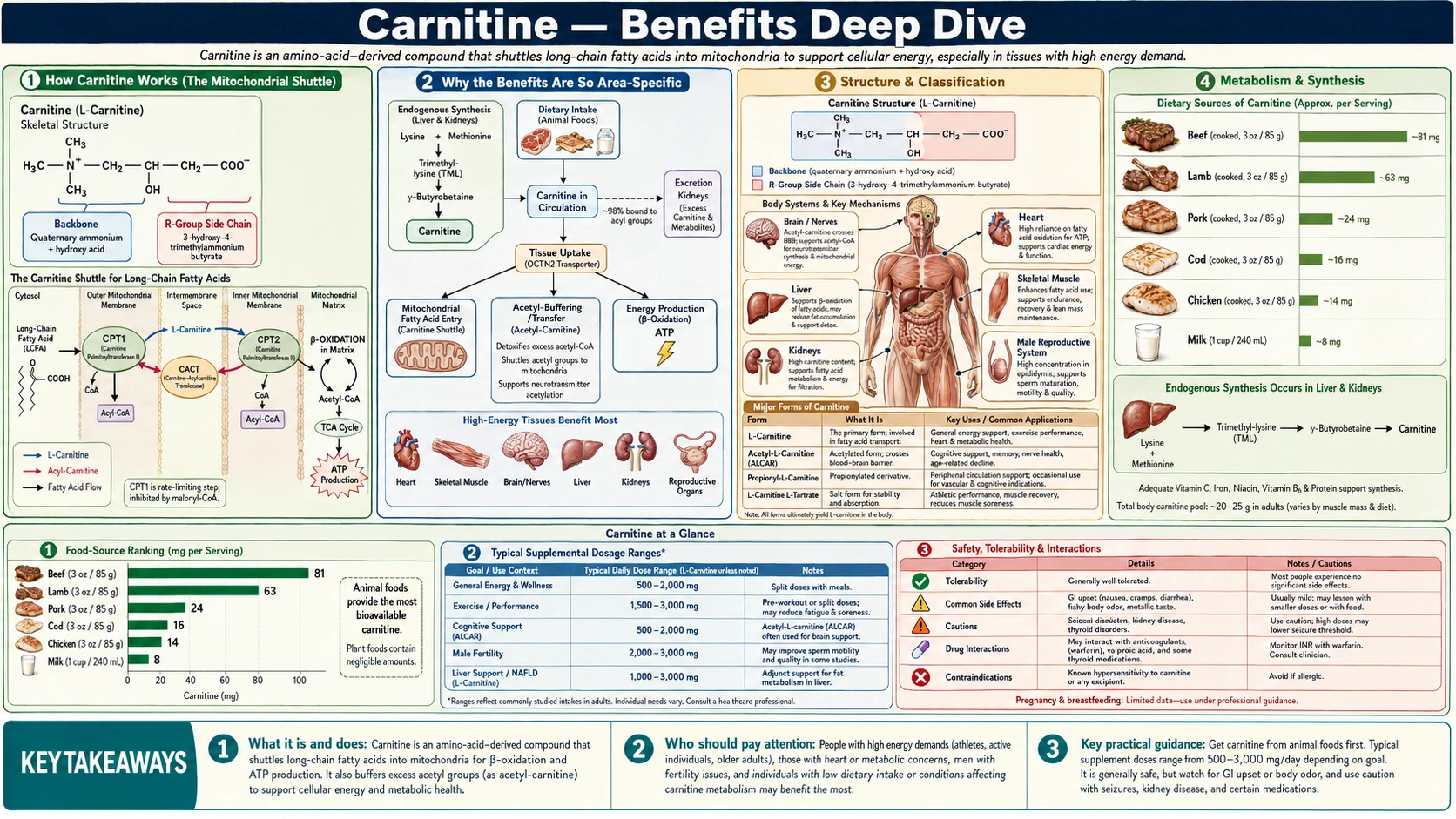
Carnitine has exactly one indispensable job in human biology: it ferries long-chain fatty acids across the inner mitochondrial membrane so they can be burned for energy. Every deeper claim about carnitine — that it strengthens a failing heart, speeds recovery from hard exercise, or melts away body fat — is a claim about what happens when you add more of a molecule the body already makes and tightly regulates. The honest answer differs sharply by area. The heart-failure and vascular evidence is the strongest (though it is adjunctive and rests largely on older trials); the exercise evidence is mixed and modest; and the popular "fat-burner" reputation rests on small effects (about 1.2–1.3 kg more weight lost in two meta-analyses, and in one of them the effect shrank the longer people took it). This hub links seven focused deep-dives that separate the real, cited benefits from the marketing — from the failing heart to the fatty liver to the depressed brain to the fertility clinic, and it tackles the unsettled question of whether the gut microbiome turns dietary carnitine into the pro-atherogenic compound trimethylamine N-oxide (TMAO).
Deep-Dive Articles
Heart & Circulation
Carnitine's strongest evidence base. Why the ischemic and failing heart becomes carnitine-depleted, the CEDIM post-heart-attack remodeling trials, the DiNicolantonio secondary-prevention meta-analysis, dilated cardiomyopathy survival data, propionyl-L-carnitine for angina and peripheral artery disease, and the honest framing: an adjunct layered on top of proven therapy, not a replacement, resting mostly on trials from the 1990s and 2000s.
Read the deep dive →Exercise & Recovery
The muscle-carnitine loading problem (you cannot raise muscle carnitine without co-ingested carbohydrate and insulin), the L-carnitine L-tartrate recovery studies showing reduced markers of muscle damage and soreness, why carnitine is not a reliable performance enhancer, and what the systematic reviews actually conclude about endurance, power, and delayed-onset muscle soreness.
Read the deep dive →Fat Metabolism & Weight
The central honest correction: carnitine is required for fat transport, but supplementing it does not reliably burn fat or drive weight loss in well-nourished people. Why "necessary for a process" does not mean "rate-limiting," what the Pooyandjoo and Talenezhad meta-analyses really show (small effects, low-to-moderate quality, confounded populations), and where a genuine deficiency changes the picture.
Read the deep dive →Forms & the Trimethylamine N-Oxide Question
L-carnitine vs acetyl-L-carnitine (ALCAR, which crosses the blood-brain barrier) vs L-carnitine L-tartrate (LCLT) vs propionyl-L-carnitine — which form for which goal. Then the unresolved paradox: gut bacteria convert carnitine to TMA and then trimethylamine N-oxide, a compound linked to atherosclerosis, yet supplement trials show cardiovascular benefit. What is actually known, and what is not.
Read the deep dive →Brain, Mood & Depression
The acetyl form (ALCAR) crosses the blood–brain barrier and carries some of the strongest randomized evidence in the whole carnitine family: a meta-analysis in which it beat placebo for depressive symptoms and matched prescription antidepressants head-to-head with fewer side effects; the Rockefeller discovery that ALCAR is measurably low in major depression; meta-analytic support in early memory decline; 1,257 patients of diabetic nerve-pain trial data; and the centenarian fatigue trial.
Read the deep dive →Male Fertility
The epididymis concentrates carnitine to extraordinary levels exactly where sperm learn to swim. Italian randomized placebo-controlled trials (L-carnitine 2 g/day for two months in one crossover trial; 3 g/day of carnitine forms for six months in another, where the gain went to men given acetyl-L-carnitine alone or combined with L-carnitine) improved sperm motility — most in the men who started lowest — alongside measurable gains in the semen's antioxidant capacity, and a 2025 network meta-analysis ranked L-carnitine best-in-class for progressive motility. With honest limits: pregnancy-rate evidence remains thin, and a supplement does not do what a fertility workup does, which is look for the cause.
Read the deep dive →Liver Disease
The liver is where carnitine is made — and where fat-burning failure shows up as non-alcoholic fatty liver disease (NAFLD), the world's most common liver condition. A 2023 meta-analysis of eight randomized controlled trials (RCTs) found L-carnitine lowered the liver-injury enzymes aspartate aminotransferase (AST) and alanine aminotransferase (ALT) and improved triglycerides and high-density lipoprotein (HDL) "with no significant adverse effects"; a 24-week randomized non-alcoholic steatohepatitis (NASH) trial added biopsy-graded improvement. Plus the hepatic-encephalopathy evidence (ammonia falls; Cochrane remains honestly unconvinced on outcomes) and carnitine's commonly recommended hospital use in severe valproate toxicity, where a 2009 review says the clinical benefit has not been established clearly.
Read the deep dive →Interactive Visualization Fat Burning & Ketosis — what actually happens Follow a fatty acid out of a fat cell to the mitochondrial gate and find it padlocked by insulin. Drop the carbs, open CPT1, and watch the liver start making ketones. Launch →
Table of Contents
- Deep-Dive Articles
- How Carnitine Works (The Mitochondrial Shuttle)
- Why the Benefits Are So Area-Specific
- Research Papers: Heart & Circulation
- Research Papers: Exercise & Recovery
- Research Papers: Fat Metabolism & Weight
- Research Papers: Forms & the Trimethylamine N-Oxide Question
- Research Papers: Brain, Mood & Depression
- Research Papers: Male Fertility
- Research Papers: Liver Disease
- External Authoritative Resources
- Connections
- Featured Videos
How Carnitine Works (The Mitochondrial Shuttle)
Carnitine (chemically 3-hydroxy-4-trimethylaminobutyric acid) is not a classic dietary amino acid built into proteins. It is a small molecule the body synthesizes from two amino acids — lysine provides the carbon backbone and methionine donates the methyl groups — in a pathway that also needs vitamin C, vitamin B6, niacin, and iron. Roughly 75% of the body's carnitine comes from the diet (overwhelmingly red meat and dairy) and about 25% from endogenous synthesis in the liver and kidneys. About 98% of the body's carnitine sits inside skeletal and cardiac muscle.
Its single essential function is the carnitine shuttle. Long-chain fatty acids cannot cross the inner mitochondrial membrane on their own. At the outer membrane, the enzyme carnitine palmitoyltransferase I (CPT1) attaches the fatty acid to carnitine, forming acylcarnitine. A translocase (CACT) carries the acylcarnitine across the inner membrane, and CPT2 on the inside detaches the carnitine and releases the fatty acid into the mitochondrial matrix, where beta-oxidation burns it for adenosine triphosphate (ATP). Without carnitine, long-chain fats simply cannot reach the furnace.
Carnitine has a second, subtler job: it acts as a buffer for the mitochondrial acetyl-CoA pool. When a cell is flooded with more acetyl-CoA than the Krebs cycle can process, carnitine soaks up the excess as acetylcarnitine, keeping free CoA available so other reactions do not stall. This buffering role is central to the exercise and metabolic-flexibility story, and it is the reason acetyl-L-carnitine exists as a distinct supplement form.
Why the Benefits Are So Area-Specific
The reason carnitine helps clearly in some settings and little in others comes down to one principle: a nutrient can only produce a benefit where its supply is actually limiting the outcome. In a healthy, meat-eating adult, muscle and heart carnitine are generally well supplied and endogenous synthesis tops up any shortfall, so the measured effects of adding more are modest. Meta-analyses of weight found about 1.33 kg (Pooyandjoo 2016, 9 trials) and 1.21 kg (Talenezhad 2020, 37 trials) more lost than on the comparison, and the first found the effect shrank the longer people took it. For exercise, one trial in 14 healthy men paired 2 g of L-carnitine L-tartrate with 80 g of carbohydrate twice daily for 24 weeks: muscle carnitine rose 21% and work output 11%, with no change on carbohydrate alone (Wall 2011).
- The failing or ischemic heart becomes genuinely carnitine-depleted — oxygen shortage and cellular stress drain cardiac carnitine and shift metabolism toward glucose. Here, restoring supply can measurably help, which is why the cardiovascular evidence is the strongest.
- Hard, glycogen-depleting exercise transiently stresses the acetyl-CoA buffer and generates muscle damage. Carnitine's buffering and possible effects on blood flow and androgen-receptor density may modestly aid recovery — but the effect is small and inconsistent.
- Genuine carnitine deficiency — primary carnitine transporter defects, valproate or certain antibiotic exposure, dialysis, and severe malabsorption — is the setting where supplementation is most clearly therapeutic, sometimes life-saving. This is a medical diagnosis, not a wellness use case. For valproate poisoning specifically, a 2009 review reports that carnitine is commonly recommended in severe cases, but that "the clinical benefit in terms of liver protection or hastening of recovery from unconsciousness has not been established clearly."
The "is supply limiting here?" question is the organizing idea of this hub. The seven deep-dives above apply it area by area.
Research Papers: Heart & Circulation
What these papers measured:
- Acute heart attack, pooled. The 2013 meta-analysis covers acute heart attack only (13 controlled trials, 3,629 people): deaths from any cause 27% lower, dangerous ventricular heart rhythms 65% lower and angina 40% lower, with no reduction in heart failure (P=.21) or repeat heart attack.
- Acute heart attack, the larger follow-up trial. The 2000 CEDIM paper below calls this trial ongoing. CEDIM 2 enrolled 2,330 people with an anterior heart attack and stopped short of its planned 4,000 because enrollment was slow. Death plus heart failure at 6 months was 9.2% on L-carnitine vs 10.5% on placebo (p = 0.27, not significant). Deaths by day 5, a secondary measure, were lower (hazard ratio 0.61).
- Chronic heart failure. A 2017 meta-analysis of 17 trials and 1,625 people found better pumping measures (ejection fraction up 4.14%) and lower heart-strain blood markers, with no significant difference in deaths or 6-minute walk. The 1999 phase III propionyl-L-carnitine study (271 and 266 patients) reports that it "fails to meet the primary objective" on maximum exercise duration; an exploratory analysis it did not plan in advance favored patients with higher ejection fraction.
- Leg pain on walking (claudication). The 2021 Cochrane review (12 studies, 1,423 people) found maximal walking distance about 51 meters (26%) better on propionyl-L-carnitine than placebo, with moderate certainty, and notes a high proportion of drug company-backed studies and no randomized trial against standard treatment. The 2013 meta-analysis found a net 16 meters across six phase III studies and 45 meters across 13 trials.
- DiNicolantonio JJ et al. (2013). L-carnitine in the secondary prevention of cardiovascular disease: systematic review and meta-analysis. Mayo Clin Proc. — PubMed PMID: 23597877
- Iliceto S et al. (1995). Effects of L-carnitine administration on left ventricular remodeling after acute anterior myocardial infarction: the CEDIM trial. J Am Coll Cardiol. — PubMed PMID: 7608438
- Colonna P, Iliceto S (2000). Myocardial infarction and left ventricular remodeling: results of the CEDIM trial. Am Heart J. — PubMed PMID: 10650326
- Rizos I (2000). Three-year survival of patients with heart failure caused by dilated cardiomyopathy and L-carnitine administration. Am Heart J. — PubMed PMID: 10650325
- Study Group (1999). Study on propionyl-L-carnitine in chronic heart failure. Eur Heart J. — PubMed PMID: 10075143
- Kamoen V, Vander Stichele R, Campens L, De Bacquer D, Van Bortel L, de Backer TL (2021). Propionyl-L-carnitine for intermittent claudication. Cochrane Database Syst Rev. — PubMed PMID: 34954832
- Brass EP, Koster D, Hiatt WR, Amato A (2013). A systematic review and meta-analysis of propionyl-L-carnitine effects on exercise performance in patients with claudication. Vasc Med. — PubMed PMID: 23321261
- Ferrari R et al. (2004). Therapeutic effects of L-carnitine and propionyl-L-carnitine on cardiovascular diseases: a review. Ann N Y Acad Sci. — PubMed PMID: 15591005
- Tarantini G, Scrutinio D, Bruzzi P, Boni L, Rizzon P, Iliceto S (2006). Metabolic treatment with L-carnitine in acute anterior ST segment elevation myocardial infarction. A randomized controlled trial. Cardiology. — PubMed PMID: 16685128
- Song X, Qu H, Yang Z, Rong J, Cai W, Zhou H (2017). Efficacy and safety of L-carnitine treatment for chronic heart failure: a meta-analysis of randomized controlled trials. Biomed Res Int. — PubMed PMID: 28497060
Research Papers: Exercise & Recovery
The 2018 recovery review below was sponsored by a company, and three of its authors declare a conflict of interest as employees of that sponsor or of a firm it sponsored.
- Volek JS et al. (2002). L-Carnitine L-tartrate supplementation favorably affects markers of recovery from exercise stress. Am J Physiol Endocrinol Metab. — PubMed PMID: 11788381
- Stephens FB, Constantin-Teodosiu D, Greenhaff PL (2007). New insights concerning the role of carnitine in the regulation of fuel metabolism in skeletal muscle. J Physiol. — PubMed PMID: 17331998
- Wall BT et al. (2011). Chronic oral ingestion of L-carnitine and carbohydrate increases muscle carnitine content and alters muscle fuel metabolism during exercise in humans. J Physiol. — PubMed PMID: 21224234
- Fielding R et al. (2018). L-Carnitine supplementation in recovery after exercise. Nutrients. — PubMed PMID: 29534031
- Orer GE, Guzel NA (2014). The effects of acute L-carnitine supplementation on endurance performance of athletes. J Strength Cond Res. — PubMed PMID: 24263659
Research Papers: Fat Metabolism & Weight
- Pooyandjoo M et al. (2016). The effect of (L-)carnitine on weight loss in adults: a systematic review and meta-analysis of randomized controlled trials. Obes Rev. — PubMed PMID: 27335245
- Talenezhad N et al. (2020). Effects of l-carnitine supplementation on weight loss and body composition: a systematic review and meta-analysis. Clin Nutr ESPEN. — PubMed PMID: 32359762
- Wall BT et al. (2011). Chronic oral ingestion of L-carnitine and carbohydrate increases muscle carnitine content and alters muscle fuel metabolism during exercise in humans. J Physiol. — PubMed PMID: 21224234
- Stephens FB, Constantin-Teodosiu D, Greenhaff PL (2007). New insights concerning the role of carnitine in the regulation of fuel metabolism in skeletal muscle. J Physiol. — PubMed PMID: 17331998
Research Papers: Forms & the Trimethylamine N-Oxide Question
- Koeth RA et al. (2013). Intestinal microbiota metabolism of L-carnitine, a nutrient in red meat, promotes atherosclerosis. Nat Med. — PubMed PMID: 23563705
- Tang WH et al. (2013). Intestinal microbial metabolism of phosphatidylcholine and cardiovascular risk. N Engl J Med. — PubMed PMID: 23614584
- Koeth RA et al. (2019). L-Carnitine in omnivorous diets induces an atherogenic gut microbial pathway in humans. J Clin Invest. — PubMed PMID: 30530985
Research Papers: Brain, Mood & Depression
The nerve-pain evidence below comes from diabetes. In a different setting, a 24-week randomized, double-blind trial of 409 women on taxane chemotherapy for breast cancer, 3,000 mg of acetyl-L-carnitine a day made no measurable difference at 12 weeks but significantly worsened nerve damage by week 24 (scores 1.8 points lower, P = .01), with grade 3–4 nerve toxicity in 8 women vs 1 on placebo.
- Veronese N et al. (2018). Acetyl-L-carnitine supplementation and the treatment of depressive symptoms: a systematic review and meta-analysis. Psychosom Med. — PubMed PMID: 29076953
- Nasca C et al. (2018). Acetyl-L-carnitine deficiency in patients with major depressive disorder. Proc Natl Acad Sci USA. — PubMed PMID: 30061399
- Nasca C et al. (2013). L-acetylcarnitine causes rapid antidepressant effects through the epigenetic induction of mGlu2 receptors. Proc Natl Acad Sci USA. — PubMed PMID: 23382250
- Montgomery SA, Thal LJ, Amrein R (2003). Meta-analysis of double blind randomized controlled clinical trials of acetyl-L-carnitine versus placebo in mild cognitive impairment and mild Alzheimer's disease. Int Clin Psychopharmacol. — PubMed PMID: 12598816
- Malaguarnera M et al. (2007). L-Carnitine treatment reduces severity of physical and mental fatigue and increases cognitive functions in centenarians. Am J Clin Nutr. — PubMed PMID: 18065594
- Sima AA et al. (2005). Acetyl-L-carnitine improves pain, nerve regeneration, and vibratory perception in patients with chronic diabetic neuropathy. Diabetes Care. — PubMed PMID: 15616239
- Hershman DL, Unger JM, Crew KD, Minasian LM, Awad D, Moinpour CM, Hansen L, Lew DL, Greenlee H, Fehrenbacher L, Wade JL 3rd, Wong SF, Hortobagyi GN, Meyskens FL, Albain KS (2013). Randomized double-blind placebo-controlled trial of acetyl-L-carnitine for the prevention of taxane-induced neuropathy in women undergoing adjuvant breast cancer therapy. J Clin Oncol. — PubMed PMID: 23733756
Research Papers: Male Fertility
- Jeulin C, Lewin LM (1996). Role of free L-carnitine and acetyl-L-carnitine in post-gonadal maturation of mammalian spermatozoa. Hum Reprod Update. — PubMed PMID: 9079406
- Lenzi A et al. (2003). Use of carnitine therapy in selected cases of male factor infertility: a double-blind crossover trial. Fertil Steril. — PubMed PMID: 12568837
- Lenzi A et al. (2004). A placebo-controlled double-blind randomized trial of the use of combined L-carnitine and L-acetyl-carnitine treatment in men with asthenozoospermia. Fertil Steril. — PubMed PMID: 15193480
- Balercia G et al. (2005). Placebo-controlled double-blind randomized trial on the use of L-carnitine, L-acetylcarnitine, or combined L-carnitine and L-acetylcarnitine in men with idiopathic asthenozoospermia. Fertil Steril. — PubMed PMID: 16169400
- Khaw SC, Wong ZZ, Anderson R, Martins da Silva S (2020). L-carnitine and L-acetylcarnitine supplementation for idiopathic male infertility. Reprod Fertil. — PubMed PMID: 35128424
- Niu C et al. (2025). Effects of carnitine and coenzyme Q10 on sperm quality and pregnancy rates in men with unexplained infertility: a systematic review and network meta-analysis. Reprod Sci. — PubMed PMID: 40813743
Research Papers: Liver Disease
How sure this evidence is: the 2023 fatty-liver meta-analysis (eight randomized trials) rates the fall in the liver enzymes AST and ALT as low certainty and the changes in HDL cholesterol and triglycerides as moderate certainty. The 2019 Cochrane review notes that all five hepatic encephalopathy trials (398 people) came from a single team in Italy at high risk of bias; it rates the evidence very low quality, finds blood ammonium reduced, and finds no clear difference in quality of life or fatigue.
- Liu A, Cai Y, Yuan Y, et al. (2023). Efficacy and safety of carnitine supplementation on NAFLD: a systematic review and meta-analysis. Syst Rev. — PubMed PMID: 37120548
- Malaguarnera M et al. (2010). L-carnitine supplementation to diet: a new tool in treatment of nonalcoholic steatohepatitis — a randomized and controlled clinical trial. Am J Gastroenterol. — PubMed PMID: 20068559
- Malaguarnera M et al. (2011). Acetyl-L-carnitine improves cognitive functions in severe hepatic encephalopathy: a randomized and controlled clinical trial. Metab Brain Dis. — PubMed PMID: 21870121
- Martí-Carvajal AJ, Gluud C, Arevalo-Rodriguez I, Martí-Amarista CE (2019). Acetyl-L-carnitine for patients with hepatic encephalopathy. Cochrane Database Syst Rev. — PubMed PMID: 30610762
- Lheureux PE, Hantson P (2009). Carnitine in the treatment of valproic acid-induced toxicity. Clin Toxicol. — PubMed PMID: 19280426
External Authoritative Resources
- U.S. National Institutes of Health (NIH) Office of Dietary Supplements — Carnitine Fact Sheet (Health Professionals) — the most balanced overview of what is and is not established
- Linus Pauling Institute — L-Carnitine Micronutrient Information Center
- U.S. National Institutes of Health Office of Dietary Supplements — Carnitine (consumer fact sheet)
- PubMed — L-carnitine cardiovascular clinical trials
- PubMed — All research on carnitine supplementation
Connections
- All Amino Acids
- Fat Burning & Ketosis — interactive animation
- Carnitine (Main Page)
- Carnitine for Heart & Circulation
- Carnitine for Exercise & Recovery
- Fat Metabolism & Weight
- Forms & the Trimethylamine N-Oxide Question
- Brain, Mood & Depression
- Male Fertility
- Liver Disease
- Lysine (Precursor)
- Methionine (Precursor)
- Creatine
- Taurine
- Heart Failure
- Angina
- Peripheral Artery Disease
- Atherosclerosis
- Beef (Dietary Source)
- Exercise
- Deficiency