L-Carnitine for Male Fertility
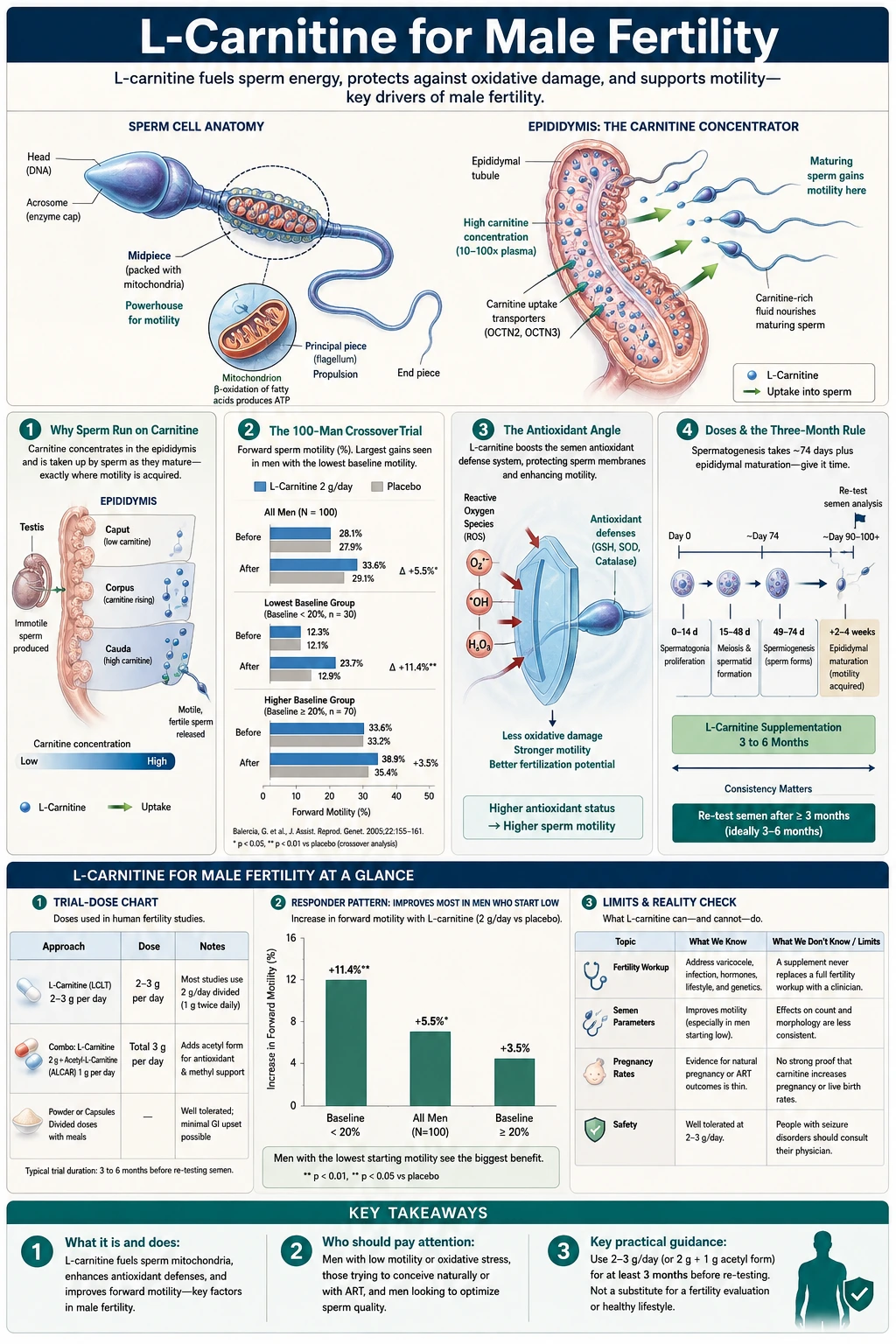
Sperm are the smallest cells in a man's body with the longest commute, and they make the trip on mitochondrial power. The body seems to know it: the epididymis — the duct where sperm learn to swim — concentrates L-carnitine to extraordinary levels, and sperm take it up as they mature. That physiology is why carnitine became one of the most-tested supplements in idiopathic male infertility (low sperm quality with no identifiable cause). A series of Italian randomized placebo-controlled trials found that L-carnitine 2 g per day for two months, or acetyl-L-carnitine alone or combined with L-carnitine for six months, improved sperm motility — most clearly in men who started with the weakest numbers — and a 2025 network meta-analysis of 16 studies comparing L-carnitine, coenzyme Q10 and L-carnitine plus acetyl-L-carnitine ranked L-carnitine the best of the three for progressive motility. The honest limits: a 2020 review found no demonstrable effect on pregnancy rates, not every trial found a motility gain, and the causes a fertility workup finds (varicocele, hormonal disorders, blocked ducts, genetic causes) are not treated by carnitine.
Interactive Visualization Mitochondria & adenosine triphosphate (ATP) — watch your cells make energy A sperm's midpiece is a spiral of mitochondria driving the tail. Watch the same adenosine triphosphate machinery that carnitine feeds — then break it and see what stalls. Launch →
Table of Contents
Why Sperm Run on Carnitine
Sperm leave the testis unable to swim. They acquire motility during a weeks-long finishing school in the epididymis, the tightly coiled duct behind each testicle — and one of the most distinctive things about epididymal fluid is how much free L-carnitine it holds. The epididymis actively concentrates carnitine far above blood levels, and a classic physiology review by Jeulin and Lewin in Human Reproduction Update lays out what happens next: free L-carnitine diffuses into the maturing sperm, and only mature sperm acetylate it, using it to buffer their coenzyme-A pools — the accounting system that keeps mitochondrial energy production running smoothly.
Sperm meet this carnitine in the epididymis, the same duct where they first become motile, but the Jeulin and Lewin review concludes that the start of motility is probably independent of the carnitine system, and that the energy role of acetyl-L-carnitine matters only in situations of "energy crisis." A sperm's engine room is the midpiece — a spiral sheath of mitochondria wrapped around the tail's driveshaft — and carnitine is part of the fuel logistics for exactly that machinery (see the main carnitine page for the transport story). Beyond fuel, carnitine and its acetyl ester also appear to help protect sperm membranes from oxidative damage — relevant because oxidative stress is one of the best-documented contributors to poor sperm quality.
The 100-Man Crossover Trial
The modern trial era began with Lenzi's group in Rome. Their 2003 study in Fertility and Sterility is worth understanding because of its unusually rigorous design: a placebo-controlled, double-blind crossover in 100 infertile men with documented low sperm counts and motility (86 completed). Each man went through two months of washout, two months of L-carnitine 2 g/day or placebo, another washout, then the opposite treatment — so every participant served as his own control, the same design trick as the classic 1990 exercise trial on the main page.
The result: semen quality improved significantly more after the carnitine cycles than the placebo cycles — specifically sperm concentration and total and forward motility. The most interesting detail sits in the subgroups: the increase in forward motility was most pronounced in the men who started worst off (fewer than 5 million, or even 2 million, forward-motile sperm). That pattern — biggest gains where the deficit is biggest — recurs throughout carnitine research, and it matches the biology: a supplement can only help if the system it feeds is actually underperforming.
Adding the Acetyl Form
The follow-up question was whether adding acetyl-L-carnitine — the ester sperm themselves make and use — would do more. In 2004 the same group ran a placebo-controlled, double-blind randomized trial in 60 men with oligoasthenoteratozoospermia (low count, poor motility, and abnormal shapes): L-carnitine 2 g/day plus L-acetyl-carnitine 1 g/day, or placebo, for six months with follow-up after.
All sperm parameters moved in the right direction on the combined treatment, but the clearly significant gains were again in total and forward motility — and once again concentrated in the men with the lowest starting values (under 4–5 million motile sperm per ejaculate). For couples trying to conceive naturally or with intrauterine insemination, forward motility is precisely the parameter that matters most: it measures how many sperm can actually make the journey.
The Antioxidant Angle
A third Italian trial — Balercia and colleagues, 2005, also in Fertility and Sterility — is the one that best connects the dots to why. Sixty men with idiopathic asthenozoospermia (normal counts, poor motility) were randomized four ways for six months: L-carnitine 3 g/day, L-acetylcarnitine 3 g/day, the combination (LC 2 g + LAC 1 g/day), or placebo.
Motility — including the precise swimming-speed measures from computer-assisted sperm analysis — rose in the groups receiving acetyl-L-carnitine, alone or combined, with the combined arm significantly improving straight progressive velocity within three months. Alongside the motility gains, the researchers measured the semen's total oxyradical scavenging capacity — its ability to neutralize hydroxyl and peroxyl free radicals — and found it increased with treatment and correlated with the motility improvement. And once more: the men with the lowest baseline motility and the weakest antioxidant capacity were the most likely to respond.
Put plainly: in these trials carnitine behaved like a targeted repair for an identifiable weakness — underpowered, oxidatively stressed sperm — rather than a universal enhancer. That is also the fairest way to set expectations for using it.
What Reviews & Meta-Analyses Conclude
Individual trials can flatter; the pooled record is where honesty lives. Three modern syntheses frame it well:
- Khaw and colleagues, 2020 (Reproduction & Fertility) systematically reviewed randomized trials of L-carnitine and L-acetylcarnitine in idiopathic male infertility; only eight qualified. Pooled, carnitines improved total motility, progressive motility and sperm shape (morphology) but not sperm count (concentration). On pregnancy rates, the outcome couples actually care about, there was no demonstrable effect in the five trials that measured it, although patient numbers were limited.
- Niu and colleagues, 2025 (Reproductive Sciences) ran a network meta-analysis of 16 studies in unexplained male infertility, ranking carnitine against coenzyme Q10. Both beat placebo on sperm quality. Coenzyme Q10 (CoQ10) produced the largest gains in sperm concentration (SMD 2.98), while L-carnitine ranked best for progressive motility (SMD 4.19; 95% confidence interval (CI) 1.60–10.95) — each nutrient strongest on a different parameter. The authors' caveat is the familiar one: the field still needs larger, higher-quality trials.
- The 2022 Cochrane review of antioxidants for male subfertility (90 studies, 10,303 men; carnitines are one group among many antioxidants) found very low-certainty evidence of more live births (odds ratio 1.43), which disappeared when studies at high risk of bias were removed (odds ratio 1.22, 95% confidence interval 0.85 to 1.75). It calls the evidence inconclusive.
Not every trial was positive. A US trial of the same combination (2 g L-carnitine plus 1 g acetyl-L-carnitine a day for 24 weeks) in 21 men with poor sperm motility found no real change in motility or in the number of moving sperm, though it was small. A US multicenter trial, MOXI (2020), gave 174 men with male-factor infertility a daily antioxidant mix including 1,000 mg L-carnitine, or placebo. Sperm motility did not differ, and live birth was 15% with the mix versus 24% with placebo (not a significant difference). It cannot isolate carnitine, because the mix also held vitamins and minerals.
A sober summary: several trials and pooled analyses found a motility benefit, though not all trials did; the leap from better semen-analysis numbers to more babies has not been shown.
Doses & the Three-Month Rule
What the positive trials actually used:
- L-carnitine alone: 2 g per day in the crossover trial. (The 3 g per day L-carnitine arm of the Balercia trial was not among the groups reported as improved.)
- Acetyl-L-carnitine alone: 3 g per day.
- Combined: L-carnitine 2 g + acetyl-L-carnitine 1 g per day.
- Duration: two months per treatment phase in the crossover trial and six months in the two later trials — with some motility measures already moving by three months.
The duration is not arbitrary. Making a sperm takes roughly two and a half to three months from stem cell to ejaculate — about 74 days of production plus a couple of weeks of epididymal maturation. On that timetable, the full effect of any intervention aimed at sperm quality would not be expected before a minimum of about three months, and the six-month trials allowed for that. The studies measured semen at baseline and re-tested during and after treatment.
Tolerability in the fertility trials was good, with the usual carnitine caveats (stomach upset, fishy odor at higher doses) covered in the main page's Safety section. Whole-food backup matters too: red meat is the richest dietary source (see Beef), and the nutrients that support the body's own carnitine synthesis — lysine, methionine, vitamin C, iron — come from the same whole-food pattern.
Honest Limits & What a Fertility Workup Finds
Three boundaries keep this evidence in its lane:
- The trials are in idiopathic infertility. Carnitine is not a treatment for varicocele, hormonal disorders, blocked ducts, genetic causes, or infections. Those are found by a fertility workup (semen analysis, examination, hormones) and have their own specific treatments. Fertility is a couple's project besides: roughly a third of cases involve female factors, a third male factors, and a third both or neither.
- Better numbers are not yet proven babies. Several trials found motility improvements, though not all; the pregnancy-rate evidence is thin. Some responders will cross a meaningful threshold; others will improve on paper and still need assisted reproduction.
- Responders look like the trial responders. Men with genuinely low motility and high oxidative stress improved most; men with normal parameters have little room to gain — the recurring carnitine theme of "helps where there's a deficit."
Within those boundaries, carnitine is one of several supplements studied in male fertility, alongside coenzyme Q10 and zinc.
Key Research Papers
- Jeulin C, Lewin LM (1996). Role of free L-carnitine and acetyl-L-carnitine in post-gonadal maturation of mammalian spermatozoa. Human Reproduction Update. — PubMed PMID: 9079406
- Lenzi A, Lombardo F, Sgrò P, et al. (2003). Use of carnitine therapy in selected cases of male factor infertility: a double-blind crossover trial. Fertility and Sterility. — PubMed PMID: 12568837
- Lenzi A, Sgrò P, Salacone P, et al. (2004). A placebo-controlled double-blind randomized trial of the use of combined L-carnitine and L-acetyl-carnitine treatment in men with asthenozoospermia. Fertility and Sterility. — PubMed PMID: 15193480
- Balercia G, Regoli F, Armeni T, Koverech A, Mantero F, Boscaro M (2005). Placebo-controlled double-blind randomized trial on the use of L-carnitine, L-acetylcarnitine, or combined L-carnitine and L-acetylcarnitine in men with idiopathic asthenozoospermia. Fertility and Sterility. — PubMed PMID: 16169400
- Khaw SC, Wong ZZ, Anderson R, Martins da Silva S (2020). L-carnitine and L-acetylcarnitine supplementation for idiopathic male infertility. Reproduction & Fertility. — PubMed PMID: 35128424
- Niu C, et al. (2025). Effects of carnitine and coenzyme Q10 on sperm quality and pregnancy rates in men with unexplained infertility: a systematic review and network meta-analysis. Reproductive Sciences. — PubMed PMID: 40813743
- Sigman M, Glass S, Campagnone J, Pryor JL (2006). Carnitine for the treatment of idiopathic asthenospermia: a randomized, double-blind, placebo-controlled trial. Fertility and Sterility. — PubMed PMID: 16600222
- Steiner AZ, Hansen KR, Barnhart KT, et al. (2020). The effect of antioxidants on male factor infertility: the Males, Antioxidants, and Infertility (MOXI) randomized clinical trial. Fertility and Sterility. — PubMed PMID: 32111479
- de Ligny W, Smits RM, Mackenzie-Proctor R, et al. (2022). Antioxidants for male subfertility. Cochrane Database of Systematic Reviews. — PubMed PMID: 35506389
PubMed Topic Searches
External Resources
Connections
- Fat Burning & Ketosis — interactive animation
- All Amino Acids
- Carnitine (Main Page)
- Carnitine Benefits Hub
- Brain, Mood & Depression
- Exercise & Recovery
- Forms & the Trimethylamine N-Oxide Question
- Coenzyme Q10 — the concentration counterpart in the 2025 network meta-analysis
- Zinc
- Arginine
- Mitochondria & Adenosine Triphosphate — interactive animation
- Beef (Dietary Source)
- Vitamin C (Carnitine Synthesis)
- Deficiency