L-Carnitine for Liver Disease
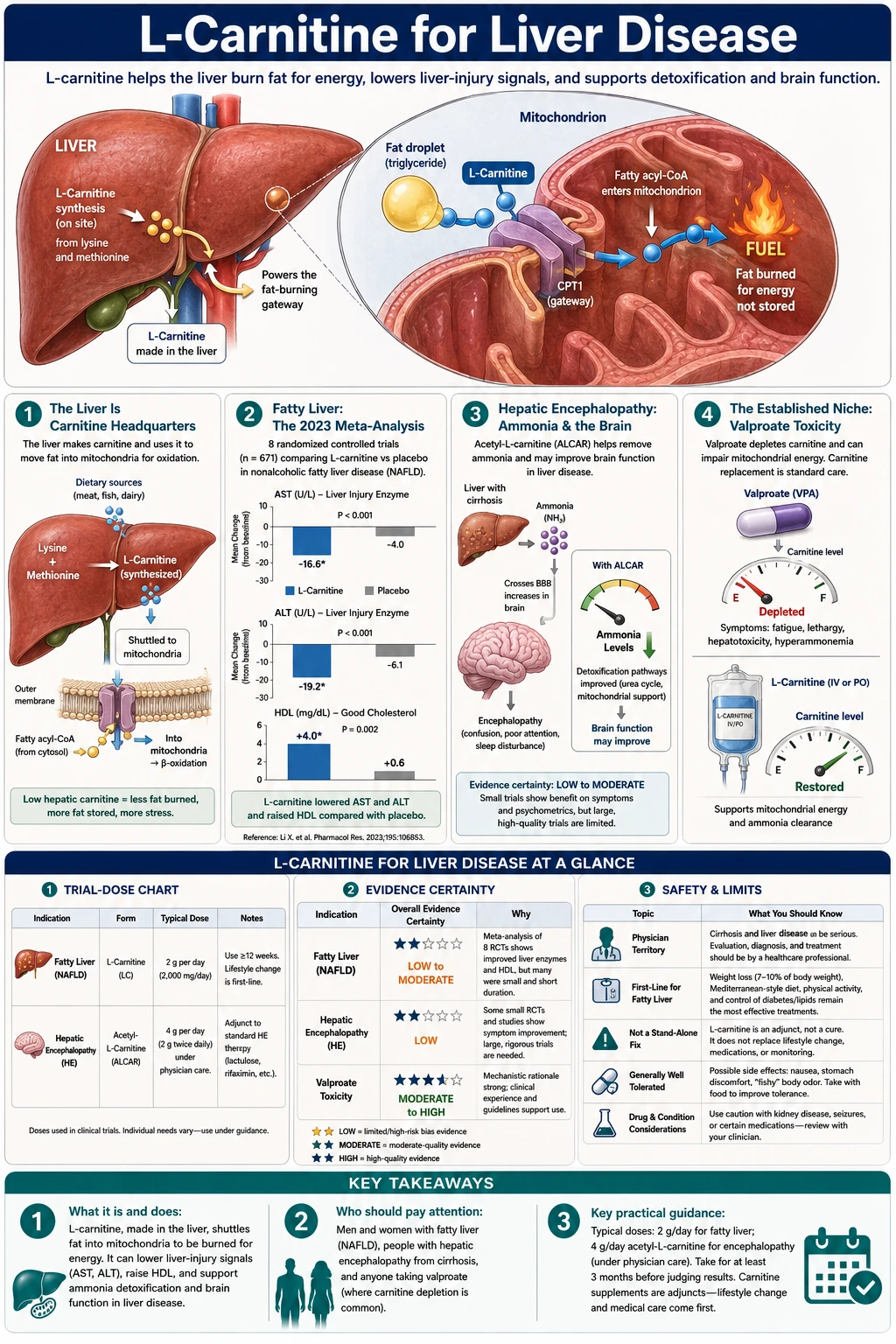
The liver is where carnitine is made, and it is also the organ with the most to gain when fat-burning goes wrong. In non-alcoholic fatty liver disease (NAFLD) — the most common liver condition in the world — fat accumulates faster than the liver's mitochondria can burn it. A 2023 systematic review and meta-analysis of eight randomized trials found that L-carnitine supplementation lowered the liver-injury enzymes aspartate aminotransferase (AST) and alanine aminotransferase (ALT), nudged high-density lipoprotein (HDL) up and triglycerides down, and did it "with no significant adverse effects." Behind that sit a 24-week randomized non-alcoholic steatohepatitis (NASH) trial with biopsy-graded improvement, a body of research on hepatic encephalopathy where acetyl-L-carnitine reliably lowers ammonia (with a Cochrane review honestly unconvinced about outcomes), and one genuinely established medical niche: carnitine for valproate drug toxicity. The boundaries matter too — weight loss and diet remain the foundation of fatty-liver treatment, and in cirrhosis everything from protein handling to drug clearance is altered.
Interactive Visualization Fat Burning & Ketosis — what actually happens Follow a fatty acid to the liver mitochondria's CPT1 gate — the carnitine-dependent doorway this whole page is about — and watch what happens when it opens. Launch →
Table of Contents
- The Liver Is Carnitine Headquarters
- Fatty Liver: The 2023 Meta-Analysis
- Inside One Strong Trial: 24 Weeks in Non-Alcoholic Steatohepatitis
- Hepatic Encephalopathy: Ammonia & the Brain
- Muscle Cramps in Cirrhosis
- Frailty in Cirrhosis
- The Established Niche: Valproate Toxicity
- Beyond the Liver: Triglycerides & Blood Pressure
- Doses & Safety in Liver Disease
- Honest Limits
- Key Research Papers
- Connections
- Featured Videos
The Liver Is Carnitine Headquarters
Two facts make the liver the most natural place to look for a carnitine benefit. First, the liver (with help from the kidneys) is where the body synthesizes its own carnitine from lysine and methionine. Second, the liver is a fat-burning furnace: it constantly takes in fatty acids, and every long-chain fatty acid it burns has to pass through the carnitine-dependent gateway (CPT1) into the mitochondria — the transport job described on the main carnitine page and animated in the Fat Burning & Ketosis visualization.
Fatty liver is what it looks like when that furnace falls behind. In non-alcoholic fatty liver disease — recently renamed metabolic dysfunction-associated steatotic liver disease (MASLD) — fat arrives (from the diet, and from fat tissue made insulin-resistant by metabolic disease) faster than the liver can burn or export it, and droplets of triglyceride pile up inside liver cells. Left alone, a subset of fatty livers progress to inflammation (non-alcoholic steatohepatitis), scarring, and eventually cirrhosis. The supplement logic is straightforward: support the fat-burning gateway, help the liver work down its backlog. Notably, elevated triglycerides are a textbook sign of true carnitine deficiency — the transport system backing up — which is exactly the pattern fatty liver mimics in miniature.
Logic is cheap, though — the page's job is what the trials show.
Fatty Liver: The 2023 Meta-Analysis
The anchor evidence is a 2023 systematic review and meta-analysis in Systematic Reviews (Liu and colleagues), which searched four databases and pooled eight randomized controlled trials of L-carnitine in non-alcoholic fatty liver disease, grading the certainty of every result with the GRADE framework.
Compared with placebo, L-carnitine supplementation produced:
- Lower liver-injury enzymes. Aspartate aminotransferase and alanine aminotransferase — the blood tests that track ongoing liver-cell damage — fell substantially more with carnitine (mean difference −26.38; 95% confidence interval (CI) −45.46 to −7.30), though the authors rate this low-certainty evidence because the underlying trials were small and varied.
- A better lipid profile. High-density lipoprotein ("good") cholesterol rose (mean difference 1.14; 95% confidence interval 0.21–2.07) and triglycerides fell (mean difference −6.92; 95% confidence interval −13.82 to −0.03) — both graded moderate-certainty.
- An age pattern. Subgroup analysis (rated moderately credible by the ICEMAN tool) found the enzyme improvement was concentrated in adults (mean difference −20.3; 95% confidence interval −28.62 to −12.28) and absent in younger participants (mean difference 0.5; 95% confidence interval −0.70 to 1.70).
What −26.38 means. A mean difference of −26.38 says that, on average, these enzyme results fell 26.38 points further on carnitine than on placebo. The abstract gives no unit for this figure and pools the two enzymes into one number, so it cannot be read as a change in any single lab result. Its wide range (−45.46 to −7.30) shows how much the small trials differed.
The authors' conclusion, worth quoting because it is measured: L-carnitine supplementation "may improve liver function and regulate triglyceride metabolism in patients with non-alcoholic fatty liver disease, and with no significant adverse effects." Lifestyle change and weight loss are no longer the only treatments with proof, since two drugs have now shown liver-tissue improvement in phase 3 trials (see Honest Limits). L-carnitine's place in this picture is a well-tolerated adjunct with enzyme-level and lipid-level support — as long as "may" and "low-to-moderate certainty" stay attached to the claim.
Inside One Strong Trial: 24 Weeks in Non-Alcoholic Steatohepatitis
To see what sits underneath a meta-analysis, look at the best single trial. In 2010, Malaguarnera's group in Catania published a randomized controlled trial in the American Journal of Gastroenterology on patients with biopsy-proven non-alcoholic steatohepatitis — the inflamed, progressive form of fatty liver. Everyone got a structured diet; half also took 1 g of L-carnitine after breakfast and 1 g after dinner (2 g/day) for 24 weeks.
The carnitine group improved significantly across essentially every measure taken: aspartate aminotransferase, alanine aminotransferase, and γ-GT liver enzymes; total and low-density lipoprotein (LDL) cholesterol, high-density lipoprotein, and triglycerides; fasting glucose and homeostatic model assessment of insulin resistance (HOMA-IR); the inflammation markers C-reactive protein (CRP) and tumor necrosis factor-α; and — the part that matters most — histological scores on repeat biopsy. That last one is rare and valuable: blood tests can flatter, but tissue under a microscope is the disease itself.
Two honest footnotes. The control arm received diet alone, so the trial shows what carnitine adds on top of lifestyle change — which is also how the liver trials used it. And this is a single-center trial from one prolific Italian research group; the same group produced much of the hepatic-encephalopathy evidence below, a concentration that the Cochrane reviewers flag as a reason for caution until independent teams replicate.
Hepatic Encephalopathy: Ammonia & the Brain
When cirrhosis is advanced, the liver stops clearing ammonia, a by-product of protein digestion. Ammonia that reaches the brain produces hepatic encephalopathy — a spectrum from subtle brain fog and reversed sleep patterns to confusion and coma. It is one of the most feared complications of liver failure, and its standard treatments (lactulose, which flushes ammonia out through the gut, and the antibiotic rifaximin) work on exactly that molecule.
Acetyl-L-carnitine entered this field with a plausible dual rationale — support brain-cell energy metabolism while assisting ammonia disposal — and a series of randomized trials from the Catania group testing it. The largest in severe hepatic encephalopathy (2011): 61 patients randomized to 2 g of acetyl-L-carnitine twice daily or placebo for 90 days. The acetyl-L-carnitine group improved significantly on essentially every cognitive instrument used — everyday memory, paragraph recall, trail-making speed, verbal fluency, visual organization — while blood ammonia fell substantially more than on placebo, and 88% versus 72% showed electroencephalogram (EEG) improvement.
Now the counterweight, because this is where honest reporting earns its keep. A 2019 Cochrane systematic review pooled all five randomized acetyl-L-carnitine-for-hepatic encephalopathy trials (398 participants, all with cirrhosis) and concluded the evidence base has structural problems: every trial came from the same single research team, all were judged at high risk of bias and underpowered, and none reported all-cause mortality, serious adverse events, or hospitalization days. Cochrane's verdict: acetyl-L-carnitine clearly reduces blood ammonia, but whether that translates into better lives or longer survival is unproven, and independent, well-designed trials are needed. Until they exist, acetyl-L-carnitine in hepatic encephalopathy is a physician-supervised adjunct hypothesis, not an alternative to lactulose and rifaximin.
The review's numbers: blood ammonium fell 13.06 mg/dL more on acetyl-L-carnitine than on placebo (95% confidence interval −17.24 to −8.99; 387 participants in 5 trials). Non-serious adverse events occurred in 6.34% versus 2.50% (8 of 126 versus 3 of 120), a difference the reviewers call unclear, and they add that adverse events were poorly reported and "harms may have been underestimated". They rated all of the evidence very low quality.
Muscle Cramps in Cirrhosis
Muscle cramps are a common complaint in cirrhosis, and two studies have looked at L-carnitine for them. In a prospective study of 42 people with cirrhosis, L-carnitine at 900-1200 mg/day for 8 weeks reduced cramps in 88.1%, and they disappeared in 28.6%; no adverse events were reported (Nakanishi and colleagues, 2015). In a 2025 records study of 91 people taking 1000 mg/day for one month, daily cramps completely resolved in 31.9%, weekly cramps in 23.1% and monthly cramps in 14.3% (Sivandzadeh and colleagues). Neither study had a comparison group, and the 2025 authors say studies with control groups are needed.
Frailty in Cirrhosis
A randomized trial of 77 people with cirrhosis (L-carnitine 500 mg three times daily for 8 weeks, or no added treatment) found improved alanine aminotransferase and clotting tests on L-carnitine. There was no significant improvement in the three frailty and performance scores it measured (Motazedian and colleagues, 2024).
The Established Niche: Valproate Toxicity
There is one liver setting where carnitine is not a supplement-aisle question but part of hospital practice. Valproic acid — a widely used seizure and mood medication — is metabolized by the liver, inhibits the body's own carnitine synthesis, and depletes carnitine stores. In a minority of patients, and especially in overdose, this contributes to two serious complications: liver toxicity and hyperammonemic encephalopathy (ammonia-driven confusion even with a working liver).
A clinical toxicology review of this literature (Lheureux & Hantson, 2009) lays out the practice: because the mechanism is carnitine depletion and carnitine appears safe to give, L-carnitine is commonly recommended in severe valproate poisoning — particularly in children, and typically intravenously in hospital — and prophylactic carnitine is advocated for high-risk pediatric patients on long-term valproic acid therapy. The review is candid that definitive proof of improved outcomes is still lacking and calls for controlled multicenter trials; but this niche is why "certain medications (such as valproic acid)" appears on the main page's short list of true carnitine-deficiency causes. Valproate lowers carnitine: in a 2021 records study of 69 patients with childhood-onset epilepsy on valproate (Okumura and colleagues), serum free carnitine was below normal in 32 of 61 patients without supplements and normal in all 8 with them. Blood ammonia did not differ significantly between the two groups.
Beyond the Liver: Triglycerides & Blood Pressure
Because the liver runs the body's fat-export economy, liver-directed effects ripple outward, and the trials above kept detecting them: triglycerides down and high-density lipoprotein up in both the non-alcoholic fatty liver disease meta-analysis and the non-alcoholic steatohepatitis trial. That coheres with basic physiology — elevated triglycerides are a classic sign of genuine carnitine deficiency, so a system running short of transport capacity shows up first in the blood-fat numbers.
Blood pressure is the more marginal story, and worth stating precisely because it circulates in videos with bigger claims attached. A 2019 meta-analysis in the Journal of Human Hypertension (10 trials) found L-carnitine lowered diastolic blood pressure by about 1.2 mmHg overall — reaching about 1.6 mmHg in the subgroup using under 2 g/day, and about 1.2 mmHg in participants with overweight or obesity — with no effect on systolic pressure. A larger 2024 dose-response meta-analysis (22 trials, 1,412 participants) walked it back further: no significant overall effect on either number, with a small diastolic benefit persisting only in obesity. Translation: a real but tiny metabolic fingerprint, not a blood-pressure treatment. For actual cardiovascular evidence, see Heart & Circulation.
Doses & Safety in Liver Disease
What the liver trials actually used:
- Non-alcoholic fatty liver disease / non-alcoholic steatohepatitis: 2 g of L-carnitine per day (1 g after breakfast, 1 g after dinner) for 24 weeks, always alongside diet change — the pattern in the strongest trial, and typical of the meta-analysis's included studies.
- Hepatic encephalopathy: 2 g of acetyl-L-carnitine twice daily (4 g/day) for 90 days — in hospital-supervised trial settings, on top of standard care.
- Valproate toxicity: physician-dosed, often intravenous — an emergency-medicine protocol, not a consumer use.
Tolerability across the liver literature matches the rest of the carnitine record — the 2023 meta-analysis found "no significant adverse effects" — with the usual caveats from the main page's Safety section: stomach upset, fishy odor at higher doses, and the standing cautions for kidney disease, thyroid medication, blood thinners, and seizure disorders. Two liver-specific points sit on top. First, decompensated liver disease (cirrhosis, encephalopathy) changes the picture: everything from protein handling to drug clearance is altered. Second, the trimethylamine N-oxide (TMAO) question applies to long-term high-dose oral carnitine here as everywhere — unsettled, and most relevant to people who also have cardiovascular disease.
Honest Limits
- Certainty is low-to-moderate, not high. The non-alcoholic fatty liver disease enzyme result is graded low-certainty; the lipid results moderate. Eight small trials are a foundation, not a fortress.
- One research group dominates. The strongest non-alcoholic steatohepatitis trial and all five hepatic encephalopathy trials come from the same Catania team — productive and pioneering, but Cochrane is right that independent replication is the missing ingredient.
- Enzymes are not outcomes. Lower alanine aminotransferase and ammonia are encouraging surrogates; proof of prevented cirrhosis, transplants, or deaths does not yet exist for carnitine in any liver condition. Two retrospective, non-randomized studies point toward a benefit without proving one: a 2022 records study from two hospitals (63 treated, 126 matched untreated people with cirrhosis) found better survival with L-carnitine (hazard ratio 0.66; 95% confidence interval 0.43–0.99), and a 2026 study of 113 patients saw encephalopathy hospital stays fall from 183 in the 2 years before treatment to 62 in the 2 years after.
- The foundation of fatty-liver treatment is not a capsule. Weight loss (even 5–10%), dietary change, exercise, and treating diabetes remain interventions with disease-reversing evidence — see the site's non-alcoholic fatty liver disease page. Carnitine's fair billing is a well-tolerated adjunct candidate layered on top, exactly as the trials used it.
- Two drugs now have phase 3 liver-tissue results. In the inflamed, scarring form of fatty liver, the disease resolved on biopsy at 52 weeks, with no worsening of scarring, in 25.9–29.9% of patients on resmetirom versus 9.7% on placebo (966 patients), with more diarrhea and nausea; see the site's FDA page on its 2024 approval. On semaglutide 2.4 mg weekly it resolved at 72 weeks in 62.9% versus 34.3% (800 patients), with more stomach and bowel side effects. None of the carnitine trials described on this page is of this size.
Key Research Papers
- Liu A, Cai Y, Yuan Y, Liu M, Zhang Z, Xu Y, Jiao P (2023). Efficacy and safety of carnitine supplementation on NAFLD: a systematic review and meta-analysis. Systematic Reviews. — PubMed PMID: 37120548
- Malaguarnera M, Gargante MP, Russo C, et al. (2010). L-carnitine supplementation to diet: a new tool in treatment of nonalcoholic steatohepatitis — a randomized and controlled clinical trial. American Journal of Gastroenterology. — PubMed PMID: 20068559
- Malaguarnera M, Vacante M, Motta M, et al. (2011). Acetyl-L-carnitine improves cognitive functions in severe hepatic encephalopathy: a randomized and controlled clinical trial. Metabolic Brain Disease. — PubMed PMID: 21870121
- Martí-Carvajal AJ, Gluud C, Arevalo-Rodriguez I, Martí-Amarista CE (2019). Acetyl-L-carnitine for patients with hepatic encephalopathy. Cochrane Database of Systematic Reviews. — PubMed PMID: 30610762
- Lheureux PE, Hantson P (2009). Carnitine in the treatment of valproic acid-induced toxicity. Clinical Toxicology. — PubMed PMID: 19280426
- Askarpour M, Hadi A, Dehghani Kari Bozorg A, et al. (2019). Effects of L-carnitine supplementation on blood pressure: a systematic review and meta-analysis of randomized controlled trials. Journal of Human Hypertension. — PubMed PMID: 31481697
- Anaraki SR, et al. (2024). The effects of L-carnitine supplementation on blood pressure in adults: a systematic review and dose-response meta-analysis. Clinical Therapeutics. — PubMed PMID: 38101999
- Okumura A, Takagi M, Numoto S, et al. (2021). Effects of l-carnitine supplementation in patients with childhood-onset epilepsy prescribed valproate. Epilepsy & Behavior. — PubMed PMID: 34371461
- Nakanishi H, Kurosaki M, Tsuchiya K, et al. (2015). L-carnitine Reduces Muscle Cramps in Patients With Cirrhosis. Clinical Gastroenterology and Hepatology. — PubMed PMID: 25496816
- Sivandzadeh GR, Shahsavari A, Meftah E, et al. (2025). Effect of L-carnitine supplementation on muscle cramps in liver cirrhosis: results from a retrospective cohort study. BMC Gastroenterology. — PubMed PMID: 40059171
- Motazedian N, Ashari A, Dehdari Ebrahimi N, et al. (2024). Effects of l-carnitine on frailty status in patients with liver cirrhosis: A randomized-controlled trial. Health Science Reports. — PubMed PMID: 39474341
- Miwa T, Hanai T, Nishimura K, et al. (2022). Survival benefit of l-carnitine supplementation in patients with cirrhosis. JPEN Journal of Parenteral and Enteral Nutrition. — PubMed PMID: 35511698
- Tani J, Moriya A, Tomonari T, et al. (2026). Long-term effects of L-carnitine on hyperammonemia and hepatic encephalopathy in patients with liver cirrhosis: a multicenter retrospective study. European Journal of Gastroenterology & Hepatology. — PubMed PMID: 41870958
- Harrison SA, Bedossa P, Guy CD, et al. (2024). A Phase 3, Randomized, Controlled Trial of Resmetirom in NASH with Liver Fibrosis. New England Journal of Medicine. — PubMed PMID: 38324483
- Sanyal AJ, Newsome PN, Kliers I, et al. (2025). Phase 3 Trial of Semaglutide in Metabolic Dysfunction-Associated Steatohepatitis. New England Journal of Medicine. — PubMed PMID: 40305708
PubMed Topic Searches
External Resources
Connections
- All Amino Acids
- Carnitine (Main Page)
- Carnitine Benefits Hub
- Fat Metabolism & Weight
- Heart & Circulation
- Brain, Mood & Depression
- Non-Alcoholic Fatty Liver Disease
- Cirrhosis
- Lactulose — the standard ammonia-lowering therapy in hepatic encephalopathy
- Milk Thistle — the other widely studied liver supplement
- Choline — the nutrient whose deficiency causes fatty liver directly
- Fat Burning & Ketosis — interactive animation
- Beef (Dietary Source)
- Deficiency