Vitamin B9 (Folate) — Benefits Deep Dive
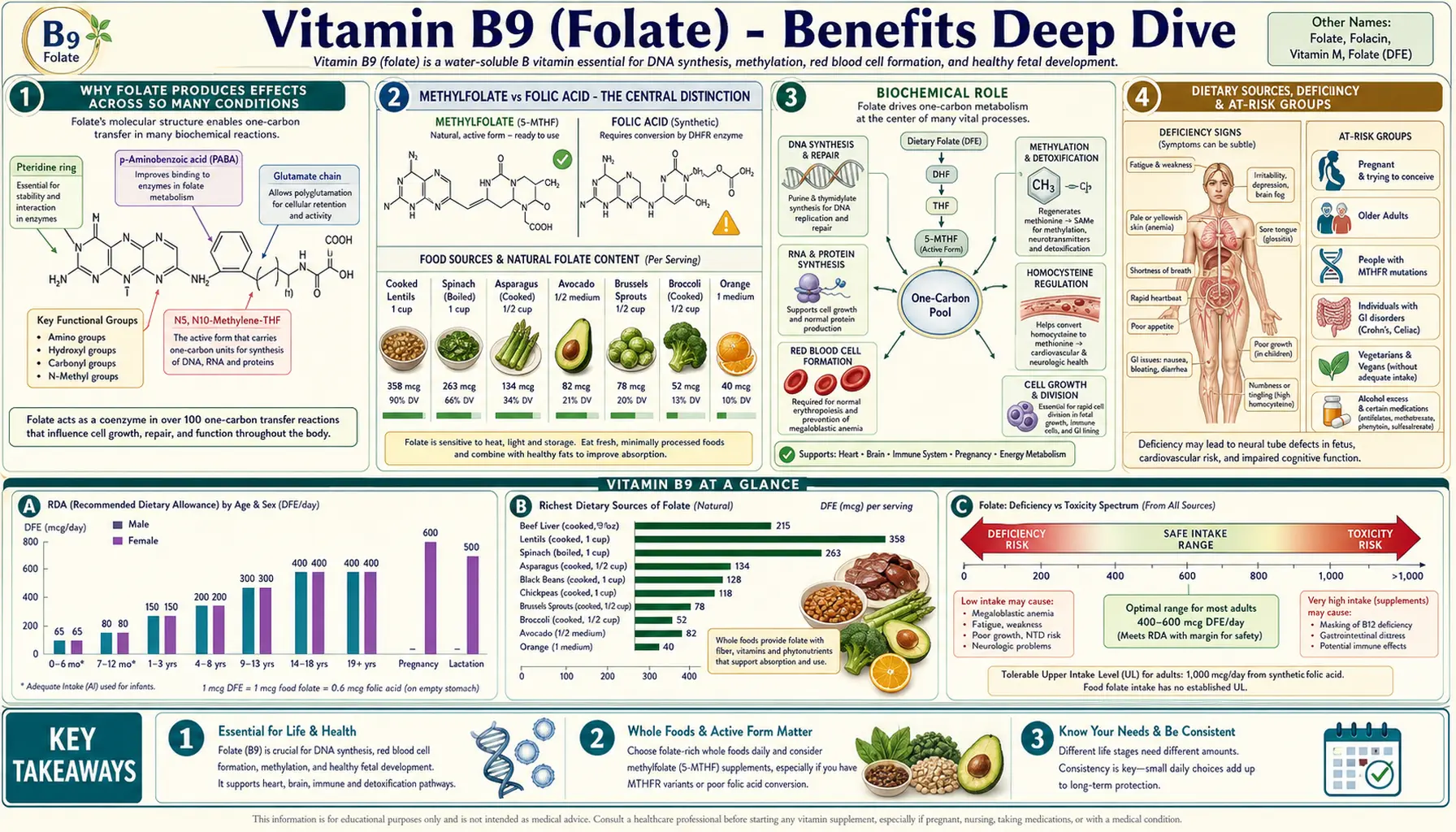
Folate carries one-carbon units that the body uses to make the building blocks of DNA, and in its 5-methyltetrahydrofolate (5-MTHF) form it supplies the methyl group that turns homocysteine back into methionine, which is then made into S-adenosylmethionine (SAM), a universal methyl donor (Selhub 2002). The four deep-dive pages below cover the prevention of neural tube defects, where ACOG's 2017 practice bulletin notes that, in contrast to many other congenital abnormalities, primary prevention is possible with folic acid; the methylation cycle and the MTHFR gene variants; the homocysteine-lowering trials for heart disease and stroke; and the trials of folate forms added to antidepressants.
Deep-Dive Articles
Pregnancy & Neural Tube Defects
The 1991 MRC Vitamin Study, in which folic acid (4 mg a day) had a 72% protective effect against a recurrent neural tube defect; the USPSTF's 2023 grade A recommendation of 0.4 to 0.8 mg of folic acid daily for everyone planning to or able to become pregnant; US grain fortification from 1998, which CDC estimates averts about 1,326 affected births a year; the closure of the neural tube 26 to 28 days after fertilization; and CDC's statement that people with an MTHFR variant can process folic acid, the only type of folate shown to help prevent neural tube defects.
Read the deep dive →Methylation & Homocysteine
How 5-MTHF supplies the methyl group that turns homocysteine back into methionine, the precursor of SAM. Covers the MTHFR C677T and A1298C variants (two copies of C677T range from 1% or less to 20% or more of people, depending on the population; people with one copy of each variant had 50–60% of control enzyme activity), the methyl trap that ties folate to B12, what studies comparing folic acid with 5-MTHF measured, CDC's statement that people with an MTHFR variant can process all types of folate, including folic acid, and unmetabolized folic acid.
Read the deep dive →Cardiovascular & Stroke
The homocysteine hypothesis and the trials that tested it. HOPE-2, NORVIT and SEARCH lowered homocysteine but did not reduce major cardiovascular events; HOPE-2 recorded fewer strokes. In the 20,702-person China Stroke Primary Prevention Trial (CSPPT), enalapril plus folic acid lowered first stroke compared with enalapril alone (2.7% vs 3.4%). A 2017 Cochrane review of 15 trials found no effect on heart attack or death and a small reduction in stroke.
Read the deep dive →Depression & Mental Health
Trials of folate forms added to antidepressants. In a 2000 trial, 500 mcg of folic acid added to fluoxetine gave greater improvement overall, confined to women. In two 2012 trials of L-methylfolate added to an SSRI in people who had not responded to it, the first found no difference from placebo and the second found 15 mg a day more effective than placebo. A 2009 review notes that folate is needed in the brain to make norepinephrine, serotonin and dopamine.
Read the deep dive →Table of Contents
- Deep-Dive Articles
- Why Folate Is Studied Across So Many Conditions
- Methylfolate and Folic Acid: What the Studies Compared
- Research Papers: Pregnancy & Neural Tube Defects
- Research Papers: Methylation, MTHFR & Homocysteine
- Research Papers: Cardiovascular & Stroke
- Research Papers: Depression & Mental Health
- Research Papers: Cross-Cutting (Forms, Safety, Mechanism)
- External Authoritative Resources
- Connections
- Featured Videos
Why Folate Is Studied Across So Many Conditions
Folate's coenzymes take part in one-carbon metabolism, a set of reactions that feeds several different processes at once (Selhub 2002). That is why research on folate reaches into four areas that look unrelated:
- DNA building blocks — a carbon unit transferred to tetrahydrofolate forms methylene-THF, which is used to make thymidine for DNA or is oxidized to formyl-THF, used to make purines (Selhub 2002). In the MRC Vitamin Study, folic acid taken around conception lowered the risk of a recurrent neural tube defect (MRC 1991); the trials are covered in the neural tube defect prevention chapter.
- The methylation cycle — methyl-THF (5-MTHF) methylates homocysteine to form methionine in a vitamin B12-dependent reaction, and much of that methionine becomes S-adenosylmethionine (SAM), a universal donor of methyl groups to DNA, RNA, hormones, neurotransmitters, membrane lipids and proteins (Selhub 2002). The methylation chapter covers the MTHFR gene variants; CDC states that more people in the United States have one or two copies of the C677T variant than don't have it, and that people with a variant can process all types of folate, including folic acid.
- Homocysteine — slightly elevated plasma homocysteine has been shown to be a risk factor for cardiovascular disease, stroke and thrombosis, and has been associated with loss of cognitive function and Alzheimer's disease (Selhub 2002). Randomized trials that lowered homocysteine with folic acid and other B vitamins did not reduce major cardiovascular events (Lonn 2006; Bønaa 2006; SEARCH 2010); the cardiovascular & stroke chapter walks through them.
- Neurotransmitters — folate is needed in the brain for the synthesis of norepinephrine, serotonin and dopamine (Fava & Mischoulon 2009). The depression chapter covers the trials of folic acid and L-methylfolate added to antidepressants (Coppen 2000; Papakostas 2012).
The evidence in these four areas comes from different kinds of studies with different results, and each deep-dive page reports them separately.
Methylfolate and Folic Acid: What the Studies Compared
Folate is the vitamin's family of forms; folic acid is one synthetic member of it. The sources on this page describe the two main supplement forms this way:
- Folic acid is a synthetic form of the vitamin, found only in fortified foods, supplements and pharmaceuticals. It lacks coenzyme activity and must be reduced to tetrahydrofolate inside the cell (Pietrzik 2010). In six human liver samples, the reduction of folic acid by dihydrofolate reductase (DHFR) averaged less than 2% of that in rat liver, with almost a 5-fold variation between samples; the authors suggest that the benefit of high folic acid doses will be limited by saturation of DHFR (Bailey & Ayling 2009). In acute studies, unaltered folic acid appeared in serum above a threshold of 266 mcg per meal with fortified cereal and bread, and above 200 mcg when given in saline, milk or white bread (Kelly 1997).
- 5-MTHF (L-5-methyltetrahydrofolate, also called L-methylfolate) is the predominant form of folate in food and the only form normally found in the circulation. It is sold as a crystalline calcium salt stable enough for supplements (Pietrzik 2010). A glucosamine salt is also sold; the comparison found for it is a single-dose study in rats (Miraglia 2016). Unmetabolized folic acid appeared regularly in plasma after a dose of folic acid but rarely after 5-MTHF (Prinz-Langenohl 2009).
- MTHFR variants — the C677T variant was found on about 38% of unselected chromosomes; it reduces enzyme activity and makes the enzyme heat-sensitive, and people with two copies had higher plasma homocysteine (Frosst 1995). Two copies (TT) range from 1% or less among Black populations in Africa and the US to 20% or more among Italians and US Hispanics (Botto & Yang 2000). For the A1298C variant, homozygotes had about 60% of control enzyme activity, and people with one copy of each variant (about 15% of the Canadian sample) had 50–60% (Weisberg 1998). On folic acid, CDC states that people with an MTHFR variant can process all types of folate, including folic acid, that TT blood folate is about 16% lower than CC on the same intake, and that folic acid intake matters more than genotype for blood folate. In a trial of 932 genotyped women, TT women had lower folate at every dose, with no significant interaction between genotype and folic acid dose (Crider 2011).
- Unmetabolized folic acid (UMFA) — in NHANES 2007–2008, UMFA was detectable in more than 95% of US serum samples from both supplement users and non-users, and above 1 nmol/L in 33.2% (Pfeiffer 2015). Among 105 postmenopausal women, natural killer cell cytotoxicity was about 23% lower in those with detectable folic acid in plasma, an observational finding the authors say needs further study (Troen 2006). Kelly and colleagues describe masking the diagnosis of B12 deficiency in pernicious anemia as chief among the risks of folic acid in the circulation (Kelly 1997).
- What the comparisons measured — a review of the two forms reports comparable physiological activity, bioavailability and absorption at equimolar doses, with 5-MTHF at least as effective as folic acid at improving folate status (Pietrzik 2010). Over 24 weeks, red blood cell folate rose more with 416 mcg of 5-MTHF than with 400 mcg of folic acid (Lamers 2006), and a single dose of 5-MTHF raised plasma folate more than folic acid in both TT and CC women (Prinz-Langenohl 2009). These studies measured blood folate, not birth defects or other clinical outcomes. CDC states that folic acid is the only type of folate shown to help prevent neural tube defects, and the USPSTF (2023, grade A) recommends that all persons planning to or who could become pregnant take a daily supplement containing 0.4 to 0.8 mg of folic acid (Barry 2023).
Each deep-dive page reports these studies in more detail.
Research Papers: Pregnancy & Neural Tube Defects
- MRC Vitamin Study Research Group (1991). Prevention of neural tube defects: results of the Medical Research Council Vitamin Study. MRC Vitamin Study Research Group. Lancet 338:131-7. — PubMed PMID: 1677062
- Czeizel AE, Dudás I (1992). Prevention of the first occurrence of neural-tube defects by periconceptional vitamin supplementation. N Engl J Med 327:1832-5. — PubMed PMID: 1307234
- Berry RJ et al. (1999). Prevention of neural-tube defects with folic acid in China. China-U.S. Collaborative Project for Neural Tube Defect Prevention. N Engl J Med 341:1485-90. — PubMed PMID: 10559448
- Honein MA et al. (2001). Impact of folic acid fortification of the US food supply on the occurrence of neural tube defects. JAMA 285:2981-6. — PubMed PMID: 11410096
- Williams J et al. (2015). Updated estimates of neural tube defects prevented by mandatory folic Acid fortification - United States, 1995-2011. MMWR Morb Mortal Wkly Rep 64:1-5. — PubMed PMID: 25590678
- Botto LD, Yang Q (2000). 5,10-Methylenetetrahydrofolate reductase gene variants and congenital anomalies: a HuGE review. Am J Epidemiol 151:862-77. — PubMed PMID: 10791559
- Surén P et al. (2013). Association between maternal use of folic acid supplements and risk of autism spectrum disorders in children. JAMA 309:570-7. — PubMed PMID: 23403681
- Lamers Y et al. (2006). Red blood cell folate concentrations increase more after supplementation with [6S]-5-methyltetrahydrofolate than with folic acid in women of childbearing age. Am J Clin Nutr 84:156-61. — PubMed PMID: 16825690
- Pietrzik K et al. (2010). Folic acid and L-5-methyltetrahydrofolate: comparison of clinical pharmacokinetics and pharmacodynamics. Clin Pharmacokinet 49:535-48. — PubMed PMID: 20608755
- American College of Obstetricians and Gynecologists (2017). Practice Bulletin No. 187 Summary: Neural Tube Defects. Obstet Gynecol 130:1394-1396. — PubMed PMID: 29189691
- US Preventive Services Task Force; Barry MJ et al. (2023). Folic Acid Supplementation to Prevent Neural Tube Defects: US Preventive Services Task Force Reaffirmation Recommendation Statement. JAMA 330:454-459. — PubMed PMID: 37526713
PubMed Topic Searches
Research Papers: Methylation, MTHFR & Homocysteine
- Frosst P et al. (1995). A candidate genetic risk factor for vascular disease: a common mutation in methylenetetrahydrofolate reductase. Nat Genet 10:111-3. — PubMed PMID: 7647779
- Shane B, Stokstad EL (1985). Vitamin B12-folate interrelationships. Annu Rev Nutr 5:115-41. — PubMed PMID: 3927946
- Pfeiffer CM et al. (2015). Unmetabolized folic acid is detected in nearly all serum samples from US children, adolescents, and adults. J Nutr 145:520-31. — PubMed PMID: 25733468
- Troen AM et al. (2006). Unmetabolized folic acid in plasma is associated with reduced natural killer cell cytotoxicity among postmenopausal women. J Nutr 136:189-94. — PubMed PMID: 16365081
- Prinz-Langenohl R et al. (2009). [6S]-5-methyltetrahydrofolate increases plasma folate more effectively than folic acid in women with the homozygous or wild-type 677C-->T polymorphism of methylenetetrahydrofolate reductase. Br J Pharmacol 158:2014-21. — PubMed PMID: 19917061
- Miraglia N et al. (2016). Enhanced oral bioavailability of a novel folate salt: comparison with folic acid and a calcium folate salt in a pharmacokinetic study in rats. Minerva Ginecol 68:99-105. — PubMed PMID: 27008238
- Smith AD et al. (2010). Homocysteine-lowering by B vitamins slows the rate of accelerated brain atrophy in mild cognitive impairment: a randomized controlled trial. PLoS One 5:e12244. — PubMed PMID: 20838622
- Weisberg I et al. (1998). A second genetic polymorphism in methylenetetrahydrofolate reductase (MTHFR) associated with decreased enzyme activity. Mol Genet Metab 64:169-72. — PubMed PMID: 9719624
- Selhub J (2002). Folate, vitamin B12 and vitamin B6 and one carbon metabolism. J Nutr Health Aging 6:39-42. — PubMed PMID: 11813080
- Bailey SW, Ayling JE (2009). The extremely slow and variable activity of dihydrofolate reductase in human liver and its implications for high folic acid intake. Proc Natl Acad Sci U S A 106:15424-9. — PubMed PMID: 19706381
- Kelly P et al. (1997). Unmetabolized folic acid in serum: acute studies in subjects consuming fortified food and supplements. Am J Clin Nutr 65:1790-5. — PubMed PMID: 9174474
- Crider KS et al. (2011). MTHFR 677C->T genotype is associated with folate and homocysteine concentrations in a large, population-based, double-blind trial of folic acid supplementation. Am J Clin Nutr 93:1365-72. — PubMed PMID: 21508090
PubMed Topic Searches
Research Papers: Cardiovascular & Stroke
- Lonn E et al. (2006). Homocysteine lowering with folic acid and B vitamins in vascular disease. N Engl J Med 354:1567-77. — PubMed PMID: 16531613
- Bønaa KH et al. (2006). Homocysteine lowering and cardiovascular events after acute myocardial infarction. N Engl J Med 354:1578-88. — PubMed PMID: 16531614
- SEARCH Collaborative Group; Armitage JM et al. (2010). Effects of homocysteine-lowering with folic acid plus vitamin B12 vs placebo on mortality and major morbidity in myocardial infarction survivors: a randomized trial. JAMA 303:2486-94. — PubMed PMID: 20571015
- Huo Y et al. (2015). Efficacy of folic acid therapy in primary prevention of stroke among adults with hypertension in China: the CSPPT randomized clinical trial. JAMA 313:1325-35. — PubMed PMID: 25771069
- Wang X et al. (2007). Efficacy of folic acid supplementation in stroke prevention: a meta-analysis. Lancet 369:1876-1882. — PubMed PMID: 17544768
- Toole JF et al. (2004). Lowering homocysteine in patients with ischemic stroke to prevent recurrent stroke, myocardial infarction, and death: the Vitamin Intervention for Stroke Prevention (VISP) randomized controlled trial. JAMA 291:565-75. — PubMed PMID: 14762035
- Antoniades C et al. (2009). MTHFR 677 C>T Polymorphism reveals functional importance for 5-methyltetrahydrofolate, not homocysteine, in regulation of vascular redox state and endothelial function in human atherosclerosis. Circulation 119:2507-15. — PubMed PMID: 19398669
- Martí-Carvajal AJ et al. (2017). Homocysteine-lowering interventions for preventing cardiovascular events. Cochrane Database Syst Rev 8:CD006612. — PubMed PMID: 28816346
PubMed Topic Searches
Research Papers: Depression & Mental Health
- Papakostas GI et al. (2012). L-methylfolate as adjunctive therapy for SSRI-resistant major depression: results of two randomized, double-blind, parallel-sequential trials. Am J Psychiatry 169:1267-74. — PubMed PMID: 23212058
- Coppen A, Bailey J (2000). Enhancement of the antidepressant action of fluoxetine by folic acid: a randomised, placebo controlled trial. J Affect Disord 60:121-30. — PubMed PMID: 10967371
- Fava M, Mischoulon D (2009). Folate in depression: efficacy, safety, differences in formulations, and clinical issues. J Clin Psychiatry 70 Suppl 5:12-7. — PubMed PMID: 19909688
PubMed Topic Searches
Research Papers: Cross-Cutting (Forms, Safety, Mechanism)
- Shea B et al. (2013). Folic acid and folinic acid for reducing side effects in patients receiving methotrexate for rheumatoid arthritis. Cochrane Database Syst Rev 2013:CD000951. — PubMed PMID: 23728635
- Ramaekers VT et al. (2005). Autoantibodies to folate receptors in the cerebral folate deficiency syndrome. N Engl J Med 352:1985-91. — PubMed PMID: 15888699
PubMed Topic Searches
External Authoritative Resources
- Linus Pauling Institute — Folate Micronutrient Information Center — a university institute's summary of folate biology and clinical research
- NIH Office of Dietary Supplements — Folate Fact Sheet for Health Professionals
- CDC — About Folic Acid
- CDC — MTHFR Gene Variant and Folic Acid Facts
- ACOG — Healthy Eating During Pregnancy
- PubMed — All research on folate / folic acid / methylfolate
Connections
- All Vitamins
- Vitamin B9 (Main Page)
- B9 for Pregnancy & Neural Tube
- B9 for Methylation & Homocysteine
- B9 for Cardiovascular & Stroke
- B9 for Depression & Mental Health
- Folate and Mental Health
- Folate and Pregnancy
- Vitamin B12
- Vitamin B6
- Vitamin B2 (Riboflavin)
- Choline
- Methionine
- Homocysteine
- Anemia
- Depression
- Alzheimer's Disease
- Deficiency
- Toxicity
- History
- Sources