Vitamin A for Vision & Eye Health
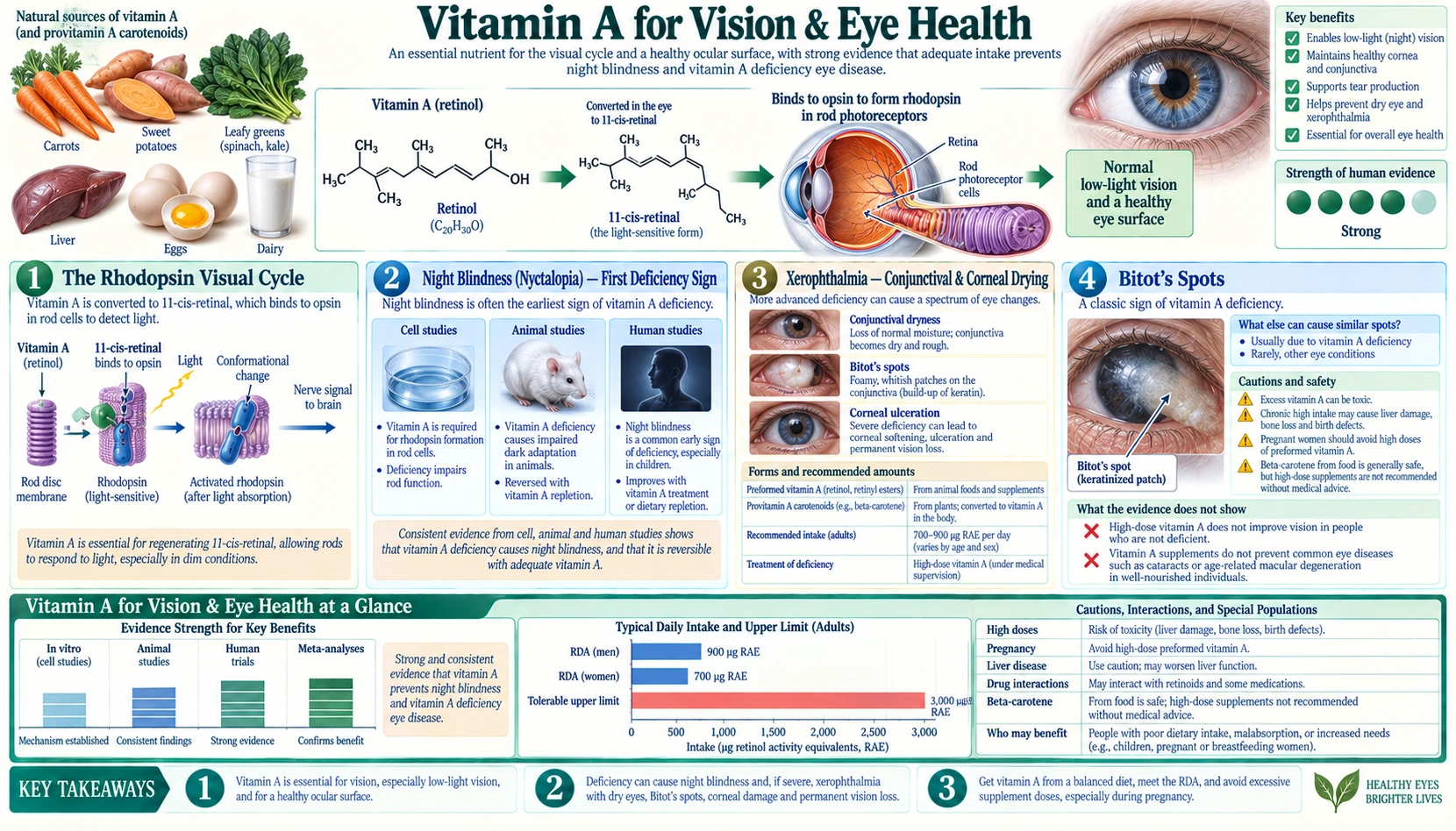
Vitamin A is the single nutrient most directly required for vision, because the retinal isomer 11-cis-retinal is the chromophore covalently bound to opsin protein in every rod and cone cell of the human eye. Photon absorption isomerizes 11-cis-retinal to all-trans-retinal, initiating the visual transduction cascade. Without continuous Vitamin A supply, the rhodopsin cycle fails — first as night blindness (nyctalopia), then as conjunctival drying (xerophthalmia), then as corneal melting (keratomalacia) and irreversible blindness. The WHO estimates Vitamin A deficiency remains the single leading preventable cause of childhood blindness worldwide, blinding 250,000 to 500,000 children annually with half of them dying within 12 months of losing their sight. The same Vitamin A also contributes to age-related macular degeneration prevention through the AREDS / AREDS2 trial findings.
Table of Contents
- The Rhodopsin Visual Cycle
- Night Blindness (Nyctalopia) — First Deficiency Sign
- Xerophthalmia — Conjunctival & Corneal Drying
- Bitot's Spots
- Keratomalacia — Severe Corneal Damage
- WHO Global Childhood Blindness Burden
- Supplementation Programs in Developing Countries
- Age-Related Macular Degeneration and the AREDS Trials
- Other Eye Conditions Linked to Vitamin A Status
- What the Research Describes for Vision
- Cautions
- Key Research Papers
- Connections
- Featured Videos
The Rhodopsin Visual Cycle
Vision begins with a photochemical reaction in the retinal photoreceptor cells. Every rod and cone contains a visual pigment composed of an opsin protein with a Vitamin A-derived chromophore covalently bonded to it through a Schiff base linkage with a specific lysine residue. In rod cells, that visual pigment is called rhodopsin, and the chromophore is 11-cis-retinal — the cis-isomer of the aldehyde form of Vitamin A.
When a single photon strikes rhodopsin, the bound 11-cis-retinal isomerizes to all-trans-retinal in roughly 200 femtoseconds — one of the fastest known biological reactions. This shape change deforms the opsin protein, which activates the G-protein transducin, which activates a cGMP phosphodiesterase, which collapses the cytoplasmic cGMP concentration, which closes cyclic-nucleotide-gated sodium channels, which hyperpolarizes the rod cell membrane, which alters neurotransmitter release at the synapse to bipolar cells, which signal the brain. The entire amplification cascade is triggered by a single Vitamin A isomerization event.
The visual cycle then must regenerate the 11-cis-retinal. All-trans-retinal dissociates from opsin, is reduced to all-trans-retinol in rod cells, transported to the retinal pigment epithelium (RPE), esterified, and converted back to 11-cis-retinol by an isomerohydrolase enzyme called RPE65. The 11-cis-retinol is then re-oxidized to 11-cis-retinal and shuttled back to the rod outer segment to bind a fresh opsin molecule. The entire visual cycle takes seconds for cones and minutes for rods, which is why returning from bright sunlight to a dim room produces gradual dark adaptation as the rhodopsin pool is rebuilt.
If serum Vitamin A is insufficient to keep this cycle replenished, the first system to fail is rod-mediated low-light vision — the rods need more retinal turnover than the brighter cones, and they fail first under nutritional shortage.
Night Blindness (Nyctalopia) — First Deficiency Sign
Night blindness, or nyctalopia, is the earliest functional sign of Vitamin A deficiency. The patient cannot see well in dim light — dusk, indoor low lighting, the inside of a movie theater after coming from a bright lobby. They bump into furniture at night, cannot find their way to a dark bedroom, lose the ability to drive after sunset, and in deficient communities are sometimes recognized by their gait pattern at dusk — arms outstretched, feet shuffling.
The defect is purely functional and fully reversible if Vitamin A is replenished before any structural eye damage occurs. Within days to weeks of starting adequate Vitamin A, the rhodopsin pool rebuilds, rod sensitivity returns, and night vision is restored. This is the most reliable acute marker of subclinical Vitamin A deficiency — even before serum retinol falls into the textbook deficiency range, the rod cells (which have the highest Vitamin A turnover of any tissue) start signaling that supply is inadequate.
Maternal night blindness in pregnancy is a recognized public health marker of Vitamin A deficiency. The seminal NNIPS-2 (Nepal Nutrition Intervention Project, Sarlahi) trial led by Keith West at Johns Hopkins found that weekly vitamin A or beta-carotene at recommended dietary amounts lowered pregnancy-related deaths by 40% and 49%: 704 deaths per 100,000 pregnancies on placebo, against 426 on vitamin A and 361 on beta-carotene (BMJ 1999). The evidence on maternal deaths is mixed, however. The much larger JiVitA-1 trial in rural Bangladesh (JAMA 2011), which gave pregnant women weekly vitamin A or beta-carotene from the first trimester to 12 weeks after birth, did not lower deaths of mothers, stillbirths or infant deaths (relative risk of the mother's death 1.15 with vitamin A and 1.21 with beta-carotene, neither significant). It reduced night blindness in pregnancy only partly: 7.1% with vitamin A against 9.2% on placebo. Asking pregnant women in a community whether they can see at dusk has become a low-cost field screen for population-level deficiency.
For patients in the developed world, isolated nyctalopia is uncommon and typically indicates either fat malabsorption (celiac disease, Crohn's, cystic fibrosis, pancreatic insufficiency, bariatric surgery), zinc deficiency (zinc is required for retinol-binding protein synthesis and for the alcohol dehydrogenase that converts retinol to retinal), or unusual dietary patterns. The usual tests for new night-driving difficulty in such adults are serum retinol, serum zinc, and a comprehensive metabolic panel, which look for malabsorption.
Xerophthalmia — Conjunctival & Corneal Drying
Continued Vitamin A deficiency beyond the night-blindness stage damages the epithelial cells that produce the tear film and that line the conjunctiva and cornea. The condition is called xerophthalmia (literally "dry eye" in Greek) and is graded by the WHO classification system from X1A through XS:
- XN — night blindness (functional, no structural damage)
- X1A — conjunctival xerosis (dryness, dullness, thickening of conjunctiva)
- X1B — Bitot's spots (foamy whitish patches on conjunctiva)
- X2 — corneal xerosis (the cornea itself becomes dry, dull, and loses its normal reflective surface)
- X3A — corneal ulceration with keratomalacia involving less than one-third of the cornea
- X3B — corneal ulceration with keratomalacia involving more than one-third of the cornea (typically permanent blindness)
- XS — corneal scarring (the healed-over end-stage of severe deficiency)
- XF — xerophthalmic fundus (retinal lesions visible on ophthalmoscopy)
The transition from X1A (reversible) to X2 and beyond (often permanent) can occur within weeks in a severely deficient child with an intercurrent infection (especially measles or severe diarrhea). The infection both consumes the limited Vitamin A stores and damages the gut epithelium that absorbs new dietary Vitamin A. This is why the WHO recommends emergency high-dose Vitamin A supplementation for measles cases in any child living in an endemic area — the intervention is too cheap and too effective to skip.
Bitot's Spots
Bitot's spots are foamy, whitish, triangular plaques of keratinized epithelial cells that appear on the bulbar conjunctiva — typically temporally (toward the outer corner of the eye), sometimes nasally as well. They are pathognomonic for Vitamin A deficiency in young children and are the easiest clinical sign to recognize in field screening: a patient with Bitot's spots almost certainly has subclinical or clinical Vitamin A deficiency.
The plaques form because the conjunctival epithelium, deprived of the retinoic acid signal that normally maintains its mucus-producing goblet cell phenotype, undergoes squamous metaplasia — the cells switch from a mucus-secreting columnar morphology to a dry, keratinized squamous morphology. The "foam" appearance is from gas trapped between keratinized cell sheets, often colonized by Corynebacterium xerosis.
Bitot's spots in young children almost always resolve completely with a single 200,000 international units (IU) oral Vitamin A dose (or two doses on consecutive days). Persistent Bitot's spots in older children or adults can be more difficult to clear because of chronic remodeling of the conjunctival surface, and without correction of the underlying deficiency the eye can still progress to corneal damage.
Keratomalacia — Severe Corneal Damage
Keratomalacia is the catastrophic end-stage of Vitamin A deficiency: the cornea itself, normally a tough crystal-clear collagenous structure, softens and melts away over hours to days. The condition is most common in severely malnourished children with a precipitating infection (measles, severe diarrhea, kwashiorkor). Without emergency Vitamin A administration, the affected eye is typically destroyed: the cornea perforates, the intraocular contents prolapse, and the eye ends up shrunken and blind.
Even a single intramuscular or oral 200,000 international units dose of Vitamin A given at the keratomalacia stage can sometimes arrest the corneal melting process and preserve some vision — the intervention is so cheap (pennies per dose) and so disproportionately effective that the WHO guideline is to give high-dose Vitamin A immediately to any child presenting with measles or severe acute malnutrition in a deficiency-endemic region, regardless of whether clinical eye findings are yet present.
In the developed world, keratomalacia is extraordinarily rare and is almost always associated with one of three settings: severe fat malabsorption (advanced cystic fibrosis, short bowel syndrome, untreated Crohn's disease, severe celiac), chronic alcoholism with cirrhosis (failed hepatic storage and mobilization of Vitamin A), or rarely a deeply restricted diet in a child with autism spectrum disorder or extreme avoidance/restrictive food intake disorder (ARFID). The latter setting has produced occasional case-report keratomalacia in industrialized countries.
WHO Global Childhood Blindness Burden
According to the most recent WHO estimates, Vitamin A deficiency remains the leading preventable cause of childhood blindness worldwide. The numbers are sobering:
- An estimated 190 million preschool-age children worldwide have subclinical Vitamin A deficiency (serum retinol below 0.70 µmol/L)
- An estimated 5.2 million children have clinical xerophthalmia
- An estimated 250,000 to 500,000 children become irreversibly blind every year from Vitamin A deficiency
- Approximately half of these newly blinded children die within 12 months of losing their sight — not because blindness itself is fatal, but because Vitamin A deficiency severely depresses immune function and the same children who progress to keratomalacia are also at sharply increased risk of dying from measles, diarrhea, or pneumonia
- Deficiency is concentrated in sub-Saharan Africa and South Asia, with the highest burden in Ethiopia, Sudan, India, Bangladesh, and Indonesia
The classic large-scale documentation of this burden was assembled by Alfred Sommer at Johns Hopkins through field epidemiology in Indonesia in the 1970s and 1980s. Sommer's work shifted global health policy: he showed that Vitamin A supplementation did not merely prevent eye damage but also reduced child deaths. In his 1986 community trial in 450 villages of northern Sumatra, deaths among children aged 12–71 months were 49% higher in the control villages than in the villages given capsules (7.3 against 4.9 per 1,000), and the authors concluded that supplements given to vitamin A deficient populations "may decrease mortality by as much as 34%". The 2022 Cochrane review, pooling 19 trials with 1,202,382 children, puts the reduction in deaths from all causes at 12% (risk ratio 0.88) — still one of the largest single-intervention mortality reductions documented for a nutritional supplement.
For context, see also our Macular Degeneration page for the age-related side of vision loss in adults, which has a different but related set of nutritional interventions.
Supplementation Programs in Developing Countries
The WHO/UNICEF Vitamin A Supplementation (VAS) program is one of the most successful public health interventions in history. It delivers two high-dose oral Vitamin A capsules per year to children aged 6-59 months in approximately 80 countries, with coverage typically integrated with measles vaccination or polio immunization campaigns. The standard dose schedule is:
- Infants 6-11 months: 100,000 international units (30 mg RAE) every 4-6 months
- Children 12-59 months: 200,000 international units (60 mg RAE) every 4-6 months
- Lactating mothers (immediately postpartum): 200,000 international units once
- Measles treatment: 200,000 international units on day 1 and day 2 (the WHO "double dose")
- Severe acute malnutrition (SAM): 50,000-200,000 international units depending on age, given as part of admission protocol
The two-doses-per-year approach exploits the fact that Vitamin A is fat-soluble and stored in the liver in the form of retinyl esters, giving slow release over months. A single megadose can maintain adequate tissue levels for 4-6 months in a previously deficient child.
Effectiveness has been overwhelming: the VAS program is estimated to prevent 600,000 deaths annually and has been one of the cheapest mortality-reduction interventions in global health (approximately $1 per child per year of protection). Coverage has been declining slightly in the last decade due to integration challenges with vaccination schedules, and ongoing research is exploring whether biofortification (orange-flesh sweet potato, Golden Rice, beta-carotene-enriched maize) can provide a sustainable food-system alternative to repeated supplementation campaigns.
The 2022 Cochrane review (47 studies with about 1.2 million children aged six months to five years, in 19 countries) gives the trial numbers behind the program. Vitamin A capsules cut deaths from all causes by 12% (risk ratio 0.88) and deaths from diarrhoea by 12% (high-certainty evidence). They cut new Bitot's spots by 58% (risk ratio 0.42) and night blindness by 68% (risk ratio 0.32). The review found no clear effect on deaths from measles or from breathing (respiratory) disease. The capsules about doubled the chance of vomiting in the first 48 hours after a dose (risk ratio 1.97).
Age-Related Macular Degeneration and the AREDS Trials
For adults in the developed world, the most relevant Vitamin A eye condition is not deficiency but rather age-related macular degeneration (AMD), the progressive loss of central vision from damage to the retinal pigment epithelium and photoreceptors in the macula. Age-related macular degeneration is the leading cause of severe vision loss in adults over 65 in the United States and Europe.
The pivotal evidence base comes from the AREDS (Age-Related Eye Disease Study) and AREDS2 trials sponsored by the U.S. National Eye Institute:
AREDS (original trial, AREDS Research Group 2001, Archives of Ophthalmology)
3,640 patients with various stages of age-related macular degeneration were randomized to one of four arms: antioxidant cocktail (Vitamin C 500 mg + Vitamin E 400 international units + beta-carotene 15 mg), zinc + copper (zinc 80 mg + copper 2 mg), the combination of both, or placebo. Follow-up averaged 6.3 years.
- The full combination (antioxidants + zinc) reduced progression to advanced age-related macular degeneration by 25% in patients with intermediate age-related macular degeneration or advanced age-related macular degeneration in one eye
- In the trial's own figures, the 3,640 participants were aged 55–80. Compared with placebo, antioxidants plus zinc lowered the odds of advanced age-related macular degeneration across the whole trial (odds ratio 0.72), and more strongly (odds ratio 0.66) once the 1,063 lower-risk participants were set aside. Those lower-risk participants (extensive small drusen, some intermediate drusen or pigment changes) had only a 1.3% chance of progressing to advanced disease over 5 years, which is why the formula is studied in intermediate and advanced disease rather than early disease
- Risk of vision loss (3+ lines on the eye chart) was reduced by 19%
- Patients without intermediate or advanced age-related macular degeneration at baseline did not show meaningful benefit, indicating the intervention is most useful as secondary prevention in established disease
This trial established the "AREDS formula" as the standard of care for patients at risk of advanced age-related macular degeneration — the only nutritional intervention with high-quality randomized evidence for slowing the disease.
AREDS2 (AREDS2 Research Group 2013, JAMA)
The second-generation trial tested whether modifying the original formula could improve safety or efficacy. 4,203 patients were randomized in a factorial design to receive lutein + zeaxanthin instead of beta-carotene, omega-3 fatty acids (eicosapentaenoic acid (EPA) + docosahexaenoic acid (DHA)), both modifications, or neither, on top of the original AREDS antioxidant base.
- Lutein + zeaxanthin (10 mg + 2 mg) substituted for beta-carotene was at least as effective as the original AREDS formula and had two important safety advantages: it did not increase lung cancer risk in former smokers (a concern raised by the ATBC and CARET trials), and it appeared marginally more effective in patients with low baseline carotenoid intake
- Omega-3 fatty acid supplementation showed no additional benefit beyond the antioxidants/minerals
- After AREDS2, lutein + zeaxanthin replaced beta-carotene in the revised supplement (the "AREDS2 formula": lutein + zeaxanthin + Vitamin C + Vitamin E + zinc + copper), given the comparable efficacy and improved safety profile
The 10-year follow-up of AREDS2 (AREDS2 Report 28, 2022, 3,882 people with intermediate age-related macular degeneration) checked whether the lung cancer signal lasted. People who had been assigned beta-carotene had nearly double the odds of lung cancer (odds ratio 1.82), while lutein/zeaxanthin showed no significant increase (odds ratio 1.15). Compared directly with beta-carotene, lutein/zeaxanthin was linked to a lower risk of late age-related macular degeneration (hazard ratio 0.85).
Note that the AREDS formula uses high-dose synthetic beta-carotene (original) or lutein + zeaxanthin (AREDS2), not preformed retinol. For more on the mechanism difference between provitamin A carotenoids and preformed retinol, see Beta-Carotene vs Preformed Retinol.
Other Eye Conditions Linked to Vitamin A Status
- Dry eye syndrome (keratoconjunctivitis sicca) — mild cases respond to oral or topical Vitamin A, which restores goblet cell function and tear mucin layer. Some pharmaceutical eye drops contain Vitamin A palmitate.
- Retinitis pigmentosa — in the Berson trial (601 adults aged 18–49, followed 4–6 years), the groups given 15,000 international units/day of Vitamin A palmitate had a slower average decline of retinal function than those not given it. Among 354 patients with stronger retinal signals at the start, they were 32% less likely to lose half or more of that signal (cone electroretinogram amplitude) in a given year, while those given 400 international units/day of Vitamin E were 42% more likely to. Visual acuity still fell by about 1 letter a year in all groups. The result remains controversial, and at this dose the liver risk described under Cautions applies, so it is used under eye-specialist (ophthalmologist) supervision.
- Leber congenital amaurosis (LCA) — specifically the RPE65-mutation form is now treated with gene therapy (voretigene neparvovec), which restores the missing isomerase enzyme in the Vitamin A visual cycle. The treatment was the first U.S. Food and Drug Administration-approved gene therapy for an inherited eye disease.
- Refractive surgery (LASIK/PRK) recovery — some surgeons recommend Vitamin A supplementation in the post-operative period to support corneal re-epithelialization.
- Cataract — modest observational evidence for protective effect from dietary carotenoids; the AREDS2 formula does not appear to delay cataract progression but may reduce cataract surgery risk in some subgroups.
What the Research Describes for Vision
Everyday intake for healthy vision in adults
- The Recommended Dietary Allowance (RDA) set by the US Institute of Medicine (now the National Academies) is 700-900 mcg RAE/day for non-pregnant adults; food sources can supply it
- Food sources are very concentrated: about 3 oz of beef liver provides ~6,500 mcg RAE, several times the daily allowance, while orange/yellow vegetables and dark leafy greens supply beta-carotene
- Cod liver oil provides Vitamin A together with Vitamin D and the omega-3 fats eicosapentaenoic acid/docosahexaenoic acid; 1 teaspoon provides approximately 1,300 mcg RAE in retinyl ester form
- Extra retinyl palmitate at 5,000-10,000 international units per day for 4-8 weeks is a dry-eye regimen described in practice; no trial cited on this page tested it
Age-related macular degeneration
- The AREDS2 formula contains Vitamin C 500 mg, Vitamin E 400 international units, zinc 80 mg, copper 2 mg, lutein 10 mg and zeaxanthin 2 mg daily; the AREDS and AREDS2 trials tested these formulas in people with intermediate or advanced disease
- The original beta-carotene-containing formula was replaced because beta-carotene raised lung cancer risk in smokers and former smokers; in the 10-year AREDS2 follow-up, beta-carotene nearly doubled the odds of lung cancer (odds ratio 1.82)
- Astaxanthin (4-12 mg/day is the range commonly promoted) is marketed for macular pigment density; it was not part of either AREDS formula — see Astaxanthin
- Blood pressure, cardiovascular health, smoking and weight are the other risk factors usually discussed alongside the disease
Night blindness in a well-fed adult
- The usual blood tests are serum retinol, serum zinc, a complete metabolic panel, vitamin D, B12 and folate
- Fat malabsorption is looked for with a celiac panel, and with fecal elastase when symptoms suggest pancreatic insufficiency
- Repletion regimens described in clinical practice for low serum retinol use 25,000-50,000 international units retinyl palmitate daily for 2-4 weeks, then a repeat test; no trial cited on this page tested this regimen
- Night blindness that continues after replenishment is examined by an eye specialist (ophthalmologist), since it points to a cause other than simple deficiency
Cautions
- Teratogenicity in pregnancy — the most consequential safety warning. Preformed Vitamin A (retinol, retinyl esters) above approximately 3,000 mcg RAE (10,000 international units) per day in pregnancy is associated with increased risk of fetal malformations of the central nervous system, face, ears, and great vessels. The Rothman 1995 NEJM study established the dose-response. The research therefore raises the strongest concern for high-dose retinol supplements in pregnancy; beef liver is the richest food source (about 6,500 mcg RAE in 3 oz), and isotretinoin and other oral retinoid drugs carry label warnings because they cause severe birth defects. Beta-carotene from food is safe at any practical intake.
- Hepatotoxicity from chronic high-dose retinol — intake above ~10,000 international units/day sustained for years (or above ~25,000 international units/day for months) can cause liver injury, ranging from elevated transaminases to overt cirrhosis. Periodic liver-function tests are part of the monitoring described for people on long-term high-dose retinyl palmitate for retinitis pigmentosa.
- Beta-carotene in smokers — the ATBC (Finland 1994) and CARET (United States 1996) trials documented that high-dose beta-carotene supplementation (20-30 mg/day) increased lung cancer incidence in current and former heavy smokers. This is the reason AREDS2 substituted lutein/zeaxanthin for beta-carotene. In the AREDS2 10-year follow-up, people assigned beta-carotene had nearly double the odds of lung cancer (odds ratio 1.82, 95% confidence interval 1.06–3.12).
- Bone-loss signal at chronic high intake — epidemiologic studies (Melhus 1998 and follow-ups) suggest sustained preformed-Vitamin-A intake above ~1,500 mcg RAE/day may be associated with reduced bone mineral density and increased hip fracture risk in older adults. The mechanism appears to involve direct osteoclast stimulation by retinoic acid. Beta-carotene from food does not carry this signal.
- Acute hypervitaminosis A — a single megadose >500,000 international units in adults (or proportionally lower in children) can cause headache, nausea, vomiting, increased intracranial pressure (pseudotumor cerebri), and skin peeling. Recovery is typically complete with discontinuation.
- Carotenodermia — harmless yellow-orange skin discoloration (most visible on the palms, soles and nasolabial folds; the whites of the eyes stay white) from very high carrot/sweet potato/orange/beta-carotene intake. Reversible with reduced intake; sometimes mistaken for jaundice but easily distinguished by normal sclera.
Key Research Papers
- Sommer A, Katz J, Tarwotjo I (1984). Increased risk of respiratory disease and diarrhea in children with preexisting mild vitamin A deficiency. American Journal of Clinical Nutrition. 40(5):1090-5. — PubMed PMID: 6496388
- Sommer A et al. (1986). Impact of vitamin A supplementation on childhood mortality. A randomised controlled community trial. The Lancet. — PubMed PMID: 2871418
- West KP et al. (1999). Double blind, cluster randomised trial of low dose supplementation with vitamin A or beta carotene on mortality related to pregnancy in Nepal. BMJ. — PubMed PMID: 10037634
- AREDS Research Group (2001). A randomized, placebo-controlled, clinical trial of high-dose supplementation with vitamins C and E, beta carotene, and zinc for age-related macular degeneration and vision loss: AREDS report no. 8. Archives of Ophthalmology. — PubMed PMID: 11594942
- AREDS2 Research Group (2013). Lutein + zeaxanthin and omega-3 fatty acids for age-related macular degeneration: the Age-Related Eye Disease Study 2 (AREDS2) randomized clinical trial. JAMA. — PubMed PMID: 23644932
- Hussey GD, Klein M (1990). A randomized, controlled trial of vitamin A in children with severe measles. New England Journal of Medicine. — PubMed PMID: 2194128
- Imdad A, Mayo-Wilson E, Haykal MR, Regan A, Sidhu J, Smith A, Bhutta ZA (2022). Vitamin A supplementation for preventing morbidity and mortality in children from six months to five years of age. Cochrane Database of Systematic Reviews. 3:CD008524. — PubMed PMID: 35294044
- Rothman KJ et al. (1995). Teratogenicity of high vitamin A intake. NEJM. — PubMed PMID: 7477116
- Berson EL, Rosner B, Sandberg MA, Hayes KC, Nicholson BW, Weigel-DiFranco C, Willett W (1993). A randomized trial of vitamin A and vitamin E supplementation for retinitis pigmentosa. Archives of Ophthalmology. 111(6):761-72. — PubMed PMID: 8512476
- West KP Jr, Christian P, Labrique AB, Rashid M, Shamim AA, Klemm RD, Massie AB, Mehra S, Schulze KJ, Ali H, Ullah B, Wu LS, Katz J, Banu H, Akhter HH, Sommer A (2011). Effects of vitamin A or beta carotene supplementation on pregnancy-related mortality and infant mortality in rural Bangladesh: a cluster randomized trial. JAMA. 305(19):1986-95. — PubMed PMID: 21586714
- Chew EY, Clemons TE, Agrón E, Domalpally A, Keenan TDL, Vitale S, Weber C, Smith DC, Christen W, AREDS2 Research Group (2022). Long-term Outcomes of Adding Lutein/Zeaxanthin and ω-3 Fatty Acids to the AREDS Supplements on Age-Related Macular Degeneration Progression: AREDS2 Report 28. JAMA Ophthalmology. 140(7):692-698. — PubMed PMID: 35653117
- Wu MT, Liu WJ, Hsieh HJ, Liu HW (1989). [A case report of carotenemia]. Gaoxiong Yi Xue Ke Xue Za Zhi. 5(7):412-5. — PubMed PMID: 2810449
- Melhus H et al. (1998). Excessive dietary intake of vitamin A is associated with reduced bone mineral density and increased risk for hip fracture. Annals of Internal Medicine. — PubMed PMID: 9841582
- Wald G et al. (the Nobel Prize 1967 work on the retinal visual cycle) — PubMed
- WHO (2009). Global prevalence of vitamin A deficiency in populations at risk 1995-2005. — PubMed
PubMed Topic Searches
Connections
- All Vitamins
- Vitamin A Overview
- Vitamin A Benefits Hub
- Vitamin A for Immune Function
- Vitamin A for Skin
- Beta-Carotene vs Preformed
- Macular Degeneration
- Astaxanthin (Eye Carotenoid)
- Organ Meats (Beef Liver)
- Sweet Potatoes
- Kale
- Zinc
- Vitamin D3 (Cod Liver Oil Partner)
- Vitamin E
- Vitamin C
- Immune Boosting
- Deficiency
- Toxicity
- History
- Sources