Perchlorate
Perchlorate is a chemical that gets in the way of one specific job your thyroid gland does: pulling iodine out of your bloodstream. It is a little unusual among the substances on this site because it is both something people make on purpose — it is a key ingredient in rocket fuel, fireworks, road flares, and explosives — and something that occurs naturally in certain dry desert soils. It also has a strange double life in medicine: the very property that makes it a concern in drinking water is the reason doctors once used it as a prescription drug to calm an overactive thyroid. This page explains, in plain language, what perchlorate is, how people come into contact with it, exactly how it acts on the thyroid, who has the most reason to pay attention (pregnant women, babies, and anyone low on iodine), what the human evidence does and does not show, where the rules stand, and the simple, practical steps that lower your exposure. The goal here is honest and calm: perchlorate is worth understanding, not worth panicking over.
Table of Contents
- What Perchlorate Is
- How People Are Exposed to It
- How It Affects the Thyroid: Blocking the Iodide Gate
- Why It Was Once Used as a Medicine
- Who Is Most Vulnerable
- What the Human Evidence Actually Shows
- The Regulatory Story
- How to Reduce Your Exposure
- The Honest Bottom Line
- Key Research Papers
- Connections
- Featured Videos
What Perchlorate Is
Perchlorate is a negatively charged particle — a molecule made of one chlorine atom surrounded by four oxygen atoms (ClO4−). Most of the perchlorate people worry about comes in the form of salts such as ammonium perchlorate, potassium perchlorate, and sodium perchlorate. These salts dissolve easily in water, do not cling to soil particles, and break down very slowly, which is why once perchlorate reaches groundwater it can spread widely and linger for a long time.
It has two very different origins:
Manufactured perchlorate
Perchlorate is prized because it releases oxygen readily, which makes things burn or explode with force. That single property explains most of its industrial uses:
- Solid rocket and missile propellant — ammonium perchlorate is the main oxidizer in the solid fuel used by rockets, missiles, and the space program. This is the largest single source of environmental contamination in the United States.
- Fireworks and pyrotechnics — perchlorate salts power the bright flashes and colors in fireworks displays.
- Road flares, matches, and airbag inflators — anywhere a fast, controlled burn is needed.
- Explosives and munitions — military manufacturing and demolition.
- Some fertilizers — historically, natural nitrate fertilizer mined from Chile carried perchlorate as a contaminant, and trace amounts can form in certain fertilizer processing.
- Water-treatment chemicals — the U.S. Environmental Protection Agency states that perchlorate is also found as an impurity in hypochlorite solutions used for drinking water treatment.
Naturally occurring perchlorate
Perchlorate is not purely a human invention. Small amounts form naturally in the atmosphere and settle out, accumulating over long stretches of time in very dry places where rain does not wash it away. The nitrate-rich deposits of Chile's Atacama Desert contain natural perchlorate, and it has been measured in arid soils of the American Southwest and in some ancient groundwater. (It has even been detected on the surface of Mars.) Natural background levels are usually low, but they explain why perchlorate can turn up in water and food far from any factory.
How People Are Exposed to It
For almost everyone, exposure is low-level and comes through two everyday routes: the water you drink and the food you eat. National biomonitoring in the United States has found measurable perchlorate in the urine of essentially every person tested, which tells us that trace exposure is universal — not that everyone is being harmed.
Drinking water and groundwater
The highest exposures come from contaminated water, typically near sites where perchlorate was manufactured, tested, or disposed of — defense installations, aerospace and rocket-motor plants, fireworks facilities, and old munitions sites. Because perchlorate travels easily through soil into aquifers, plumes have affected public water systems and private wells in a number of states, with the Colorado River basin and parts of the Southwest historically among the most affected. If your water comes from a private well near any of these activities, that is the exposure most worth checking.
Food
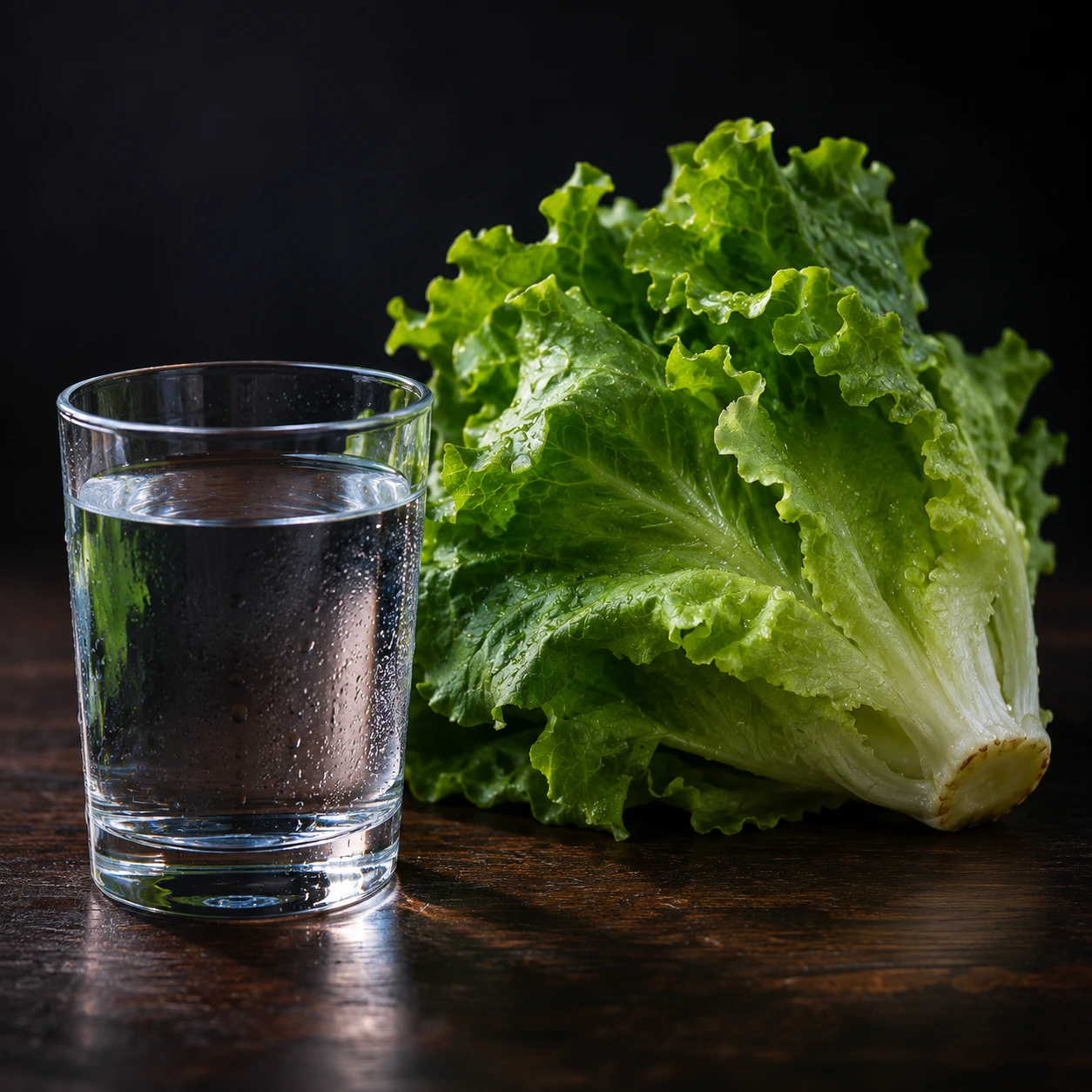
Plants take up perchlorate from soil and irrigation water, so it concentrates in produce — especially leafy greens such as spinach and lettuce, and other vegetables. It also appears in dairy milk, because cows eat forage and drink water that carry it, and it has been measured in human breast milk for the same reason. For many people, food actually contributes more total perchlorate than water does. This sounds alarming, but the amounts are small, and leafy greens and dairy are nutritious foods all the same.
The U.S. Food and Drug Administration's Total Diet Study (samples from 2008 to 2012) estimated a mean perchlorate intake from food of 0.13 micrograms per kilogram of body weight per day for the U.S. population, and between 0.09 and 0.43 across 14 age and sex groups. All of these means were below the 0.7 reference dose described under the regulatory story below. The same study estimated a mean iodine intake of 216.4 micrograms per person per day.
Historical fertilizer exposure
Natural sodium-nitrate fertilizer imported from Chile once introduced perchlorate onto farm fields. Modern synthetic fertilizers generally do not, and this is a smaller contributor today than it was decades ago.
How It Affects the Thyroid: Blocking the Iodide Gate
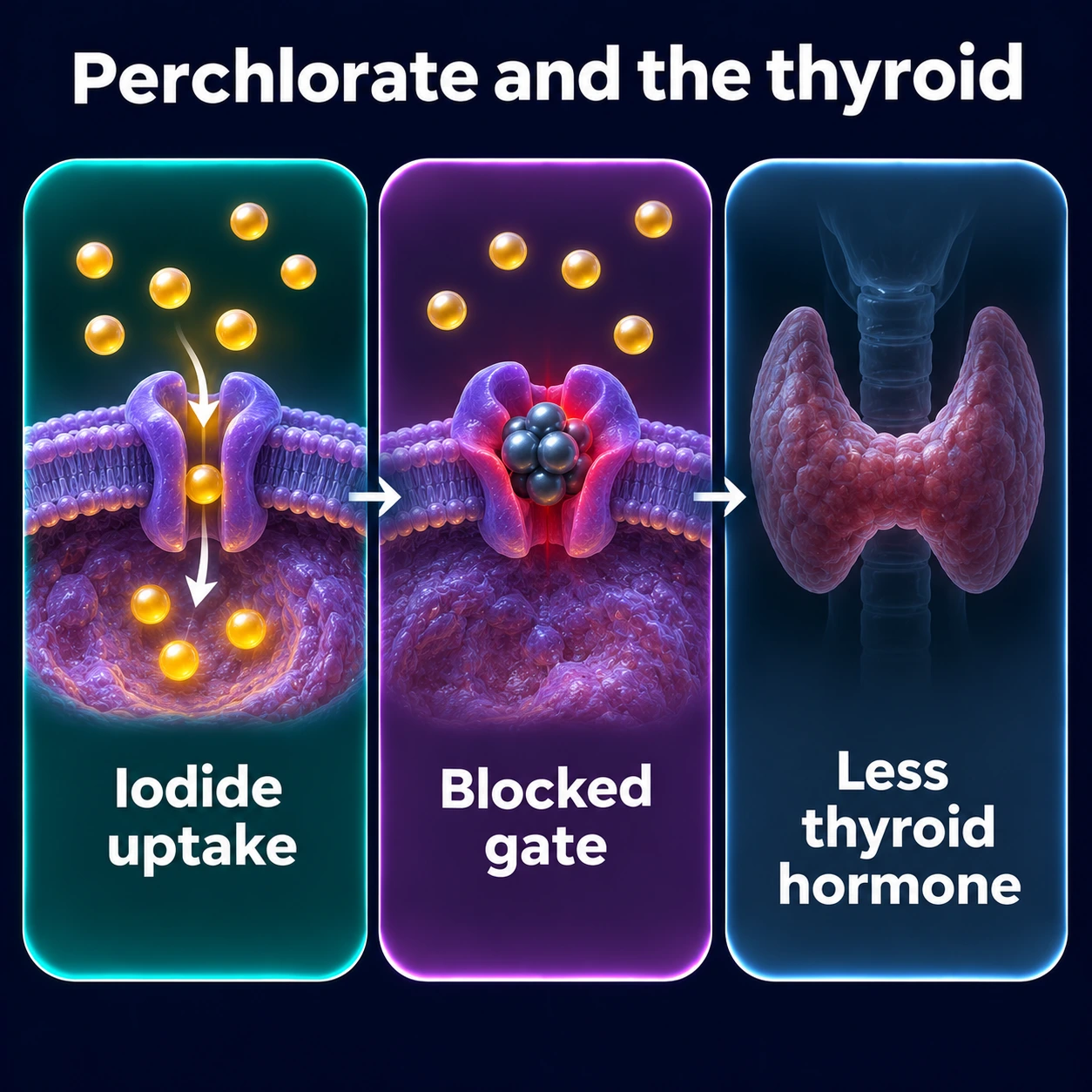
To understand perchlorate, you first have to understand one small door on the surface of your thyroid cells. Your thyroid needs iodine to make thyroid hormone, and it pulls iodine (as iodide) out of the blood using a molecular pump called the sodium-iodide symporter, usually shortened to NIS. Think of NIS as a turnstile that grabs iodide from the bloodstream and carries it into the gland, where it becomes the raw material for the hormones that run your metabolism.
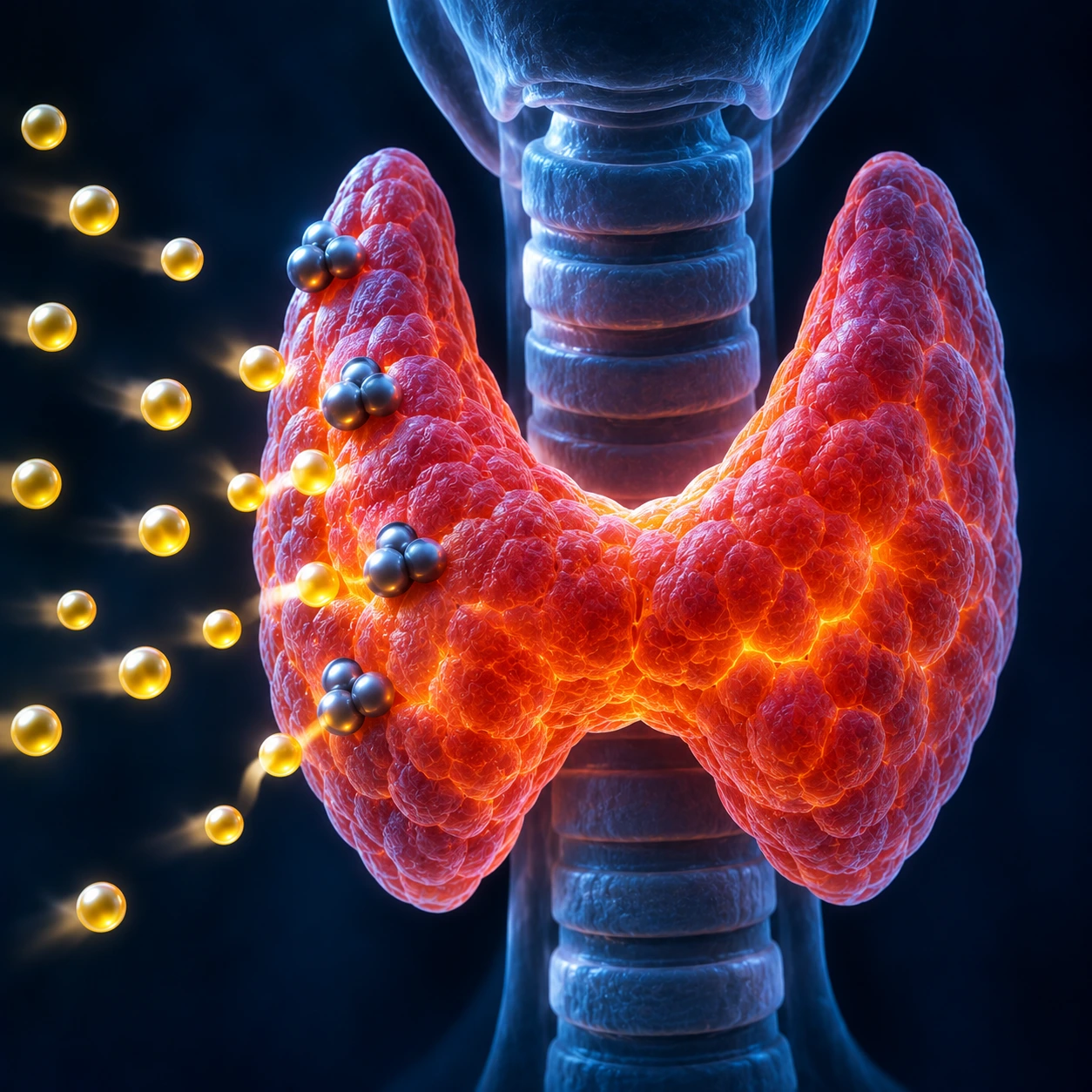
Perchlorate happens to be almost exactly the right size and shape to fit that turnstile. It is competitively taken up by NIS in place of iodide — in effect it jams the door and, remarkably, is itself carried across, occupying the pump that iodide needs. When perchlorate is present, the thyroid pulls in less iodine. Among the common substances that block NIS, perchlorate is the most potent: molecule for molecule, a study in hamster cells carrying the human symporter measured it at 15 times the strength of thiocyanate (from cigarette smoke and some foods) and 240 times the strength of nitrate (from fertilizer runoff and cured meats). And the effects of these three add together, so someone exposed to all of them at once feels a combined pull on their iodide uptake.
Here is the important nuance. Blocking iodide uptake is not the same as causing thyroid disease. If your body has plenty of iodine, the thyroid has a large reserve to draw on and can usually keep hormone production normal despite a modest amount of perchlorate. The chain of events that would lead to a real problem is longer: enough perchlorate, for long enough, in a person whose iodine intake is low enough that the gland cannot compensate — only then does iodide uptake fall far enough to reduce thyroid hormone output. That is why iodine status, dose, and duration all matter, and why the same water might be a genuine concern for one person and a non-issue for another.
Why It Was Once Used as a Medicine
The clearest proof that perchlorate blocks the thyroid is that doctors deliberately used it to do exactly that. In the 1950s and 1960s, potassium perchlorate was a prescription drug for hyperthyroidism — an overactive thyroid, as in Graves' disease. By throttling iodide uptake, it lowered the gland's hormone output and calmed the overactivity. It worked precisely because of the NIS-blocking mechanism described above.
It fell out of routine use not because it failed but because, at the high therapeutic doses, a small number of patients developed serious blood disorders — aplastic anemia and agranulocytosis, in which the bone marrow stops making blood cells. Safer antithyroid drugs replaced it. Perchlorate still has narrow medical roles today: it is used in a diagnostic "perchlorate discharge test" to detect certain thyroid enzyme defects, and occasionally to help manage thyroid overactivity triggered by the iodine-rich heart drug amiodarone.
This history offers a crucial sense of scale. The medicinal doses were on the order of hundreds of milligrams per day. Everyday environmental exposure from water and food is measured in micrograms per day — roughly ten thousand to a hundred thousand times smaller. That enormous gap is the single most important fact for keeping perchlorate in perspective: the mechanism is real and proven, but the doses most people encounter are a tiny fraction of what it takes to treat a disease.
Who Is Most Vulnerable
Perchlorate's risk is not spread evenly. It concentrates in a few groups for whom thyroid hormone is especially critical:
- Pregnant women — pregnancy raises the demand for thyroid hormone and for iodine, and the mother's thyroid supplies the baby, especially in the first trimester before the fetus's own gland is working. Anything that nudges maternal thyroid output down matters more during pregnancy.
- Fetuses and infants — thyroid hormone is essential for building the developing brain and nervous system. A shortfall at this stage can affect development in ways that a shortfall in a healthy adult would not. Newborns also have very little stored hormone, so they have less buffer.
- People with low iodine intake — this is the amplifier that ties everything together. In someone with ample iodine, the thyroid shrugs off modest perchlorate. In someone whose iodine is low, the same exposure has a bigger effect because there is no reserve. Mild iodine insufficiency is more common than many people assume, including among some pregnant women.
Notice that these groups overlap: a pregnant woman with borderline-low iodine is exactly the situation where perchlorate exposure deserves the most attention — and, encouragingly, adequate iodine intake is the step reviews point to for that situation.
What the Human Evidence Actually Shows
It is worth being straight about what is well established and what is still debated.
What is clear: The mechanism is beyond dispute — perchlorate blocks NIS and reduces iodide uptake, and this has been demonstrated in cells, in animals, in the medication history, and in controlled human studies. In a carefully done dosing experiment, 37 volunteers drank perchlorate in water for 14 days at doses from 0.007 to 0.5 milligrams per kilogram of body weight per day. Researchers identified the level below which no measurable drop in thyroid iodide uptake occurred, estimated at 5.2 and 6.4 micrograms per kilogram per day, and regulators later built safety limits on that finding by adding a large margin of caution. Only the top dose showed any effect on blood hormones (a slight downward trend in thyroid-stimulating hormone), with recovery 15 days after dosing ended. The experiment lasted two weeks, so it does not show what longer exposure or exposure during pregnancy does.
What is genuinely debated: Whether the low levels found in ordinary drinking water and food measurably affect thyroid hormones or health in the general population. The studies point in different directions. A large national survey, the National Health and Nutrition Examination Survey (2,299 people, 2001–2002), found that urinary perchlorate was not a significant predictor of thyroid hormones in men, but was in women overall. In women with urinary iodine under 100 micrograms per liter, higher perchlorate went with lower thyroid hormone (T4) and higher thyroid-stimulating hormone (TSH). In women at or above that iodine level, it went with higher TSH but not with lower T4 — a signal, and one that fits the mechanism, with both hormones moving only in the low-iodine group. A study of 1,880 pregnant women in San Diego County (median urinary perchlorate 6.5 micrograms per liter, about twice the general U.S. level) also tied higher perchlorate to lower total and free T4 and higher TSH. Other well-conducted studies, including a large cohort of first-trimester pregnant women, found no significant association between environmental perchlorate and thyroid function.
One study of 487 mother-child pairs, in which the mothers had underactive or borderline-underactive thyroids during pregnancy, linked higher maternal perchlorate to lower cognitive scores in their children: mothers in the top 10% for perchlorate had an odds ratio of 3.14 (95% confidence interval 1.38 to 7.13) of a child whose IQ at age 3 fell in the lowest 10%, and levothyroxine treatment did not reduce it. This is concerning, though the authors state that the result needs replication, while other pregnancy studies did not find such effects. Two 2026 reports from the MARBLES cohort, a group of families with a raised likelihood of autism (310 mothers and 1,916 urine samples in the first, 195 mother-child pairs in the second), found no overall link between prenatal perchlorate, thiocyanate or nitrate and autism or other developmental concerns at age 3. The first report did find links in some subgroups, by child sex, trimester of exposure, maternal iodine and passive smoking, which its authors call hypothesis generating.
How do we hold these together honestly? The most reasonable reading is that at typical environmental levels, perchlorate is unlikely to cause problems in a healthy, iodine-sufficient person, but it may matter for the vulnerable groups above. Reviews point to adequate iodine as the factor the effect may depend on, though the studies do not line up neatly: in the national survey, women with higher iodine still showed the TSH link, and the first-trimester cohort found no link even though its women were low in iodine (median urinary iodine 98 and 52 micrograms per liter). The debate is real; it is not resolved by pretending the effect is either proven-catastrophic or proven-harmless.
The Regulatory Story
Perchlorate has had an unusually back-and-forth regulatory history in the United States, which is part of why it confuses people.
In 2005, a National Academies expert panel reviewed the science and recommended a reference dose of 0.0007 milligrams per kilogram of body weight per day (0.7 micrograms per kilogram per day) — the daily intake considered safe even for sensitive people, derived from the human no-effect level with a tenfold safety margin. The U.S. Environmental Protection Agency (EPA) adopted that reference dose.
Whether to set an enforceable national drinking-water limit has been the contested part. The U.S. Environmental Protection Agency announced in 2011 that it intended to regulate perchlorate in drinking water. In 2020, it reversed course and decided not to set a federal limit, concluding perchlorate did not meet the criteria for regulation — a decision that was challenged in court. In May 2023, in NRDC v. Regan, a federal appeals court (the D.C. Circuit) vacated that 2020 withdrawal and sent it back to the agency. On January 2, 2026, the agency signed a proposed national drinking-water regulation, with a health-based goal of 20 micrograms per liter (about 20 parts per billion) and enforceable limits of 20, 40 or 80 micrograms per liter co-proposed. Public comments closed on March 9, 2026, and the agency is required to sign a final rule by May 21, 2027. Until a final rule is in force there is still no single federal enforceable limit, though the U.S. Environmental Protection Agency has cited a health reference level in the range of about 15 parts per billion.
In the absence of a federal number, some states set their own limits. California established a drinking-water standard of 6 parts per billion, and Massachusetts set a standard of 2 parts per billion, along with monitoring requirements. California's Public Health Goal has been 1 microgram per liter since 2015, replacing the earlier 6, and the level at which its laboratories report perchlorate fell from 4 to 2 micrograms per liter on July 1, 2021, and to 1 on January 1, 2024. The U.S. Food and Drug Administration monitors perchlorate in food through its Total Diet Study. The practical takeaway: rules vary by where you live, so local water-quality reports and state agencies are the place to check what applies to you.
In Europe, the European Food Safety Authority updated its 2014 assessment in 2025 and set a tolerable daily intake of 1.4 micrograms per kilogram of body weight per day. It found dietary exposure below that level for all age groups including pregnant women, except at the upper-bound 95th percentile for infants, including breastfed and formula-fed infants, and its uncertainty analysis gave a higher than 50% likelihood of no concern for all scenarios.
How to Reduce Your Exposure
The good news is that the two most effective steps are straightforward and address both sides of the equation — lowering the amount that reaches you, and giving your thyroid the reserve to handle what does.
Testing and treating water
- Water reports. Public systems publish annual water-quality reports, and utilities can say whether perchlorate is measured. For a private well — especially near a defense, aerospace, fireworks, or agricultural site — a certified laboratory test is the way to measure it, since perchlorate is not part of standard well panels.
- Filtration methods differ in whether they remove it. Ordinary activated-carbon pitcher and faucet filters do not reliably remove perchlorate. The methods that do are reverse osmosis and ion-exchange (anion-exchange) systems, and both depend on the upkeep listed in their instructions.
- Boiling water does not remove perchlorate — if anything it concentrates it as water evaporates.
Adequate iodine intake
Iodine sufficiency is described as the body's buffer against perchlorate, which matters most before and during pregnancy and while breastfeeding. Reliable sources include iodized salt, dairy, eggs, and seafood, and many prenatal vitamins include iodine. The aim is adequacy, not excess: very high iodine intakes carry their own thyroid risks, so this is about meeting the recommended amount, not megadosing. A 2010 review lists the figures: the U.S. Institute of Medicine recommends 220 micrograms of iodine a day during pregnancy and 290 during breastfeeding, the World Health Organization recommends 250 for both, and American Thyroid Association guidelines urge that prenatal vitamins contain 150 micrograms a day.
Other points
- Washing produce helps with surface residues generally, though perchlorate taken up inside a plant will not rinse off. The nutritional benefit of leafy greens is generally described as outweighing the trace exposure.
- Breastfeeding. Despite perchlorate being measurable in breast milk, health bodies continue to recommend breastfeeding. A 2010 review notes that breastfed infants rely entirely on the mother's iodine intake, which is why maternal iodine adequacy is described as the lever that best protects the infant.
- Tobacco smoke matters here too, because its thiocyanate adds to the same iodide-blocking effect.
The Honest Bottom Line
Perchlorate is a real, well-understood substance with a real, well-understood mechanism: it blocks the thyroid's iodide pump, and at high enough doses it lowers thyroid hormone — which is exactly why it was once a medicine. Trace exposure through water and food is essentially universal, but the everyday amounts are thousands of times below the doses that treated thyroid disease, and in a healthy person with adequate iodine the thyroid has plenty of reserve to absorb them.
The place to focus attention is narrow and clear: pregnancy, infancy, and low iodine intake, where thyroid hormone is most critical and the margin is thinnest. For those groups, the two protective steps described above are simple — adequate iodine, and, where there is reason to suspect the water (a nearby defense, aerospace, or agricultural source, or a private well), testing it and using reverse-osmosis or ion-exchange filtration. For most people, perchlorate is worth knowing about and worth a sensible check, not a source of alarm. Understanding beats fear, and here the understanding points to a handful of calm, doable actions.
Key Research Papers
- Wolff J. Perchlorate and the thyroid gland. Pharmacological Reviews. 1998;50(1):89–105. — the classic review of how perchlorate blocks thyroid iodide uptake and its history as an antithyroid drug. — doi:10.1016/s0031-6997(24)01350-4
- Dohán O, Portulano C, Basquin C, Reyna-Neyra A, Amzel LM, Carrasco N. The Na+/I− symporter (NIS) mediates electroneutral active transport of the environmental pollutant perchlorate. Proceedings of the National Academy of Sciences. 2007;104(51):20250–20255. — showed perchlorate is itself carried by the very pump iodide needs, explaining the block at the molecular level. — doi:10.1073/pnas.0707207104
- Tonacchera M, Pinchera A, Dimida A, et al. Relative potencies and additivity of perchlorate, thiocyanate, nitrate, and iodide on the inhibition of radioactive iodide uptake by the human sodium iodide symporter. Thyroid. 2004;14(12):1012–1019. — ranked perchlorate as the most potent NIS blocker and confirmed its effect adds to thiocyanate and nitrate. — doi:10.1089/thy.2004.14.1012
- Greer MA, Goodman G, Pleus RC, Greer SE. Health effects assessment for environmental perchlorate contamination: the dose response for inhibition of thyroidal radioiodine uptake in humans. Environmental Health Perspectives. 2002;110(9):927–937. — the controlled human dosing study that established the no-effect level underlying today's safety limits. — doi:10.1289/ehp.02110927
- Blount BC, Pirkle JL, Osterloh JD, Valentin-Blasini L, Caldwell KL. Urinary perchlorate and thyroid hormone levels in adolescent and adult men and women living in the United States. Environmental Health Perspectives. 2006;114(12):1865–1871. — the National Health and Nutrition Examination Survey analysis linking higher perchlorate to lower T4 and higher TSH in women with urinary iodine under 100 micrograms per liter and to higher TSH alone in women above that level, with no significant link in men. — doi:10.1289/ehp.9466
- Blount BC, Valentin-Blasini L, Osterloh JD, Mauldin JP, Pirkle JL. Perchlorate exposure of the U.S. population, 2001–2002. Journal of Exposure Science & Environmental Epidemiology. 2007;17(4):400–407. — national biomonitoring finding measurable perchlorate in essentially everyone tested. — doi:10.1038/sj.jes.7500535
- Kirk AB, Martinelango PK, Tian K, Dutta A, Smith EE, Dasgupta PK. Perchlorate and iodide in dairy and breast milk. Environmental Science & Technology. 2005;39(7):2011–2017. — documented food and milk, including human breast milk, as real exposure routes. — doi:10.1021/es048118t
- Pearce EN, Lazarus JH, Smyth PPA, et al. Perchlorate and thiocyanate exposure and thyroid function in first-trimester pregnant women. The Journal of Clinical Endocrinology & Metabolism. 2010;95(7):3207–3215. — a large pregnancy cohort that found no significant association at environmental exposure levels. — doi:10.1210/jc.2010-0014
- Steinmaus C, Pearl M, Kharrazi M, et al. Thyroid hormones and moderate exposure to perchlorate during pregnancy in women in southern California. Environmental Health Perspectives. 2016;124(6):861–867. — examined perchlorate in pregnancy and its interaction with iodine and thiocyanate. — doi:10.1289/ehp.1409614
- Taylor PN, Okosieme OE, Murphy R, et al. Maternal perchlorate levels in women with borderline thyroid function during pregnancy and the cognitive development of their offspring. The Journal of Clinical Endocrinology & Metabolism. 2014;99(11):4291–4298. — linked higher maternal perchlorate to lower child IQ among women with underactive thyroids. — doi:10.1210/jc.2014-1901
- Leung AM, Pearce EN, Braverman LE. Perchlorate, iodine and the thyroid. Best Practice & Research Clinical Endocrinology & Metabolism. 2010;24(1):133–141. — a clinical review emphasizing adequate iodine as the key protective factor. — doi:10.1016/j.beem.2009.08.009
- National Research Council. Health Implications of Perchlorate Ingestion. Washington, DC: National Academies Press; 2005. — the expert-panel report that recommended the 0.7 µg/kg/day reference dose. — doi:10.17226/11202
- Abt E, Spungen J, Pouillot R, Gamalo-Siebers M, Wirtz M. Update on dietary intake of perchlorate and iodine from U.S. Food and Drug Administration's Total Diet Study: 2008–2012. Journal of Exposure Science & Environmental Epidemiology. 2018;28(1):21–30. — mean perchlorate and iodine intakes for the U.S. population and 14 age and sex groups. — doi:10.1038/jes.2016.78
- Jang H, Bennett DH, Tancredi DJ, Schmidt RJ, Shin HM. Associations between prenatal exposure to perchlorate, thiocyanate, and nitrate and child neurodevelopment in the MARBLES study. Environmental Science & Technology. 2026;60(38):26961–26973. — no overall link with autism or other developmental concerns at age 3; subgroup links called hypothesis generating. — doi:10.1021/acs.est.6c03054
- Jang H, Bennett DH, Hoofnagle AN, Tancredi DJ, Pearce EN, Schmidt RJ, Shin HM. Prenatal exposure to perchlorate, thiocyanate, and nitrate: associations with maternal thyroid function and child neurodevelopment in the MARBLES cohort. Ecotoxicology and Environmental Safety. 2026;326:121008. — 195 mother-child pairs; no significant link with child neurodevelopment. — doi:10.1016/j.ecoenv.2026.121008
- EFSA Panel on Contaminants in the Food Chain (CONTAM). Update of the scientific opinion on the risks for human health related to the presence of perchlorate in food. EFSA Journal. 2025;23(5). — set the tolerable daily intake of 1.4 µg/kg/day. — doi:10.2903/j.efsa.2025.9393
- U.S. Environmental Protection Agency. Perchlorate in Drinking Water (agency page). — the 2023 court decision, the 2026 proposed regulation and the hypochlorite impurity. — epa.gov/sdwa/perchlorate-drinking-water
- California State Water Resources Control Board. Perchlorate in Drinking Water (agency page). — California's Public Health Goal and reporting limits. — waterboards.ca.gov: Perchlorate in Drinking Water