⚠ Evidence warning: Clinical trials or other evidence do not support the claims that Tai Chi lowers the risk of falling most when practiced more often and that it is one of the most evidence-backed choices for older adults worried about falling. This page keeps it as a report of what people, websites or other media say.
Tai Chi
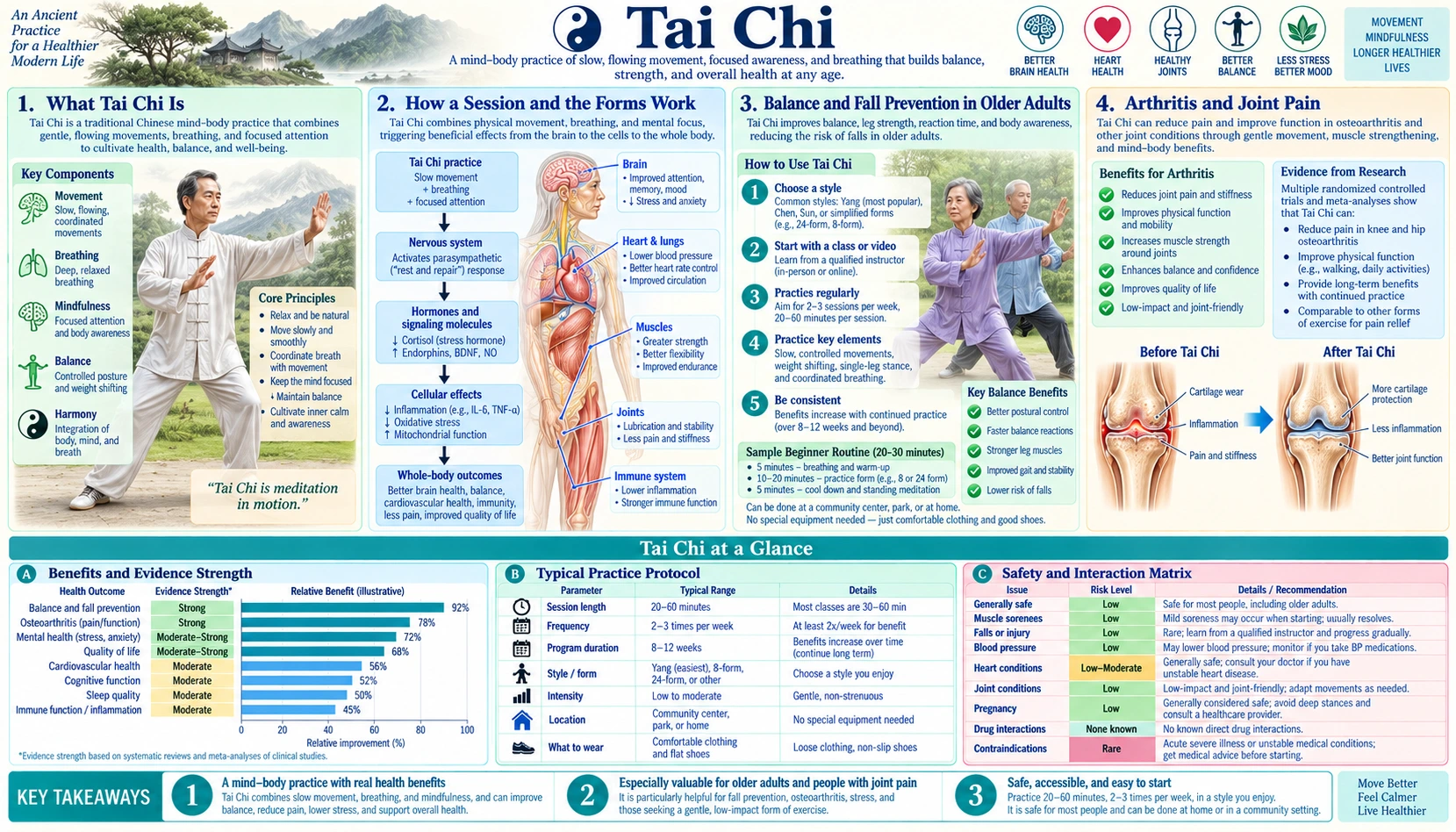
Tai Chi is a gentle Chinese mind-body practice built from slow, flowing movements linked to steady, relaxed breathing. It is often described as "meditation in motion" — you move through a sequence of soft, continuous postures while keeping your attention on your body, your balance, and your breath. It grew out of Chinese martial arts hundreds of years ago, but the health-oriented forms most people practice today are calm and non-combative, done standing at your own pace.
Tai Chi has become popular partly because it is unusually easy on the body: no jumping, no pounding, no heavy weights, and it can be adapted for people who are older, frail, or recovering from illness. It is also one of the better-studied "alternative" movement practices. This page walks through what Tai Chi is, how a session works, and what the research honestly shows — where the evidence is genuinely strong (balance and fall prevention, arthritis pain), where it is promising but weaker (blood pressure, mood, sleep), and where it is thin (bone density). The short version: Tai Chi is very safe, pleasant, and clearly helps balance and joint pain, while its other benefits are real but more modest.
Table of Contents
- What Tai Chi Is
- How a Session and the Forms Work
- Balance and Fall Prevention in Older Adults
- Arthritis and Joint Pain
- Parkinson's Disease and Balance
- Heart Health and Blood Pressure
- Mood, Stress, and Sleep
- Bone Density and General Fitness
- Especially Good for Older or Deconditioned People
- Starting Tai Chi and How Safe It Is
- Key Research Papers
- Connections
- Featured Videos
What Tai Chi Is
Tai Chi — more fully Tai Chi Chuan (tàijí quán) — began in China as an internal martial art. The word "chuan" literally means "fist" or "boxing," and the original forms trained slow, precise, whole-body movement that could be sped up for self-defense. Over the centuries, the practice split into distinct family styles, each with its own flavor:
- Chen style — the oldest, mixing slow movement with occasional bursts of faster, more forceful "silk-reeling" motions and low stances.
- Yang style — the most widely practiced worldwide, known for large, even, gentle movements at a steady tempo. Most beginner and health classes teach a simplified Yang form.
- Wu, Wu (Hao), and Sun styles — smaller, more compact family styles; Sun style, with its higher stance and agile stepping, is often chosen for older adults and people with arthritis.
What all styles share is the core idea of meditation in motion: slow continuous movement, an upright but relaxed posture, weight shifting smoothly from one leg to the other, and breathing that stays soft and unforced. In traditional Chinese thinking, Tai Chi is said to cultivate qi (life energy) and balance yin and yang. You do not have to accept that framework to benefit — from a plain physical standpoint, Tai Chi is low-intensity aerobic-plus-balance exercise that trains coordination, leg strength, and body awareness. That is a big part of why it turns out to be so useful for balance and joint health, covered below.
How a Session and the Forms Work
A typical class runs 45 to 60 minutes and is done standing (though seated Tai Chi exists for people who cannot stand safely). A session usually has three parts:
- Warm-up. Gentle loosening of the neck, shoulders, spine, hips, knees, and ankles, plus some relaxed breathing to settle the mind.
- The form. The heart of the practice is a form — a memorized sequence of named postures ("Grasp the Sparrow's Tail," "Wave Hands Like Clouds," "White Crane Spreads Its Wings") that flow one into the next without stopping. A short simplified form may have 8 to 24 movements; traditional long forms can have over 100. You move slowly, keep your knees soft, shift your weight deliberately, and try to stay relaxed and upright.
- Cool-down. Slow breathing, gentle stretching, and a quiet standing rest.
Because the movements are slow and repetitive, the real skill is attention — noticing where your weight is, keeping your posture tall, and letting your breath stay easy. Beginners learn just a few movements at a time and repeat them until they feel natural. Nothing needs to be strenuous or perfect; the benefit comes from regular, mindful, gentle practice, ideally a few times a week. Many people find the pace itself calming, which is one reason Tai Chi doubles as a stress-relief practice, much like yoga or seated meditation.
Balance and Fall Prevention in Older Adults
This is Tai Chi's strongest and best-supported benefit, and it is worth taking seriously. Falls are a leading cause of injury, hospitalization, and loss of independence in older adults, and a broken hip after a fall can change a person's whole life. Tai Chi trains exactly the things that protect against falls: steady weight-shifting, leg strength, ankle and hip control, and the confidence to move without freezing up.
The evidence here is unusually good for a mind-body practice. A large 2019 Cochrane review of exercise for fall prevention analysed Tai Chi as its own category: in community-dwelling older adults, Tai Chi may reduce the rate of falls by 19% (low-certainty evidence) and reduced the number of people who fall by 20% (high-certainty evidence); balance and functional exercise, a separate category, reduced the rate of falls by 24%. A dedicated 2017 meta-analysis of 10 trials found that Tai Chi lowered the rate of falls by about 43% over the short term (under 12 months) and by a smaller amount over the long term, with no effect on the time to a first fall. Tai Chi specifically lowers the risk of falling, with the benefit strongest when people practice more often. National fall-prevention programs in several countries now recommend Tai Chi by name.
Fewer falls also means fewer fractures, which matters most for people with thin bones. If you or a family member has osteoporosis, the most reliable thing Tai Chi offers is not thicker bone (that evidence is limited — see below) but a lower chance of the fall that would break the bone in the first place. For an older adult worried about falling, Tai Chi is one of the most evidence-backed choices available. Tai Chi is one of the exercise types with fall-prevention evidence for older adults in the 2019 Cochrane review.
Arthritis and Joint Pain
Tai Chi also has genuinely good evidence for certain kinds of chronic joint and muscle pain, and it appears in some clinical guidelines as a recommended option.
Knee osteoarthritis
A well-designed 2016 trial published in Annals of Internal Medicine compared 12 weeks of Tai Chi against standard physical therapy for knee osteoarthritis. Tai Chi worked as well as physical therapy for pain and function — and the Tai Chi group reported better mood and quality of life. Because Tai Chi is low-impact and does not pound the joints, it suits arthritic knees and hips well. Several arthritis and rheumatology organizations list Tai Chi among the non-drug options for knee osteoarthritis.
Fibromyalgia
The evidence for fibromyalgia — a condition of widespread pain, fatigue, and poor sleep — is especially striking. A 2010 randomized trial in the New England Journal of Medicine found that 12 weeks of Tai Chi produced clinically meaningful improvement in fibromyalgia symptoms compared with a wellness-and-stretching control. A larger 2018 follow-up trial in the BMJ confirmed it, finding Tai Chi to be at least as effective as aerobic exercise, with more people sticking with it. For a condition that is often frustrating to treat, that is a meaningful result.
Parkinson's Disease and Balance
One of the most cited Tai Chi studies is a 2012 randomized controlled trial in the New England Journal of Medicine. Researchers assigned people with mild-to-moderate Parkinson's disease to tailored Tai Chi, resistance training, or stretching. The Tai Chi group improved the most in balance and stability, took longer, steadier steps, and had fewer falls than the stretching group — benefits that persisted for months after the program ended.
Parkinson's causes stiffness, slowed movement, and impaired balance, and falls are a serious problem as the disease progresses. Tai Chi's slow, deliberate weight-shifting seems especially well matched to retraining that balance. It is not a cure and does not slow the underlying disease, but as a supportive movement therapy for balance in Parkinson's, it has some of the best clinical-trial evidence of any exercise. Many neurology and movement-disorder clinics now suggest it alongside standard care.
Heart Health and Blood Pressure
Here the evidence is promising but more modest, and honesty matters. Tai Chi is light-to-moderate exercise, so it is reasonable to expect some cardiovascular benefit, and studies do point that way — but the effects are gentler than the balance findings.
- Blood pressure. A 2024 randomized trial in JAMA Network Open found that Tai Chi lowered systolic blood pressure somewhat more than conventional aerobic exercise in adults with prehypertension. An earlier systematic review also reported modest blood-pressure reductions across most studies. The drops are real but usually small, so for people managing high blood pressure the studies place Tai Chi as an addition to prescribed medication, not a replacement for it.
- Heart failure. A 2011 trial in Archives of Internal Medicine found that Tai Chi improved quality of life, mood, and exercise confidence in people with chronic heart failure, even though it did not change objective measures like walking distance. It is a gentle way for heart-failure patients to stay active.
Overall: Tai Chi is low-risk physical activity, and it may nudge blood pressure down — but claims that it dramatically transforms cardiovascular health go beyond what the studies show.
Mood, Stress, and Sleep
Because Tai Chi combines movement with focused, meditative attention, it is often promoted for mental well-being. The research is encouraging but the effects are small-to-moderate, and many studies are short or imperfectly designed.
- Mood and stress. A 2014 systematic review found that Tai Chi was associated with small-to-moderate improvements in depression, anxiety, and general psychological well-being. This fits what practitioners describe: the slow pace and breath focus are genuinely calming.
- Sleep. A randomized trial of "Tai Chi Chih" (a simplified Western form) in older adults with moderate sleep complaints found improved self-reported sleep quality. Better sleep may partly follow from lower stress and more daytime activity.
- Thinking and memory. A 2014 review suggested Tai Chi may bring modest benefits to cognitive performance in older adults, though the studies varied a lot and firm conclusions are not yet possible.
The reasonable takeaway: Tai Chi can help you feel calmer and may modestly improve mood and sleep, especially if practiced regularly — but it is a supportive practice, not a treatment for clinical depression or an insomnia disorder on its own.
Bone Density and General Fitness
This is where honesty is most important, because Tai Chi is sometimes oversold as a bone-building exercise. The truth is more limited:
- Bone density. A 2007 systematic review in postmenopausal women found six small studies, two of them randomized trials; the two trials and one cohort study suggested that women new to Tai Chi lost bone mineral density more slowly after menopause, and the review concluded that this limited evidence suggests Tai Chi may be an effective, safe and practical way of maintaining bone density, while calling for better research. Tai Chi is gentle and low-load, and building bone generally requires higher-impact or resistance loading. Its real value for bone health is indirect: by improving balance and cutting falls, it lowers the chance of a fracture — which for many people matters more than a small change on a bone scan.
- General fitness. Tai Chi is light-to-moderate exercise. It gently improves leg strength, flexibility, and stamina, and it clearly beats being sedentary. But it will not build large muscles or high-end cardiovascular fitness the way running or weight training does. It is steady, sustainable activity rather than intense conditioning.
So Tai Chi is excellent for staying mobile, steady, and active — and a fine complement to strength or weight-bearing work — but it is not, by itself, a powerful bone-density or peak-fitness tool.
Especially Good for Older or Deconditioned People
Tai Chi's biggest advantage is that almost anyone can do it. That makes it a standout choice for people who find ordinary exercise intimidating or unsafe:
- Low-impact. No jumping, running, or pounding — kind to knees, hips, and backs.
- Adaptable. Movements can be made smaller, slower, higher (less deep knee bend), or done seated. There are versions for wheelchair users and for people recovering from stroke or surgery.
- Low-cost and equipment-free. No gym, machines, or special clothing. Comfortable clothes and flat shoes are enough.
- Social and sustainable. Group classes are common and friendly, which helps people keep going — and consistency is what makes the balance and pain benefits show up.
For a deconditioned, frail, or older person — exactly the group most at risk from falls and most helped by better balance — Tai Chi hits a sweet spot of being safe, gentle, and genuinely effective. That combination is rare.
Starting Tai Chi and How Safe It Is
Tai Chi is one of the safest forms of exercise there is. Serious injuries are very rare; the most common complaints are mild, temporary muscle soreness or a little knee or ankle achiness, usually from bending the knees too deeply. Beginners usually start like this:
- A class or a video series. A qualified instructor teaches upright posture and safe knee alignment, which matters most early on. Community centers, senior centers, hospitals, and physical-therapy clinics often offer beginner or "Tai Chi for arthritis / for fall prevention" programs, some of them evidence-based and standardized.
- Small beginnings. Beginners usually learn a few movements and practice them a few times a week; consistency matters more than intensity.
- Comfortable stances. Forced deep stances are the usual cause of knee soreness; instructors teach soft knees pointing the same way as the toes, a tall posture and easy breathing. The practice is meant to feel gentle, never painful.
- Support. People with poor balance often practice near a wall, sturdy chair, or countertop, or begin with seated Tai Chi.
Cautions: severe balance problems, recent surgery, a fracture, uncontrolled heart or blood-pressure problems and advanced joint disease raise the risk of a fall or strain during practice, and classes experienced with medical conditions adapt the movements for them. Tai Chi complements medical care and prescribed medication; it does not replace them. With those adaptations, it is a pleasant, low-risk practice that most people can do for the rest of their lives.
Key Research Papers
- Li F, Harmer P, Fitzgerald K, et al. Tai Chi and Postural Stability in Patients with Parkinson's Disease. New England Journal of Medicine. 2012;366(6):511-519. — RCT: tailored Tai Chi improved balance and reduced falls in Parkinson's more than resistance or stretching. — doi:10.1056/NEJMoa1107911
- Wang C, Schmid CH, Rones R, et al. A Randomized Trial of Tai Chi for Fibromyalgia. New England Journal of Medicine. 2010;363(8):743-754. — 12 weeks of Tai Chi produced clinically meaningful improvement in fibromyalgia symptoms versus a control. — doi:10.1056/NEJMoa0912611
- Wang C, Schmid CH, Fielding RA, et al. Effect of tai chi versus aerobic exercise for fibromyalgia: comparative effectiveness randomized controlled trial. BMJ. 2018;360:k851. — Larger trial confirming Tai Chi is at least as effective as aerobic exercise for fibromyalgia. — doi:10.1136/bmj.k851
- Wang C, Schmid CH, Iversen MD, et al. Comparative Effectiveness of Tai Chi Versus Physical Therapy for Knee Osteoarthritis. Annals of Internal Medicine. 2016;165(2):77-86. — Tai Chi matched standard physical therapy for knee osteoarthritis pain and function. — doi:10.7326/M15-2143
- Lomas-Vega R, Obrero-Gaitán E, Molina-Ortega FJ, Del-Pino-Casado R. Tai Chi for Risk of Falls. A Meta-analysis. Journal of the American Geriatrics Society. 2017;65(9):2037-2043. — Ten trials: Tai Chi reduced the rate of falls by about 43% over the short term (under 12 months) and less over the long term; no effect on time to first fall. — doi:10.1111/jgs.15008
- Sherrington C, Fairhall NJ, Wallbank GK, et al. Exercise for preventing falls in older people living in the community. Cochrane Database of Systematic Reviews. 2019;1:CD012424. — Tai Chi, analysed as its own category, may reduce the rate of falls by 19% (low certainty) and reduced the number of people falling by 20%; balance and functional exercise reduced the rate of falls by 24%. — doi:10.1002/14651858.CD012424.pub2
- Li X, Chang P, Wu M, et al. Effect of Tai Chi vs Aerobic Exercise on Blood Pressure in Patients With Prehypertension: A Randomized Clinical Trial. JAMA Network Open. 2024;7(2):e2354937. — Tai Chi lowered systolic blood pressure somewhat more than aerobic exercise in prehypertension. — doi:10.1001/jamanetworkopen.2023.54937
- Yeh GY, Wang C, Wayne PM, Phillips RS. The Effect of Tai Chi Exercise on Blood Pressure: A Systematic Review. Preventive Cardiology. 2008;11(2):82-89. — Review found modest blood-pressure reductions across most studies. — doi:10.1111/j.1751-7141.2008.07565.x
- Yeh GY, McCarthy EP, Wayne PM, et al. Tai Chi Exercise in Patients With Chronic Heart Failure: A Randomized Clinical Trial. Archives of Internal Medicine. 2011;171(8):750-757. — Tai Chi improved quality of life and mood in heart-failure patients. — doi:10.1001/archinternmed.2011.150
- Wayne PM, Walsh JN, Taylor-Piliae RE, et al. Effect of Tai Chi on Cognitive Performance in Older Adults: Systematic Review and Meta-analysis. Journal of the American Geriatrics Society. 2014;62(1):25-39. — Suggests modest cognitive benefits, though the underlying studies varied widely. — doi:10.1111/jgs.12611
- Wang F, Lee EO, Wu T, et al. The Effects of Tai Chi on Depression, Anxiety, and Psychological Well-Being: A Systematic Review and Meta-Analysis. International Journal of Behavioral Medicine. 2014;21(4):605-617. — Small-to-moderate improvements in mood and psychological well-being. — doi:10.1007/s12529-013-9351-9
- Irwin MR, Olmstead R, Motivala SJ. Improving Sleep Quality in Older Adults with Moderate Sleep Complaints: A Randomized Controlled Trial of Tai Chi Chih. Sleep. 2008;31(7):1001-1008. — Tai Chi improved self-reported sleep quality in older adults. — doi:10.5665/sleep/31.7.1001
- Wayne PM, Kiel DP, Krebs DE, et al. The Effects of Tai Chi on Bone Mineral Density in Postmenopausal Women: A Systematic Review. Archives of Physical Medicine and Rehabilitation. 2007;88(5):673-680. — Limited evidence (6 studies, 2 of them randomized trials) suggests Tai Chi may help maintain bone density in postmenopausal women. — doi:10.1016/j.apmr.2007.02.012
Connections
- All Remedies
- Yoga
- Exercise
- Meditation
- Parkinson's Disease
- Neurology
- Osteoarthritis
- Osteoporosis
- Fibromyalgia
- Orthopedics
- Hypertension
- Heart Failure
- Discussed in depth on these pages: Qigong