Cautions and Adaptation
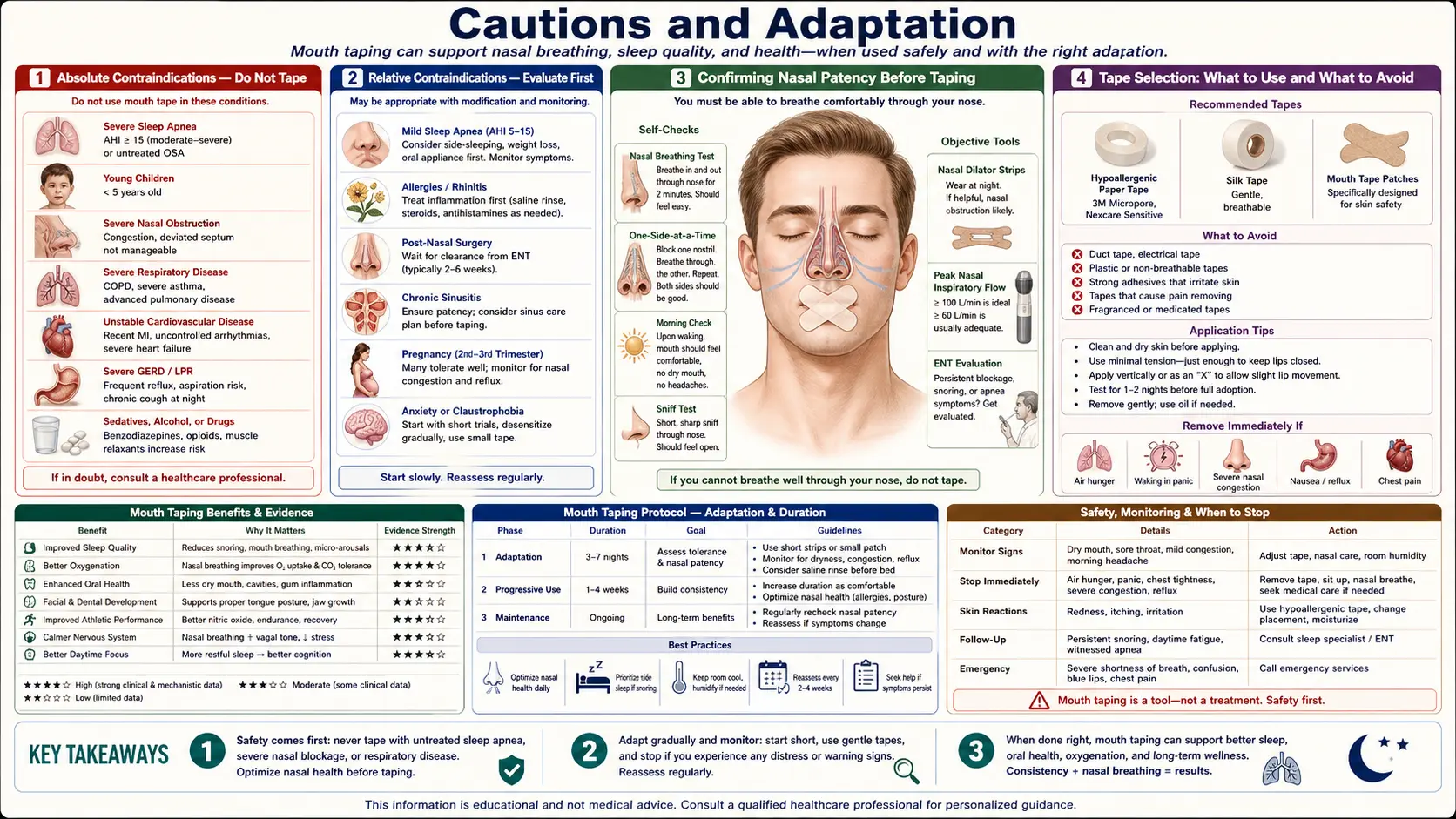
Mouth taping — holding the lips closed with tape or an adhesive patch during sleep — rests on a small research base. A 2025 systematic review in PLOS ONE found 10 eligible studies, rated all of them poor quality, and concluded that the data do not support mouth taping as a sound clinical intervention for the general population with sleep-disordered breathing, describing a potentially serious risk of harm for people who practise it indiscriminately. This deep dive sets out which groups the research raises concerns for, who the studies excluded, what tape the studies used and how they applied it, what is known about tolerance and skin reactions, and where the evidence is simply missing.
Table of Contents
- Groups the Research Raises the Strongest Concerns For
- Who the Studies Excluded
- Nasal Obstruction and Mouth Closure
- What Tape the Studies Used
- How the Studies Applied the Tape
- Adaptation Schedules: What Has Been Studied
- Skin Reactions and Tolerance
- Findings of Harm or No Benefit
- Children, Pregnancy, Older Adults and Other Groups
- Key Research Papers
- Connections
- Featured Videos
Groups the Research Raises the Strongest Concerns For
No study of mouth taping has set out formal contraindications. The concerns below come from what the study authors and reviewers wrote about risk, and from the groups the studies left out.
- Nasal obstruction. The 2025 systematic review (Rhee and colleagues) found that four of its ten studies explicitly discussed a serious risk of asphyxiation from closing the mouth in the presence of nasal obstruction or regurgitation, and that many studies excluded anyone with nasal obstruction or nasal disease. The reviewers wrote of “potential serious detrimental health outcomes” for people with nasal obstruction who tape their mouths. The nasal obstruction section below covers the research on blocked noses during sleep.
- Moderate-to-severe obstructive sleep apnea (OSA). The two studies that found a lower apnea-hypopnea index (AHI) with mouth closure alone enrolled only people with mild OSA (AHI below 15). The authors of one of them (Lee 2022) wrote: “Mouth-taping is not recommended for moderate or severe OSA patients because it may impose dangers rather than benefits in these patients.” In a 2024 sleep-endoscopy trial of 54 people with OSA (median AHI 26.9), closing the mouth increased airflow overall, but airflow worsened in those who breathed mainly through the mouth, and velopharyngeal obstruction was linked to reduced airflow with mouth closure. The Snoring and OSA deep dive covers the OSA evidence in more detail. The 2019 American Academy of Sleep Medicine guideline recommends positive airway pressure (PAP), compared with no therapy, for adults with OSA and excessive sleepiness.
- Regurgitation and vomiting. Study authors quoted in the 2025 review raised the possibility of aspiration of stomach contents if a person with a sealed mouth regurgitates during the night. The authors of a 1999 mouth-leak study wrote that they did not advocate taping the mouth “for indiscriminate long-term home use, because of the risk of asphyxia in the presence of nasal obstruction, machine or power failure, or regurgitation.”
- Sedative medicines and alcohol. A 2022 mouth-closure trial (Labarca and colleagues) excluded people currently taking benzodiazepines, hypnotics or opioids, so there are no trial data for these groups. A 2018 meta-analysis of observational studies linked alcohol use with higher odds of OSA (odds ratio about 1.33), with evidence the authors rated low to very low in quality. No study found for this page tested mouth taping after alcohol.
No case report of death or serious injury from mouth taping was found in PubMed when this page was checked (October 2026). The asphyxia and aspiration risks above are described by study authors and reviewers; they have not been measured in a published case series.
Who the Studies Excluded
The positive results come from narrowly selected adults, so they say little about anyone outside those groups. The exclusion lists, as reported in the studies and in the 2025 systematic review, include:
- Lee 2022 (20 mouth-breathers with mild OSA, ages 20–60, body mass index below 30). Excluded significant retrognathia, allergy to mouth tape, intolerance of mouth sealing (tape dislodged by morning), severe medical comorbidity, grade III/IV tonsil enlargement, previous nose, palate or tongue surgery, and shift workers. Participants with nasal obstruction were given medication and nasal spray before taping.
- Labarca 2022 (21 adults, AHI 10–50). Excluded current benzodiazepine, hypnotic or opioid use; other sleep disorders including insomnia, narcolepsy, central sleep apnea and parasomnia; failure to breathe comfortably through the nose; and allergy to adhesives.
- Jau and colleagues, 2023 (one of two studies that year). Excluded chronic psychiatric, neurological, renal and cardiovascular disease, diabetes, cancer, and cigarette or alcohol addiction.
- Age. The mean or median ages of the studies in the 2025 review ranged from 38 to 64 years. No study of mouth taping in children was found for this page.
People already using CPAP. This is a separate question from taping without other treatment. A 2025 randomized crossover trial of 62 people with OSA who breathed through the mouth during CPAP found that silicone mouth tape increased average CPAP use by 51.8 minutes per day and improved sleepiness scores, snoring ratings, mouth and throat dryness and night awakenings; the abstract states that adverse effects were reported, without listing them. A 1999 study of nine patients on nasal bilevel ventilation found that taping the mouth reduced mouth leak and lowered the arousal index.
Nasal Obstruction and Mouth Closure
The research on blocking the nose during sleep is the main reason nasal obstruction heads the list of concerns:
- Experimental obstruction. In a 1981 study of eight healthy people, a night with the nose obstructed brought more awakenings, more light sleep and a significant increase in obstructive apneas and hypopneas; one subject developed sleep apnea on the basis of the nasal obstruction alone.
- Nasal packing after surgery. In a 2011 study of 49 adults, postoperative nasal packing worsened measures of OSA in people with mild OSA (respiratory disturbance index 5.2 to 10.4) but not in those with moderate-to-severe OSA.
- Meta-analysis. A 2026 systematic review and meta-analysis found that nasal obstruction, induced surgically or non-surgically, was associated with an increase in AHI of 13.78 events per hour and in oxygen desaturation index of 7.45 events per hour. The same review found only two mouth-taping studies, too few to pool.
- Mouth breathing as a bypass. The authors of the 2024 sleep-endoscopy trial describe mouth breathing as a possible essential route around obstruction along the nasal route, such as the velopharynx; in that trial, heavy mouth breathers with velopharyngeal obstruction had less airflow when the mouth was closed.
The 2025 systematic review lists allergic rhinitis, enlarged adenoids and tonsils, and deviation of the nasal septum among the most common causes of mouth breathing. A 2016 review of nasal surgery for OSA reports that treating nasal obstruction with topical nasal steroid sprays or nasal dilators has been shown to improve sleep-disordered breathing, and that surgical treatment of nasal obstruction has been shown to improve sleep-disordered breathing, CPAP requirement and compliance with CPAP.
What Tape the Studies Used
The published studies used purpose-chosen medical materials, not household or industrial tape:
- Silicone hypoallergenic tape — Lee 2022 (mild OSA) and the 2025 CPAP crossover trial.
- A porous oral patch — Huang 2015: a three-layer skin pad of silicone sheet, polyurethane foam and polyurethane film.
- Microporous tape — Cooper 2009 (asthma), described as the tape used in the Buteyko technique.
- An adhesive mouthpiece — Labarca 2022, tested alone and combined with a mandibular advancement device.
Each of these studies tested a single material against no tape or against another treatment, so the research does not show whether one material is safer or better tolerated than another.
How the Studies Applied the Tape
Few studies describe the method in detail. In Lee 2022, a piece of silicone tape trimmed to 4 cm was placed on the philtrum, spanning the upper and lower lips. Huang 2015 used its porous patch to keep the mouth closed during sleep. In the 2024 sleep-endoscopy trial the mouth was not taped at all: researchers closed it by pressing on the chin until the teeth met, alternating breath by breath.
The vertical-strip, horizontal-strip and cross patterns, and step-by-step application routines, that circulate in popular sources were not compared in any study found for this page.
Adaptation Schedules: What Has Been Studied
None of the ten studies in the 2025 systematic review tested a graduated adaptation schedule, and the week-by-week programmes found in popular sources were not evaluated in any study found for this page. What the studies did report about duration:
- Mostly one night or one week. Lee 2022 compared a baseline home sleep test with a second test one week later under taping. The 2025 review’s risk-of-bias table records no follow-up for most of its studies.
- Four weeks. In the 2009 asthma crossover trial, 50 participants taped their mouths for a median of 26 of 28 nights.
- Thirty days. In the 2025 CPAP crossover trial, each intervention period lasted 30 days.
The role of daytime breathing habits is covered in the Daytime Breathing Habits deep dive.
Skin Reactions and Tolerance
The published studies say little about the skin. Lee 2022 excluded people with an allergy to mouth tape and Labarca 2022 excluded people with an allergy to adhesives, so people with known adhesive allergy are outside the evidence. The 2025 CPAP trial abstract reports that adverse effects occurred but does not list them. No study found here measured how often mouth tape irritates the lips or surrounding skin.
On tolerance, the 2009 asthma trial found that 36 participants rated mouth taping very or fairly acceptable. Lee 2022 enrolled only people who tolerated sealing of the mouth, so its results describe people who could keep the tape on.
Findings of Harm or No Benefit
Several studies found no benefit, or found effects that point the other way:
- Asthma. A randomized, single-blind crossover trial of 51 people with symptomatic asthma found that taping the mouth at night had no effect on morning peak flow, symptom scores or any secondary measure.
- Mouth closure alone in OSA. In Labarca 2022, the adhesive mouthpiece alone did not significantly lower AHI compared with baseline; the benefit appeared only when it was combined with a mandibular advancement device (median AHI 10.5 with the device alone versus 5.6 combined).
- Heavy mouth breathers. In the 2024 sleep-endoscopy trial, airflow worsened with mouth closure in people with high levels of mouth breathing, and the authors concluded that outcomes were heterogeneous.
- Air escaping past the tape. A 2023 study of people with OSA sleeping with taped mouths recorded “mouth puffing”; minutes with intermittent mouth puffing had a higher AHI and oxygen desaturation index than minutes without it.
The 2025 scoping review (Fangmeyer and colleagues) found nine eligible studies, described the literature as markedly heterogeneous with little consensus on benefits, and noted that few of the claims made about mouth taping on TikTok have been evaluated. The 2019 American Academy of Sleep Medicine guideline’s first good practice statement is that PAP treatment be based on a diagnosis of OSA established using objective sleep apnea testing; questions about snoring, pauses in breathing or daytime sleepiness belong with a clinician.
Children, Pregnancy, Older Adults and Other Groups
Children. No study of mouth taping in children was found; the studies in the 2025 systematic review had mean or median ages of 38 to 64. The same review notes that sleep-disordered breathing and OSA in children are typically managed with adenotonsillectomy, and a 2008 review describes adenotonsillectomy as the first line of treatment for pediatric OSA, while noting it may not be as efficacious as previously thought; the 2008 review reports that OSA affects up to 3% of non-obese, otherwise healthy children. Allergic rhinitis and enlarged adenoids and tonsils are among the common causes of mouth breathing the 2025 review lists.
Pregnancy. A 2026 narrative review reports that rising estrogen and progesterone in pregnancy engorge the nasal turbinates and progressively raise nasal airflow resistance, and that progressive nasal obstruction may contribute to mouth breathing, snoring and sleep-disordered breathing. It describes mouth taping in pregnancy as investigational because pregnancy-specific safety and efficacy data are absent.
Older adults. In a 2004 overnight study of 41 adults aged 20 to 66, oro-nasal breathing during sleep increased with age; people aged 40 or over were about six times more likely than younger people to spend more than half their sleep breathing oro-nasally. Lee 2022 enrolled only people aged 20 to 60, so there are no taping data for older age groups.
Chronic neurological, psychiatric and other medical disease. These groups were excluded from the studies (a 2023 study by Jau and colleagues excluded chronic psychiatric and neurological disease; Lee 2022 excluded severe medical comorbidity), so there are no data on mouth taping in them.
Central sleep apnea. Central sleep apnea is a different condition from obstructive apnea. A 2019 review describes one form, with a periodic breathing pattern, as often associated with heart failure, cerebrovascular disease and stays at high altitude, and another, based on hypoventilation, as associated with central nervous, neuromuscular and rib-cage disorders, obesity, and certain medicines or substances. The mouth-taping studies were done in mouth breathing and obstructive sleep apnea, and Labarca 2022 excluded people with central sleep apnea.
Key Research Papers
- Lee YC, Lu CT, Cheng WN, Li HY (2022). The impact of mouth-taping in mouth-breathers with mild obstructive sleep apnea: a preliminary study. Healthcare (Basel) 10(9):1755 — PubMed PMID: 36141367
- Huang TW, Young TH (2015). Novel porous oral patches for patients with mild obstructive sleep apnea and mouth breathing: a pilot study. Otolaryngology–Head and Neck Surgery 152(2):369–373 — PubMed PMID: 25450408
- Patil SP, Ayappa IA, Caples SM, Kimoff RJ, Patel SR, Harrod CG (2019). Treatment of adult obstructive sleep apnea with positive airway pressure: an American Academy of Sleep Medicine clinical practice guideline. Journal of Clinical Sleep Medicine 15(2):335–343 — PubMed PMID: 30736887
- Friedman M, Maley A, Kelley K, et al. (2011). Impact of nasal obstruction on obstructive sleep apnea. Otolaryngology–Head and Neck Surgery 144(6):1000–1004 — PubMed PMID: 21493302
- Mickelson SA (2016). Nasal surgery for obstructive sleep apnea syndrome. Otolaryngologic Clinics of North America 49(6):1373–1381 — PubMed PMID: 27720463
- Choi JE, Waddell JN, Lyons KM, Kieser JA (2016). Intraoral pH and temperature during sleep with and without mouth breathing. Journal of Oral Rehabilitation 43(5):356–363 — PubMed PMID: 26666708
- Gozal D, Kheirandish-Gozal L (2008). The multiple challenges of obstructive sleep apnea in children: morbidity and treatment. Current Opinion in Pediatrics 20(6):654–658 — PubMed PMID: 19005334
- Guilleminault C, Huang YS (2018). From oral facial dysfunction to dysmorphism and the onset of pediatric OSA. Sleep Medicine Reviews 40:203–214 — PubMed PMID: 29103943
- Brockmann PE, Bertrand P, Pardo T, et al. (2012). Prevalence of habitual snoring and associated neurocognitive consequences among Chilean school aged children. International Journal of Pediatric Otorhinolaryngology 76(9):1327–1331 — PubMed PMID: 22748305
- Camacho M, Certal V, Abdullatif J, et al. (2015). Myofunctional therapy to treat obstructive sleep apnea: a systematic review and meta-analysis. Sleep 38(5):669–675 — PubMed PMID: 25348130
- Bonuck K, Freeman K, Chervin RD, Xu L (2012). Sleep-disordered breathing in a population-based cohort: behavioral outcomes at 4 and 7 years. Pediatrics 129(4):e857–e865 — PubMed PMID: 22392181
- Olsen KD, Kern EB, Westbrook PR (1981). Sleep and breathing disturbance secondary to nasal obstruction. Otolaryngology–Head and Neck Surgery 89(5):804–810 — PubMed PMID: 6799913
- Rhee J, Iansavitchene A, Mannala S, Graham ME, Rotenberg B (2025). Breaking social media fads and uncovering the safety and efficacy of mouth taping in patients with mouth breathing, sleep disordered breathing, or obstructive sleep apnea: a systematic review. PLOS ONE 20(5):e0323643 — PubMed PMID: 40397877
- Fangmeyer SK, Badger CD, Thakkar PG (2025). Nocturnal mouth-taping and social media: a scoping review of the evidence. American Journal of Otolaryngology 46(1):104545 — PubMed PMID: 39662104
- Alshehri NA, Alsaif NF, Abdulrazaq AN, Jabor RM, Al-Sayed AA (2026). Impact of nasal obstruction and mouth taping on sleep apnea indicators: systematic review and meta-analysis. OTO Open 10(3):e70294 — PubMed PMID: 42662994
- Yang H, Huyett P, Wang TY, et al. (2024). Mouth closure and airflow in patients with obstructive sleep apnea: a nonrandomized clinical trial. JAMA Otolaryngology–Head & Neck Surgery 150(11):1012–1019 — PubMed PMID: 39361293
- Labarca G, Sands SA, Cohn V, et al. (2022). Mouth closing to improve the efficacy of mandibular advancement devices in sleep apnea. Annals of the American Thoracic Society 19(7):1185–1192 — PubMed PMID: 35254967
- Jau JY, Kuo TBJ, Li LPH, et al. (2023). Mouth puffing phenomena of patients with obstructive sleep apnea when mouth-taped: device’s efficacy confirmed with physical video observation. Sleep and Breathing 27(1):153–164 — PubMed PMID: 35277783
- Meksukree A, Pitipanyakul S, Laohavinij W, et al. (2025). The role of mouth tape for CPAP use in patients with mouth breathing and OSA. Journal of Clinical Sleep Medicine 21(12):2063–2071 — PubMed PMID: 40963295
- Cooper S, Oborne J, Harrison T, Tattersfield A (2009). Effect of mouth taping at night on asthma control: a randomised single-blind crossover study. Respiratory Medicine 103(6):813–819 — PubMed PMID: 19285849
- Teschler H, Stampa J, Ragette R, Konietzko N, Berthon-Jones M (1999). Effect of mouth leak on effectiveness of nasal bilevel ventilatory assistance and sleep architecture. European Respiratory Journal 14(6):1251–1257 — PubMed PMID: 10624751
- Madronio MR, Di Somma E, Stavrinou R, et al. (2004). Older individuals have increased oro-nasal breathing during sleep. European Respiratory Journal 24(1):71–77 — PubMed PMID: 15293607
- Taveira KVM, Kuntze MM, Berretta F, et al. (2018). Association between obstructive sleep apnea and alcohol, caffeine and tobacco: a meta-analysis. Journal of Oral Rehabilitation 45(11):890–902 — PubMed PMID: 29971810
- Herkenrath SD, Randerath WJ (2019). More than heart failure: central sleep apnea and sleep-related hypoventilation. Respiration 98(2):95–110 — PubMed PMID: 31291632
- Babbar S, Maulik D (2026). Nasal breathing in pregnancy: a narrative review of physiology, dysregulation and therapeutic interventions. Journal of Maternal-Fetal & Neonatal Medicine 39(1):2728784 — PubMed PMID: 42705916