Snoring and Sleep Apnea
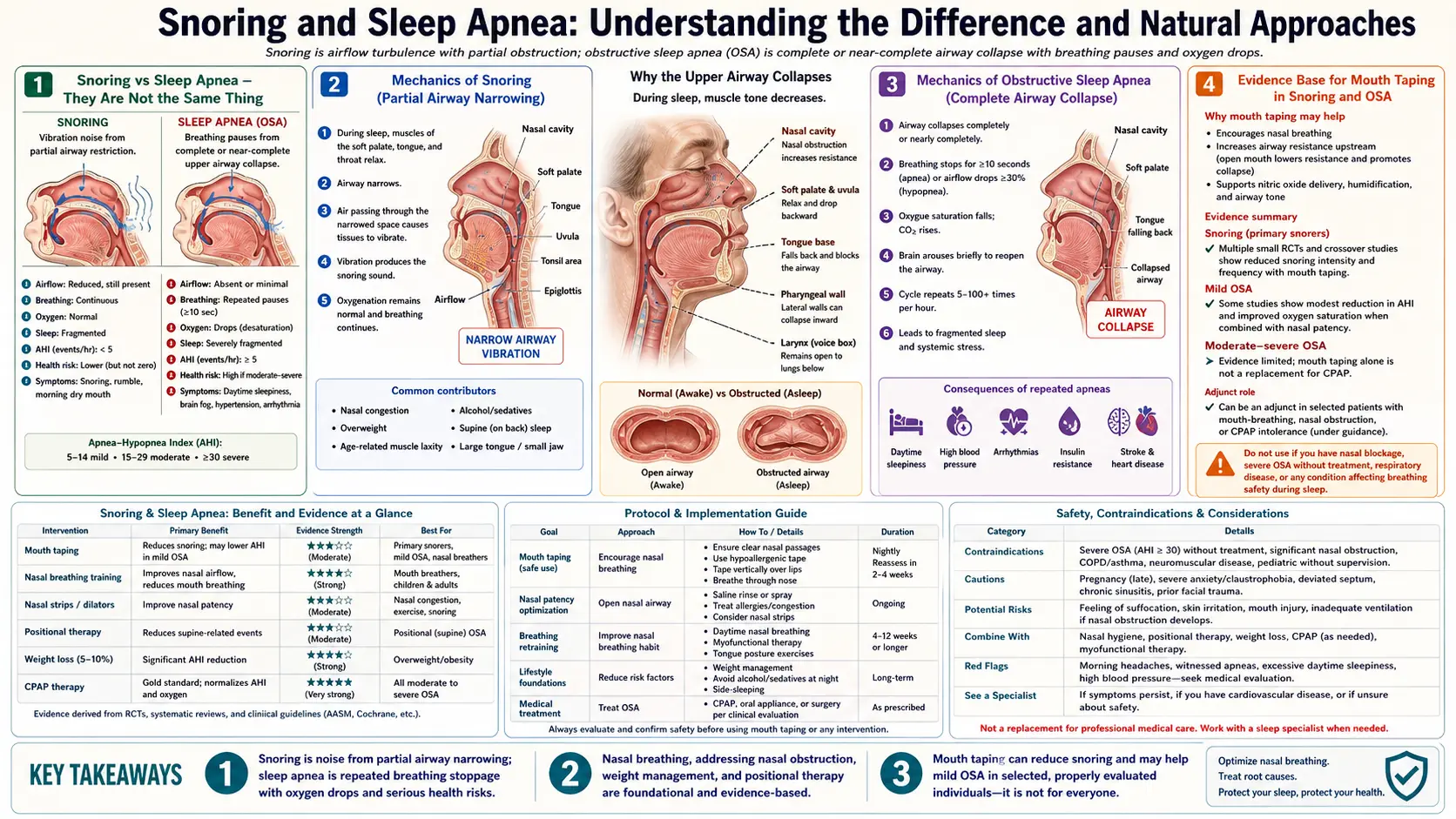
Snoring and obstructive sleep apnea (OSA) are often discussed together in the popular mouth-taping conversation, but they are different conditions. A German otolaryngology guideline describes snoring as soft-tissue vibration in the upper airway and states that, on current knowledge, snoring is not associated with medical hazard; OSA is repeated narrowing or collapse of the throat during sleep, and in two community cohorts moderate-to-severe or severe sleep apnea was linked with higher mortality. Two small studies found a lower apnea-hypopnea index with mouth closure in mild OSA, and a 2025 systematic review rated all ten mouth-taping studies it found poor quality, concluding that the data do not support mouth taping as a sound clinical intervention for the general population with sleep-disordered breathing. This deep dive sets out what those studies measured, what the sleep-medicine guidelines say about testing and treatment, and the research on mouth tape used alongside CPAP.
Interactive Visualization Sleep Apnea — collapse the airway, then splint it open with CPAP Watch the throat close as sleep deepens, the chest heave against a shut airway and oxygen slide into the 80s — then switch on CPAP and see the whole night go quiet. Launch →
Table of Contents
- Snoring vs. Sleep Apnea — They Are Not the Same Thing
- The Mechanics of Snoring
- The Mechanics of Obstructive Sleep Apnea
- The Evidence Base for Mouth Taping in Snoring and OSA
- The Lee 2022 Taiwan Study
- The Huang 2015 Porous Oral Patch Study
- Sleep Testing: What the Guidelines Say
- What the AASM Guidelines and Statements Say
- Mouth Tape Used Alongside CPAP
- Key Research Papers
- Connections
- Featured Videos
Snoring vs. Sleep Apnea — They Are Not the Same Thing
A 2010 review of the acoustics of snoring describes snoring as vibration of structures in the pharyngeal airway, affecting 20–40% of the general population, with flutter of the soft palate accounting for the harsh quality of the sound. A 2015 German otolaryngology guideline describes snoring as soft-tissue vibration triggered by the relaxation of the upper-airway dilator muscles during sleep, of multifactorial origin, and states that according to current knowledge snoring is not associated with medical hazard.
Obstructive sleep apnea (OSA) is a different condition. A 2008 review describes it as repetitive narrowing or collapse of the pharyngeal airway during sleep, associated with excessive daytime sleepiness and an increased risk of cardiovascular disease. Severity is graded by the apnea-hypopnea index (AHI), the number of apneas and hypopneas per hour of sleep. The Wisconsin Sleep Cohort used cutpoints of 5, 15 and 30 events per hour to identify mild, moderate and severe sleep-disordered breathing:
- Mild: AHI from 5 to under 15 events per hour
- Moderate: AHI from 15 to under 30 events per hour
- Severe: AHI 30 or more events per hour
A 2021 American Heart Association scientific statement reports that about 34% of middle-aged men and 17% of middle-aged women meet the diagnostic criteria for OSA, and that OSA prevalence is as high as 40% to 80% in people with hypertension, heart failure, coronary artery disease, pulmonary hypertension, atrial fibrillation and stroke.
Two community cohorts published in 2008 followed people tested for sleep apnea and counted deaths. In the Wisconsin Sleep Cohort (1,522 people, 18 years of follow-up), the adjusted hazard ratio for death from any cause with severe versus no sleep-disordered breathing was 3.0; after the 126 people who had used CPAP were excluded, it was 3.8 for death from any cause and 5.2 for cardiovascular death. In the Busselton Health Study in Western Australia (380 people analysed, up to 14 years of follow-up), moderate-to-severe OSA was associated with a fully adjusted hazard ratio of 6.24 for death from any cause, while mild OSA was not an independent risk factor for higher mortality.
The distinction matters for mouth taping because a change in snoring is not a measurement of OSA. The 2017 American Academy of Sleep Medicine (AASM) diagnostic guideline recommends that clinical tools, questionnaires and prediction algorithms not be used to diagnose OSA in adults in the absence of polysomnography or home sleep apnea testing. The mouth-taping studies described below measured AHI with a sleep test, not with snoring reports.
The Mechanics of Snoring
The 2010 acoustics review lists body position, sleep stage, the route of breathing and the presence or absence of sleep-disordered breathing among the influences on snoring, and notes that it can vary within and between nights. Several laboratory studies looked at what happens to the airway when the mouth is open during sleep:
- Airway resistance. In a 2003 randomized, single-blind crossover study of 12 healthy adults, upper-airway resistance during sleep was much higher when breathing through the mouth (median 12.4 cmH2O/L/s) than through the nose (5.2), and obstructive apneas and hypopneas were far more frequent with oral breathing (AHI 43 versus 1.5). During wakefulness, resistance was similar for the two routes.
- Collapsibility. In a 1996 study of six healthy sleeping volunteers, opening the mouth made the upper airway more collapsible (critical closing pressure −12.7 cmH2O with the mouth open versus −16.4 with it closed) and increased total respiratory resistance.
- Airway shape. In a 2011 CT study of 52 people with OSA, opening the mouth reduced the narrowest cross-sectional areas behind the soft palate and behind the tongue and lengthened the upper airway, at every OSA severity, without changing total airway volume.
These findings are the physiological basis usually given for keeping the mouth closed during sleep. A 2024 trial, described in the next section, found that closing the mouth does not have the same effect in everyone.
The Mechanics of Obstructive Sleep Apnea
The 2008 review describes the pathophysiology of OSA as multifactorial and notes that it may vary considerably between individuals; obesity, male sex and aging are among the important risk factors, though the mechanisms behind them are not clearly understood. The AHA statement describes OSA as recurrent complete and partial obstruction of the upper airway, resulting in intermittent drops in blood oxygen, autonomic fluctuation and sleep fragmentation.
Research on breathing route in OSA:
- In a 2006 study of 41 snorers with normal nasal resistance, the 28 who had OSA spent more of the night breathing through the mouth or through mouth and nose together than the 13 simple snorers, and AHI was the main factor related to the time spent breathing orally.
- A 2011 review of the nose in snoring and OSA found that nasal obstruction is associated with snoring and mild sleep-disordered breathing, but that there is no linear relationship between the degree of nasal obstruction and OSA severity, and nasal obstruction is not the main contributing factor in most people with moderate-to-severe OSA.
- In a 2024 sleep-endoscopy trial of 54 people with OSA (median AHI 26.9), researchers closed the mouth by pressing on the chin on alternating breaths. Closing the mouth increased inspiratory airflow overall, but the results were heterogeneous: airflow improved in people with moderate levels of mouth breathing, showed no change in those with near-zero mouth breathing, and worsened in those who breathed mainly through the mouth. Velopharyngeal obstruction was linked to more mouth breathing and to reduced airflow when the mouth was closed. The authors describe mouth breathing as possibly an essential route around obstruction along the nasal route in some patients.
The Evidence Base for Mouth Taping in Snoring and OSA
A 2025 systematic review in PLOS ONE (Rhee and colleagues) searched the literature from February 1999 to February 2024 and found 10 eligible studies with a total of 213 patients. Using the Newcastle-Ottawa Scale, the reviewers rated all of them poor quality. Two studies showed statistically significant improvement in AHI or oxygen desaturations; other studies found no differences, and some discussed potential risks, including asphyxiation in the presence of nasal obstruction. Many studies excluded anyone with nasal obstruction or nasal disease. The reviewers concluded that the existing data do not support mouth taping or oral occlusion as a sound clinical intervention for the general population with sleep-disordered breathing, and that there appears to be a potentially serious risk of harm for people who follow the trend indiscriminately.
What the individual studies report, by group:
- Snoring. In the two mild-OSA studies, snoring measures fell along with AHI: in Huang 2015 the snoring index fell from 146.7 to 40.0 per hour and snoring intensity from 49.1 to 41.1 dB; in Lee 2022 the median snoring index fell by 47%, from 303.8 to 121.1 events per hour.
- Mild OSA (AHI 5 to under 15). Huang 2015 (30 patients) reported a fall in median AHI from 12.0 to 7.8 events per hour; Lee 2022 (20 patients) reported a fall from 8.3 to 4.7.
- Moderate-to-severe OSA. In a 2022 crossover pilot study of 21 adults with AHI between 10 and 50 (Labarca and colleagues; baseline AHI 24.3), an adhesive mouthpiece used alone did not significantly reduce AHI compared with baseline; combined with a mandibular advancement device, it lowered median AHI to 5.6, against 10.5 with the device alone. The authors of Lee 2022, who enrolled only mild OSA, wrote: “Mouth-taping is not recommended for moderate or severe OSA patients because it may impose dangers rather than benefits in these patients.”
- People already using CPAP. This is a separate question from taping without other treatment, covered in the CPAP section below.
The Lee 2022 Taiwan Study
Lee and colleagues published a preliminary study in Healthcare (Basel) in 2022. According to the full text, it was a retrospective study conducted in 2020–2021 at a hospital medical center in Taoyuan, Taiwan. It enrolled 20 mouth-breathers aged 20 to 60 with mild OSA who tolerated sealing of the mouth. A piece of silicone hypoallergenic tape trimmed to 4 cm was placed on the philtrum, spanning the upper and lower lips. Each participant had a baseline home sleep test and a second home sleep test one week later with the mouth taped.
The published results:
- Median AHI fell from 8.3 to 4.7 events per hour (47%, p = 0.0002); supine AHI fell from 9.4 to 5.5.
- Median snoring index fell by 47%, from 303.8 to 121.1 events per hour; 13 of the 20 patients (65%) met the study’s definition of a good response, a fall of at least 50% in snoring index.
- The oxygen desaturation index fell from 8.7 to 5.8 and the lowest oxygen saturation rose from 82.5% to 87%; mean saturation did not change significantly.
- Greater baseline AHI, oxygen desaturation index and snoring index were associated with greater improvement.
The authors list the study’s limitations: a small sample with no control group, so a placebo effect could not be ruled out; a retrospective design with a short follow-up and no long-term evaluation; a home sleep test that may underestimate OSA severity; and a low proportion of women. They note possible low long-term adherence and call for prospective studies with larger samples and control groups.
The Huang 2015 Porous Oral Patch Study
Huang and Young published a prospective pilot study in Otolaryngology–Head and Neck Surgery in 2015, carried out at a tertiary referral center in Taiwan. It enrolled 30 patients with mild OSA (AHI of at least 5 but under 15 events per hour) and habitual open-mouth breathing during sleep. All slept with the mouth closed by a porous oral patch, a skin pad of three layers: a silicone sheet, polyurethane foam and polyurethane film. Measurements were made before and during patch use with polysomnography and cephalometry (x-ray measurement of the airway).
The published results, before versus during patch use:
- Median AHI fell from 12.0 to 7.8 events per hour (P < .01).
- Epworth Sleepiness Scale scores fell from 8.1 to 5.2 and visual analog snoring scores from 7.5 to 2.4.
- Snoring intensity fell from 49.1 to 41.1 dB and the median snoring index from 146.7 to 40.0 per hour.
- The space behind the soft palate widened from 7.4 to 8.6 mm and the space behind the tongue from 6.8 to 10.2 mm.
The authors concluded that the patch is a useful device for patients with mild OSA and habitual open-mouth breathing. The study compared each patient with themselves before and during treatment, enrolled only mild OSA, and tested a purpose-made patch rather than ordinary tape.
Sleep Testing: What the Guidelines Say
The 2017 AASM clinical practice guideline on diagnostic testing for adult OSA states that polysomnography is the standard diagnostic test in adults in whom there is a concern for OSA based on a comprehensive sleep evaluation. Its recommendations include:
- Polysomnography, or home sleep apnea testing with a technically adequate device, for uncomplicated adults with signs and symptoms that indicate an increased risk of moderate to severe OSA (strong recommendation).
- Polysomnography if a single home sleep apnea test is negative, inconclusive or technically inadequate (strong).
- Polysomnography rather than home testing in people with significant cardiorespiratory disease, possible respiratory muscle weakness from a neuromuscular condition, awake hypoventilation or suspected sleep-related hypoventilation, chronic opioid use, a history of stroke, or severe insomnia (strong).
- No diagnosis of OSA from clinical tools, questionnaires or prediction algorithms alone, without polysomnography or home testing (strong).
The 2021 AHA scientific statement recommends screening for OSA in people with resistant or poorly controlled hypertension, pulmonary hypertension, and recurrent atrial fibrillation after cardioversion or ablation. A 2020 review of two common throat-examination scales, the modified Mallampati grade and Friedman tongue position, describes controversy over their practical usefulness and a lack of consistency between examiners.
The groups the mouth-taping research raises concerns for, and the people the studies excluded, are set out in Cautions and Adaptation. Questions about snoring, pauses in breathing or daytime sleepiness belong with a clinician.
What the AASM Guidelines and Statements Say
Three AASM clinical practice guidelines cover the main treatments for adult OSA:
- Positive airway pressure (2019). The guideline recommends that clinicians use PAP, compared with no therapy, to treat OSA in adults with excessive sleepiness (strong), and suggests it for adults with impaired sleep-related quality of life or comorbid hypertension (conditional). Its first good practice statement is that PAP treatment be based on a diagnosis of OSA established using objective sleep apnea testing.
- Oral appliances (2015, with the American Academy of Dental Sleep Medicine). The guideline recommends that sleep physicians consider oral appliances, rather than no treatment, for adults with OSA who are intolerant of CPAP or prefer an alternative, and prescribe them, rather than no therapy, for adults who request treatment of primary snoring without OSA.
- Surgical referral (2021). The guideline recommends that clinicians discuss referral to a sleep surgeon with adults with OSA and a body mass index under 40 who are intolerant or unaccepting of PAP, and referral to a bariatric surgeon for adults with OSA and a body mass index of 35 or more who are intolerant or unaccepting of PAP.
None of these three guideline abstracts mentions mouth taping. The 2021 AHA statement states that continuous positive airway pressure should be offered to patients with severe OSA, that oral appliances can be considered for mild to moderate OSA or for people intolerant of CPAP, and that all patients with OSA should be considered for treatment, including behavioral modification and weight loss as indicated.
No AASM position statement on mouth taping was found for this page. In a July 2023 press release on viral sleep trends, the AASM reported that 12% of 2,005 U.S. adults in a survey it commissioned had tried mouth taping, and quoted a spokesperson: “At best, these viral trends are unproven, but at worst – like mouth taping – they can be extremely dangerous.”
The research on nasal versus oral breathing is covered in the Nasal Breathing Benefits deep dive.
Mouth Tape Used Alongside CPAP
The authors of Lee 2022 note that mouth breathing affects adherence to nasal CPAP. Studies of mouth tape used together with pressure therapy:
- 2025 randomized crossover trial. In 62 people with OSA (mean AHI 45.8) who breathed through the mouth during CPAP, silicone hypoallergenic mouth tape was compared with no tape for 30 days each, separated by a one-week washout. With tape, average CPAP use rose by 51.8 minutes per day, 17.6% more days reached at least 4 hours of use, and the odds ratio for good adherence was 4.5. Sleepiness scores, snoring ratings, mouth and throat dryness and night awakenings improved. The abstract states that adverse effects were reported, without listing them.
- 1999 study of mouth leak. In nine patients on long-term nasal bilevel ventilation with symptomatic mouth leak, taping the mouth closed for one night reduced median leak from 0.35 to 0.06 L/s, lowered the arousal index in every patient (mean 35.0 to 13.9 per hour) and increased REM sleep from 12.9% to 21.1% of sleep time.
- 2025 case report. A single case report in Sleep Medicine describes mouth taping with PAP therapy in a patient with severe OSA; PubMed lists no abstract for it.
In these studies the tape was added to pressure therapy rather than used in its place, which is a different question from mouth taping without other treatment.
Key Research Papers
- Lee YC, Lu CT, Cheng WN, Li HY (2022). The impact of mouth-taping in mouth-breathers with mild obstructive sleep apnea: a preliminary study. Healthcare (Basel) 10(9):1755 — PubMed PMID: 36141367
- Huang TW, Young TH (2015). Novel porous oral patches for patients with mild obstructive sleep apnea and mouth breathing: a pilot study. Otolaryngology–Head and Neck Surgery 152(2):369–373 — PubMed PMID: 25450408
- Meurice JC, Marc I, Carrier G, Sériès F (1996). Effects of mouth opening on upper airway collapsibility in normal sleeping subjects. American Journal of Respiratory and Critical Care Medicine 153(1):255–259 — PubMed PMID: 8542125
- Kim EJ, Choi JH, Kim KW, Kim TH, Lee SH, Lee HM, Shin C, Lee KY, Lee SH (2011). The impacts of open-mouth breathing on upper airway space in obstructive sleep apnea: 3-D MDCT analysis. European Archives of Oto-Rhino-Laryngology 268(4):533–539 — PubMed PMID: 20957487
- Fitzpatrick MF, McLean H, Urton AM, Tan A, O’Donnell D, Driver HS (2003). Effect of nasal or oral breathing route on upper airway resistance during sleep. European Respiratory Journal 22(5):827–832 — PubMed PMID: 14621092
- Koutsourelakis I, Vagiakis E, Roussos C, Zakynthinos S (2006). Obstructive sleep apnoea and oral breathing in patients free of nasal obstruction. European Respiratory Journal 28(6):1222–1228 — PubMed PMID: 17005578
- Patil SP, Ayappa IA, Caples SM, Kimoff RJ, Patel SR, Harrod CG (2019). Treatment of adult obstructive sleep apnea with positive airway pressure: an American Academy of Sleep Medicine clinical practice guideline. Journal of Clinical Sleep Medicine 15(2):335–343 — PubMed PMID: 30736887
- Madronio MR, Di Somma E, Stavrinou R, Kirkness JP, Goldfinch E, Wheatley JR, Amis TC (2004). Older individuals have increased oro-nasal breathing during sleep. European Respiratory Journal 24(1):71–77 — PubMed PMID: 15293607
- Friedman M, Maley A, Kelley K, Leesman C, Patel A, Pulver T, Joseph N, Catli T (2011). Impact of nasal obstruction on obstructive sleep apnea. Otolaryngology–Head and Neck Surgery 144(6):1000–1004 — PubMed PMID: 21493302
- Georgalas C (2011). The role of the nose in snoring and obstructive sleep apnoea: an update. European Archives of Oto-Rhino-Laryngology 268(9):1365–1373 — PubMed PMID: 21340561
- Yu JL, Rosen I (2020). Utility of the modified Mallampati grade and Friedman tongue position in the assessment of obstructive sleep apnea. Journal of Clinical Sleep Medicine 16(2):303–308 — PubMed PMID: 31992434
- Brockmann PE, Bertrand P, Pardo T, Cerda J, Reyes B, Holmgren NL (2012). Prevalence of habitual snoring and associated neurocognitive consequences among Chilean school aged children. International Journal of Pediatric Otorhinolaryngology 76(9):1327–1331 — PubMed PMID: 22748305
- Rhee J, Iansavitchene A, Mannala S, Graham ME, Rotenberg B (2025). Breaking social media fads and uncovering the safety and efficacy of mouth taping in patients with mouth breathing, sleep disordered breathing, or obstructive sleep apnea: a systematic review. PLOS ONE 20(5):e0323643 — PubMed PMID: 40397877
- Yang H, Huyett P, Wang TY, et al. (2024). Mouth closure and airflow in patients with obstructive sleep apnea: a nonrandomized clinical trial. JAMA Otolaryngology–Head & Neck Surgery 150(11):1012–1019 — PubMed PMID: 39361293
- Labarca G, Sands SA, Cohn V, et al. (2022). Mouth closing to improve the efficacy of mandibular advancement devices in sleep apnea. Annals of the American Thoracic Society 19(7):1185–1192 — PubMed PMID: 35254967
- Meksukree A, Pitipanyakul S, Laohavinij W, Chaitusaney B, Chirakalwasan N, Hirunwiwatkul P, Charakorn N (2025). The role of mouth tape for CPAP use in patients with mouth breathing and OSA. Journal of Clinical Sleep Medicine 21(12):2063–2071 — PubMed PMID: 40963295
- Teschler H, Stampa J, Ragette R, Konietzko N, Berthon-Jones M (1999). Effect of mouth leak on effectiveness of nasal bilevel ventilatory assistance and sleep architecture. European Respiratory Journal 14(6):1251–1257 — PubMed PMID: 10624751
- Sumner J, Cano CA (2025). Sealing the deal? Mouth taping with PAP therapy improves sleep consolidation in a case of severe OSA. Sleep Medicine 129:383–385 — PubMed PMID: 40132384
- Young T, Finn L, Peppard PE, Szklo-Coxe M, Austin D, Nieto FJ, Stubbs R, Hla KM (2008). Sleep disordered breathing and mortality: eighteen-year follow-up of the Wisconsin sleep cohort. Sleep 31(8):1071–1078 — PubMed PMID: 18714778
- Marshall NS, Wong KK, Liu PY, Cullen SR, Knuiman MW, Grunstein RR (2008). Sleep apnea as an independent risk factor for all-cause mortality: the Busselton Health Study. Sleep 31(8):1079–1085 — PubMed PMID: 18714779
- Eckert DJ, Malhotra A (2008). Pathophysiology of adult obstructive sleep apnea. Proceedings of the American Thoracic Society 5(2):144–153 — PubMed PMID: 18250206
- Yeghiazarians Y, Jneid H, Tietjens JR, Redline S, Brown DL, El-Sherif N, Mehra R, Bozkurt B, Ndumele CE, Somers VK (2021). Obstructive sleep apnea and cardiovascular disease: a scientific statement from the American Heart Association. Circulation 144(3):e56–e67 — PubMed PMID: 34148375
- Kapur VK, Auckley DH, Chowdhuri S, Kuhlmann DC, Mehra R, Ramar K, Harrod CG (2017). Clinical practice guideline for diagnostic testing for adult obstructive sleep apnea: an American Academy of Sleep Medicine clinical practice guideline. Journal of Clinical Sleep Medicine 13(3):479–504 — PubMed PMID: 28162150
- Ramar K, Dort LC, Katz SG, Lettieri CJ, Harrod CG, Thomas SM, Chervin RD (2015). Clinical practice guideline for the treatment of obstructive sleep apnea and snoring with oral appliance therapy: an update for 2015. Journal of Clinical Sleep Medicine 11(7):773–827 — PubMed PMID: 26094920
- Kent D, Stanley J, Aurora RN, Levine C, Gottlieb DJ, Spann MD, Torre CA, Green K, Harrod CG (2021). Referral of adults with obstructive sleep apnea for surgical consultation: an American Academy of Sleep Medicine clinical practice guideline. Journal of Clinical Sleep Medicine 17(12):2499–2505 — PubMed PMID: 34351848
- Stuck BA, Dreher A, Heiser C, Herzog M, Kühnel T, Maurer JT, Pistner H, Sitter H, Steffen A, Verse T (2015). Diagnosis and treatment of snoring in adults — S2k Guideline of the German Society of Otorhinolaryngology, Head and Neck Surgery. Sleep and Breathing 19(1):135–148 — PubMed PMID: 24729153
- Pevernagie D, Aarts RM, De Meyer M (2010). The acoustics of snoring. Sleep Medicine Reviews 14(2):131–144 — PubMed PMID: 19665907