Aspirin: History and Origins
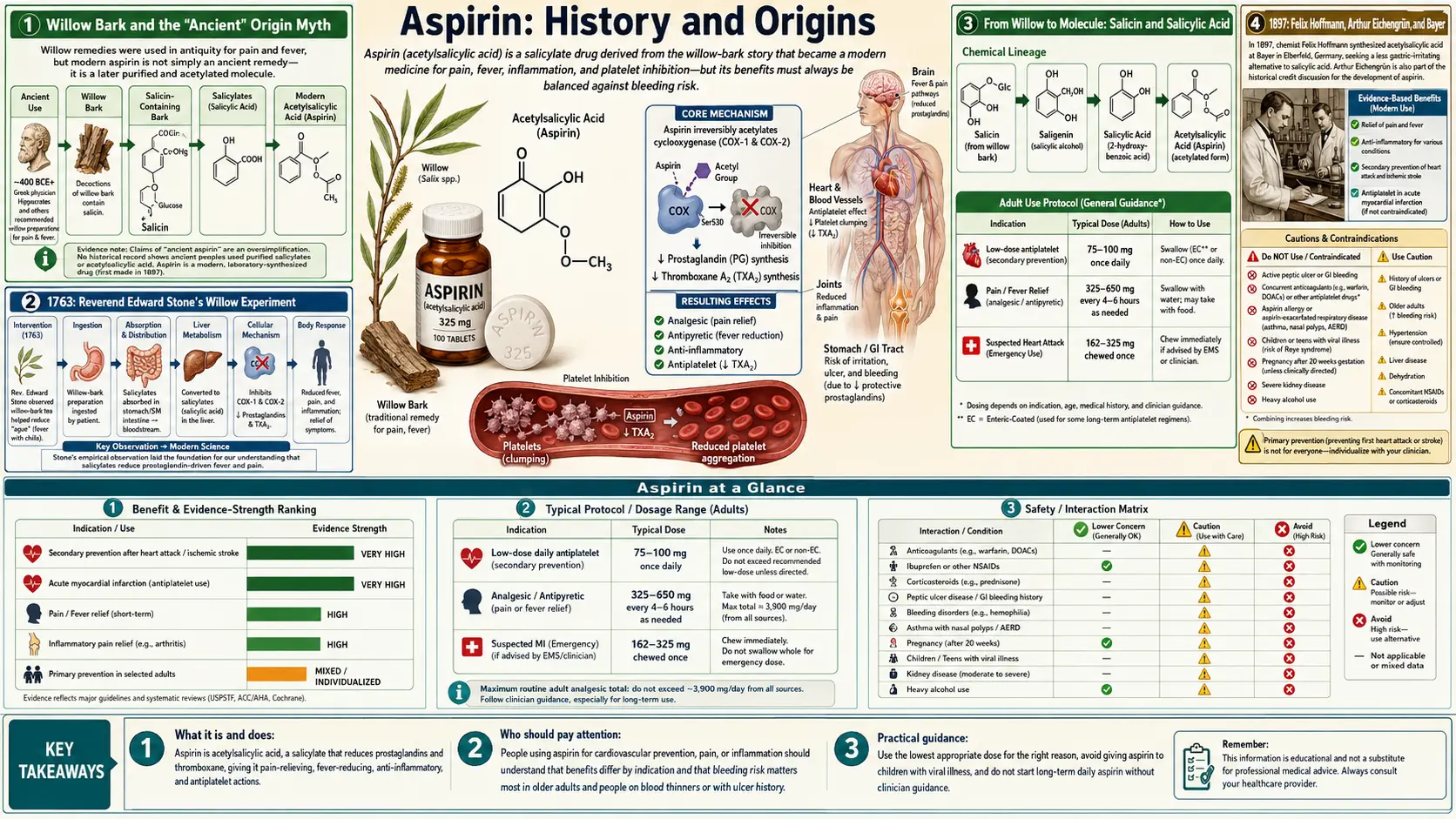
Aspirin — acetylsalicylic acid — is, in the words of a 2017 history review, “now the most commonly used drug in the world.” The same review traces the story back more than 3,500 years, to willow bark used as a pain reliever and antipyretic, and through an Oxfordshire clergyman, scientists at a German dye manufacturer, a Nobel Prize-winning discovery and a series of pivotal clinical trials (PMID: 28106908). This article follows that chain: Edward Stone's 1763 report on willow bark, the nineteenth-century chemists who isolated salicin and made salicylic acid, the 1897 preparation of pure acetylsalicylic acid and the still-argued question of whether Felix Hoffmann or Arthur Eichengrün deserves the credit, Vane's 1971 explanation of how the drug works, and the trials that changed how aspirin is used.
Table of Contents
- Willow Bark in Ancient Medicine
- 1763: Reverend Edward Stone's Willow Experiment
- From Willow to Molecule: Salicin and Salicylic Acid
- 1897: Felix Hoffmann and Pure Acetylsalicylic Acid
- The Disputed Credit: Hoffmann vs. Eichengrün
- 1899: The Name "Aspirin" and Its Trademark
- 1971: John Vane Finds Out How It Works
- Evidence & Reception: From Cure-All to Careful Use
- Key Research Papers
- Connections
- Featured Videos
Willow Bark in Ancient Medicine
Histories of aspirin begin with willow (the genus Salix). A 2017 review in the British Journal of Haematology traces the story back more than 3,500 years, to when willow bark was used as a pain reliever and antipyretic (PMID: 28106908). A 2019 review gives the same span and names the Sumerians and Egyptians, and then physicians of ancient Greece and Rome, as users of willow bark against pain and fever (PMID: 30391545).
Writing in 2000, the pharmacologist John Vane placed the first record about 3,500 years ago in the Ebers papyrus, and wrote that Hippocrates, Celsus, Pliny the Elder, Dioscorides and Galen all recommended decoctions containing salicylate for rheumatic pain; most or all of the early herbal remedies for rheumatism turned out to contain salicylates (PMID: 11192932). A French review of 2000 states that Hippocrates recommended chewing willow leaves for pain in childbirth (PMID: 10763200), and a German review of rheumatic remedies says willow bark has been considered a remedy against fever, pain and gout for 4,000 years (PMID: 18437401). The reviews differ on the exact span, but none of them treats ancient willow use as a myth.
The chemistry links the old remedy to the modern drug: willow contains salicin, from which salicylic acid was later made, and acetylsalicylic acid is the acetylated form of salicylic acid (PMID: 18175528). Willow bark itself is covered on the Willow Bark page.
1763: Reverend Edward Stone's Willow Experiment
In 1763 the Reverend Edward Stone of Chipping Norton in Oxfordshire wrote to the Earl of Macclesfield, then President of the Royal Society, with “An account of the success of the bark of the willow in the cure of agues,” published in the Society's Philosophical Transactions (doi:10.1098/rstl.1763.0033). A 2015 commentary on the letter calls it the first convincing demonstration of a potent antipyretic effect of willow bark (PMID: 25750237); Vane called it the first “clinical trial” of willow bark (PMID: 11192932).
According to Vane, Stone was surprised by the bark's bitter taste, which reminded him of cinchona bark (the source of quinine, then used to treat malaria) (PMID: 11192932). The 2015 commentary adds his reasoning that “many natural maladies carry their cures along with them, or that their remedies lie not far from their causes” — the willow grew in the damp places where agues were common. Stone gathered a pound of willow bark, left it next to a baker's oven for three months, then pulverized and sifted it; he first took 20 grains himself and, seeing no ill effects, tested the powder on around 50 people (PMID: 25750237). Vane quotes Stone's stated aim: “I have no other motives for publishing this valuable specific, than that it may have a fair and full trial in all its variety of circumstances and situations, and that the world may reap the benefits accruing from it” (PMID: 11192932).
An Italian history of anti-rheumatic therapy describes Stone's 1763 report as the first report of willow bark extract in treating malaria (PMID: 20657891). Salicylates lower fever; the reviews cited here do not say whether the agues Stone treated were cured or simply relieved.
From Willow to Molecule: Salicin and Salicylic Acid
Stone used the whole bark; nineteenth-century chemists worked out what in the bark was active and how to make it in quantity.
- Salicin. Buchner first isolated the active ingredient of willow bark (a 2015 commentary dates this to 1827 (PMID: 25750237); a 2006 Czech review to 1828 (PMID: 17323609)). In 1829 the French pharmacist Leroux isolated salicin (PMID: 18175528), obtaining about 30 g of purified salicin from 1.5 kg of bark (PMID: 25750237).
- Salicylic acid. The Italian chemist Raffaele Piria was the first to make salicylic acid from salicin (PMID: 18175528); a German review dates salicylic acid to 1838 (PMID: 18437401). In 1833 the chemist Löwig prepared an acid he called Spirsäure from meadowsweet (Spiraea ulmaria) and wintergreen (PMID: 17323609) — the name that later supplied the “spir” in aspirin.
- Synthetic salicylic acid. The German chemist Hermann Kolbe published a synthesis of salicylic acid in Justus Liebigs Annalen der Chemie in 1860 (doi:10.1002/jlac.18601130120); Vane also dates it to 1860 (PMID: 11192932), while the Science History Institute biography of Hoffmann gives 1859 (Science History Institute). Kolbe prepared salicylic acid from sodium phenate and carbon dioxide (PMID: 18175528). According to Vane, its ready supply led to wider use as an external antiseptic, as an antipyretic and in the treatment of rheumatism (PMID: 11192932).
- Salicin in rheumatism. In 1876 the antirheumatic effect of salicin was described by T. MacLagan, and that of salicylic acid by Stricker and Riess (PMID: 20509453); MacLagan's Lancet paper was reprinted with commentary in 2002 (PMID: 12064852).
- The first acetylsalicylic acid (1853). The French chemist Charles Gerhardt reported the reaction of sodium salicylate with acetyl chloride in work done in 1852 and published in 1853. He thought the product was an acid anhydride, but what he had obtained was crude acetylsalicylic acid. Von Gilm made acetylsalicylic acid by another method in 1859, and Gerhardt's product was shown to be the same compound in 1869 (PMID: 11624864).
1897: Felix Hoffmann and Pure Acetylsalicylic Acid
The decisive step came in 1897 at the Elberfeld laboratories of a German dye and pharmaceutical company. A 2017 review describes the scientists involved as working at “a German dye manufacturer” (PMID: 28106908). According to the long-standing account, the chemist Felix Hoffmann prepared the first sample of pure acetylsalicylic acid on 10 August 1897 (PMID: 11124191); a 2015 commentary describes it as a pure form suitable for medical use (PMID: 25750237).
Hoffmann (1868–1946) studied chemistry and pharmacy at the University of Munich, graduating in 1893, and joined the company's newly established pharmaceutical research department; in the summer of 1897 he was adding the acetyl group to many molecules (Science History Institute). The same biography notes that Heinrich Dreser instructed Hoffmann to acetylate morphine, producing heroin, a compound that had already been discovered in 1874 by an English chemist (Science History Institute).
The best-known version of the story says Hoffmann made the compound to help his rheumatic father, who disliked the unpleasant effects of sodium salicylate. Sneader's 2000 reappraisal traces that account to a footnote in a 1934 history of chemical engineering by Albrecht Schmidt (PMID: 11124191), and a French review calls the story of Hoffmann testing the compound on himself and his arthritic father a legend (PMID: 10763200).
Dreser was head of experimental pharmacology at Elberfeld. Sneader reports that, according to Eichengrün, Dreser believed it “harmful to the heart” and opposed clinical trials (PMID: 11124191).
The Disputed Credit: Hoffmann vs. Eichengrün
The rival claim belongs to Arthur Eichengrün, a chemist at the same company who, according to a 2015 commentary, directed Hoffmann's work (PMID: 25750237). In 1949 Eichengrün wrote in Pharmazie that the work had been done under his direction; he died on 23 December 1949, the month the account appeared. He had made similar claims in a letter typed in 1944 in the Theresienstadt concentration camp, where he was held because he was Jewish; the letter is in the company's archives (PMID: 11124191).
In 2000 the pharmaceutical historian Walter Sneader of the University of Strathclyde published a reappraisal in the BMJ. He found that archival and published material supports Eichengrün's claim and throws doubt on the reliability of the source crediting Hoffmann, judged it likely that acetylsalicylic acid was synthesised under Eichengrün's direction and would not have been introduced in 1899 without his intervention, and concluded: “The most reasonable conclusion is that Arthur Eichengrün was telling the truth” (PMID: 11124191). The Science History Institute writes that evidence has surfaced that Eichengrün played a significant role, and that it has been suggested he was left out of the story as told since the 1930s because he was Jewish (Science History Institute).
Accounts still differ. A 2003 review by Vane and Botting (PMID: 14592543) and a 2019 history (PMID: 30391545) describe Hoffmann as the chemist who made aspirin in 1897, while Sneader's reappraisal and the 2015 commentary give the directing role to Eichengrün. The surviving evidence, as these sources present it, does not settle the exact division of credit.
1899: The Name "Aspirin" and Its Trademark
Acetylsalicylic acid was marketed in 1899 under the registered trademark Aspirin (PMID: 11124191). The name is a contraction of acetyl and Spirsäure, an old name for salicylic acid (PMID: 25750237), which Löwig had obtained from meadowsweet, Spiraea ulmaria (PMID: 17323609).
In the United States the company obtained a patent that gave it the monopoly on manufacturing the drug from 1900 to 1917. Its American plants were sold in 1919 as part of the reparations exacted from Germany after the First World War, and the American firm that bought them was unable to protect the trademark status of aspirin, which became a staple of the over-the-counter market in the United States and elsewhere (Science History Institute).
One darker episode belongs to this early era. A 2009 historical analysis put forward the hypothesis that aspirin contributed to deaths in the 1918–1919 influenza pandemic: the regimens then used (8.0–31.2 g per day) produce levels associated with hyperventilation and pulmonary edema, and the US Surgeon General, the US Navy and the Journal of the American Medical Association recommended aspirin just before the October 1918 death spike. The author presented this as a hypothesis, not a measured result (PMID: 19788357).
1971: John Vane Finds Out How It Works
For about seventy years aspirin was used without anyone knowing how it worked. In 1971 the British pharmacologist John Vane (1927–2004), then at the Institute of Basic Medical Sciences of the University of London in the Royal College of Surgeons of England (NobelPrize.org), published in Nature New Biology his finding that aspirin-like drugs inhibit prostaglandin synthesis (doi:10.1038/newbio231232a0).
The enzyme involved is now called cyclooxygenase (COX). Vane and Botting wrote in 2003 that by inhibiting it, aspirin-like drugs block the prostaglandins that cause inflammation, swelling, pain and fever, but also the prostaglandins that protect the stomach lining, maintain kidney function and aggregate platelets — a unifying explanation for both the therapeutic actions and the shared side effects of the drug class. About twenty years later a second COX gene was found: COX-1 supports normal housekeeping functions, while COX-2 is induced by inflammatory mediators (PMID: 14592543). A 2026 review states that once-daily low-dose aspirin (75–100 mg) completely and permanently inactivates COX-1 in platelets, suppressing thromboxane A2-dependent platelet activation (PMID: 41592353).
In 1982 Vane shared the Nobel Prize in Physiology or Medicine with Sune Bergström and Bengt Samuelsson “for their discoveries concerning prostaglandins and related biologically active substances” (NobelPrize.org).
Evidence & Reception: From Cure-All to Careful Use
Aspirin's use against heart disease began with clinical observation. In 1953 the physician Lawrence Craven reported prescribing aspirin to hundreds of adult male patients for the prevention of coronary thrombosis (PMID: 19390498), and an Italian history credits him with identifying aspirin's anti-platelet property (PMID: 20657891).
The large trials came later. In the ISIS-2 trial, published in 1988, 17,187 patients with suspected acute myocardial infarction were randomised; one month of 160 mg/day enteric-coated aspirin reduced 5-week vascular mortality to 9.4%, against 11.8% with placebo tablets (PMID: 2899772). A 2009 meta-analysis by the Antithrombotic Trialists' Collaboration found low-dose aspirin of “definite and substantial net benefit for many people who already have occlusive vascular disease,” with reductions of about a fifth in total stroke and in coronary events in secondary prevention (PMID: 19482214). Twenty-year follow-up of five randomised trials found that aspirin taken for several years at doses of at least 75 mg daily reduced long-term colorectal cancer incidence and mortality (PMID: 20970847).
For primary prevention — people with no established cardiovascular disease — the same 2009 meta-analysis judged aspirin of uncertain net value, because the reduction in occlusive events had to be weighed against an increase in major bleeds (PMID: 19482214). Three trials reported in 2018 addressed the question:
- ARRIVE (12,546 people at moderate estimated risk, 100 mg enteric-coated aspirin): the primary endpoint occurred in 4.29% with aspirin and 4.48% with placebo (hazard ratio 0.96, not significant), and gastrointestinal bleeding events, mostly mild, in 0.97% and 0.46%. The event rate was much lower than expected, so the authors could not address the role of aspirin at moderate risk (PMID: 30158069).
- ASCEND (15,480 adults with diabetes and no evident cardiovascular disease, 100 mg daily): fewer serious vascular events with aspirin, but major bleeding in 4.1% of the aspirin group; the authors wrote that the absolute benefits were largely counterbalanced by the bleeding hazard (PMID: 30146931).
- ASPREE (19,114 people aged 70 or older, or 65 or older among Black and Hispanic participants in the United States): no significant reduction in cardiovascular disease (hazard ratio 0.95) and a significantly higher risk of major hemorrhage (hazard ratio 1.38) (PMID: 30221597).
In 2022 the US Preventive Services Task Force recommended against initiating low-dose aspirin for primary prevention of cardiovascular disease in adults 60 or older (a D recommendation), and stated that for adults aged 40 to 59 with a 10% or greater 10-year cardiovascular risk the decision should be an individual one, the net benefit being small (a C recommendation) (PMID: 35471505).
Aspirin also carries real harms. In the 2009 meta-analysis, aspirin increased major gastrointestinal and extracranial bleeds, and in primary prevention haemorrhagic stroke was 0.04% versus 0.03% per year (PMID: 19482214). Reye's syndrome — encephalopathy with fatty degeneration of the liver, usually after influenza or chickenpox — was linked to aspirin; warnings about salicylates in children with those infections began in 1980, and US surveillance recorded a sharp fall in reported cases, from a peak of 555 in 1980 to no more than 36 a year from 1987 (PMID: 10228187). Clinical evidence, doses and cautions are covered in the companion Aspirin Benefits articles and on the main Aspirin page; this history is concerned with how the drug came to be.
Key Research Papers
The list below combines key primary and historical sources on aspirin with curated PubMed topic-search links. Author names, titles, and journals are given as plain text; only the stable DOI, PMID, or archival link is hyperlinked, and each opens in a new tab. Historical primary documents (Edward Stone's 1763 letter; Arthur Eichengrün's own writings) are named in the article as historical sources.
- Stone E. An account of the success of the bark of the willow in the cure of agues. Philosophical Transactions of the Royal Society of London. 1763;53:195-200. — doi:10.1098/rstl.1763.0033
- Sneader W. The discovery of aspirin: a reappraisal. BMJ. 2000;321(7276):1591-1594. — PubMed PMID: 11124191
- Vane JR. Inhibition of prostaglandin synthesis as a mechanism of action for aspirin-like drugs. Nature New Biology. 1971;231(25):232-235. — doi:10.1038/newbio231232a0
- Desborough MJR, Keeling DM. The aspirin story — from willow to wonder drug. British Journal of Haematology. 2017;177(5):674-683. — PubMed PMID: 28106908
- Vane JR, Botting RM. The mechanism of action of aspirin. Thrombosis Research. 2003;110(5-6):255-258. — PubMed PMID: 14592543
- Jack DB. One hundred years of aspirin. The Lancet. 1997;350(9075):437-439. — PubMed PMID: 9259670
- Buchanan WW, Kean WF. The treatment of acute rheumatism by salicin, by T.J. Maclagan — The Lancet, 1876. The Journal of Rheumatology. 2002;29(6):1321-1323. — PubMed PMID: 12064852
- Nobel Prize in Physiology or Medicine 1982 (Sune K. Bergström, Bengt I. Samuelsson, John R. Vane). The Nobel Foundation. — NobelPrize.org — 1982 Medicine
- Vane JR. The fight against rheumatism: from willow bark to COX-1 sparing drugs. Journal of Physiology and Pharmacology. 2000;51(4 Pt 1):573-586. — PubMed PMID: 11192932
- Montinari MR, Minelli S, De Caterina R. The first 3500 years of aspirin history from its roots — a concise summary. Vascular Pharmacology. 2019;113:1-8. — PubMed PMID: 30391545
- Wood JN. From plant extract to molecular panacea: a commentary on Stone (1763) ‘An account of the success of the bark of the willow in the cure of the agues’. Philosophical Transactions of the Royal Society B. 2015;370(1666):20140317. — PubMed PMID: 25750237
- Lévesque H, Lafont O. [Aspirin throughout the ages: a historical review]. La Revue de Médecine Interne. 2000;21 Suppl 1:8s-17s. (In French.) — PubMed PMID: 10763200
- Kaiser H. [From the plant to chemistry — the early history of “rheumatic medication”]. Zeitschrift für Rheumatologie. 2008;67(3):252-262. (In German.) — PubMed PMID: 18437401
- Lafont O. [From the willow to aspirin]. Revue d'Histoire de la Pharmacie. 2007;55(354):209-216. (In French.) — PubMed PMID: 18175528
- Lafont O. [Clarification on publications concerning the synthesis of acetylsalicylic acid]. Revue d'Histoire de la Pharmacie. 1996;43(310):269-273. (In French.) — PubMed PMID: 11624864
- Jerie P. [Milestones of cardiovascular pharmacotherapy: salicylates and aspirin]. Časopis Lékařů Českých. 2006;145(12):901-904. (In Czech.) — PubMed PMID: 17323609
- Norn S, Permin H, Kruse PR, Kruse E. [From willow bark to acetylsalicylic acid]. Dansk Medicinhistorisk Årbog. 2009;37:79-98. (In Danish.) — PubMed PMID: 20509453
- Pasero G, Marson P. [A short history of anti-rheumatic therapy. II. Aspirin]. Reumatismo. 2010;62(2):148-156. (In Italian.) — PubMed PMID: 20657891
- Kolbe H. Ueber Synthese der Salicylsäure. Justus Liebigs Annalen der Chemie. 1860;113:125-127. — doi:10.1002/jlac.18601130120
- Starko KM. Salicylates and pandemic influenza mortality, 1918-1919 pharmacology, pathology, and historic evidence. Clinical Infectious Diseases. 2009;49(9):1405-1410. — PubMed PMID: 19788357
- Gensini GF, Conti AA. The preventive and therapeutic impact of antiplatelet agents: past and present. Minerva Medica. 2009;100(2):133-136. — PubMed PMID: 19390498
- ISIS-2 (Second International Study of Infarct Survival) Collaborative Group. Randomised trial of intravenous streptokinase, oral aspirin, both, or neither among 17,187 cases of suspected acute myocardial infarction: ISIS-2. The Lancet. 1988;2(8607):349-360. — PubMed PMID: 2899772
- Antithrombotic Trialists' (ATT) Collaboration. Aspirin in the primary and secondary prevention of vascular disease: collaborative meta-analysis of individual participant data from randomised trials. The Lancet. 2009;373(9678):1849-1860. — PubMed PMID: 19482214
- Rothwell PM, Wilson M, Elwin CE, et al. Long-term effect of aspirin on colorectal cancer incidence and mortality: 20-year follow-up of five randomised trials. The Lancet. 2010;376(9754):1741-1750. — PubMed PMID: 20970847
- Gaziano JM, Brotons C, Coppolecchia R, et al. Use of aspirin to reduce risk of initial vascular events in patients at moderate risk of cardiovascular disease (ARRIVE): a randomised, double-blind, placebo-controlled trial. The Lancet. 2018;392(10152):1036-1046. — PubMed PMID: 30158069
- ASCEND Study Collaborative Group; Bowman L, Mafham M, Wallendszus K, et al. Effects of aspirin for primary prevention in persons with diabetes mellitus. New England Journal of Medicine. 2018;379(16):1529-1539. — PubMed PMID: 30146931
- McNeil JJ, Wolfe R, Woods RL, et al. Effect of aspirin on cardiovascular events and bleeding in the healthy elderly. New England Journal of Medicine. 2018;379(16):1509-1518. — PubMed PMID: 30221597
- US Preventive Services Task Force; Davidson KW, Barry MJ, Mangione CM, et al. Aspirin use to prevent cardiovascular disease: US Preventive Services Task Force recommendation statement. JAMA. 2022;327(16):1577-1584. — PubMed PMID: 35471505
- Belay ED, Bresee JS, Holman RC, et al. Reye's syndrome in the United States from 1981 through 1997. New England Journal of Medicine. 1999;340(18):1377-1382. — PubMed PMID: 10228187
- Patrono C, Burn J, Patrignani P, Langley RE. Platelet activation, aspirin, and cancer: from basic science to clinical trials. Pharmacological Reviews. 2026;78(1):100109. — PubMed PMID: 41592353
- Aspirin history and the willow-to-drug story — PubMed PMID: 28106908
- Aspirin discovery, Hoffmann and Eichengrün — PubMed: aspirin discovery and disputed credit
External Authoritative Resources
- Science History Institute — Felix Hoffmann
- Wikipedia — History of aspirin (a general encyclopedia overview; no statement on this page rests on it alone)
- USPSTF — Aspirin to Prevent Cardiovascular Disease