⚠ Evidence warning: Clinical trials or other evidence do not support the claim that a quercetin-plus-zinc protocol, or zinc ionophores such as chloroquine and hydroxychloroquine, raise zinc inside the body's cells enough to stop viruses multiplying in people; the cited antiviral evidence comes from test tubes and cell culture. This page keeps it as a report of what people, websites or other media say.
Immune Boosting — Zinc and Selenium
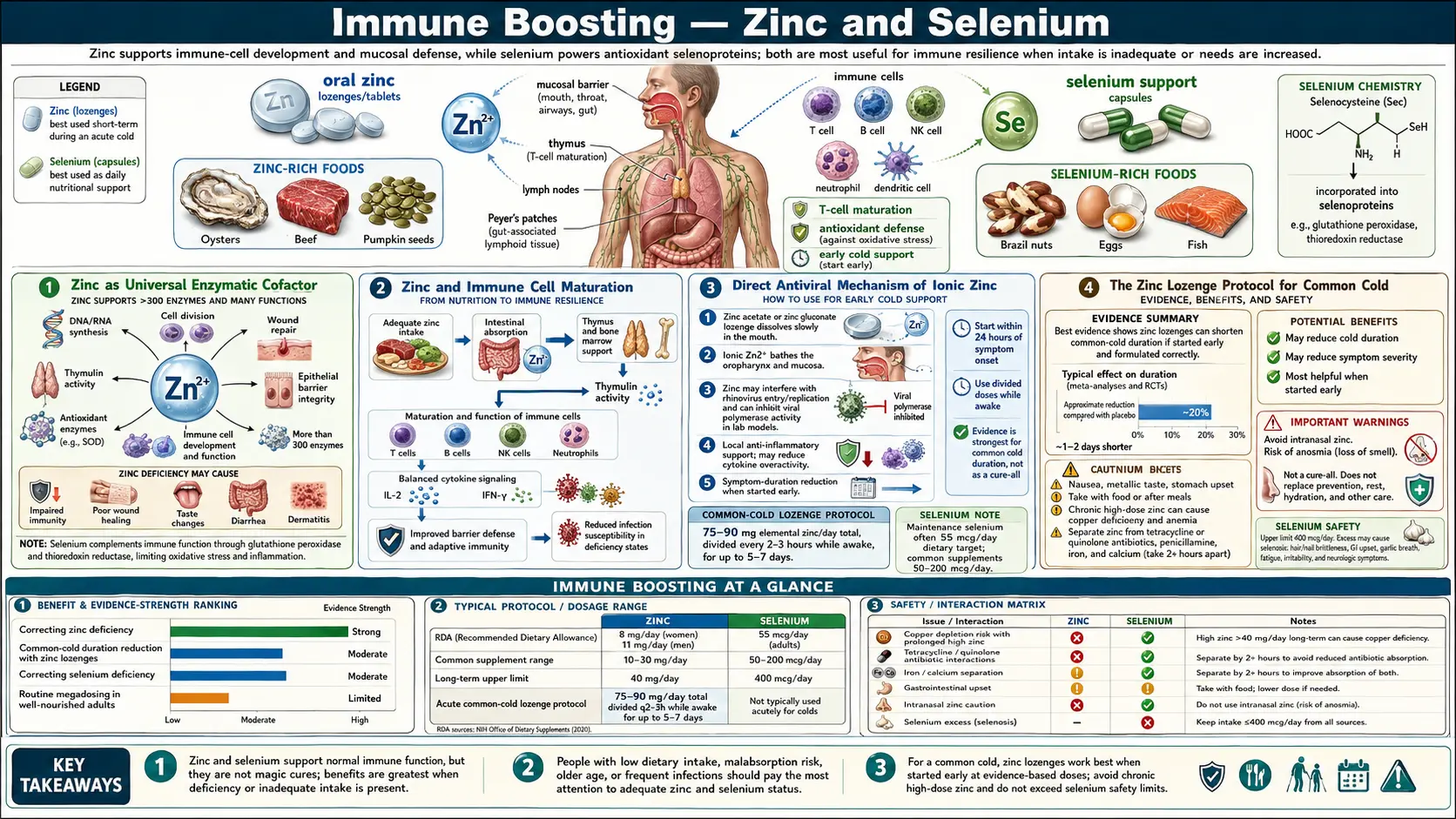
Zinc and selenium are the two redox-active trace minerals most central to antiviral and antibacterial defense. Zinc is the structural cofactor of more than 300 enzymes and more than 1,000 transcription factors, the master regulator of T-cell and natural killer-cell maturation in the thymus, and, in laboratory studies, a direct inhibitor of the RNA-copying enzyme (RNA-dependent RNA polymerase) of some viruses. Selenium is the catalytic atom in glutathione peroxidase and thioredoxin reductase — the two enzymes that determine whether oxidative stress damages or signals — and selenium status determines the in-vivo mutation rate of RNA viruses (the Beck mouse-coxsackievirus model). Together they govern both the cytotoxic capacity of innate immune cells and the antioxidant buffer that keeps that cytotoxicity from collaterally damaging host tissue. This deep-dive walks through the mechanism, the clinical evidence, and the practical dosing of both minerals as immune interventions.
Table of Contents
- Zinc as Universal Enzymatic Cofactor
- Zinc and Immune Cell Maturation
- Direct Antiviral Mechanism of Ionic Zinc
- The Zinc Lozenge Protocol for Common Cold
- Zinc and Copper Balance
- Selenium and Glutathione Peroxidase
- The Beck Mouse-Coxsackievirus Model
- Keshan Disease and Selenium Geography
- Practical Zinc and Selenium Dosing
- Cautions and Interactions
- Key Research Papers
- Connections
- Featured Videos
Zinc as Universal Enzymatic Cofactor
Zinc is the second most abundant trace mineral in the human body after iron. Total body zinc is approximately 2 to 3 grams, distributed across virtually every tissue but concentrated in skeletal muscle (60%), bone (30%), skin, liver, and the prostate. Unlike iron, zinc is not stored in a dedicated reservoir — there is no zinc equivalent of ferritin. Body zinc is functional zinc, in constant turnover, and serum zinc reflects recent intake more than total body content.
The biological role of zinc is dominated by its catalytic and structural function in enzymes. More than 300 human enzymes require a zinc atom for catalysis — including carbonic anhydrase, alkaline phosphatase, RNA polymerase, DNA polymerase, alcohol dehydrogenase, matrix metalloproteinases, and the Cu/Zn superoxide dismutase that protects against oxidative damage. Beyond enzymatic roles, more than 1,000 transcription factors (proteins that switch genes on and off) require zinc; many are zinc-finger proteins that bind DNA by holding a zinc atom between cysteine and histidine residues. A 2006 count of the human genome estimated that about 2,800 human proteins — about 10% of all human proteins — bind zinc, and zinc fingers are the largest group among them.
The clinical relevance: zinc deficiency simultaneously cripples hundreds of biochemical processes. The clinical phenotype of severe zinc deficiency includes growth retardation in children, hypogonadism in young men (first described by Ananda Prasad in Iran in 1961), dermatitis, delayed wound healing, taste and smell impairment (dysgeusia and anosmia), night blindness (zinc is required for activation of the rhodopsin visual cycle), diarrhea, and dramatically increased susceptibility to infection. The famous Prasad work began in Shiraz, Iran, with a 21-year-old man who looked like a 10-year-old boy and ate only bread made from whole wheat flour (the phytate in cereals binds zinc and blocks its absorption); the syndrome proved common in the villages around Shiraz, but zinc deficiency was only suspected there. Prasad's later studies in Egypt showed that zinc supplementation produced 12.7–15.2 cm of growth in one year and normal genital development within 3–6 months, and the essentiality of zinc in humans was established in 1963. This work established zinc as the prototypical "universal essential trace mineral" whose deficiency produces broad systemic phenotype.
Zinc and Immune Cell Maturation
The immune effects of zinc are concentrated at three molecular nodes: T-cell development in the thymus, natural killer cell cytotoxic function, and neutrophil chemotaxis and phagocytosis. Each depends on specific zinc-requiring proteins.
In the thymus, the hormone thymulin requires bound zinc to function. Zinc-deficient thymulin is biologically inactive. Thymulin drives the final stages of thymic T-cell maturation — the differentiation of double-positive thymocytes into mature naive CD4+ and CD8+ T cells before export to the periphery. Zinc-deficient animals develop thymic atrophy (the thymus shrinks dramatically) and have measurably reduced numbers of circulating naive T cells. Zinc supplementation in elderly subjects partially reverses age-related thymic involution and restores naive T cell output.
Natural killer cells require zinc for cytotoxic granule formation and for the conformational stability of the perforin and granzyme proteins that lyse virally infected and transformed cells. Zinc-deficient subjects have measurably reduced natural killer (NK) cell cytotoxic activity per cell, even when natural killer cell numbers are normal. The reduction in natural killer cytotoxicity is one mechanism by which zinc deficiency increases susceptibility to viral infection.
Neutrophils require zinc for both chemotaxis (the directed migration toward sites of infection) and phagocytosis (the engulfment of microbes). Zinc-deficient neutrophils respond more slowly to chemotactic signals and engulf fewer microbes per cell. This combines with reduced natural killer and T-cell function to produce the broad susceptibility-to-infection phenotype seen in zinc deficiency.
Beyond cell-autonomous effects, zinc shapes the Th1/Th2 balance through cytokine signaling. Adequate zinc supports Th1 cytokine production (interleukin-2 and interferon-gamma), favoring cellular immunity appropriate for intracellular pathogens and viruses. Zinc deficiency shifts the balance toward Th2 (interleukin-4, interleukin-5 and interleukin-10), favoring humoral and allergic responses inappropriately and reducing antiviral capacity.
Direct Antiviral Mechanism of Ionic Zinc
Beyond the cellular immunology effects, ionic zinc has a direct biochemical mechanism against viral replication. The 2010 te Velthuis et al. paper in PLoS Pathogens showed that Zn(2+) inhibits the RNA-dependent RNA polymerase (RdRp) of coronaviruses and arteriviruses in vitro. In these test-tube studies zinc blocked the starting step of RNA copying by the arterivirus enzyme, while for the SARS coronavirus enzyme it slowed the lengthening of the RNA chain and reduced binding to the RNA template. In cell culture, zinc stopped the two viruses multiplying when it was given together with pyrithione, a laboratory zinc ionophore (2 µM of each).
The challenge for therapeutic application is intracellular delivery. Zinc ion concentrations inside cells are tightly homeostatically regulated by zinc transporter proteins (ZnT and ZIP families); simply ingesting more zinc does not necessarily raise intracellular zinc to inhibitory concentrations. Zinc ionophores — molecules that shuttle zinc across the cell membrane independent of the regulated transporters — can raise intracellular zinc enough to achieve the antiviral effect. Quercetin (a flavonoid found in onions, apples, capers, red wine) and the antimalarial drugs chloroquine and hydroxychloroquine are zinc ionophores. The combined quercetin-plus-zinc protocol that has been used in some clinical settings exploits this ionophore mechanism.
For the upper respiratory tract specifically, ionic zinc released from zinc gluconate or zinc acetate lozenges achieves high local concentrations at the throat and nasopharyngeal mucosa — the site of rhinovirus and coronavirus replication. This local delivery is the basis for the zinc lozenge protocol covered in the next section.
The Zinc Lozenge Protocol for Common Cold
The clinical use of zinc lozenges for common cold dates to the 1984 Eby et al. double-blind, placebo-controlled trial of zinc gluconate lozenges (one 23 mg lozenge dissolved in the mouth every 2 waking hours after a first double dose). After 7 days, 86% of 37 people taking zinc had no symptoms, compared with 46% of 28 people taking placebo, and the authors reported that the lozenges shortened the average cold by about 7 days.
Subsequent trials have produced mixed results, with the variation explained primarily by formulation. The active mechanism is local delivery of ionic zinc to the nasopharyngeal mucosa. Lozenges that release ionic zinc effectively work; lozenges that bind the zinc with sweeteners, flavoring agents, or organic acids (citric acid forms unreleasable zinc citrate, sorbitol and mannitol also bind zinc) do not work, regardless of zinc content listed on the label.
A 2016 individual patient data meta-analysis by Hemilä and colleagues (three zinc acetate lozenge trials, 199 patients) found colds 2.7 to 2.9 days shorter with zinc acetate lozenges, against an average cold length of 7 days in those trials. A 2017 meta-analysis by Hemilä of seven trials (575 people) that used more than 75 mg of zinc a day found colds 33% shorter on average — 40% in the three zinc acetate trials and 28% in the four zinc gluconate trials, a difference that was not statistically significant. Five of the seven trials used 80–92 mg of zinc a day (typically 6–8 lozenges spaced through the day); two trials at 192–207 mg a day did no better, and the review found no evidence that doses over 100 mg a day work better.
The 2024 Cochrane review (34 randomized trials, 8,526 people, zinc in any form against placebo) found that zinc may make little or no difference to the chance of catching a cold (risk ratio 0.93, low-certainty evidence). When zinc was used to treat a cold already under way, colds may have been about 2.4 days shorter on average (8 trials, 972 people, low-certainty evidence), but the trials differed widely. Zinc used to treat colds probably increased non-serious side effects (risk ratio 1.34, moderate-certainty evidence); the side effects the review counted include unpleasant taste, vomiting, stomach cramps and diarrhoea.
The protocol as practitioners describe it:
- Started within 24 hours of the first symptom (sore throat, first sniffle)
- Zinc acetate lozenges — the formulation with the most clinical evidence for ionic-zinc release; zinc gluconate lozenges are the other common form
- 13–18 mg elemental zinc per lozenge, dissolved slowly (not chewed) in the mouth every 2–3 hours while awake
- Continued for up to 7 days or until symptoms resolve
- Kept at or below 100 mg/day and 7–10 days of use — the 2017 meta-analysis found no extra benefit above 100 mg a day, and chronic high-dose zinc impairs copper absorption (see next section)
- Lozenges without added citric acid, sorbitol, or mannitol, which bind zinc
Note: zinc nasal sprays and gels have been associated with loss of the sense of smell (anosmia), which can be long-lasting or permanent, in case reports and in the reports behind the FDA's 2009 warning (see Cautions). The clinical trial evidence described in this section is for lozenges.
Zinc and Copper Balance
Chronic high-dose zinc supplementation produces secondary copper deficiency. The mechanism: high luminal zinc in the small intestine induces production of metallothionein, an intestinal binding protein that has higher affinity for copper than for zinc. Copper bound to metallothionein in enterocytes is sloughed off in normal turnover and lost in stool rather than absorbed. Sustained zinc intake above approximately 50 mg/day for more than a few weeks can produce measurable copper depletion, with clinical sequelae of microcytic anemia (copper is required for iron incorporation into hemoglobin), neutropenia, neuropathy, and the rare but well-documented "zinc-induced myeloneuropathy" that mimics Vitamin B12 deficiency.
The practice usually described for long-term zinc supplementation:
- When zinc is taken at > 25 mg/day for > 4 weeks, 1–2 mg of copper daily is commonly added (as copper gluconate or bisglycinate; cupric oxide has poor bioavailability)
- Copper is usually taken at a different time of day from zinc (zinc inhibits copper absorption acutely)
- A zinc-to-copper ratio of no more than about 15:1 is commonly cited for long-term supplementation, with about 10:1 described as closer to the body's own balance
- For short-term use (the 1-week zinc lozenge course for a cold), copper is not usually added — the course is described as too short to deplete copper
For more on the broader role of these two minerals see our Zinc page and Copper page. The Morley Robbins work on copper, ceruloplasmin, and bioavailable iron metabolism — covered on our Morley Robbins page — is relevant for anyone exploring copper status more deeply.
Selenium and Glutathione Peroxidase
Selenium is biologically unique among trace minerals because it is incorporated into proteins as the 21st amino acid — selenocysteine — through a dedicated translation mechanism. The human genome encodes 25 known selenoproteins, of which the glutathione peroxidase family and the thioredoxin reductase family (three isoforms) are the most quantitatively important. Mammals have eight glutathione peroxidases (GPx1 through GPx8), but only five of them (GPx1–4 and GPx6) contain selenium; GPx5, GPx7 and GPx8 do not.
Glutathione peroxidase catalyzes the reduction of hydrogen peroxide and organic peroxides to water and the corresponding alcohol, using glutathione (reduced glutathione, GSH) as the electron donor. This is the primary intracellular mechanism for detoxifying the hydrogen peroxide generated as a byproduct of normal aerobic metabolism and as a deliberate weapon by phagocytic immune cells. Without selenium, the selenium-containing GPx enzymes cannot function, and the redox balance of every cell is disrupted — oxidative damage accumulates, and the regulated use of hydrogen peroxide as a signaling molecule is also impaired.
Thioredoxin reductase reduces oxidized thioredoxin, which in turn reduces oxidized protein cysteine residues throughout the cell, maintaining the reducing intracellular environment that enzymes and signaling molecules require to function. This system is critical for both detoxification of reactive oxygen species and for the proper folding of disulfide-containing proteins.
The immune relevance: phagocytic cells (neutrophils, macrophages) use the "respiratory burst" to generate superoxide, hydrogen peroxide, and hypochlorous acid as antimicrobial weapons. Adequate selenium status allows these cells to deploy oxidative weapons against engulfed pathogens without simultaneously damaging themselves or surrounding host tissue. Selenium-deficient phagocytes either fail to mount an adequate respiratory burst (impaired pathogen killing) or undergo self-destructive oxidative damage (impaired return to homeostasis after the infection clears).
The Beck Mouse-Coxsackievirus Model
The single most striking finding in the selenium-immunity literature is the Beck et al. demonstration that selenium status affects not just the host but the virus itself. Working in the 1990s and 2000s at the University of North Carolina, Beck showed that mice deficient in selenium infected with normally benign coxsackievirus B3 developed severe viral myocarditis — and when the virus was harvested from the heart tissue of these deficient mice and re-injected into selenium-replete mice, those mice now also developed myocarditis from a virus that had previously been benign.
The mechanism: in the high-oxidative-stress environment of a selenium-deficient cell, the coxsackievirus RNA genome accumulated mutations at an accelerated rate. Specific point mutations in the viral genome converted the avirulent strain into a virulent one, and the new virulent strain was now infectious for all subsequent hosts regardless of their selenium status. This was the first clean experimental demonstration that host nutrient deficiency drives viral evolution.
The implications extend beyond coxsackievirus. The same mechanism — oxidative stress-driven viral mutation in the deficient host — has been proposed for influenza virus evolution, with some observational evidence that selenium-deficient populations may serve as "reservoir" hosts where novel influenza strains emerge. Beck's work fundamentally reshaped thinking about the interaction between host nutritional status and infectious disease epidemiology — the deficient population is not just at higher individual risk; they may be the breeding ground for the next pandemic strain.
Keshan Disease and Selenium Geography
Selenium content of crops is determined by selenium content of the underlying soil, and soil selenium varies dramatically by geography. Regions with selenium-poor soil include parts of China (most famously Keshan County in Heilongjiang Province), New Zealand, Finland, parts of central Africa, and parts of the central United States. Regions with selenium-rich soil include the western United States, parts of Venezuela, and any region built on selenium-bearing volcanic substrate.
The eponymous Keshan disease — a juvenile dilated cardiomyopathy that occurred in epidemic patterns in Keshan County, China — was traced in the 1970s to the combination of selenium deficiency in the local diet plus coxsackievirus exposure. The selenium deficiency made the local population susceptible to coxsackievirus myocarditis; the high prevalence of the virus in the population produced an endemic disease. Selenium supplementation in China's Keshan disease areas reduced the disease sharply: a 2018 review of 41 community trials in China (nearly 2 million people) found protection rates over 80% in 35 of the trials and an overall risk ratio of 0.14, validating both the mechanism and the public health intervention.
Finland decided in 1984 to add selenium (as sodium selenate) to fertilizers, in response to recognition of widespread soil deficiency and a very low intake of about 0.025 mg a day in the 1970s; almost all fertilizers used in Finland since 1985 have contained it. Selenium in spring cereals rose about 15-fold, and average blood plasma selenium rose from 0.89 µmol/L to about 1.40 µmol/L, a level the researchers describe as optimal; the program has continued for forty years. Rates of heart disease and cancer stayed similar before and after the fertilizer program, so the researchers judged medical and lifestyle factors to be much stronger influences on those diseases than selenium.
For Americans in the western half of the country, dietary selenium intake from wheat and other grains is typically adequate. Eastern US populations and especially those eating primarily imported or local-soil produce from selenium-poor regions are the groups for whom selenium supplementation is most often discussed. A single Brazil nut contains approximately 70–90 micrograms of selenium — more than the daily Recommended Dietary Allowance (RDA) of 55 mcg — but Brazil nut selenium content is highly variable (depending on which region of Brazil the nuts came from), and overconsumption can produce selenium toxicity (selenosis: hair loss, brittle nails, garlic-breath odor, neuropathy). Intakes commonly described are two Brazil nuts a day or 100–200 mcg/day of selenium from selenomethionine supplements; the adult upper limit is 400 mcg/day.
Practical Zinc and Selenium Dosing
Doses commonly described for routine immune-support supplementation in adults:
- Zinc: 15–25 mg/day elemental zinc as picolinate, bisglycinate, or citrate. Usually taken with food (zinc can cause nausea on an empty stomach). The Recommended Dietary Allowance is 11 mg/day for men, 8 mg/day for women; 15–25 mg/day is a modest excess that accounts for the variable absorption and the phytate-binding losses from grain- and legume-heavy diets. The adult Tolerable Upper Intake Level is 40 mg/day from food and supplements combined.
- Copper: 1–2 mg/day as copper bisglycinate, usually taken at a different time of day than zinc. Commonly added when zinc is taken long term at >25 mg/day, and described as optional at lower doses.
- Selenium: 100–200 mcg/day as selenomethionine (the form best incorporated into selenoproteins) or as two Brazil nuts. The adult upper limit is 400 mcg/day; in one long-term trial, 200 mcg/day was followed by more type 2 diabetes than placebo (see Cautions).
For the acute zinc lozenge protocol for common cold, see the Zinc Lozenge Protocol section above. This is a short-term high-dose protocol distinct from the maintenance dosing.
Combined zinc/copper/selenium supplements are common in immune-support formulations. One common combination contains 15 mg zinc, 1 mg copper, and 100 mcg selenium per capsule, usually taken with the largest meal.
Cautions and Interactions
- Zinc-induced copper deficiency — chronic zinc >50 mg/day without copper produces microcytic anemia, neutropenia, and myeloneuropathy that mimics B12 deficiency. Copper is commonly added when zinc is taken long term above 25 mg/day.
- Zinc nasal gels and swabs and loss of smell — in 2009 the U.S. Food and Drug Administration (FDA) warned consumers about three intranasal zinc cold products (a nasal gel and two nasal swab products) after more than 130 reports of loss of the sense of smell (anosmia), which the FDA said may be long-lasting or permanent; many people reported it after the first dose. The warning covered nasal products, not lozenges.
- Zinc-quinolone interaction — zinc and other divalent cations bind fluoroquinolone antibiotics (ciprofloxacin, levofloxacin) and reduce absorption substantially. The antibiotic is usually taken at least 2 hours before or 6 hours after zinc.
- Zinc-tetracycline interaction — same chelation mechanism with tetracycline-class antibiotics (doxycycline, minocycline); doses are usually taken hours apart.
- Selenium toxicity (selenosis) — sustained intake >400 mcg/day produces hair loss (most distinctive sign), brittle nails, garlic-breath odor, nausea, and neuropathy. Brazil nut overconsumption is the most common cause — some nuts contain >500 mcg each.
- Zinc and hospital infection prevention — zinc supplementation in critically ill patients in intensive care units (ICUs) has shown modest reduction in hospital-acquired (nosocomial) pneumonia in some trials. The doses and patient selection in those trials were specific to hospital care.
- Pregnancy — both zinc (11–12 mg/day) and selenium (60 mcg/day) are required in pregnancy at slightly higher levels than non-pregnant baseline; typical prenatal vitamins provide adequate amounts. The Tolerable Upper Intake Levels in pregnancy are 40 mg/day of zinc (34 mg/day at age 18 and under) and 400 mcg/day of selenium.
- Selenium and type 2 diabetes — in a randomized trial in low-selenium areas of the eastern United States (1,202 people followed for an average of 7.7 years), 200 mcg/day of selenium — the top of the dose range on this page — was followed by more type 2 diabetes than placebo (12.6 vs 8.4 cases per 1,000 person-years; hazard ratio 1.55). The risk was highest in people whose blood selenium was already in the top third at the start (hazard ratio 2.70). Diabetes was a secondary outcome of a trial designed for another purpose.
Key Research Papers
- Prasad AS (2008). Zinc in human health: effect of zinc on immune cells. Molecular Medicine; 14(5-6):353-357. — PubMed PMID: 18385818
- Hemilä H, Petrus EJ, Fitzgerald JT, Prasad A (2016). Zinc acetate lozenges for treating the common cold: an individual patient data meta-analysis. British Journal of Clinical Pharmacology; 82(5):1393-1398. — PubMed PMID: 27378206
- Hemilä H (2017). Zinc lozenges and the common cold: a meta-analysis comparing zinc acetate and zinc gluconate, and the role of zinc dosage. JRSM Open; 8(5):2054270417694291. — PubMed PMID: 28515951
- te Velthuis AJ et al. (2010). Zn(2+) inhibits coronavirus and arterivirus RNA polymerase activity in vitro and zinc ionophores block the replication of these viruses in cell culture. PLoS Pathogens; 6(11):e1001176. — PubMed PMID: 21079686
- Rayman MP (2012). Selenium and human health. Lancet; 379(9822):1256-1268. — PubMed PMID: 22381456
- Wessels I et al. (2017). Zinc as a gatekeeper of immune function. Nutrients; 9(12):1286. — PubMed PMID: 29186856
- Hoffmann PR, Berry MJ (2008). The influence of selenium on immune responses. Molecular Nutrition & Food Research; 52(11):1273-1280. — PubMed PMID: 18384097
- Read SA et al. (2019). The role of zinc in antiviral immunity. Advances in Nutrition; 10(4):696-710. — PubMed PMID: 31305906
- Avery JC, Hoffmann PR (2018). Selenium, selenoproteins, and immunity. Nutrients; 10(9):1203. — PubMed PMID: 30200430
- Eby GA, Davis DR, Halcomb WW (1984). Reduction in duration of common colds by zinc gluconate lozenges in a double-blind study. Antimicrobial Agents and Chemotherapy; 25(1):20-24. — PubMed PMID: 6367635
- Nault D, Machingo TA, Shipper AG, Antiporta DA, Hamel C, Nourouzpour S, Konstantinidis M, Phillips E, Lipski EA, Wieland LS (2024). Zinc for prevention and treatment of the common cold. Cochrane Database of Systematic Reviews; 5(5):CD014914. — PubMed PMID: 38719213
- Beck MA, Levander OA, Handy J (2003). Selenium deficiency and viral infection. Journal of Nutrition; 133(5 Suppl 1):1463S-1467S. — PubMed PMID: 12730444
- Prasad AS (2013). Discovery of human zinc deficiency: its impact on human health and disease. Advances in Nutrition; 4(2):176-190. — PubMed PMID: 23493534
- Andreini C, Banci L, Bertini I, Rosato A (2006). Counting the zinc-proteins encoded in the human genome. Journal of Proteome Research; 5(1):196-201. — PubMed PMID: 16396512
- Brigelius-Flohé R, Maiorino M (2013). Glutathione peroxidases. Biochimica et Biophysica Acta; 1830(5):3289-3303. — PubMed PMID: 23201771
- Zhou H, Wang T, Li Q, Li D (2018). Prevention of Keshan disease by selenium supplementation: a systematic review and meta-analysis. Biological Trace Element Research; 186(1):98-105. — PubMed PMID: 29627894
- Alfthan G, Eurola M, Ekholm P, Venäläinen ER, Root T, Korkalainen K, Hartikainen H, Salminen P, Hietaniemi V, Aspila P, Aro A; Selenium Working Group (2015). Effects of nationwide addition of selenium to fertilizers on foods, and animal and human health in Finland: from deficiency to optimal selenium status of the population. Journal of Trace Elements in Medicine and Biology; 31:142-147. — PubMed PMID: 24908353
- Stranges S, Marshall JR, Natarajan R, Donahue RP, Trevisan M, Combs GF, Cappuccio FP, Ceriello A, Reid ME (2007). Effects of long-term selenium supplementation on the incidence of type 2 diabetes: a randomized trial. Annals of Internal Medicine; 147(4):217-223. — PubMed PMID: 17620655
PubMed Topic Searches
Connections
- All Remedies
- Immune Boosting Regimen (Main Page)
- Immune Boosting Benefits Hub
- Vitamin D and K2
- Sleep and Cortisol
- Herbal Adaptogens
- Zinc
- Selenium
- Copper
- Morley Robbins Protocol
- Vitamin A for Immune Function
- Vitamin C
- Vitamin D3
- Oysters (Zinc Source)
- Beef (Zinc Source)
- Cardiology (Keshan/Selenium link)