Cold Exposure
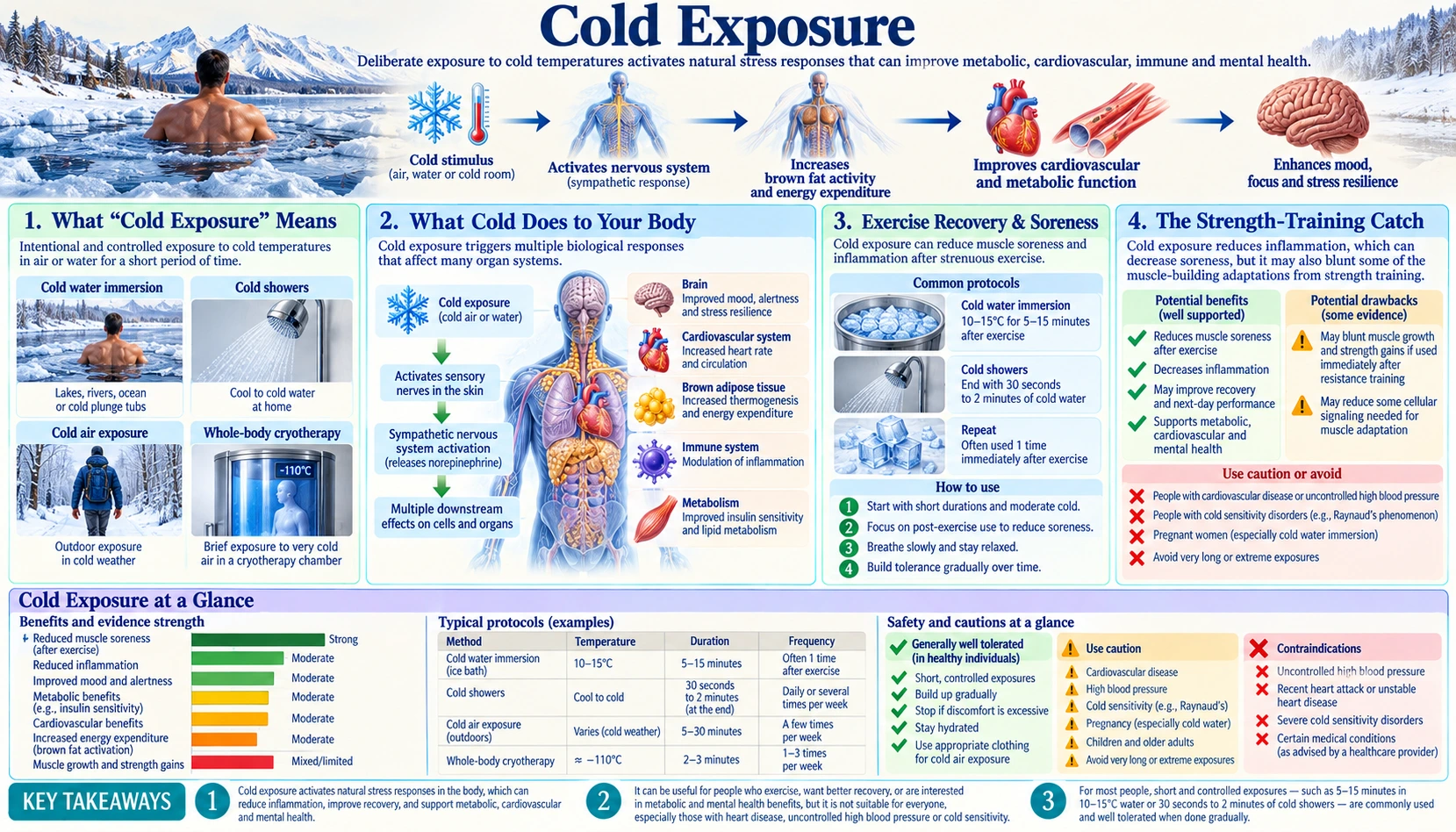
Deliberate cold exposure — cold showers, ice baths, "cold plunges," winter dips in the sea, and the popular Wim Hof method — has grown from a fringe habit into a mainstream wellness trend. Advocates describe it as a lever for recovery, mood, metabolism, immunity, and resilience. Some of that enthusiasm rests on real physiology and reasonable evidence; a good deal of it runs ahead of the data. This page separates what the science actually supports from what is still hopeful marketing, and it takes safety seriously, because cold water can be genuinely dangerous. The single most important message here is a safety one: the cold-shock response is real, it can make you gasp and drown, and the breathing exercises paired with some cold protocols can cause a sudden blackout, which is frequently fatal when it happens in or near water. Many healthy people practise cold exposure at little or no cost, in moderation, building up gradually.
Interactive Visualization Cryotherapy: How Cold Changes Your Body Press cold onto the skin and watch the blood vessel clamp shut and the pain nerve slow to a crawl until the ache fades — then push too far and ice crystals form, the same freezing a surgeon uses on purpose to take off a wart or a tumour. Launch →
Table of Contents
What "Cold Exposure" Means
"Cold exposure" is an umbrella term for deliberately putting your body into a cold environment for a short time. In practice it covers a spectrum, from mild and low-risk to serious and potentially hazardous:
- Cold showers — the gentlest and most accessible version. Usually this means finishing a warm shower with 30 seconds to a few minutes of cold water. There is no drowning risk and it is easy to step out, which is why many people start there.
- Ice baths / cold plunges — sitting or immersing up to the neck in water chilled with ice, typically in the range of roughly 10–15 °C (50–59 °F), sometimes colder. Popular in athletic recovery and among home "cold plunge" enthusiasts.
- Winter / open-water swimming — swimming or dipping in cold lakes, rivers, or the sea, sometimes near freezing. This is the highest-risk form because it combines very cold water, open water (drowning risk), and often distance from help.
- The Wim Hof method — a branded system that pairs cold exposure with a specific breathing practice and a mindset/commitment component. The breathing portion involves rounds of rapid, deep breaths (a form of controlled hyperventilation) followed by a breath-hold; the cold portion is showers or immersion. It is worth understanding the two parts separately: the breathing changes your blood chemistry and can make you light-headed or cause fainting, and the cold triggers the physiology described below. Some of the method's most striking research findings (see Brown Fat, Metabolism & Immune Claims) come mainly from the breathing, not the cold. Described neutrally, it is a structured way to combine breath work with cold — and its breathing component is exactly why the safety rule about never breathing this way in water matters so much.
Across all of these, two variables drive the physical effect: how cold the water or air is, and how much of your skin is exposed. A cold shower on the back is mild; full head-out immersion to the neck in ice water is a far bigger physiological event, because far more skin is suddenly cooled at once.
What Cold Does to Your Body
When cold hits a large area of skin quickly, your body reacts in a fast, coordinated, and largely involuntary way. Understanding this cascade explains both the appeal and the danger.
The cold-shock response
The first thing that happens on sudden cold immersion is the cold-shock response: an immediate, sharp gasp for air followed by rapid, uncontrollable breathing (hyperventilation), a spike in heart rate, and a jump in blood pressure. This is not the same as hypothermia — it happens in the first seconds to minutes, long before your core cools. The gasp reflex is a reflex; you cannot fully suppress it the first time. In open water, that first involuntary gasp can pull water into the lungs, which is one reason sudden cold-water immersion is a leading cause of drowning. The cold-shock response fades with repeated exposure — the body habituates — which is a large part of what regular cold exposure "trains."
Vasoconstriction and blood flow
Cold makes the small blood vessels in your skin and limbs clamp down (vasoconstriction), shunting warm blood toward your core to protect vital organs. This is why your skin goes pale and your hands and feet feel numb and ache. When you warm up afterward those vessels reopen, and blood flow rushes back — the pleasant, tingling glow people describe after a plunge. This constrict-then-dilate cycle is also part of why the cardiovascular system is stressed by cold (see Safety First).
The noradrenaline and catecholamine surge
Cold is a potent trigger for the release of catecholamines — the "fight-or-flight" chemicals noradrenaline (norepinephrine) and, to a lesser extent, adrenaline. One frequently cited human study measured a striking rise in noradrenaline of around 530% and in dopamine of about 250% during cold-water immersion (see Key Research Papers). Noradrenaline is a stimulant and a mood-and-focus signal, which is the physiological seed behind reports of alertness and elevated mood after cold exposure. It is important to keep the numbers in perspective: these were short-term blood measurements in small studies, and a large percentage rise does not automatically translate into a lasting change in how you feel or function.
Shivering, brown fat, and heat generation
To defend its temperature, the body makes heat two ways. Shivering is muscle activity that generates warmth. Non-shivering thermogenesis is heat produced chemically, largely by brown adipose tissue (brown fat, or BAT) — a special fat that burns energy to make heat rather than storing it. Cold exposure activates brown fat, and adults have more functional brown fat than scientists once believed (see Key Research Papers). This is the real mechanism behind the "cold burns calories and revs metabolism" idea — but as the metabolic section explains, the size and durability of that effect in real life is still an open question.
Exercise Recovery & Soreness
Cold-water immersion (often called cryotherapy in this context) has been used by athletes for decades to feel better after hard training. This is one of the better-studied uses, and the honest picture is "helpful for how you feel, modest overall, and not magic."
A large Cochrane systematic review concluded that cold-water immersion after exercise can reduce the delayed-onset muscle soreness (DOMS) people feel in the day or two afterward, compared with doing nothing (see Key Research Papers). Reviewers rated much of the underlying evidence as low quality, with many small studies and a real chance of bias, but the direction is fairly consistent: plunging after a tough session tends to leave people reporting less soreness.
There is an important caveat, though. A well-known controlled trial in 30 men compared cold-water immersion after a hard interval-training session against a convincing placebo (a "recovery placebo" of 15 minutes in thermoneutral water at 34.7 °C) and found that the benefits were not clearly greater than the placebo effect (see Key Research Papers). In other words, part of what makes an ice bath feel restorative may be the expectation and ritual, not the cold itself. That does not make the benefit worthless — feeling recovered has real value, and reduced soreness can help you train again sooner — but it tempers claims that cold immersion is a uniquely powerful recovery tool.
Bottom line: for perceived recovery and reduced soreness after endurance or high-intensity sessions, the research on cold-water immersion points to a modest benefit, not dramatic gains, and part of that benefit appears to be expectation.
The Strength-Training Catch
Here is a genuinely important, evidence-based nuance that a lot of cold-plunge enthusiasm skips over: cold-water immersion right after resistance (strength) training can blunt the muscle gains you were training for.
A carefully designed study followed people through weeks of strength training and had them either do cold-water immersion or active recovery after each session. The cold group showed smaller long-term gains in muscle size and strength, and the researchers traced this to reduced activation of the molecular "build-muscle" signaling that normally follows a workout (see Key Research Papers). The likely reason is that the post-exercise inflammation and blood flow that cold suppresses are part of the adaptation signal — the very process that tells the muscle to grow and get stronger. Cool it down too aggressively and too soon, and you mute the message.
What this means in practice:
- For building muscle or strength (hypertrophy), this is the finding that matters: in that study, published in 2015, 21 active men who took 10 minutes of cold-water immersion after each session of a 12-week strength programme gained less strength and muscle mass than men who did active recovery instead.
- For people whose aim is simply to feel less sore, or who face a packed competition schedule where recovering fast matters more than maximizing growth (for example, back-to-back events), the soreness findings in the section above are the ones that apply.
- A common practice is to separate cold exposure from strength sessions — using it on rest days, or several hours before or after lifting, with the aim of keeping the mood or recovery feel without blunting the growth signal.
This "recovery vs. adaptation" tension is one of the clearest, most useful findings in the whole field, and it is why the research does not support a blanket "always ice bath after training" rule.
Mood, Alertness & the Dopamine Story
For many people, the biggest draw of cold exposure is how it makes them feel afterward: alert, clear-headed, energized, even euphoric. This is the area with the most enthusiastic claims and, so far, the most promising-but-limited evidence.
The mechanistic story is appealing. As noted above, cold immersion drives a large surge in noradrenaline and a substantial rise in dopamine — neurochemicals tied to focus, drive, and mood. Unlike the quick spike-and-crash of some stimulants, the cold-driven rise in these chemicals appears to build and stay elevated for a while, which fits people's reports of a lingering "up" feeling for an hour or more after getting out.
What does the human evidence show? It is genuinely encouraging but limited:
- A brain-imaging (functional magnetic resonance imaging, fMRI) study found that a short cold-water immersion produced measurable increases in positive mood and changed the interaction between large-scale brain networks in ways consistent with feeling more alert and less sluggish (see Key Research Papers). It was a small study, but it is one of the better attempts to look under the hood.
- A widely shared hypothesis paper proposed that regular cold showers might help with depression, reasoning from the noradrenaline and endorphin effects (see Key Research Papers). This is worth reading honestly: it is a proposal and a small anecdotal series, not proof that cold showers treat depression. Cold exposure is not a substitute for treatment of a mental-health condition.
- A large randomized trial of ending your daily shower with cold water found the cold-shower group took fewer sick days off work and often reported more energy, though it did not find a clear reduction in actual illness (see Key Research Papers and the next section).
The fair summary: the mood and alertness benefits are plausible, mechanistically supported, and reported consistently by users, but the formal trials are small, short, and hard to blind (you always know you got in cold water). Many people report the mood boost as a nice, cheap lift; it is not a proven medical treatment.
Brown Fat, Metabolism & Immune Claims
Two of the most-hyped promises of cold exposure — that it meaningfully boosts your metabolism and that it "supercharges" your immune system — are the two where the gap between the excitement and the evidence is widest. The mechanisms are real; the practical payoff is unproven.
Metabolism and brown fat
Cold reliably activates brown fat, which burns energy to make heat: a 2009 study found active brown fat in 23 of 24 healthy men during a single mild cold exposure (16 °C), and a 2013 study found that 10 days of cold acclimation increased brown-fat activity, along with the body's heat production without shivering (see Key Research Papers). That has led to hopes that regular cold plunges could aid weight loss or improve blood-sugar handling. The reality check: the amount of extra energy brown fat burns during a cold session is modest, the effect on body weight in real-world use is small and unproven, and the body often compensates (for example, by making you hungrier or warming up afterward). Cold exposure is not a reliable weight-loss tool. There is early, interesting research on cold improving insulin sensitivity in some groups, but it is preliminary and not a reason to expect metabolic transformation from an ice bath.
"Immune-boosting"
The immune claims come from two sources, and both need context. First, the large cold-shower trial found fewer sick days in the cold group — but not clearly fewer illnesses, so people may have simply felt able to push through rather than actually getting sick less often (see Key Research Papers). Second, a famous 2014 study of the Wim Hof method showed that 12 healthy volunteers, trained for 10 days in meditation, breathing and cold exposure together, could voluntarily dampen their inflammatory response to an injected bacterial toxin, after practising the learned techniques sharply raised their adrenaline (see Key Research Papers) — a genuinely remarkable result. That study did not separate the breathing from the cold. A 2022 follow-up pilot study in 48 healthy young men did: cold exposure training alone did not relevantly change the inflammatory response, the breathing exercise did, cold training strengthened the breathing exercise's effect, and the combination dampened the response most (see Key Research Papers). And "dampening inflammation" is not the same as "a stronger immune system." Blunting an immune reaction can be good or bad depending on the situation. The honest verdict on immunity is preliminary and easy to overstate: interesting signals, no proof that cold showers make you meaningfully more resistant to infection.
Inflammation
Cold's effect on inflammation is a double-edged sword, and it ties several of the sections above together. In the short term, cold constricts blood vessels and reduces local blood flow, which can calm the swelling, warmth, and discomfort of an acute flare — the same logic behind icing a fresh sprain. Some people with inflammatory joint pain report symptom relief from cold exposure, and there are small studies exploring it, but the evidence is limited and mixed.
The catch is that inflammation is not simply "bad." The post-exercise inflammation that cold blunts is exactly what drives muscle adaptation and repair (see The Strength-Training Catch). So the same anti-inflammatory action that soothes soreness can also interfere with the beneficial, growth-promoting inflammation you want after training. Whether cold's inflammation-lowering effect helps or hurts depends entirely on context and timing: helpful for calming an acute ache, potentially counterproductive right after a muscle-building workout. There is no good evidence that routine cold plunging produces a meaningful, lasting reduction in the kind of chronic low-grade inflammation linked to disease.
How People Do It
The guiding principles commonly described in practice are start gentle, cool gradually, and keep it short; the heart, drowning and blackout risks are set out in Safety First. There is no official medical prescription for cold exposure, so the ranges below reflect what is commonly used in research and practice, not a mandate.
- Cold showers first. The lowest-risk entry point. A common start is ending a normal shower with 15–30 seconds of cold and adding time over weeks. Cold showers carry no drowning risk and let people build tolerance to the gasp reflex safely.
- Temperature. Immersion studies commonly use water around 10–15 °C (50–59 °F). Colder water is riskier and shortens the safe duration. The US National Weather Service notes that cold shock can be just as severe and dangerous in water of 10–15 °C (50–60 °F) as in water at 2 °C (35 °F), and that gasping and rapid breathing can be triggered by water as warm as 25 °C (77 °F).
- Duration. Benefits people seek do not require long exposures. A few minutes is typical; many protocols total only 1–5 minutes in genuinely cold water. Longer immersion mainly increases the risk of your core temperature dropping (see afterdrop and hypothermia below), not the benefit.
- Gradual adaptation. The cold-shock response and cardiovascular strain habituate with repeated, spaced exposure. Building up over weeks is both safer and more effective than one shocking plunge.
- Warming up afterward. Practitioners dry off, dress in warm layers, move gently, and have a warm drink. Because of afterdrop (below), the body can keep cooling after getting out, and staying cold and wet prolongs it.
- Company in open water. Open water is where the drowning risk is; cold-water swimmers commonly go with others, and cold showers and controlled tubs are the usual choice for solo practice.
Consistency matters more than intensity. A brief, regular, gradually-built habit delivers the adaptation and mood effects people are after, without chasing dangerous extremes.
Safety First
This is the most important section on the page. Cold exposure is not a harmless novelty; done carelessly it can injure or kill. It applies to anything beyond a cold shower.
Cold-shock and the gasp reflex (drowning risk)
As described in the physiology section, sudden cold immersion triggers an involuntary gasp and rapid breathing you cannot fully control the first time. In open water, that gasp can inhale water and the panic and hyperventilation that follow can lead to drowning within seconds to minutes, well before hypothermia is a factor. The US National Weather Service notes that this gasping and rapid breathing lasts for the first 2–3 minutes or more. This is why experienced cold-water swimmers do not swim or plunge alone in open water, enter slowly to let the shock pass, and have a way out and someone watching.
Breath-holds in or near water: shallow-water blackout
This is the most serious hazard on this page. The rapid, deep breathing used in the Wim Hof method and similar practices lowers your carbon-dioxide levels, which can delay the urge to breathe and cause a sudden blackout (loss of consciousness) with no warning — a phenomenon known as shallow-water or hypoxic blackout. If that happens in or near water, it is frequently fatal. That is why the breathing exercises are done seated or lying down on solid ground, away from water, with the breathing and the cold water kept as separate activities. People have died combining hyperventilation breath-holds with water.
Cardiovascular risk
The cold-shock surge simultaneously spikes heart rate and blood pressure and can provoke abnormal heart rhythms (arrhythmias). For a healthy heart this is usually tolerated, but for some it can be dangerous. The US National Weather Service states that cold water can cause a sudden spike in heart rate and blood pressure, and that this increase can cause heart failure and stroke in vulnerable people. The people this concern applies to most are those with heart disease, high blood pressure, a history of arrhythmia or another cardiovascular condition, and older people with risk factors. The combination of intense cold and physical exertion is a particular stress on the heart.
Afterdrop and hypothermia
Stay in cold water long enough and your core temperature falls, leading to hypothermia — shivering, confusion, clumsiness, slurred speech, and eventually life-threatening collapse. A specific hazard is afterdrop: when you get out, cold blood from your chilled limbs circulates back to your core and your temperature can keep falling for a while after you exit. The US National Weather Service notes that core temperature can keep dropping to dangerous levels even after leaving cold water, so being out of the water does not by itself mean being safe; this is why practitioners limit time in the water and warm up gradually and steadily afterward. Impaired coordination from cold also makes swimming and climbing out harder — another reason longer immersions carry more risk.
Who Faces Higher Risk
- Anyone with heart disease, high blood pressure, or arrhythmia — the sudden spike in heart rate and blood pressure can cause heart failure and stroke in vulnerable people (US National Weather Service) and can provoke abnormal heart rhythms.
- Pregnant people, older adults, children, and anyone with a serious chronic illness — the trials described on this page were done in healthy adults, so they say little about these groups.
- People with Raynaud's, cold urticaria (cold-triggered hives), or circulatory disorders — cold can trigger or worsen symptoms.
- Anyone who has been drinking alcohol — alcohol impairs judgment and temperature regulation and raises the danger sharply.
Done gently, gradually and briefly, with breath-holds kept away from water, cold exposure is a low-cost practice many healthy people report enjoying and benefiting from. Done recklessly, it is one of the more dangerous "wellness" trends around.
Key Research Papers
- Šrámek P, Šimečková M, Janský L, Šavlíková J, Vybíral S. Human physiological responses to immersion into water of different temperatures. European Journal of Applied Physiology. 2000;81(5):436–442. — The frequently cited source for the catecholamine surge, reporting roughly a 530% rise in noradrenaline and 250% in dopamine during cold-water immersion. — doi:10.1007/s004210050065
- van Marken Lichtenbelt WD, Vanhommerig JW, Smulders NM, et al. Cold-activated brown adipose tissue in healthy men. New England Journal of Medicine. 2009;360(15):1500–1508. — A landmark demonstration, in 24 men during a single mild cold exposure (16 °C), that healthy adults have functional, cold-activated brown fat — the mechanism behind cold's metabolic claims. — doi:10.1056/NEJMoa0808718
- van der Lans AA, Hoeks J, Brans B, Vijgen GH, Visser MG, Vosselman MJ, Hansen J, Jörgensen JA, Wu J, Mottaghy FM, Schrauwen P, van Marken Lichtenbelt WD. Cold acclimation recruits human brown fat and increases nonshivering thermogenesis. The Journal of Clinical Investigation. 2013;123(8):3395–3403. — A 10-day cold acclimation protocol increased brown-fat activity together with heat production without shivering (nonshivering thermogenesis). — doi:10.1172/JCI68993
- Tipton MJ, Collier N, Massey H, Corbett J, Harper M. Cold water immersion: kill or cure? Experimental Physiology. 2017;102(11):1335–1355. — A balanced review of the cold-shock response, cardiovascular and drowning risks, and potential benefits — the key safety reference. — doi:10.1113/EP086283
- Buijze GA, Sierevelt IN, van der Heijden BCJM, Dijkgraaf MG, Frings-Dresen MHW. The effect of cold showering on health and work: a randomized controlled trial. PLOS ONE. 2016;11(9):e0161749. — A large RCT (3,018 participants) in which ending showers cold was associated with fewer sick days off work, though not clearly fewer illnesses. — doi:10.1371/journal.pone.0161749
- Bleakley C, McDonough S, Gardner E, Baxter GD, Hopkins JT, Davison GW. Cold-water immersion (cryotherapy) for preventing and treating muscle soreness after exercise. Cochrane Database of Systematic Reviews. 2012;(2):CD008262. — The Cochrane review finding cold-water immersion can reduce delayed-onset muscle soreness, while cautioning that much of the evidence is low quality. — doi:10.1002/14651858.CD008262.pub2
- Roberts LA, Raastad T, Markworth JF, et al. Post-exercise cold water immersion attenuates acute anabolic signalling and long-term adaptations in muscle to strength training. The Journal of Physiology. 2015;593(18):4285–4301. — The key study showing that cold-water immersion after resistance training blunts muscle-building signaling and reduces long-term gains in size and strength. — doi:10.1113/JP270570
- Broatch JR, Petersen A, Bishop DJ. Postexercise cold water immersion benefits are not greater than the placebo effect. Medicine & Science in Sports & Exercise. 2014;46(11):2139–2147. — A controlled trial in 30 men comparing 15 minutes of cold-water immersion (10.3 °C) with a thermoneutral water-immersion placebo (34.7 °C) after high-intensity interval exercise; the placebo was as effective as cold water for recovery of muscle strength over 48 hours, suggesting the benefits are at least partly placebo-related. — doi:10.1249/MSS.0000000000000348
- Yankouskaya A, Williamson R, Stacey C, Totman JJ, Massey H. Short-term head-out whole-body cold-water immersion facilitates positive affect and increases interaction between large-scale brain networks. Biology. 2023;12(2):211. — A small fMRI study linking a brief cold immersion to improved mood and altered brain-network activity. — doi:10.3390/biology12020211
- Shevchuk NA. Adapted cold shower as a potential treatment for depression. Medical Hypotheses. 2008;70(5):995–1001. — A hypothesis paper (not proof) proposing a mood benefit from cold showers via noradrenaline and endorphin effects; useful for understanding the mechanistic argument, not as evidence of treatment. — doi:10.1016/j.mehy.2007.04.052
- Kox M, van Eijk LT, Zwaag J, et al. Voluntary activation of the sympathetic nervous system and attenuation of the innate immune response in humans. Proceedings of the National Academy of Sciences. 2014;111(20):7379–7384. — The Wim Hof method study: 12 healthy volunteers trained for 10 days in meditation, breathing and cold exposure together showed a sharp rise in adrenaline and a dampened inflammatory response to injected bacterial endotoxin; the study did not separate the breathing from the cold. — doi:10.1073/pnas.1322174111
- Zwaag J, Naaktgeboren R, van Herwaarden AE, Pickkers P, Kox M. The Effects of Cold Exposure Training and a Breathing Exercise on the Inflammatory Response in Humans: A Pilot Study. Psychosomatic Medicine. 2022;84(4):457–467. — A pilot study in 48 healthy young men that separated the parts: cold exposure training alone did not relevantly change the inflammatory response to endotoxin, the breathing exercise did, cold training enhanced the breathing exercise's effect, and the combination dampened the response most. — doi:10.1097/PSY.0000000000001065
- Knechtle B, Waśkiewicz Z, Sousa CV, Hill L, Nikolaidis PT. Cold water swimming — benefits and risks: a narrative review. International Journal of Environmental Research and Public Health. 2020;17(23):8984. — A wide-ranging review weighing the claimed benefits of cold-water swimming against its real risks. — doi:10.3390/ijerph17238984
- Espeland D, de Weerd L, Mercer JB. Health effects of voluntary exposure to cold water – a continuing subject of debate. International Journal of Circumpolar Health. 2022;81(1):2111789. — A recent overview underscoring that many purported benefits of voluntary cold exposure remain unproven and contested. — doi:10.1080/22423982.2022.2111789
Connections
- All Remedies
- Cryotherapy: How Cold Changes Your Body & the cold response — interactive animation
- Exercise
- Breathwork
- Stress Management
- Immune Boosting
- Meditation
- Sleep Hygiene
- Natural Anxiety Relief
- Cardiology
- Tyrosine for Cold Tolerance — replenishing catecholamines during cold stress.
- Cold and Sauna Exposure for Stress — the cold-pressor response, the dopamine rise, and hormetic stress adaptation.
- Intermittent Hypoxia