Tyrosine for Cold Tolerance
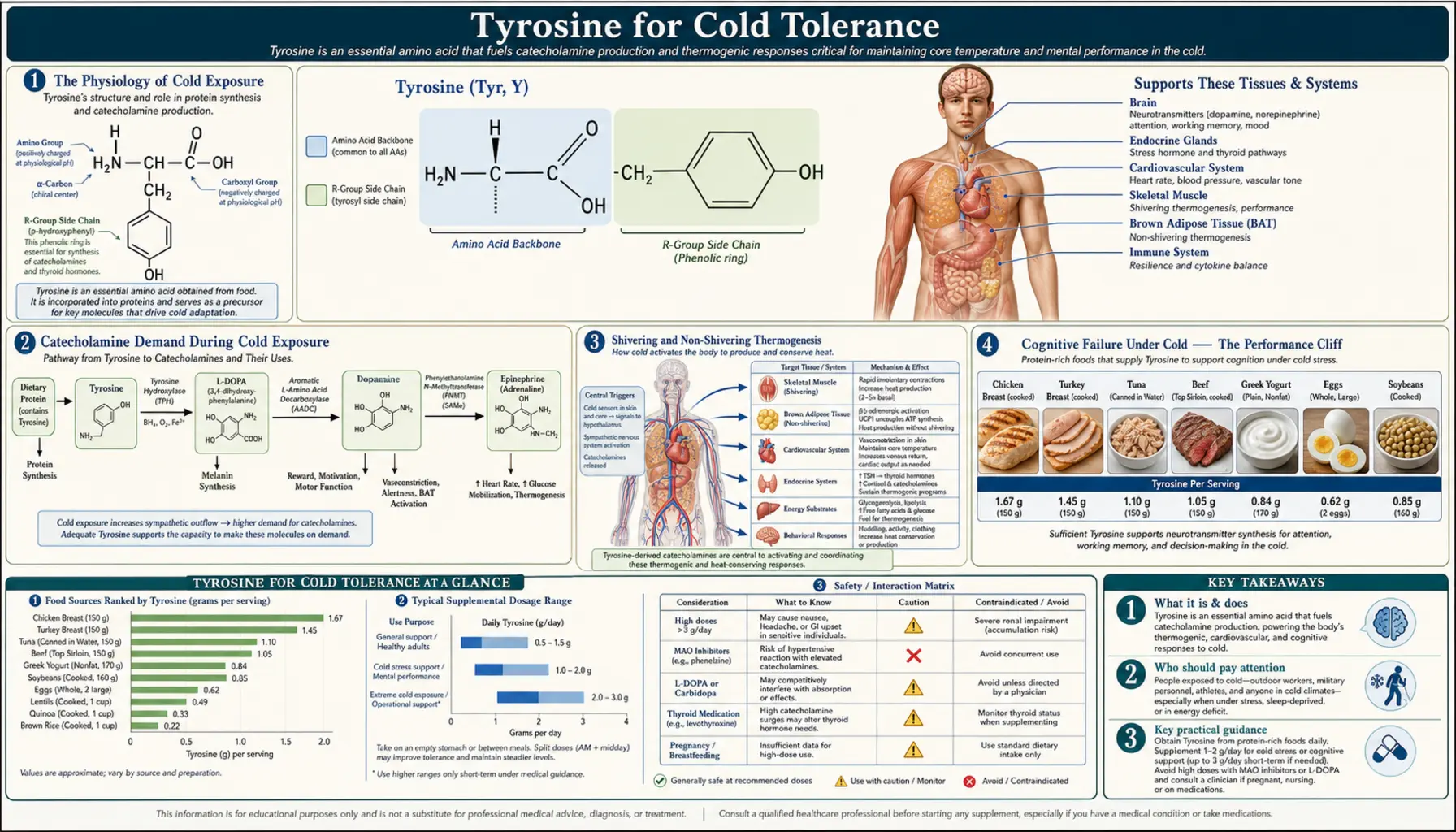
Cold exposure is a uniquely catecholamine-demanding stressor. The autonomic nervous system mounts a sympathetic surge to drive vasoconstriction (preserving core temperature) and shivering thermogenesis (generating heat from skeletal muscle adenosine triphosphate (ATP) hydrolysis), while the brain simultaneously must maintain vigilance and decision-making for survival behavior. Both axes draw heavily on norepinephrine and epinephrine, and after several hours both deplete catecholamine pools faster than synthesis can replace them. In rats, tyrosine supplementation prevents the depletion of brain catecholamines seen during acute environmental stress. In people, the cold trials — the Banderet 1989 USARIEM trial, the Shurtleff 1994 cold-only trial, the Mahoney 2007 working-memory study, and the O'Brien 2007 cooling protocols — measured mental performance and mood: tyrosine protected working memory, while the one trial that measured physical work found no protection. This page is the operational deep-dive on the cold use case, including reported military and polar-research use, the cold-plus-hypoxia-plus-sleep-loss combined stressors, and the limitations.
Interactive Visualization Dopamine, Reward & How Habits Hijack You Dopamine is not the pleasure chemical. Watch the spike migrate from the reward to the cue — then withhold the reward and see it dip below zero. That dip is craving. Launch →
Table of Contents
- The Physiology of Cold Exposure
- Catecholamine Demand During Cold Exposure
- Shivering and Non-Shivering Thermogenesis
- Cognitive Failure Under Cold — The Performance Cliff
- Shurtleff 1994 — Cold-Only Working Memory Trial
- Mahoney 2007 — Repeat Cold + Working Memory
- O'Brien 2007 — Body Cooling Protocols
- The Combined Stressors — Cold + Altitude + Sleep Loss
- Reported Military Cold-Weather Use
- Cold-Water Diving and Immersion Applications
- Polar Research and Extreme Cold Expeditions
- What Tyrosine Will Not Do for Cold (Limits)
- Summary of Trial Doses and Safety Facts
- Key Research Papers
- Connections
- Featured Videos
The Physiology of Cold Exposure
The human thermoregulatory response to cold is layered, with each layer engaging at a progressively lower body temperature or a longer exposure duration:
- Behavioral thermoregulation — first line. Add clothing layers, seek shelter, increase activity, drink hot fluids. Conscious and most effective. Failure here leads to engagement of the autonomic responses.
- Cutaneous vasoconstriction — sympathetic norepinephrine release at peripheral cutaneous arterioles produces alpha-1 adrenergic vasoconstriction, shunting blood from skin and extremities to the core. Preserves core temperature at the cost of cold hands and feet. Begins within seconds of cold exposure; sustained throughout exposure.
- Increased muscle tone (pre-shivering) — baseline muscle tension increases, generating modest heat without overt shivering. Mediated by sympathetic outflow and local muscle reflexes.
- Shivering thermogenesis — rhythmic synchronized contraction of antagonist muscle pairs, producing no net work but releasing the energy of adenosine triphosphate hydrolysis as heat. Engages at modest cold stress. Can increase metabolic rate 4–6 fold above basal but is metabolically expensive, fatiguing, and impairs fine motor function.
- Non-shivering thermogenesis — norepinephrine activates brown adipose tissue (more abundant in infants and cold-acclimated adults) and skeletal muscle uncoupling protein 3, producing heat without contraction. Mediates the metabolic adaptation to chronic cold exposure.
- Endocrine acclimation — chronic cold exposure increases thyroid hormone output (slightly), increases sympathetic tone, and increases brown adipose tissue depots. Develops over weeks of repeated exposure.
Every step from vasoconstriction onward depends on sympathetic catecholamine release. The colder the exposure and the longer it lasts, the larger the catecholamine demand. This is the substrate-availability problem that tyrosine addresses.
Catecholamine Demand During Cold Exposure
Acute cold exposure produces measurable spikes in plasma norepinephrine (3–5-fold above basal) and epinephrine (2–3-fold above basal) within the first 10–30 minutes. Both elevations sustain throughout the exposure. The synthesis of new catecholamines must keep pace with the accelerated release, or the catecholamine pools will deplete.
Three principal sites of catecholamine demand under cold:
- Adrenal medulla — secretes epinephrine and norepinephrine into the circulation in response to cold. Drives non-shivering thermogenesis via brown adipose tissue and supports cardiovascular response (increased cardiac output, vasoconstriction).
- Sympathetic postganglionic neurons — release norepinephrine onto cutaneous vasoconstrictors (alpha-1 mediated), onto cardiac muscle (beta-1 mediated, increasing heart rate and contractility), onto bronchial smooth muscle (beta-2, mild bronchodilation), and onto thermogenic tissues.
- Locus coeruleus (brainstem norepinephrine nucleus) — the principal source of brain norepinephrine. Activation during cold supports cortical arousal, attention, vigilance, and decision-making for cold-environment behavior. Without sustained LC activity, cognitive performance collapses.
The catecholamine pool of each of these sites is finite. The intracellular pool of dopamine, norepinephrine, and epinephrine is on the order of micrograms to milligrams per gram of tissue, with the largest depot in the adrenal medulla and the brain depots smaller. Sustained accelerated release without proportional synthesis depletes the pool over a timeframe of hours, depending on the intensity of the stressor.
This is what tyrosine pre-loading addresses. By providing the rate-limiting substrate for tyrosine hydroxylase across the elevated synthesis demand, tyrosine is proposed to sustain the catecholamine pool and delay the performance failure that occurs when stores are exhausted. In the human trials it protected working memory, but a step test of physical work was not protected (O'Brien 2007).
Shivering and Non-Shivering Thermogenesis
Shivering thermogenesis is the brute-force response. Antagonist muscle pairs contract rhythmically at 8–12 Hz, producing no net work but releasing the heat of adenosine triphosphate hydrolysis. Metabolic rate can increase 4–6 fold above basal (from approximately 70 W to 300–420 W) during peak shivering. The catecholamine demand here is sympathetic activation of muscle perfusion, glucose mobilization, and lipolysis to fuel the contraction. Shivering is fatiguing and impairs fine motor control (a shivering soldier cannot accurately fire a rifle, a shivering surgeon cannot operate, a shivering diver cannot manage complex gear).
Non-shivering thermogenesis (NST) is the elegant alternative. Norepinephrine at beta-3 adrenergic receptors on brown adipose tissue activates uncoupling protein 1 (UCP1), which short-circuits the mitochondrial proton gradient and dissipates the energy as heat without adenosine triphosphate production. Skeletal muscle also has a smaller contribution via UCP3. NST is metabolically more efficient than shivering, does not fatigue the same way, and does not impair motor function. Critical for infant thermoregulation; less abundant but still present in adults, with brown adipose tissue depots concentrated in supraclavicular, cervical, paraspinal, and perirenal locations.
Chronic cold exposure increases NST capacity. Cold-acclimated individuals (Inuit, Scandinavian fishermen, regular cold-plunge enthusiasts) have larger brown adipose depots, more responsive UCP1 expression, and rely more on NST and less on shivering for a given cold stress. This is the physiological basis for the modern interest in cold exposure (Wim Hof method, cold plunges, cryotherapy) as a metabolic-conditioning practice.
The tyrosine connection: both shivering and non-shivering thermogenesis depend on sympathetic catecholamine output. Tyrosine substrate support sustains both. For acute cold exposure of moderate to severe intensity (cold-water immersion, multi-hour cold-environment operations), tyrosine pre-loading is proposed to delay the cumulative catecholamine depletion. In O'Brien 2007, core temperature fell to the same level (35.5°C) with or without tyrosine, while memory and marksmanship scores were protected.
Cognitive Failure Under Cold — The Performance Cliff
One of the most consistently demonstrated findings in environmental physiology is that cognitive performance degrades nonlinearly with cold exposure. Mild cold (single-digit Celsius for under an hour with appropriate clothing) produces minimal cognitive impairment. Moderate cold (cold-clothed but with prolonged exposure of 2–4 hours) produces measurable degradation. Severe cold (insufficient clothing, multi-hour exposure, peripheral cold injury developing) produces dramatic performance failure that can be life-threatening — the hypothermic patient cannot make adaptive decisions, cannot navigate to safety, cannot self-extract.
The cognitive domains affected:
- Working memory — capacity to hold and manipulate information over seconds to minutes. Degrades early and substantially under cold.
- Vigilance and sustained attention — capacity to maintain alertness across a monotonous task. Highly susceptible to the combined cold-plus-sleep-loss profile of military and search-and-rescue operations.
- Reaction time — slows progressively with peripheral cold (slower nerve conduction in cold extremities contributes mechanically), with central cold (reduced central processing speed), and with sustained exposure (catecholamine depletion).
- Spatial navigation and map reading — complex visuospatial tasks degrade substantially. Soldiers in cold environments perform map-and-compass tasks significantly worse than warm-equivalent controls.
- Decision-making and judgment — the most consequential. Hypothermic individuals make poor decisions about clothing, shelter, and route, sometimes including the paradoxical undressing observed in severe hypothermia (an irrational behavior that accelerates death from exposure).
- Mood and motivation — irritability, depressed mood, and reduced effort under sustained cold exposure. Affects team cohesion and morale during multi-day operations.
Tyrosine supplementation in the operational cold trials consistently mitigates these cognitive impairments. Effect sizes are larger when baseline degradation is larger — the soldiers who suffer most under placebo benefit most from tyrosine. Effect sizes are smaller in milder cold exposures where degradation is also smaller.
Shurtleff 1994 — Cold-Only Working Memory Trial
The Shurtleff 1994 study isolated the cold-exposure variable from the hypoxia and sleep-deprivation confounds present in earlier trials. Eight male volunteers performed a 30-minute computer memory task at either 4°C (cold) or 22°C, after a 30-minute pre-exposure period and 2 hours after taking 150 mg/kg of L-tyrosine or placebo.
The cognitive battery focused on working memory using a delayed matching-to-sample task. Subjects had to remember a target stimulus and then identify it after a delay of 2, 8 or 16 seconds. Accuracy fell as the delay grew. Under placebo, matching accuracy at 4°C was significantly lower than at 22°C. Tyrosine significantly improved accuracy at the longest (16-second) delay, the one most affected by cold, bringing it to the same level as at 22°C. Tyrosine taken before the 22°C sessions had no effect on the task.
This study established that the cognitive benefit of tyrosine under cold was not driven by the altitude / hypoxia component of the earlier Banderet trial — cold alone was sufficient to produce a memory deficit that tyrosine reversed. The cleaner experimental design made it a useful citation for the cold-only operational use case.
Mahoney 2007 — Repeat Cold + Working Memory
Mahoney and colleagues at USARIEM in 2007 extended the cold + tyrosine paradigm with a repeated-exposure design. Nineteen volunteers completed three test sessions on different days (35°C water with placebo, about 10°C water with placebo, and about 10°C water with tyrosine) in a double-blind, within-subjects design. In each session they completed two 90-minute water immersions and ate a food bar containing 150 mg/kg tyrosine or placebo before each immersion (300 mg/kg tyrosine in total). Cognitive performance (including a Match-to-Sample memory task and a choice reaction time test), mood and saliva cortisol were measured.
Results replicated the Shurtleff finding: in the cold on placebo, cortisol rose, volunteers made fewer correct responses on the Match-to-Sample memory measure, reaction time and errors increased on the choice reaction time test, and tension, depression and confusion increased. With tyrosine, correct responses on the memory measure increased and the time needed to study the sample was shorter, which the authors read as faster and more accurate information processing.
The Mahoney protocol — repeated cold-water immersion as the stressor — is operationally relevant for special operations, swift-water rescue, and emergency cold-water survival. The reproducibility of the tyrosine benefit in this paradigm strengthens the operational evidence base.
O'Brien 2007 — Body Cooling Protocols
O'Brien and colleagues 2007 examined tyrosine after whole-body cooling. Fifteen subjects completed a control trial in warm (35°C) water and two cold-water trials, each a week apart; the cold-water immersion lowered core temperature to about 35.5°C, against 37.1°C on the control trial. Subjects ate an energy bar during each trial; on one cold trial it contained tyrosine (300 mg/kg body weight), and on the other cold trial and the control trial it contained none. After each immersion, subjects completed a battery of cognitive, psychomotor and physical tasks in a 10°C cold-air chamber.
On the cold trial without tyrosine, performance on a Match-to-Sample memory task fell 18% and marksmanship fell 14% compared with the warm control; with tyrosine, neither differed from the control. A step test of physical work fell 11% on both cold trials, with or without tyrosine, so tyrosine kept memory and marksmanship at warm-water levels but did not protect physical performance. The whole-body cooling paradigm is closer to the operational scenario of soldiers, hikers, or workers exposed to cold-weather conditions without adequate shelter, making this evidence particularly applicable to field operational use.
The cumulative body of cold + tyrosine evidence (Banderet 1989, Shurtleff 1994, Mahoney 2007, O'Brien 2007) makes tyrosine one of the best-supported nutritional countermeasures for cold-environment cognitive performance. The memory effect has been reproduced across trials, though the doses differed: 100 mg/kg in Banderet 1989, 150 mg/kg in Shurtleff 1994, and 300 mg/kg in total (two doses of 150 mg/kg) in Mahoney 2007 and O'Brien 2007.
The Combined Stressors — Cold + Altitude + Sleep Loss
In real-world military and high-altitude operations, the three stressors of cold, hypoxia (altitude), and sleep deprivation often combine. Each individually produces catecholamine depletion; combined, they produce a substantially larger demand on the catecholamine system than any one alone. This is the operational profile of:
- Mountain warfare operations (Hindu Kush, Andes, Himalayan deployments)
- Special Forces winter operations (10th Mountain Division, Norwegian Marines, Swedish K3 jaegers)
- High-altitude alpine search-and-rescue
- Polar expedition science (Antarctica, Arctic research stations)
- Long-range arctic patrols (Canadian Rangers, NORAD detachments)
Banderet's 1989 trial deliberately combined cold (4°C) and hypoxia (4,700 meter equivalent altitude) to model this operational reality. Tyrosine (100 mg/kg) during the 4.5-hour exposure significantly decreased symptoms, adverse moods and performance impairments in subjects who reacted to the conditions to an average or greater degree. The Neri 1995 trial examined the third stressor on its own: during one night's sleep loss, with no cold, 150 mg/kg tyrosine in a split dose lessened the usual decline on a psychomotor task and reduced lapses on a vigilance task, with the improvement lasting about 3 hours. Combined-stressor field studies in mountain warfare units have similarly shown tyrosine benefit, though with more variability due to operational confounds (food, hydration, individual fitness, mission complexity).
The trials above did not test redosing schedules or combinations with caffeine. A 2025 review of nutrition for military cold-weather operations lists caffeine 1 hour and tyrosine 2 hours before a mentally demanding task as options, and concludes that much about the effectiveness and practical use of such supplements in the cold is still unknown (Smid 2025). Tyrosine is not a substitute for proper cold-weather preparation, acclimatization, hydration, fuel, or rest — it is an adjunct that softens the cognitive cliff when the protective measures are insufficient.
Reported Military Cold-Weather Use
Tyrosine use in special-operations and other military units for cold-environment work is described informally; no published source was found that describes a unit protocol. What the published research gave and reports:
- Dose: 100 mg/kg of L-tyrosine (Banderet 1989), 150 mg/kg (Shurtleff 1994), or two doses of 150 mg/kg in food bars, one before each of two cold-water immersions, 300 mg/kg in total (Mahoney 2007; O'Brien 2007). At 100–150 mg/kg this is approximately 7–10 g for a 70 kg adult.
- Timing: Shurtleff 1994 tested memory 2 hours after the dose. A 2025 review of nutrition for military cold-weather operations lists tyrosine 2 hours and caffeine 1 hour before a mentally demanding task as options, and notes that much is still unknown about their use in the cold (Smid 2025).
- Food: in Mahoney 2007 and O'Brien 2007 the tyrosine was given inside a food or energy bar.
- Hydration: dehydration worsens cognitive performance on its own, independent of the cold.
- Interactions: high-protein meals and branched-chain amino acid (BCAA) supplements supply other large neutral amino acids that compete with tyrosine for transport into the brain (at the LAT1 carrier). Tyrosine feeds the catecholamine pathway that levodopa (L-DOPA) for Parkinson's disease and monoamine oxidase (MAO) inhibitors also act on.
Cold-Water Diving and Immersion Applications
Cold-water diving (commercial, scientific, military, recreational) is one of the most cognitively demanding cold scenarios civilian populations engage in. The combination of:
- Cold water producing rapid heat loss (water conducts heat approximately 25-fold faster than air)
- Decision-making under task load (gas management, depth control, decompression, navigation, equipment management)
- Time pressure (gas supply finite; decompression obligation accumulating)
- Often combined sleep loss (pre-dawn dive schedules)
- Hypoxia at depth (if breathing mixed gas)
produces a textbook substrate-limited catecholamine state. The cold-water trials above used immersion in water tanks, not dives: they gave tyrosine in food bars before each immersion (Mahoney 2007; O'Brien 2007).
Practical caveats. Free amino acid doses can cause mild gastrointestinal (GI) upset, which is unpleasant in a dive context. Heavy protein meals supply other amino acids that compete with tyrosine for entry into the brain. Tyrosine supported memory under cold stress in the trials but does not protect against hypothermia or peripheral cold injury; protection against cold-water heat loss comes from exposure protection (drysuit, hood, gloves).
Polar Research and Extreme Cold Expeditions
Polar field researchers, Antarctic station personnel, Arctic expedition members, and unsupported polar trekkers face sustained cold exposure over weeks to months. The acute tyrosine protocol does not translate directly to these chronic exposures — tolerance to high-dose tyrosine appears to develop over sustained dosing, possibly through TH down-regulation, possibly through tyrosine catabolism upregulation, possibly through receptor adaptations downstream.
For sustained polar operations, the trial evidence covers only acute pre-loading for specific high-demand periods (a difficult day's travel, a complex scientific operation in the field, a research aircraft landing on a remote ice runway) rather than daily prophylactic supplementation. The chronic cold acclimatization process itself (increased brown adipose tissue, increased sympathetic tone, increased thyroid hormone output) reduces the acute catecholamine demand of any given cold exposure, partially obviating the need for substrate support.
Some polar expedition medical kits include tyrosine for use on high-demand days. Some do not. The evidence does not currently support routine daily dosing across multi-month expeditions.
What Tyrosine Will Not Do for Cold (Limits)
Honest limits on the cold + tyrosine evidence base:
- Will not prevent frostbite or peripheral cold injury — vasoconstriction of cutaneous vessels under cold is mechanical and chemical; sustained adequate catecholamine output may marginally support distal perfusion in early cold exposure, but tyrosine does not provide meaningful protection against tissue freezing.
- Will not prevent hypothermia — core temperature drop is a function of net heat balance (heat loss versus heat production). Tyrosine modestly supports thermogenesis through sustained sympathetic activation but cannot compensate for inadequate clothing or insulation. In O'Brien 2007, core temperature fell to the same 35.5°C with or without tyrosine.
- Will not enhance baseline cold tolerance in unstressed individuals — the substrate-limitation mechanism requires the acute physiological stress that depletes catecholamines. Routine tyrosine dosing in subjects not facing acute cold stress produces no measurable cold tolerance improvement.
- Will not replace cold acclimatization — the long-term adaptation to cold (brown adipose tissue expansion, increased sympathetic tone, increased non-shivering thermogenesis) requires repeated exposure over weeks. Acute tyrosine supports a single cold exposure event; it does not produce the chronic adaptation.
- Will not work without adequate cofactors — iron deficiency, BH4 cofactor problems, B6 deficiency, copper deficiency, ascorbate deficiency can all blunt the catecholamine-synthesis benefit.
- Will not produce stimulant-like overstimulation — tyrosine is a substrate, not a stimulant. The effect feels subtle (slightly more alert and capable under stress) rather than dramatic. Subjects expecting a coffee-like buzz are sometimes underwhelmed.
- Will not protect physical work capacity — in O'Brien 2007, a step test of physical work fell 11% in the cold whether or not tyrosine was taken.
- Will not blunt every stress response — in 78 military trainees under severe mock-interrogation stress, tyrosine (two doses of 150 mg/kg in food bars) did not change most mood, cortisol or heart-rate responses, but it increased ratings of anger (Lieberman 2015).
Summary of Trial Doses and Safety Facts
- Cold plus hypoxia, 4.5 hours: 100 mg/kg of L-tyrosine (Banderet 1989).
- Cold air, 30-minute memory task at 4°C: 150 mg/kg taken 2 hours before (Shurtleff 1994).
- Cold-water immersion: two doses of 150 mg/kg in food bars, one before each of two immersions, 300 mg/kg in total (Mahoney 2007; O'Brien 2007).
- One night's sleep loss, no cold: 150 mg/kg in a split dose; the benefit lasted about 3 hours (Neri 1995).
- Severe psychological stress: two doses of 150 mg/kg; anger ratings rose (Lieberman 2015).
- Groups the research raises concerns for: people with an overactive thyroid (tyrosine is a building block of thyroid hormone), people taking levodopa (L-DOPA) for Parkinson's disease or monoamine oxidase (MAO) inhibitors (both act on the catecholamine pathway that tyrosine feeds), people with melanoma (tyrosine is the starting material for melanin), and pregnancy.
- Common side effects at high dose: mild gastrointestinal upset (nausea, loose stool) from osmotic load; split doses were used in some trials (Neri 1995). Mild headache occasionally reported. Insomnia if taken late in the day.
Key Research Papers
- Banderet LE, Lieberman HR (1989). Treatment with tyrosine, a neurotransmitter precursor, reduces environmental stress in humans. Brain Research Bulletin. — PubMed PMID: 2736402
- Shurtleff D et al. (1994). Tyrosine reverses a cold-induced working memory deficit in humans. Pharmacology Biochemistry and Behavior. — PubMed PMID: 8029265
- Mahoney CR et al. (2007). Tyrosine supplementation mitigates working memory decrements during cold exposure. Physiology & Behavior. — PubMed PMID: 17585971
- O'Brien C et al. (2007). Dietary tyrosine benefits cognitive and psychomotor performance during body cooling. Physiology & Behavior. — PubMed PMID: 17078981
- Lieberman HR (2003). Nutrition, brain function and cognitive performance. Appetite. — PubMed PMID: 12798782
- Cuddy JS, Buller M, Hailes WS, Ruby BC (2013). Skin temperature and heart rate can be used to estimate physiological strain during exercise in the heat in a cohort of fit and unfit males. Military Medicine, 178(7):e841-7. — PubMed PMID: 23820362
- Castellani JW, Young AJ (2016). Human physiological responses to cold exposure: acute responses and acclimatization to prolonged exposure. Autonomic Neuroscience. — PubMed PMID: 26924539
- Young AJ, Sawka MN, Epstein Y, Decristofano B, Pandolf KB (1987). Cooling different body surfaces during upper and lower body exercise. Journal of Applied Physiology, 63(3):1218-23. — PubMed PMID: 3654466
- Stocks JM et al. (2004). Human physiological responses to cold exposure. Aviation, Space, and Environmental Medicine. — PubMed PMID: 15152898
- Cannon B, Nedergaard J (2004). Brown adipose tissue: function and physiological significance. Physiological Reviews. — PubMed PMID: 14715917
- Lieberman HR, Caruso CM, Niro PJ, et al. (2008). A double-blind, placebo-controlled test of 2 d of calorie deprivation: effects on cognition, activity, sleep, and interstitial glucose concentrations. American Journal of Clinical Nutrition, 88(3):667-76. — PubMed PMID: 18779282
- Coull NA, Watkins SL, Aldous JW, et al. (2015). Effect of tyrosine ingestion on cognitive and physical performance utilising an intermittent soccer performance test (iSPT) in a warm environment. European Journal of Applied Physiology, 115(2):373-86. — PubMed PMID: 25326727
- Tipton MJ et al. (2017). Cold water immersion: kill or cure? Experimental Physiology. — PubMed PMID: 28833689
- Neri DF, Wiegmann D, Stanny RR, Shappell SA, McCardie A, McKay DL (1995). The effects of tyrosine on cognitive performance during extended wakefulness. Aviation, Space, and Environmental Medicine, 66(4):313-9. — PubMed PMID: 7794222
- Lieberman HR, Thompson LA, Caruso CM, et al. (2015). The catecholamine neurotransmitter precursor tyrosine increases anger during exposure to severe psychological stress. Psychopharmacology, 232(5):943-51. — PubMed PMID: 25220844
- Smid DJ, Klous L, Ballak SB, Catoire M, De Hoogh IM, Hoevenaars FPM (2025). Exploring the role of nutritional strategies to influence physiological and cognitive mechanisms in cold weather operations in military personnel. Frontiers in Physiology, 16:1539615. — PubMed PMID: 40092148
PubMed Topic Searches
Connections
- All Amino Acids
- Dopamine, Reward & How Habits Hijack You — interactive animation
- Tyrosine Overview
- Tyrosine Benefits Hub
- Tyrosine for Stress & Cognitive Performance
- Tyrosine for Dopamine & Mood
- Tyrosine for Thyroid Function
- Phenylalanine (Precursor)
- Tryptophan
- Fatigue
- Brain Fog
- Attention-Deficit/Hyperactivity Disorder
- Vitamin B6 (AADC Cofactor)
- Vitamin C (DBH Cofactor)
- Iron (TH Cofactor)
- Iodine
- Selenium
- Cold Exposure — the practice page on cold plunges, showers, and acclimation.
- History
- Sources