Dry Brushing
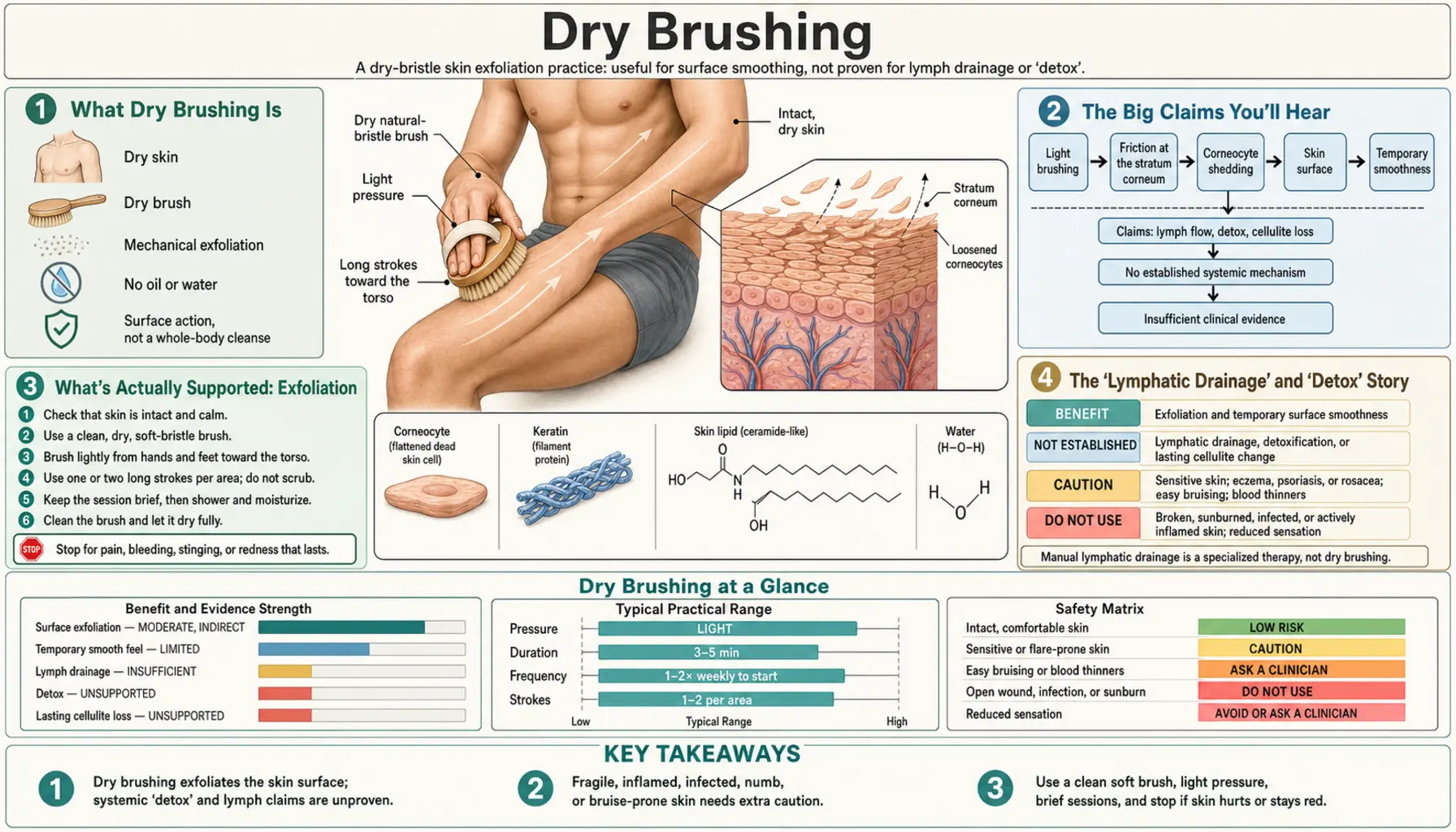
Dry brushing is exactly what it sounds like: sweeping a stiff, dry natural-bristle brush over dry skin, usually in long strokes moving up the arms and legs toward the heart, right before a shower. It has roots in old European spa culture and in Ayurvedic self-massage traditions, and in the last decade it has been reborn as a wellness ritual sold with big promises — smoother skin, "lymphatic drainage," "detox," less cellulite, more energy, and better circulation.
This page tries to sort the real from the oversold, honestly and without sneering. Some of what dry brushing does is genuine and immediate: it exfoliates, it leaves skin feeling temporarily smoother and looking a little brighter, and it produces a pleasant warm tingle. Those effects are real. But the headline claims — that brushing "drains your lymph," "flushes toxins," or "gets rid of cellulite" — are not supported by evidence, and it's worth understanding why. Below we walk through what dry brushing is, the claims you'll hear, what the science actually supports, why it still feels so good, and how to do it safely without damaging your skin.
Table of Contents
- What Dry Brushing Is
- The Big Claims You'll Hear
- What's Actually Supported: Exfoliation
- The "Lymphatic Drainage" and "Detox" Story
- Does It Help Cellulite?
- Circulation, Tingle, and Why It Feels Good
- How to Dry Brush Safely
- Who Should Be Careful or Skip It
- The Honest Bottom Line
- Research Papers
- Connections
- Featured Videos
What Dry Brushing Is
The practice is simple and cheap, which is part of its appeal. You take a firm brush with natural bristles — commonly made from plant fibers such as sisal, agave, or boar bristle — and you sweep it over dry skin (no water, no oil). The usual method is long, smooth strokes on the arms and legs directed upward toward the heart, with gentler circular motions over the belly, and lighter passes on more delicate areas. Most people do it for a few minutes standing in the shower before turning the water on, then rinse and moisturize.
The tradition has two main strands. In parts of Europe, brushing and friction rubs were a fixture of old spa and hydrotherapy routines meant to invigorate the skin. In Ayurveda, the Indian system of traditional medicine, a related practice called garshana uses raw silk gloves or dry brushing as a stimulating self-massage, often before an oil massage. Neither tradition was built on modern physiology; both were built on how the practice feels — brisk, warming, and awakening — and on cultural ideas about stimulating the body.
It helps to hold two facts side by side from the start. Dry brushing is a legitimate, pleasant form of mechanical exfoliation and skin stimulation with a long history. And most of the dramatic health claims attached to it today are marketing that outran the evidence. Both can be true at once.
The Big Claims You'll Hear
Search for dry brushing and you'll meet a familiar list of promises. It's worth laying them out plainly so we can take them one at a time:
- Exfoliation and smoother, brighter skin — that brushing sloughs off dead surface cells and leaves skin softer and more even.
- "Lymphatic drainage" — that brushing toward the heart pushes lymph fluid through the body and "moves" a sluggish lymphatic system.
- "Detoxification" — that it helps the body clear "toxins" through the skin.
- Reduced cellulite — that regular brushing smooths the dimpled appearance of cellulite on thighs and hips.
- Boosted circulation and energy — that it wakes up blood flow, reduces puffiness, and leaves you feeling energized.
The honest verdict, in one line: the first claim is largely true, the last is partly true in a small and temporary way, and the middle three — lymph "drainage," "detox," and cellulite removal — are not supported by good evidence. The rest of this page explains that split.
What's Actually Supported: Exfoliation
Start with the good news, because it's real. Dry brushing is a form of mechanical exfoliation: the stiff bristles physically dislodge loose, dead cells from the outermost layer of skin, the stratum corneum. This is the same basic idea behind a loofah, a washcloth, or a scrub, just done dry. The immediate result is skin that feels smoother to the touch and often looks a little brighter, because you've swept away the dull, flaky surface layer and left fresher skin exposed.
Dermatology recognizes gentle exfoliation as a reasonable part of skin care. It can temporarily improve texture and help even out rough or flaky patches, and by clearing surface debris it can help moisturizers absorb a bit better afterward. This is why brushing and then applying lotion to slightly damp skin tends to leave it feeling especially soft.
Two honest limits keep this in perspective. First, the benefit is cosmetic and short-lived — you're improving how the surface looks and feels today, not changing the deeper structure or health of the skin. Second, more is not better. The stratum corneum is a working barrier that holds moisture in and irritants out, and over-scrubbing it — brushing too hard, too often, or on already-dry or sensitive skin — can damage that barrier, leaving skin red, tight, itchy, or more prone to irritation. Gentle and occasional beats vigorous and daily.
The "Lymphatic Drainage" and "Detox" Story
This is where dry brushing's marketing gets furthest ahead of the facts, so it's worth being direct. The claim is that stroking a brush toward the heart "drains the lymphatic system" and helps the body "release toxins." Neither part holds up.
Take the lymph claim first. The lymphatic system is a network of vessels and nodes that returns fluid from your tissues back to your bloodstream and carries immune cells. But it isn't a passive pond that a brush stirs. Lymph is moved mainly by the squeezing of your skeletal muscles as you move, by the pressure changes of breathing, and by the vessels' own rhythmic contractions — an internal pumping system. Light strokes on the skin's surface don't meaningfully change how that deeper network flows. Even manual lymphatic drainage — a trained, hands-on therapy used for genuine medical lymphedema (chronic swelling, often after cancer surgery) — is a specialized clinical technique, and reviews of it find only modest, condition-specific benefit as an add-on to compression therapy. If skilled clinical lymph work is that carefully qualified, the idea that a few minutes of casual dry brushing "drains your lymph" simply doesn't follow.
Now the "detox" claim. Your body already has a highly effective detoxification system: the liver chemically neutralizes waste and drugs, and the kidneys filter them out in urine, with help from the gut and lungs. The skin's job is to be a barrier, not an exit route for metabolic "toxins." There's no measured toxin that brushing removes, and no plausible pathway by which sweeping bristles across intact skin would filter one out. Critical reviews of "detox" practices in general have found no good evidence that they eliminate any specific toxin or improve health beyond what your organs already do. So the fair statement is blunt but not unkind: dry brushing does not detox you, and it does not drain your lymphatic system. What it does is exfoliate and feel invigorating — which is plenty, without the borrowed physiology.
Does It Help Cellulite?
"Brush away cellulite" is one of the most common promises, and it's an understandable hope, so it deserves a clear, evidence-based answer: there is no good evidence that dry brushing reduces cellulite, and understanding what cellulite actually is explains why.
Cellulite — the dimpled, "orange-peel" look on thighs, hips, and buttocks that affects the great majority of adult women — is a structural feature of the skin, not a surface blemish or a buildup of "toxins." It happens where fat lobules push up against fibrous connective-tissue bands (septae) that tether the skin down; the fat bulges between the tethered points, creating the dimpling. Its causes are largely built-in: sex differences in how these connective bands are arranged, hormones, genetics, and changes in skin thickness with age. Because the dimpling is anchored in that deeper architecture, sweeping a brush over the skin's surface can't reach or remodel it.
The formal literature backs this up. Evidence-based reviews of cellulite treatments consistently find that most heavily marketed options — creams, massage devices, and physical routines — produce, at best, small and temporary changes in appearance, often driven by short-term swelling or hydration of the skin rather than any real reduction of the cellulite itself. Dry brushing may briefly plump and pinken the skin so dimpling looks slightly softer for a little while, but that fades within hours, and there is no trial showing it changes cellulite in any lasting way. If someone is bothered by cellulite, honesty is kinder than a false promise: brushing won't remove it, and that's not a personal failing — cellulite is normal anatomy, not a flaw to be scrubbed out.
Circulation, Tingle, and Why It Feels Good
If dry brushing doesn't detox or de-dimple, why do so many people swear by it and genuinely enjoy it? Because it delivers a cluster of small, real, pleasant effects — and those are reason enough on their own.
- A brief circulation "flush." Rubbing and stroking the skin does temporarily increase blood flow to the surface. That's the warmth and the pink glow you see afterward. It's a genuine, if short-lived, local response — the same reason any brisk rub or massage leaves the skin feeling awake. Just don't confuse a passing surface flush with a lasting change to your circulation.
- The tingle and stimulation. The bristles stimulate a dense field of nerve endings in the skin, producing that bracing, tingly, "awake" sensation many people find energizing first thing in the morning. It's a real sensory effect, even if "boosts energy" is an overstatement.
- The massage and touch effect. Dry brushing is a form of self-massage, and gentle massage and skin stimulation are well documented to feel good, ease tension, and support relaxation and mood. Pleasant touch is not nothing — it's a legitimate, studied benefit.
- The ritual. Taking a few mindful minutes for yourself before a shower is a small act of self-care. That routine — the pause, the attention to your own body — carries real value for wellbeing, independent of any effect on the skin.
Put together, that's a cheap, pleasant, low-risk way to start the day feeling a little smoother, warmer, and more relaxed. You don't need the detox mythology to justify it — the honest, modest benefits stand on their own.
How to Dry Brush Safely
Done gently, dry brushing is very low-risk. Almost all the trouble comes from too much force or too much frequency — treating the skin like a scouring pad. A sensible routine:
- Use a soft-to-medium natural-bristle brush on clean, dry skin. If it hurts, scratches, or leaves you red and stinging, it's too stiff or you're pressing too hard.
- Keep the pressure light. The goal is a gentle glide that sweeps away flakes, not a hard scrub. Your skin should feel warm and tingly afterward, never raw, scraped, or sore.
- Use long, smooth strokes on the limbs, generally moving upward toward the heart, with softer circles on the torso. (The direction is traditional and harmless — it won't "drain lymph," but there's no downside to it.)
- Go easy and less often on delicate skin. Skip the face unless you use a much softer, dedicated facial brush, and lighten up over thin-skinned areas. A couple of times a week is plenty; daily vigorous brushing invites irritation.
- Avoid broken or irritated skin. Don't brush over cuts, rashes, sunburn, active breakouts, eczema or psoriasis flares, moles, warts, or any inflamed or infected area.
- Moisturize afterward. Rinse in the shower and apply a moisturizer to help offset the drying, barrier-thinning effect of exfoliation. This step matters more than the brushing itself for keeping skin comfortable.
- Keep the brush clean and dry. Wash it with soap and water every week or two and let it dry fully, bristles-down, so it doesn't harbor bacteria, mold, or mildew. Don't share brushes.
If brushing consistently leaves your skin red, itchy, tight, or more sensitive, you're overdoing it — brush less often, more gently, or stop. There is no benefit worth an irritated skin barrier.
Who Should Be Careful or Skip It
Because dry brushing is mechanical friction on the skin, some people should be cautious or skip it entirely. This isn't about the practice being dangerous — it's about matching it to your skin:
- Eczema, psoriasis, rosacea, or sensitive skin. Friction and exfoliation can trigger or worsen flares and disrupt an already-fragile barrier. Avoid brushing over affected areas; if your skin is broadly reactive, this practice may not be for you.
- Broken, inflamed, or infected skin. Never brush over open cuts, wounds, sunburn, active acne, or infected patches — you'll spread irritation or bacteria and delay healing.
- Very thin, fragile, or older skin. Skin naturally thins and dries with age, tearing and bruising more easily. Elderly or very dry (xerotic) skin needs a much gentler touch, if brushing at all — moisturizing is more important than exfoliating here.
- Bleeding or bruising tendencies. If you take blood thinners, have a bleeding disorder, or bruise very easily, firm brushing can cause bruising or broken capillaries; keep it very light or skip it.
- Varicose veins and diabetes/neuropathy. Don't press hard over prominent varicose veins. If you have diabetes or reduced sensation in the feet or legs, be especially careful — you may not feel a scrape that could become a slow-healing sore, so inspect the skin and keep pressure minimal.
None of this makes dry brushing risky for most healthy people. It simply means the practice should fit your skin, not the other way around — and that any skin condition or bleeding concern is worth a word with your doctor or dermatologist before you start.
The Honest Bottom Line
Dry brushing is a cheap, pleasant, low-risk skin-care and self-care ritual. Stripped of the marketing, here is what the evidence fairly supports:
- It genuinely exfoliates. Brushing sloughs off dead surface skin, leaving it temporarily smoother and brighter — a real, immediate, cosmetic benefit.
- It feels invigorating and relaxing. The brief surface-blood-flow flush, the tingle, and the self-massage ritual are real small pleasures worth having on their own.
- It does not "detox" you or "drain your lymph." Your liver and kidneys handle detoxification; lymph is moved by muscle activity and internal pumping, not by skin brushing.
- It does not remove cellulite. Cellulite is normal skin architecture, and no surface brushing changes it in any lasting way.
So enjoy dry brushing for what it honestly is: a few soothing minutes that leave your skin smoother and you a little more awake. Keep the pressure gentle, moisturize after, be careful if your skin is sensitive, thin, or broken — and quietly let go of the detox and cellulite promises. The real, modest benefits are more than enough to make it a nice ritual, and holding on to the exaggerated ones only sets you up for disappointment.
Research Papers
Direct clinical trials of "dry skin brushing" specifically are scarce — there is very little high-quality research on the practice itself. The citations below are the most relevant, verifiable science on the mechanisms it's claimed to work through: skin exfoliation and barrier function, lymphatic physiology and lymph-drainage therapy, cellulite biology and treatment, the "detox" question, and the touch/massage effects that explain why it feels good.
- Klein AV, Kiat H. Detox diets for toxin elimination and weight management: a critical review of the evidence. Journal of Human Nutrition and Dietetics. 2015;28(6):675–686. doi:10.1111/jhn.12286 — found no compelling evidence that "detox" practices eliminate any specific toxin; the body's own organs do the work.
- Moore JE Jr, Bertram CD. Lymphatic System Flows. Annual Review of Fluid Mechanics. 2018;50:459–482. doi:10.1146/annurev-fluid-122316-045259 — lymph is propelled by intrinsic vessel contractions and external forces like muscle movement, not by light surface brushing.
- Ezzo J, Manheimer E, McNeely ML, et al. Manual lymphatic drainage for lymphedema following breast cancer treatment. Cochrane Database of Systematic Reviews. 2015;(5):CD003475. doi:10.1002/14651858.CD003475.pub2 — even trained, hands-on lymph-drainage therapy shows only modest, condition-specific benefit as an add-on to compression.
- Huang TW, Tseng SH, Lin CC, et al. Effects of manual lymphatic drainage on breast cancer-related lymphedema: a systematic review and meta-analysis of randomized controlled trials. World Journal of Surgical Oncology. 2013;11:15. doi:10.1186/1477-7819-11-15 — clinical lymphatic drainage had limited added benefit, underscoring how specialized (and modest) genuine lymph therapy is.
- Luebberding S, Krueger N, Sadick NS. Cellulite: An Evidence-Based Review. American Journal of Clinical Dermatology. 2015;16(4):243–256. doi:10.1007/s40257-015-0129-5 — found most marketed cellulite treatments give small, temporary appearance changes at best, with weak evidence overall.
- Khan MH, Victor F, Rao B, Sadick NS. Treatment of cellulite: Part I. Pathophysiology. Journal of the American Academy of Dermatology. 2010;62(3):361–370. doi:10.1016/j.jaad.2009.10.042 — cellulite is a structural feature of fat lobules and connective-tissue bands, not surface debris or "toxins."
- Khan MH, Victor F, Rao B, Sadick NS. Treatment of cellulite: Part II. Advances and controversies. Journal of the American Academy of Dermatology. 2010;62(3):373–384. doi:10.1016/j.jaad.2009.10.041 — reviews cellulite therapies and highlights how limited and short-lived their effects are.
- Rodan K, Fields K, Majewski G, Falla T. Skincare Bootcamp: The Evolving Role of Skincare. Plastic and Reconstructive Surgery – Global Open. 2016;4(12 Suppl):e1152. doi:10.1097/GOX.0000000000001152 — reviews the role of exfoliation and skincare in surface texture, and the value of moisturizing.
- Rawlings AV, Harding CR. Moisturization and skin barrier function. Dermatologic Therapy. 2004;17(Suppl 1):43–48. doi:10.1111/j.1396-0296.2004.04S1005.x — explains how the stratum corneum barrier holds moisture in, and why over-exfoliating and moisturizing after matter.
- Proksch E, Brandner JM, Jensen JM. The skin: an indispensable barrier. Experimental Dermatology. 2008;17(12):1063–1072. doi:10.1111/j.1600-0625.2008.00786.x — details the skin's barrier role, reinforcing that skin protects rather than serving as a "detox" exit.
- Field T. Massage therapy research review. Complementary Therapies in Clinical Practice. 2016;24:19–31. doi:10.1016/j.ctcp.2016.04.005 — documents the relaxation, mood, and tension-relief effects of massage and skin stimulation — part of why brushing feels good.
- White-Chu EF, Reddy M. Dry skin in the elderly: complexities of a common problem. Clinics in Dermatology. 2011;29(1):37–42. doi:10.1016/j.clindermatol.2010.07.005 — older, thinner, drier skin is more fragile, a key reason to brush gently or not at all in that group.
For the direct question — where the evidence is genuinely thin — you can follow the current literature yourself: PubMed: dry skin brushing, PubMed: skin brushing lymphatic drainage, and PubMed: mechanical exfoliation and skin barrier.
Connections
- All Remedies
- Gua Sha
- Massage
- Cupping
- Reflexology
- Acupuncture
- Detox Protocols
- Grounding & Earthing
- Sauna
- Dermatology
- Eczema
- Psoriasis
- Salt in Socks — a real sensation on the skin paired with an unsupported “drawing out” explanation