Exercise and Weight Loss: What It Can and Can't Do
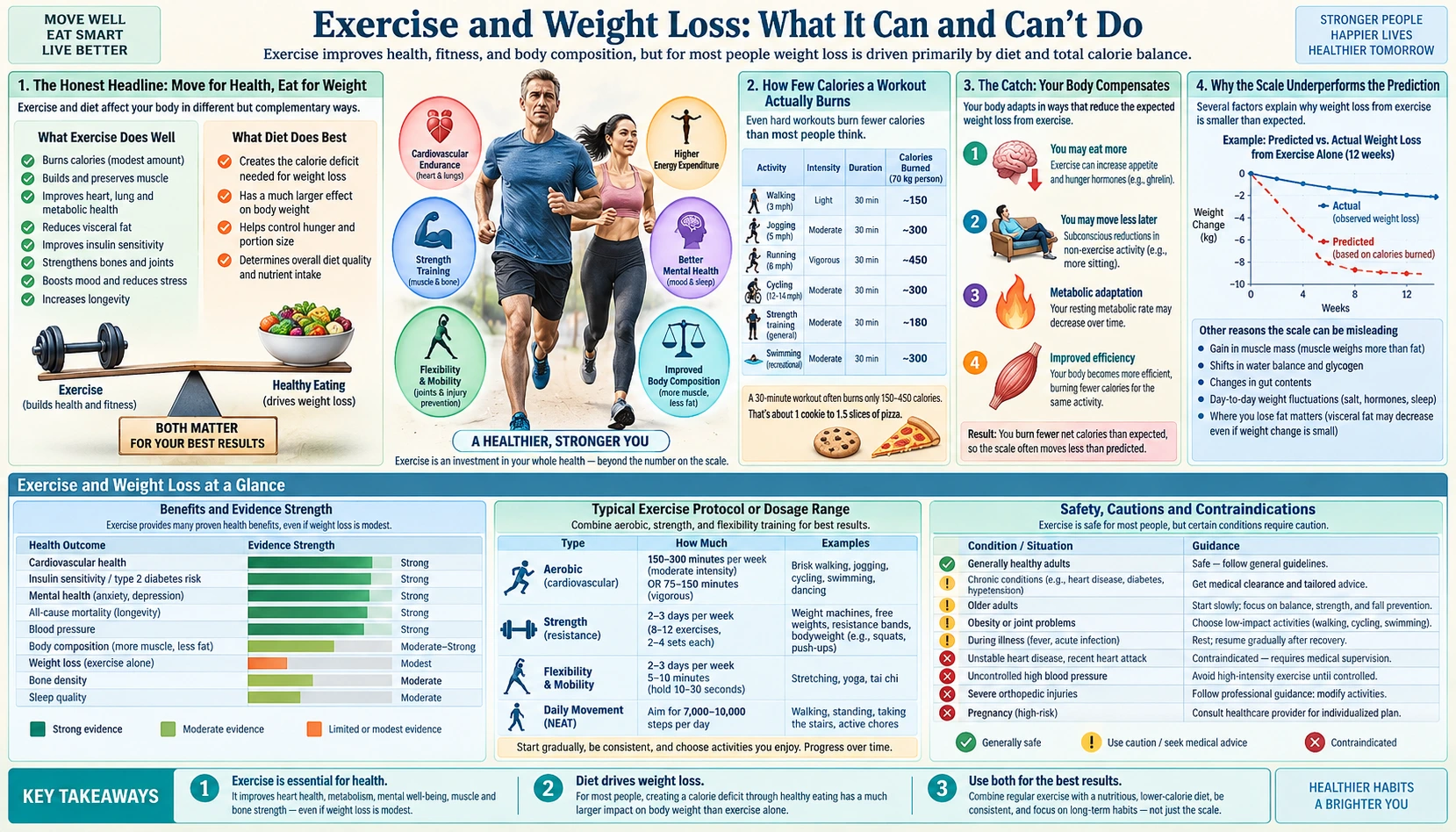
Exercise is one of the best things you can do for your body — and one of the most oversold tools for losing weight. This page is honest about both halves of that sentence. The uncomfortable truth, backed by decades of careful research, is that exercise on its own usually produces only modest weight loss: a workout burns fewer calories than most people imagine, and the body quietly pushes back by making you hungrier and by trimming the movement you do the rest of the day. You have probably heard the line "you can't outrun a bad diet," and where the number on the scale is concerned, it is largely true. But that is only half the story, and the other half is genuinely good news. Exercise turns out to be one of the strongest predictors of keeping weight off once you have lost it; it protects the calorie-burning muscle you would otherwise shed while dieting; and it improves your health, blood sugar, mood, and long-term survival to a degree that has surprisingly little to do with what the scale says. This page separates what exercise can do for your weight from what it can't — and explains why a small change on the scale is a normal, well-documented response, not a personal failure.
Table of Contents
- The Honest Headline: Move for Health, Eat for Weight
- How Few Calories a Workout Actually Burns
- The Catch: Your Body Compensates
- Why the Scale Underperforms the Prediction
- The "Constrained Energy" Idea
- Where Exercise Shines: Keeping the Weight Off
- Exercise Protects Calorie-Burning Muscle
- Fit at Many Sizes: Health Beyond the Scale
- Cardio, Resistance, and Everyday Movement
- What the Research Shows About Appetite
- What Guidelines and Trials Describe as a Starting Point
- Key Research Papers
- Connections
- Featured Videos
The Honest Headline: Move for Health, Eat for Weight
Here is the single most useful idea on this page, stated plainly up front: for most people, the plate controls your weight and exercise controls your health. Both matter enormously, but they do different jobs, and confusing the two is the reason so many people work out faithfully for months, watch the scale barely move, and conclude that their body is broken. Your body is not broken. Exercise simply is not a very powerful weight-loss lever, even though it is a spectacularly powerful health lever.
This is not a fringe opinion or an excuse to skip the gym. It is the consistent conclusion of large, careful reviews of the evidence. The American College of Sports Medicine's position stand on physical activity and weight, summarized by Donnelly and colleagues, found that exercise alone typically produces only small amounts of weight loss — and that its real superpower shows up in preventing weight regain after you have already lost weight. Swift and colleagues, reviewing the same landscape, reached the same split verdict: modest for losing, excellent for keeping it off and for health. The point of the rest of this page is to explain why that split exists, so it stops feeling like a personal failing and starts feeling like a map of where to put your effort.
How Few Calories a Workout Actually Burns
Start with the arithmetic, because it is where most disappointment begins. People routinely overestimate how many calories exercise burns and underestimate how many are in food. A brisk 30-minute walk burns roughly 120–180 calories for an average adult. A hard 45-minute gym session might burn 300–450. An hour of steady running, for many people, lands somewhere around 500–700.
Now put those numbers next to food. A large flavored coffee drink, a muffin, or a couple of cookies can carry 400–600 calories — enough to erase the entire run in about ninety seconds of eating. This is the mechanical heart of "you can't outrun a bad diet." Cutting 500 calories from what you eat is quick, free, and easy to repeat every single day. Adding 500 calories of burn means a long, sweaty daily effort that is hard to sustain and, as the next sections explain, doesn't even translate cleanly into a 500-calorie deficit once your body responds.
None of this means the walk or the run is wasted — far from it. It means that, measured only by the scale, an hour of exercise is worth less than a modest change in what is eaten. That ratio explains why so many hard-working exercisers see little change on the scale: for weight, the larger lever is food.
The amount of exercise matters too. A 2024 review of 116 randomized trials with 6,880 adults with overweight or obesity found that each extra 30 minutes a week of supervised aerobic exercise went with about 0.52 kg more weight loss and 0.56 cm less around the waist, with losses growing steadily up to 300 minutes a week. The authors concluded that more than 150 minutes a week at moderate intensity or above may be needed for changes large enough to matter clinically.
The Catch: Your Body Compensates
If burning calories were the whole story, exercise would still slowly chip away at your weight. But your body is not a passive calculator — it is an active system that defends its energy balance. When you burn more through exercise, it tends to quietly claw some of it back in two ways. Researchers call this compensation, and it is the most under-appreciated fact in the entire exercise-and-weight conversation.
First, you get hungrier. Exercise can nudge appetite upward, and even small, barely-conscious increases in how much you eat can offset a large share of what a workout burned. You feel you have "earned" a treat, or you are simply hungrier than usual, and the extra food closes much of the gap.
Second, you unconsciously move less the rest of the day. After a hard workout you may sit more, fidget less, take the elevator, and generally slump — all without deciding to. This everyday, non-workout movement has a name, non-exercise activity thermogenesis or NEAT, and Levine and colleagues showed in a classic overfeeding study that NEAT varies enormously between people and powerfully influences fat gain. The catch for exercisers is that NEAT tends to fall on days you train hard, silently refunding some of the calories you just spent.
How real is this effect? In a striking controlled study, Church and colleagues had 411 sedentary, overweight postmenopausal women do supervised exercise at three different doses for six months. In the two lower-dose groups (about 72 and 136 minutes a week), actual weight loss closely matched the calorie math, with no significant compensation. Only the highest-dose group (about 194 minutes a week) fell short: it lost 1.5 kg against the 2.7 kg predicted — about half — and so lost no more weight than the lower-dose groups. All three exercise groups trimmed their waists, independent of any change in weight. King and colleagues, following 35 overweight and obese adults through twelve weeks of supervised exercise five times a week, found that the group’s average loss (3.7 kg) matched the prediction, but individual results were wildly variable, from a loss of 14.7 kg to a gain of 1.7 kg. Those the researchers classed as “compensators” lost only 1.5 kg on average, and their food intake rose by about 268 calories a day. And in one of the most quietly humbling trials, Jakicic and colleagues found that adding wearable activity trackers to a weight-loss program actually led to less weight loss over two years than the same program without trackers — a vivid reminder that "just move more" does not reliably become "weigh less."
Why the Scale Underperforms the Prediction
Put compensation together and you get one of the most important papers in this field. Thomas and colleagues asked a simple, honest question in the title of their 2012 analysis: why do individuals not lose more weight from an exercise intervention at a defined dose? They took the amount of exercise people actually did in a set of studies, calculated how much weight that exercise should have burned off, and compared it to how much weight people really lost.
The gap was large: actual weight loss consistently fell short of the prediction. The authors weighed several explanations — eating more, a drop in resting calorie burn, a gain in lean tissue, less movement outside workouts, and flawed prediction models — and concluded that the small weight loss in most of the programs was mainly due to low prescribed doses of exercise (the programs did not ask people to burn many calories), compounded by people eating more at the same time. The exercise was real and the calories were genuinely burned; part of the deficit was refilled by eating, in ways that are largely automatic and mostly invisible to the person doing the exercising.
This is the science behind an experience millions of people have had and blamed themselves for: "I exercised hard for three months and barely lost anything." That is not a lack of willpower or a broken metabolism. It is a normal, well-documented biological response, and knowing it exists is the first step to planning around it instead of being defeated by it.
The "Constrained Energy" Idea
A newer and even more provocative line of research suggests the body's pushback runs deeper than day-to-day snacking and slumping. The traditional "additive" model assumes total daily calorie burn is simply your baseline plus whatever exercise adds on top. Pontzer and colleagues have challenged that assumption with what they call the constrained total energy expenditure model.
Studying populations that range from very sedentary to extremely physically active, Pontzer's group found that total daily energy expenditure does not keep climbing in step with activity. Beyond a certain point, people who move far more do not burn proportionally more calories overall — the body appears to adapt by trimming the energy it spends on other internal processes, holding total expenditure within a relatively constrained band. In other words, add a lot of exercise and your body may quietly economize elsewhere, so the total does not rise as much as the additive math predicts.
This idea is still debated, and it does not mean exercise is pointless — the health benefits of activity are not in question. What it means is that expecting exercise to simply add a big daily calorie deficit, week after week, may misunderstand how human energy budgets actually work. It is one more reason the scale so often refuses to cooperate with the treadmill's calorie readout.
Where Exercise Shines: Keeping the Weight Off
Now for the turn in the story, and it is a genuinely hopeful one. Everything above is about losing weight, where exercise is a weak lever. But keeping weight off is a completely different problem, and here exercise is one of the most reliable tools we have.
The best window into long-term success is the National Weight Control Registry, a long-running study of thousands of people who have lost significant weight (on average 33 kilograms, about 73 pounds) and kept it off for more than five years. Wing and Phelan, summarizing what these successful maintainers have in common, found that a very high level of physical activity is one of their most consistent shared habits — registry members report averaging close to an hour a day of moderate activity, often just walking. Alongside habits like eating breakfast, monitoring their weight, and keeping a fairly consistent diet, movement is a thread that runs through nearly every long-term success story.
Why would exercise be weak for losing but strong for maintaining? A few reasons. Maintenance is a smaller battle — you are defending against a slow creep of a few hundred calories, a scale exercise can tip. Regular activity also builds the daily structure, identity, and appetite regulation that keep eating steady. And it burns real calories that, over a maintained lifetime rather than a frantic diet, add up in your favor. Swift and colleagues reach the same conclusion in their review: physical activity's clearest, best-supported role in body weight is in preventing regain after a loss. If you have ever lost weight and watched it slowly return, this is the section to remember. The exercise that felt useless while you were losing becomes essential the moment you are trying to stay there.
A 2021 trial tested this directly. 195 adults with obesity first lost an average of 13.1 kg on an 8-week low-calorie diet. Over the following year, compared with placebo, a moderate-to-vigorous exercise program kept off 4.1 kg more, the weight-loss drug liraglutide 6.8 kg more, and the two combined 9.5 kg more. The combination lowered body-fat percentage by 3.9 points, about twice the fall seen with exercise alone or liraglutide alone.
Exercise Protects Calorie-Burning Muscle
There is a second reason exercise earns its place even during active weight loss, and it does not show up on a bathroom scale at all — it shows up in what kind of weight you lose. When you cut calories, your body sheds a mix of fat and lean tissue, including muscle. Losing muscle is doubly bad: it is the tissue that gives you strength and function, and because muscle burns calories even at rest, losing it lowers your metabolism and makes regain easier.
This is where exercise and adequate protein change the composition of your loss. Weinheimer and colleagues, in a systematic review of energy restriction with and without exercise in middle-aged and older adults, found that adding exercise to a diet better preserves fat-free mass (largely muscle) than dieting alone: across 52 studies, 81% of diet-only groups lost 15% or more of their weight as fat-free mass, against 39% of diet-plus-exercise groups. The exercise in those studies was mainly aerobic; for resistance training specifically, the STRRIDE trial described below found that it added lean mass. The practical meaning is important: two people can lose the same ten pounds on the scale, but the one who trained while dieting loses more of it as fat and keeps more of their calorie-burning muscle, ending up leaner, stronger, and metabolically better protected against putting the weight back.
So even when exercise is not moving the scale number much, it is quietly improving the quality of every pound you lose. That is a benefit worth having regardless of what the scale says on any given morning.
Fit at Many Sizes: Health Beyond the Scale
Perhaps the most freeing finding in this whole area is that most of exercise's health rewards do not require weight loss to collect. You can become dramatically healthier through movement while the scale barely budges — and that healthier state is real, measurable, and life-extending.
The evidence here is deep. In a landmark study, Blair and colleagues followed 10,224 men and 3,120 women, whose fitness was measured on a treadmill, for about eight years and found that higher cardiorespiratory fitness was strongly associated with lower death rates from all causes — and that the least-fit individuals carried by far the highest risk. Age-adjusted death rates fell from 64.0 per 10,000 person-years in the least-fit men to 18.6 in the most-fit men, and from 39.5 to 8.5 in women. A great deal of later work has reinforced the theme now often summarized as "fitness versus fatness": being physically fit predicts better health and longer life across a wide range of body sizes, and improving your fitness lowers your risk even if your weight does not change. Recognizing this, an American Heart Association scientific statement led by Ross and colleagues argued that cardiorespiratory fitness should be treated as a clinical vital sign, measured and valued alongside blood pressure and cholesterol.
Beyond longevity, regular movement improves blood sugar control and insulin sensitivity, lowers blood pressure, improves cholesterol, strengthens bones, sharpens sleep, and is one of the most effective non-drug treatments there is for anxiety and low mood. Nearly all of these benefits arrive whether or not you lose a single pound. This is why the framing at the top of the page matters so much: if you exercise expecting the scale to reward you, you may quit in disappointment and walk away from an enormous pile of benefits you were already earning. What movement delivers — a healthier, stronger, longer, better-feeling life — arrives whether or not the scale changes.
Cardio, Resistance, and Everyday Movement
"Exercise" is not one thing, and the three main kinds do different jobs for weight and health. A realistic plan usually blends all three rather than betting everything on one.
Cardio (aerobic exercise)
Walking, jogging, cycling, and swimming burn the most calories per session and drive the biggest improvements in heart and lung fitness. In the STRRIDE trial, Willis and colleagues directly compared training types and found that aerobic training beat resistance training for reducing body mass and fat mass — if raw fat loss is the goal, cardio does more of it. Cardio is also the backbone of the high daily activity that long-term maintainers rely on.
Resistance training (strength work)
Lifting weights or using your body weight burns fewer calories in the moment, so on its own it is a weak tool for dropping scale weight. Its value is different and, in a diet, arguably more important: it builds and preserves muscle. In the same STRRIDE comparison, resistance training added lean mass but did little for fat loss by itself; combined with cardio it delivered fat loss plus muscle, at the cost of more time. During weight loss, resistance work is the single best insurance against losing the calorie-burning muscle discussed earlier.
NEAT: the movement between workouts
The calories you burn simply living — walking to the store, taking the stairs, standing, fidgeting, doing chores — is NEAT, and across a whole day it can dwarf a single workout. Levine and colleagues showed that differences in NEAT explain a large share of why some people resist fat gain and others don't. The practical point: a daily step target, standing more, parking farther away, and taking walking breaks can add more total movement than a gym session — and, crucially, this everyday activity seems less prone to the appetite backlash that hard workouts can trigger.
What the Research Shows About Appetite
If compensation is the reason exercise underdelivers on the scale, the appetite side of compensation is where the research looks most closely. The body's tendency to refill a deficit cannot be switched off, but the findings above point to what makes it larger or smaller.
- Rewarding a workout with food. The honest, human thought "I earned this" is one of the most common ways the calorie gap closes. Because a workout burns far fewer calories than a treat contains (see the figures above), one reward can undo the whole session.
- Protein and high-volume, filling foods. Adequate protein blunts hunger and protects muscle; high-water, high-fiber foods (vegetables, fruit, beans, potatoes with the skin) fill the stomach on fewer calories. Managing appetite through food choices is described as more effective than trying to out-exercise it.
- Steady daily movement versus occasional exhausting sessions. Gentler, consistent activity — especially walking and NEAT — tends to provoke less of a hunger rebound than exhausting workouts, while still delivering health benefits and supporting maintenance.
- Individual variation. King and colleagues showed that people vary enormously in how much they compensate. A strong hunger response to exercise is biology, not weakness — and for people who have it, food choices carry even more of the weight-loss work.
What Guidelines and Trials Describe as a Starting Point
None of this argues against exercise; it changes what exercise is expected to deliver. Guidelines and the trials above describe the following starting points, which fit both what exercise can and can't do.
- The guideline baseline. Public-health and ACSM guidance points to about 150–300 minutes of moderate activity a week (roughly 30–60 minutes most days) for health, with the higher end especially valuable for preventing weight regain. Brisk walking counts as moderate activity.
- Strength training twice a week. Public-health activity guidelines add muscle-strengthening work on two or more days a week; resistance sessions protect muscle, bone, and metabolism — the benefits that make weight loss stick and aging kinder.
- A daily movement floor. A step goal, standing breaks, stairs, and short walks raise NEAT with little appetite backlash. This everyday activity may matter more for weight than any single workout.
- Exercise paired with the plate. In the research on this page, exercise does most for fitness, mood, muscle, and maintenance, while food choices — enough protein, plenty of filling whole foods, portions and liquid calories — are the main weight-loss lever. The two do different jobs.
- What people keep doing. For weight maintenance and health, the exercise that counts is the one a person enjoys enough to keep doing for years, not the most punishing one they can tolerate for six weeks.
A closing word, meant kindly. For anyone who has exercised hard and felt betrayed by the scale, the research says they were not doing it wrong and their body is not defective — they were handed a myth about what exercise is for. The honest science is, in the end, encouraging. Exercise makes people healthier, stronger, steadier, and longer-lived, and on every one of those fronts it delivers far more than it is usually given credit for. For weight itself, the research puts food first; for nearly everything else, exercise is the stronger tool.
Key Research Papers
- Thomas DM, Bouchard C, Church T, Slentz C, et al. Why do individuals not lose more weight from an exercise intervention at a defined dose? An energy balance analysis. Obesity Reviews. 2012;13(10):835-847. — the key analysis showing real weight loss falls short of what the exercise "should" have burned, mainly because the prescribed exercise doses were low, compounded by eating more. — doi:10.1111/j.1467-789X.2012.01012.x
- Swift DL, Johannsen NM, Lavie CJ, Earnest CP, Church TS. The role of exercise and physical activity in weight loss and maintenance. Progress in Cardiovascular Diseases. 2014;56(4):441-447. — review finding exercise modest for losing weight but strong for preventing regain and for health. — doi:10.1016/j.pcad.2013.09.012
- Donnelly JE, Blair SN, Jakicic JM, Manore MM, et al. American College of Sports Medicine Position Stand: appropriate physical activity intervention strategies for weight loss and prevention of weight regain for adults. Medicine & Science in Sports & Exercise. 2009;41(2):459-471. — the authoritative position stand on how much activity is needed for weight loss versus maintenance. — doi:10.1249/MSS.0b013e3181949333
- Wing RR, Phelan S. Long-term weight loss maintenance. The American Journal of Clinical Nutrition. 2005;82(1 Suppl):222S-225S. — National Weight Control Registry summary; high physical activity is one of the most consistent habits of successful maintainers. — doi:10.1093/ajcn/82.1.222S
- Pontzer H, Durazo-Arvizu R, Dugas LR, Plange-Rhule J, et al. Constrained total energy expenditure and metabolic adaptation to physical activity in adult humans. Current Biology. 2016;26(3):410-417. — evidence that total daily calorie burn does not rise proportionally with activity; the body adapts. — doi:10.1016/j.cub.2015.12.046
- Church TS, Martin CK, Thompson AM, Earnest CP, et al. Changes in weight, waist circumference and compensatory responses with different doses of exercise among sedentary, overweight postmenopausal women. PLoS ONE. 2009;4(2):e4515. — higher exercise doses did not produce proportionally more weight loss, demonstrating compensation directly. — doi:10.1371/journal.pone.0004515
- King NA, Hopkins M, Caudwell P, Stubbs RJ, Blundell JE. Individual variability following 12 weeks of supervised exercise: identification and characterization of compensation for exercise-induced weight loss. International Journal of Obesity. 2008;32(1):177-184. — people vary widely in how much appetite and eating rise to offset exercise. — doi:10.1038/sj.ijo.0803712
- Jakicic JM, Davis KK, Rogers RJ, King WC, et al. Effect of wearable technology combined with a lifestyle intervention on long-term weight loss: the IDEA randomized clinical trial. JAMA. 2016;316(11):1161-1171. — adding activity trackers led to less weight loss over two years, a caution against "just move more.". — doi:10.1001/jama.2016.12858
- Willis LH, Slentz CA, Bateman LA, Shields AT, et al. Effects of aerobic and/or resistance training on body mass and fat mass in overweight or obese adults. Journal of Applied Physiology. 2012;113(12):1831-1837. — the STRRIDE trial: aerobic training beat resistance training for fat and weight loss; resistance built lean mass. — doi:10.1152/japplphysiol.01370.2011
- Weinheimer EM, Sands LP, Campbell WW. A systematic review of the separate and combined effects of energy restriction and exercise on fat-free mass in middle-aged and older adults: implications for sarcopenic obesity. Nutrition Reviews. 2010;68(7):375-388. — adding exercise to a diet better preserves calorie-burning muscle than dieting alone. — doi:10.1111/j.1753-4887.2010.00298.x
- Levine JA, Eberhardt NL, Jensen MD. Role of nonexercise activity thermogenesis in resistance to fat gain in humans. Science. 1999;283(5399):212-214. — the classic study showing everyday movement (NEAT) varies hugely between people and strongly shapes fat gain. — doi:10.1126/science.283.5399.212
- Ross R, Blair SN, Arena R, Church TS, et al. Importance of assessing cardiorespiratory fitness in clinical practice: a case for fitness as a clinical vital sign (American Heart Association scientific statement). Circulation. 2016;134(24). — argues fitness predicts health and survival strongly enough to be treated as a vital sign, largely independent of weight. — doi:10.1161/CIR.0000000000000461
- Blair SN, Kohl HW 3rd, Paffenbarger RS Jr, Clark DG, Cooper KH, Gibbons LW. Physical fitness and all-cause mortality. A prospective study of healthy men and women. JAMA. 1989;262(17):2395-2401. — fitter men and women had far lower death rates over about eight years. — PubMed PMID: 2795824
- Jayedi A, Soltani S, Emadi A, Zargar MS, Najafi A. Aerobic Exercise and Weight Loss in Adults: A Systematic Review and Dose-Response Meta-Analysis. JAMA Network Open. 2024;7(12):e2452185. — each 30 minutes a week of aerobic exercise went with about 0.52 kg more weight loss. — PubMed PMID: 39724371
- Lundgren JR, Janus C, Jensen SBK, Juhl CR, et al. Healthy Weight Loss Maintenance with Exercise, Liraglutide, or Both Combined. New England Journal of Medicine. 2021;384(18):1719-1730. — exercise, liraglutide and the two combined each kept off more weight than placebo over a year. — PubMed PMID: 33951361