Contrast Therapy
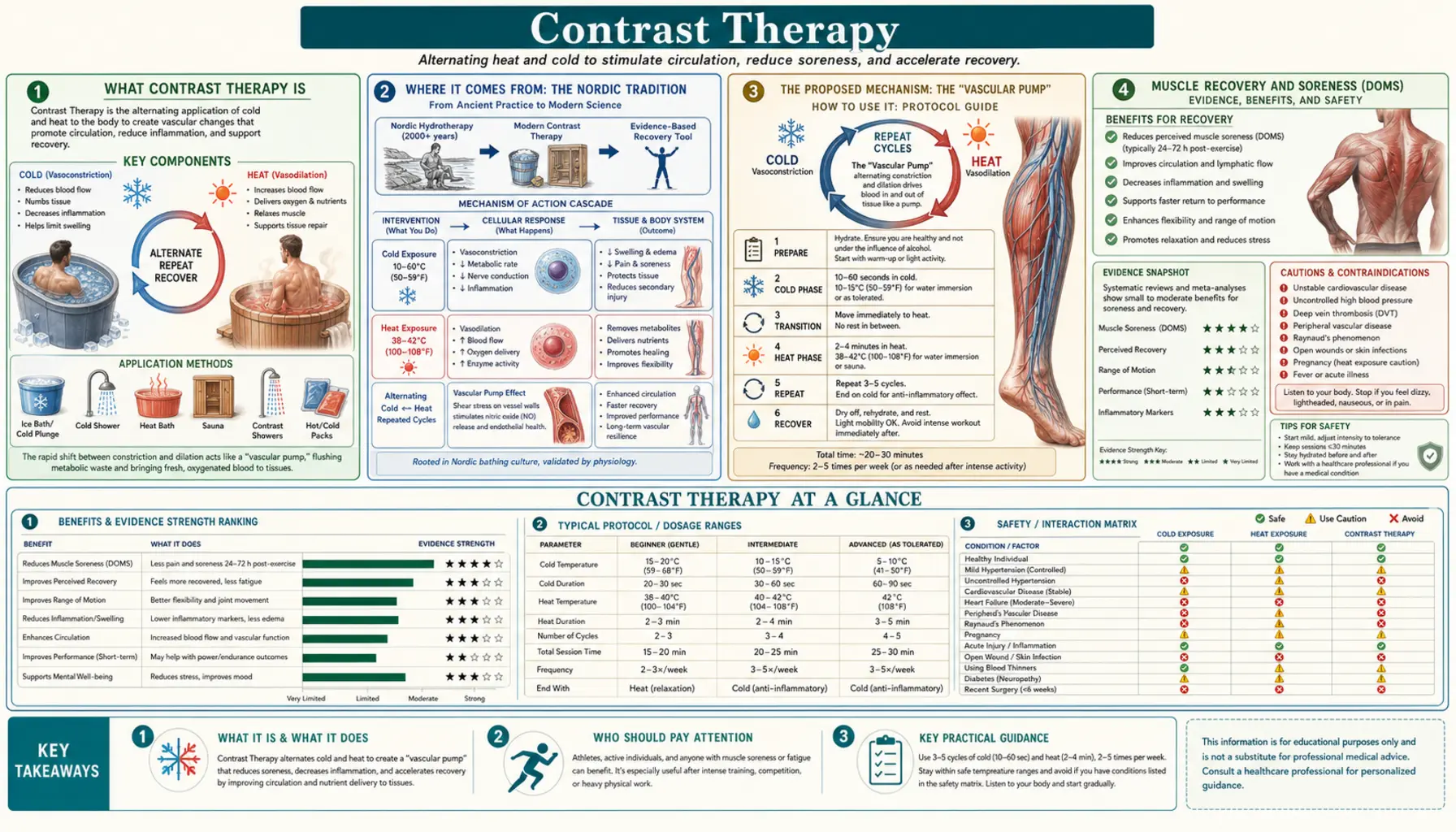
Contrast therapy is the simple, old practice of moving your body back and forth between hot and cold — a warm bath then a cold one, a hot shower that finishes on cold, or the classic Nordic ritual of a hot sauna followed by a plunge into icy water. People reach for it to bounce back after hard workouts, to soothe achy hands and feet, and often just because it feels invigorating. This page walks through what contrast therapy actually is, the popular "vascular pump" idea behind it, and what the research really shows. The honest headline: it is a pleasant, generally low-risk recovery habit with modest evidence that it eases short-term muscle soreness — roughly on par with other simple recovery methods — but it is not a miracle, the studies are mixed, and there is one safety issue worth taking seriously. We will keep it plain, keep it honest, and point you to the individual pages on heat and cold, where the evidence for each is stronger on its own.
Table of Contents
- What Contrast Therapy Is
- Where It Comes From: The Nordic Tradition
- The Proposed Mechanism: The "Vascular Pump"
- Muscle Recovery and Soreness (DOMS)
- Circulation, Swelling, and Rehab Uses
- The Real Value May Be in the Parts
- How to Do It: Typical Protocols
- Safety: Who Should Be Careful
- The Honest Bottom Line
- Research Papers
- Connections
- Featured Videos
What Contrast Therapy Is
Contrast therapy means deliberately alternating hot and cold exposure on the body, usually in a repeating cycle. There is nothing high-tech about it. The three common forms are:
- Contrast baths. Two tubs or basins — one warm, one cold — and you move a limb, or your whole body, back and forth between them. This is the version physical therapists have used for decades on hands, wrists, ankles, and feet.
- Contrast showers. The most accessible version: you simply alternate the water temperature in your shower, switching between comfortably hot and bracingly cold for a minute or so at a time, often finishing on cold.
- Sauna and cold plunge. The most intense version and the one most people picture today — heat up thoroughly in a sauna (or hot tub), then get into cold water: a cold plunge, a lake, a cold shower, or even snow. Repeat the cycle a few times.
The temperatures are not extreme in the contrast-bath version used in clinics — think roughly warm-bath hot and tap-cold. The sauna-and-plunge version is a much bigger swing, from a sweaty 80–90°C sauna to water that may be near freezing. That difference matters a lot for both the experience and the safety picture, which we come back to below. What all three share is the pattern: heat, then cold, then heat again, cycling for perhaps 10 to 30 minutes.
Where It Comes From: The Nordic Tradition
Alternating heat and cold is genuinely ancient and appears in many cultures — Roman bath houses moved bathers from hot rooms to cold pools, and Russian, Turkish, and Japanese bathing customs all include hot-then-cold rituals. The version most familiar today, though, is Nordic. In Finland, Sweden, and across Scandinavia, the sauna followed by a roll in the snow or a dip in a frozen lake is a centuries-old social and cultural practice, not a fad. For millions of people it is simply how you unwind at the end of a week.
It is worth being clear-eyed about what that history does and does not tell us. Long tradition means the practice is broadly tolerated and culturally valued — that is real. It does not, by itself, prove specific health claims. Plenty of enjoyable traditions are good for us in ways science later confirms, and plenty of others turn out to be neutral. So we treat the tradition as a reason to take contrast therapy seriously and study it, not as evidence in place of the studies.
The Proposed Mechanism: The "Vascular Pump"
The most popular explanation for why contrast therapy might help is the idea of a vascular pump. The reasoning goes like this: heat makes blood vessels near the skin and in the muscles widen (vasodilation), while cold makes them clench down (vasoconstriction). Alternate the two, the theory says, and you rhythmically open and squeeze the blood vessels — like gently pumping a bellows — flushing stagnant fluid and metabolic waste out of tired tissue and drawing fresh, oxygen-rich blood in. On paper, that sounds like it should speed recovery and reduce swelling.
It is a tidy story, and it may capture part of what happens near the skin. But the honest picture is more cautious. When researchers have actually measured blood flow deep inside the muscle during contrast baths — for example using near-infrared spectroscopy — the changes they find tend to be small and mostly superficial, not the powerful deep "flushing" the pump metaphor implies. In other words, the temperature swings clearly reach the skin and the shallow tissue, but the evidence that they meaningfully churn blood through the deeper muscle is weak. Reviews of the topic reach the same measured conclusion: contrast therapy does change skin temperature and surface circulation, but whether that translates into the deep pumping effect people imagine is far from settled.
There is a second, separate way it might help, and it has nothing to do with plumbing. Heat and cold each do their own well-documented things to the body. Heat relaxes muscles, eases stiffness, and feels soothing. Cold numbs pain, calms inflammation, and reduces the sensation of soreness. So even if the "pump" turns out to be more metaphor than mechanism, alternating heat and cold still delivers the individual comforts of each — plus, for many people, a genuine lift in mood and alertness from the shock of the cold.
Muscle Recovery and Soreness (DOMS)
This is the use contrast therapy has been studied for the most, so it deserves the most honest treatment. The setting is athletic recovery: after a hard or unfamiliar workout, muscles get sore a day or two later — the familiar ache called delayed-onset muscle soreness (DOMS). The question researchers keep asking is whether jumping between hot and cold water afterward helps you recover faster and feel less sore.
Here is the fair summary of what dozens of studies show. Compared with doing nothing (just resting passively), contrast water therapy does seem to reduce muscle soreness and the feeling of fatigue in the short term, and it can help preserve strength and performance between hard sessions. That is a real, repeated finding. But two important caveats come with it:
- It is usually no better than other simple recovery methods. When contrast therapy is compared not with rest but with plain cold-water immersion, a light warm-down, active recovery, or compression, it tends to come out about even — sometimes slightly ahead, sometimes slightly behind. It is one good option among several, not a clear winner. In some head-to-head studies, cold-water immersion alone actually edged it out.
- The effect sizes are modest and the results are mixed. Meta-analyses that pool many trials rate the overall evidence as low quality: studies are small, protocols differ wildly, and a fair number find no meaningful benefit at all on measures like strength or power. So the average points to a small helpful effect on soreness and perceived recovery, not a dramatic one.
Put simply: if you finish a tough workout, hop between a hot and cold shower, and feel less stiff and more refreshed the next day, that experience lines up with the evidence. Just do not expect it to outperform the basics or to rescue you from genuinely overdoing it. For everyday exercisers, the biggest advantage may honestly be that it feels good and is easy to stick with — and a recovery habit you enjoy is one you will actually do.
Circulation, Swelling, and Rehab Uses
Long before it became a wellness trend, contrast bathing lived in physical therapy clinics. Therapists have traditionally used contrast baths for hands, wrists, ankles, and feet — for stiff or swollen joints, after certain injuries, and in conditions like arthritis or post-surgical stiffness. The thinking was the same vascular-pump idea: alternate hot and cold to reduce swelling (edema) and ease pain so a person can move and rehabilitate the area.
The evidence here is, again, limited and honest people should say so. Systematic reviews of contrast baths — including in hand therapy — find that they reliably change skin temperature, but the proof that they actually reduce swelling or improve function better than other treatments is weak and inconsistent. That does not mean they are useless. Many patients find contrast baths comforting, they are cheap and low-risk for most people, and the warmth and movement can make gentle rehab exercises easier to tolerate. It is reasonable to view contrast baths in rehab as a supportive comfort measure with a long clinical tradition, rather than a proven treatment that clears swelling on its own. If a physical therapist recommends them as part of a plan, that is a sensible use; just keep expectations grounded. (One important exception on safety — people with reduced sensation in the hands or feet — is covered in the safety section below.)
The Real Value May Be in the Parts
Here is a perspective that helps make sense of everything above. The evidence for contrast therapy as a combined package is modest. But the evidence for its two ingredients, studied on their own, is considerably stronger — and each has its own dedicated page on this site.
- Heat. Regular sauna bathing has a growing and fairly impressive body of research behind it, including large long-term studies linking frequent sauna use with better cardiovascular health. Heat also plainly relaxes muscles and relieves stiffness. See the Sauna page for the details and the honest limits of that research.
- Cold. Deliberate cold exposure — cold showers, cold-water immersion, ice baths — has its own evidence base for dampening inflammation, blunting pain, and giving a sharp, well-documented boost in alertness and mood. See the Cold Exposure page for what holds up and what is overhyped.
So one reasonable way to think about contrast therapy is that it is a convenient, enjoyable way to get a dose of both heat and cold in one session. If you love the ritual of sauna-then-plunge, you are getting the individual benefits of each, wrapped in an experience many people find genuinely pleasurable and mentally refreshing. Whether the alternation adds anything beyond simply doing heat and cold separately is the part that remains unproven — but you do not have to resolve that debate to enjoy the practice sensibly.
How to Do It: Typical Protocols
There is no single official recipe, and you should read the numbers below as common conventions rather than proven formulas. The studies themselves used many different timings, which is part of why the evidence is muddy. That said, here is what typical practice looks like.
Contrast baths or showers
- Ratio. A common pattern is a longer hot phase and a shorter cold phase — for example 3–4 minutes hot to 1 minute cold, or a simpler 1:1 of a minute each in the shower.
- Rounds. Repeat the cycle 3 to 5 times, for a total of roughly 10 to 20 minutes.
- Temperatures. For clinical-style contrast baths, "hot" is a warm-bath comfortable (not scalding) and "cold" is cool tap water. In the shower, use temperatures that feel strong but tolerable, never painful.
Sauna and cold plunge
- Heat. Warm up in the sauna until you are thoroughly sweating — often 10 to 20 minutes — then cool off.
- Cold. A short cold plunge or cold shower of anywhere from 30 seconds to a few minutes, depending on how cold the water is and how used to it you are. Colder water means shorter dips.
- Rounds. Two to three full cycles is typical. Rest and rehydrate between rounds.
"Always end on cold"?
A widely repeated rule of thumb is to finish on cold when the goal is recovery (the idea being that ending cold leaves the tissue constricted and reduces swelling), and to finish on warm if you simply want to relax and feel cozy afterward. Be honest with yourself here: this convention is sensible and harmless, but it is not strongly proven. Do what feels right for your purpose. General common-sense pointers apply to any version: stay hydrated, do not push through dizziness or chest discomfort, ease into the cold rather than shocking yourself, never do intense heat-and-cold alone if you are new to it, and stop if anything feels wrong.
Safety: Who Should Be Careful
For most healthy people, contrast therapy is low risk. But it is not risk-free, and the cautions below are the important part of this page — please do not skip them.
The big one: cardiovascular stress
The single most important safety issue is the strain that a rapid hot-to-cold shift puts on your heart and blood vessels. Going quickly from deep heat into cold water makes your heart rate jump and your blood pressure spike as vessels clamp down. In a healthy person this surge is tolerated fine. But it can be dangerous for people with underlying heart or blood-pressure problems. If you have heart disease, a history of heart attack or stroke, an irregular heartbeat, or uncontrolled high blood pressure, talk to your doctor before doing intense contrast therapy — especially the sauna-and-plunge kind. The same caution applies during pregnancy, where both extreme heat and the cardiovascular swings warrant medical advice first.
Reduced sensation: burn and frostbite risk
If you cannot feel temperature normally, you cannot protect yourself from it. People with peripheral neuropathy (nerve damage that dulls sensation, common in diabetes), or any condition that reduces feeling in the hands or feet, should be very cautious — or avoid contrast baths on those areas altogether — because they may not notice water that is hot enough to burn or cold enough to cause frostbite. This is a real reason clinicians screen for neuropathy before recommending contrast baths.
Raynaud's and cold-sensitive conditions
People with Raynaud's — where cold triggers painful blood-vessel spasms in the fingers and toes — may find the cold phase provoking symptoms and should generally avoid it or keep the cold very mild.
Never mix extreme heat with alcohol
Do not combine a hot sauna and cold plunge with alcohol. Alcohol interferes with your body's temperature regulation and blood-pressure control, blunts your judgment about how you are feeling, and raises the risk of fainting, dangerous drops in blood pressure, and drowning in the plunge. Sauna-related emergencies are strongly associated with alcohol. This is a firm rule, not a suggestion.
General common sense
Never do intense heat-and-cold sessions alone if you are new to them or have any health concern — have someone nearby. Get out immediately if you feel dizzy, lightheaded, nauseated, or notice chest tightness or a pounding, irregular heartbeat. Keep cold immersions short, stay hydrated, and build up gradually. If you are older, take medications that affect heart rate or blood pressure, or have any chronic condition, run the idea past your doctor first.
The Honest Bottom Line
Contrast therapy — alternating hot and cold — is a pleasant, inexpensive, and for most people low-risk recovery practice with a long and genuine cultural history. The best evidence supports a modest benefit for short-term muscle soreness and perceived recovery after exercise, roughly on par with other simple recovery methods rather than clearly superior to them. The popular "vascular pump" explanation is appealing but only partly supported; much of the real value probably comes from the separate, better-documented effects of heat and of cold, which you can read about on their own pages. In rehab settings, contrast baths are a comforting tradition with limited proof of specific benefit.
The sensible takeaway: if you enjoy it, contrast therapy is a fine addition to a recovery routine — just enjoy it for what it is rather than expecting dramatic results. Respect the cardiovascular caution, avoid it if you have reduced sensation, Raynaud's, or a heart condition without checking with your doctor, and never pair extreme heat and cold with alcohol. Within those limits, alternating hot and cold is one of the more agreeable ways to feel refreshed.
This page is general health information, not medical advice. Talk with a qualified healthcare professional before starting contrast therapy if you have any heart, circulation, nerve, or pregnancy-related condition.
Research Papers
- Bieuzen F, Bleakley CM, Costello JT. Contrast water therapy and exercise induced muscle damage: a systematic review and meta-analysis. PLoS One. 2013;8(4):e62356. doi:10.1371/journal.pone.0062356 — Pooled 18 studies: contrast water therapy eased post-exercise muscle soreness better than passive rest, but was no better than other active recovery methods; overall evidence quality was low.
- Higgins TR, Greene DA, Baker MK. Effects of cold water immersion and contrast water therapy for recovery from team sport: a systematic review and meta-analysis. J Strength Cond Res. 2017;31(5):1443–1460. doi:10.1519/JSC.0000000000001559 — Both cold-water immersion and contrast therapy aided recovery versus doing nothing, but the benefits were modest and the studies varied widely.
- Versey NG, Halson SL, Dawson BT. Water immersion recovery for athletes: effect on exercise performance and practical recommendations. Sports Med. 2013;43(11):1101–1130. doi:10.1007/s40279-013-0063-8 — A practical review of cold, hot, and contrast water immersion; protocols differ enormously and no single best recipe is established.
- Hing WA, White SG, Bouaaphone A, Lee P. Contrast therapy — a systematic review. Phys Ther Sport. 2008;9(3):148–161. doi:10.1016/j.ptsp.2008.06.001 — Contrast therapy clearly changes skin (and to a lesser degree deeper) temperature and blood flow, but its clinical benefits remain poorly proven.
- Cochrane DJ. Alternating hot and cold water immersion for athlete recovery: a review. Phys Ther Sport. 2004;5(1):26–32. doi:10.1016/j.ptsp.2003.10.002 — Lays out the "vascular pump" rationale and notes the practice is popular while the supporting evidence is limited.
- Breger Stanton DE, Lazaro R, MacDermid JC. A systematic review of the effectiveness of contrast baths. J Hand Ther. 2009;22(1):57–70. doi:10.1016/j.jht.2008.08.001 — In hand rehabilitation, contrast baths raise skin temperature but the evidence for reducing swelling or improving function is weak and inconsistent.
- Vaile J, Halson S, Gill N, Dawson B. Effect of hydrotherapy on the signs and symptoms of delayed onset muscle soreness. Eur J Appl Physiol. 2008;102(4):447–455. doi:10.1007/s00421-007-0605-6 — Contrast and cold water immersion reduced soreness and helped preserve strength after damaging exercise compared with passive recovery.
- Vaile J, Halson S, Gill N, Dawson B. Effect of hydrotherapy on recovery from fatigue. Int J Sports Med. 2008;29(7):539–544. doi:10.1055/s-2007-989267 — Contrast water therapy helped cyclists recover performance between hard sessions better than passive rest.
- French DN, Thompson KG, Garland SW, et al. The effects of contrast bathing and compression therapy on muscular performance. Med Sci Sports Exerc. 2008;40(7):1297–1306. doi:10.1249/MSS.0b013e31816b10d5 — Contrast bathing did not meaningfully speed recovery of strength or power after resistance exercise — a reminder the results are mixed.
- Ingram J, Dawson B, Goodman C, Wallman K, Beilby J. Effect of water immersion methods on post-exercise recovery from simulated team sport exercise. J Sci Med Sport. 2009;12(3):417–421. doi:10.1016/j.jsams.2007.12.011 — Cold-water immersion outperformed contrast therapy on several recovery markers after simulated team-sport exercise.
- Shadgan B, Pakravan AH, Hoens A, Reid WD. Contrast baths, intramuscular hemodynamics, and oxygenation as monitored by near-infrared spectroscopy. J Athl Train. 2018;53(8):782–787. doi:10.4085/1062-6050-127-17 — Direct measurement of blood flow found only small, mostly superficial changes, casting doubt on the deep "flushing" idea.
- Mooventhan A, Nivethitha L. Scientific evidence-based effects of hydrotherapy on various systems of the body. N Am J Med Sci. 2014;6(5):199–209. doi:10.4103/1947-2714.132935 — A broad overview of how hot and cold water applications affect circulation, muscles, and the nervous system.
Connections
- All Remedies
- Sauna (heat therapy)
- Cold Exposure
- Exercise
- Physical Therapy
- Cramp Prevention
- Massage
- Float Therapy
- High Blood Pressure (Hypertension)
- Peripheral Neuropathy
- Raynaud's Disease