Robert Koch: Anthrax, the Tubercle Bacillus, and the Birth of Medical Bacteriology
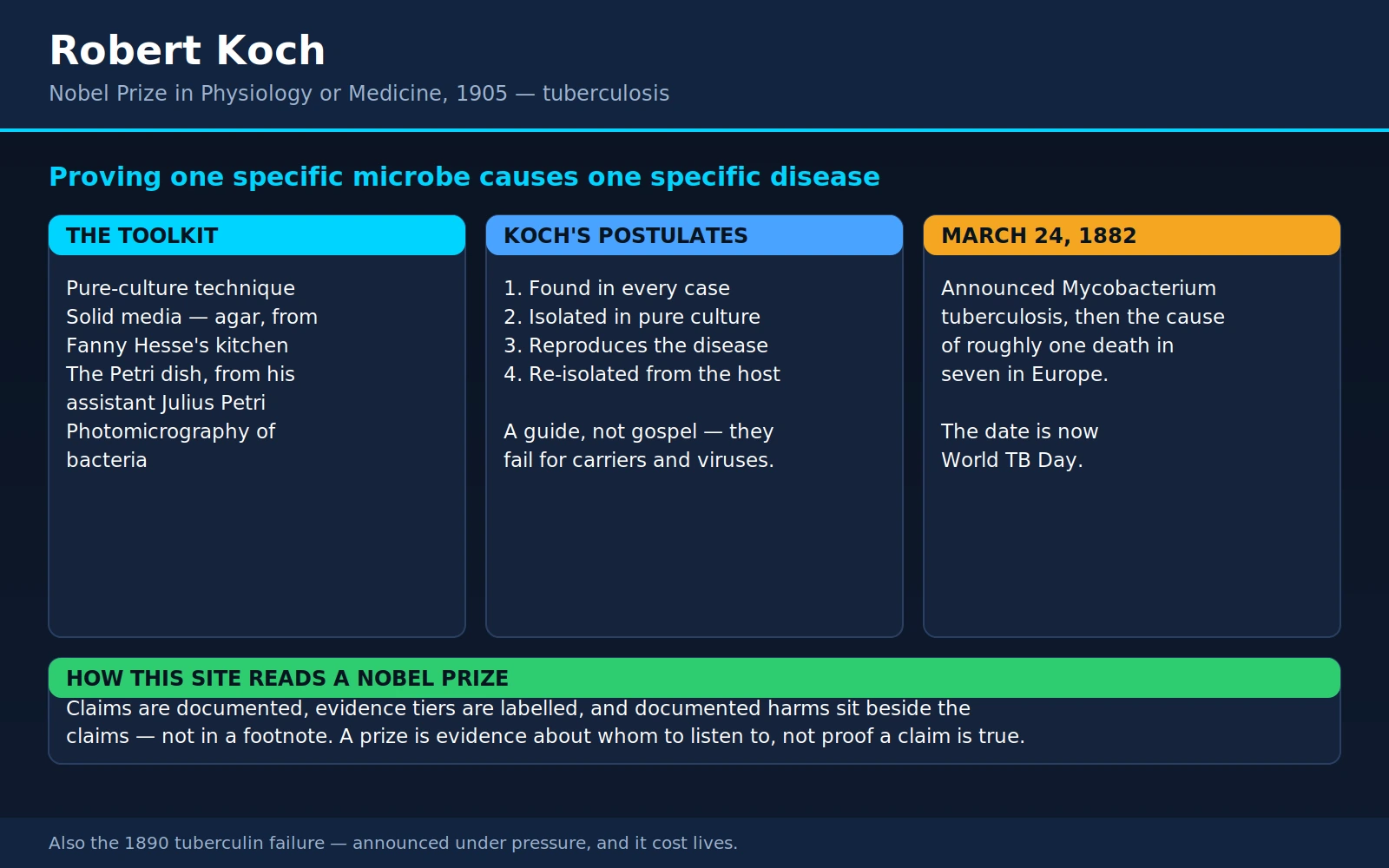
Table of Contents
- The Country Doctor with a Microscope
- Anthrax, 1876: One Microbe, One Disease
- Inventing the Toolkit
- Koch's Postulates: The Rules of Proof
- March 24, 1882: The Tubercle Bacillus
- Cholera, 1883–84: The Comma Bacillus
- The Tuberculin Stumble
- The Rivalry with Pasteur
- The Nobel and the Students Who Carried It On
- What Koch Means for You Today
- Where Mainstream Medicine Agrees — and Where the Story Gets Simplified
- Key Research Papers
- Connections
- Featured Videos
1. The Country Doctor with a Microscope
Robert Koch (1843–1910) received the 1905 Nobel Prize in Physiology or Medicine "for his investigations and discoveries in relation to tuberculosis," and he is remembered as the founder of medical bacteriology — the man who proved, with evidence nobody could argue away, that specific microbes cause specific diseases. What makes his story worth telling slowly is where it started: not in a great university institute, but in the curtained-off corner of a country doctor's consulting room, with a microscope, some mice, and slivers of wood he sharpened himself because he could not afford proper instruments.
Koch was born on December 11, 1843, in Clausthal, a silver-mining town in the Harz mountains of what was then the Kingdom of Hanover, the third of thirteen children of a mining official. The family story has it that he announced at age five that he had taught himself to read from the newspapers. He studied medicine at Göttingen, where one of his teachers was the anatomist Jacob Henle — a man who had argued, decades before it could be proven, that contagious diseases might be caused by living parasitic organisms. Koch graduated with highest honors in 1866, served as a volunteer field surgeon in the Franco-Prussian War, and in 1872 settled into the unglamorous post of district medical officer in Wollstein, a small farming town in the Prussian province of Posen (today Wolsztyn, Poland).
There he saw patients, delivered babies, and did the public-health paperwork of a rural district — and, in his spare hours, he began to investigate. The famous story, told by his family ever after, is that his wife Emma gave him a microscope for his 28th birthday. His laboratory was a section of his four-room flat separated from the examination room by a curtain. He had no scientific library, no colleagues, no institutional backing, and no idea that he was about to settle one of the oldest arguments in medicine. What he had was a district full of farms — and the farms had a problem.
2. Anthrax, 1876: One Microbe, One Disease
The problem was anthrax. Sheep and cattle in the district would sicken suddenly and die with blackened blood, and farmers knew certain pastures were dangerous — "cursed fields" where animals kept dying year after year, long after the last carcass had been buried. Earlier researchers had seen rod-shaped structures in the blood of anthrax-dead animals, and the French physician Casimir Davaine suspected they were the cause, but nobody could prove the rods were not just debris, or a consequence of the disease rather than its source. The prevailing medical theories blamed soil vapors, "miasmas," and bad constitutions.
Koch settled it. Working with material from dead sheep, he grew the rods outside the body — in hanging drops of fluid from the eyes of oxen, warmed by a home-made incubator — and watched the organism's entire life cycle under his microscope. The rods grew into long filaments, and then, when conditions turned hostile, they formed something no one had understood before: spores, dormant, tough-coated survival capsules that could withstand drying and cold and lie in the soil for years, then wake into deadly bacteria when swallowed by a grazing animal. In one observation, the mystery of the cursed fields dissolved: the pastures were not cursed, they were seeded. Koch then passed the bacteria through mouse after mouse — more than twenty generations — and at every step recovered the same organism producing the same disease.
In 1876 the unknown district doctor wrote to Ferdinand Cohn, the leading botanist and bacteriologist at Breslau, asking to demonstrate his findings. Cohn — who might reasonably have ignored a letter from nowhere — invited him. For three days Koch reproduced his experiments in front of Cohn and the pathologist Julius Cohnheim, whose verdict became famous: there was nothing left to prove. Cohn published Koch's paper on the etiology of anthrax that year. It was the first rigorous demonstration in history that a specific microbe causes a specific disease — the founding document of medical bacteriology, produced in a living room behind a curtain.
3. Inventing the Toolkit
Proving anthrax was one thing; building a science was another, and Koch's least romantic contribution may be his most important. In the late 1870s, bacteria were grown in flasks of broth — and a flask of broth is a mob. Different species mix invisibly, and whatever you observe, you can never say which organism did it. The central technical problem of the new science was obtaining a pure culture: one species, alone, whose behavior could be studied and blamed.
Koch's answer came partly from lunch. A slice of boiled potato left out in the laboratory grew small, separate, differently colored droplets — and Koch grasped what he was seeing: each droplet was a colony, millions of identical descendants of a single germ that had landed on a solid surface and been unable to swim away and mix. Solidity was the trick. His group began pouring meat broth stiffened with gelatin onto glass plates, letting colonies grow apart from each other, and picking single colonies to start pure cultures — the plate technique he published in 1881, and which Pasteur himself, no friend of Koch's, greeted with the words "C'est un grand progrès, Monsieur."
Gelatin had two flaws: it melts at body temperature — exactly where you incubate human pathogens — and some bacteria digest it. The fix came from Fanny Hesse, the American-born wife of Koch's collaborator Walther Hesse, who suggested the seaweed extract she used to set her jellies in warm weather: agar-agar, which stays solid past 80 °C and which almost no microbe can eat. Another assistant, Julius Petri, contributed the shallow lidded glass dish that keeps airborne contaminants off the plate. Nearly 150 years later, microbiology still runs on agar in Petri dishes — a kitchen tip and a piece of glassware from one laboratory in Berlin. Add Koch's pioneering photomicrographs (he published the first photographs of bacteria, so that scientists could compare organisms instead of comparing drawings), his systematic use of aniline dye staining to make the invisible visible, and his work on steam sterilization, and the pattern is clear: Koch did not just make discoveries, he built the machine that let everyone else make them.
4. Koch's Postulates: The Rules of Proof
Out of the anthrax and tuberculosis work came the rules Koch is named for — Koch's postulates, the checklist for proving that a particular microbe causes a particular disease. As they are taught today:
- The microbe must be found in every case of the disease, distributed in the body in a way that matches the damage — and not found in healthy individuals.
- It must be isolated from the sick host and grown in pure culture, away from the body and from every other organism.
- The pure culture, introduced into a healthy, susceptible host, must reproduce the disease.
- The same microbe must then be re-isolated from that experimentally infected host.
The power of these rules is hard to overstate. Before them, medical causation was a shouting match — miasmas, humors, heredity, filth, and germs all claimed the same diseases, and there was no agreed way to decide. The postulates turned "what causes this disease?" into an experiment with a yes-or-no answer, and within two decades of their formulation the causative organisms of tuberculosis, cholera, diphtheria, typhoid, tetanus, plague, and more had been nailed down, mostly by Koch's own school and Pasteur's.
But here is what a good history owes you and a bad one skips: the postulates are a guide, not a law of nature, and Koch knew it. His own cholera work turned up healthy people carrying and shedding the microbe with no symptoms — breaking rule 1's "not in healthy individuals" clause — and he revised his thinking accordingly. Viruses, unknown in 1882, cannot be grown in pure culture on lifeless media at all, and the leprosy bacillus has never been cultured to this day; rule 2 cannot touch them. And rule 3 quietly assumes a susceptible laboratory animal exists. A century later that assumption failed Barry Marshall, who was convinced Helicobacter pylori caused stomach ulcers but could not infect piglets with it — so in 1984 he fulfilled postulate 3 with the only susceptible host available and drank the culture himself, developing gastritis on schedule and, eventually, collecting his own Nobel. That is the postulates working exactly as Koch intended: not as scripture, but as a standard of proof worth going to extremes for.
5. March 24, 1882: The Tubercle Bacillus
To understand what Koch announced in 1882, you have to understand what tuberculosis was. "Consumption" was the leading killer of the nineteenth century — Koch opened his lecture with the arithmetic that one in seven of all human beings died of it, and among working-age adults the toll was worse. It was widely believed to be hereditary, or constitutional, or the fate of sensitive souls; it killed poets and factory workers alike, slowly, and it was so woven into life that its infectiousness was genuinely hard for people to accept.
The tubercle bacillus fought Koch harder than any organism he had faced. It is wrapped in a waxy coat that ordinary dyes will not penetrate, so it was effectively invisible until he devised a new staining method — alkaline methylene blue, with a brown counterstain that turned everything else in the tissue dull and left the bacilli glowing blue. It also grows with agonizing slowness: where most bacteria carpet a plate overnight, Mycobacterium tuberculosis took weeks to appear on the coagulated blood-serum medium Koch designed for it, and a less patient man would have declared the cultures dead. Koch stained it, grew it, inoculated guinea pigs, watched them develop tuberculosis, and recovered the organism again — the postulates, fulfilled end to end on the biggest killer of the age.
On the evening of March 24, 1882, at the Berlin Physiological Society, Koch laid it all out — slides, cultures, animals, everything, arranged on the table for the audience to examine. By the accounts of those present, the room did not applaud; it sat in stunned silence, and then walked forward to look down the microscopes. Paul Ehrlich, then a young scientist in the audience, called that evening the most important scientific experience of his life. The paper, "Die Aetiologie der Tuberculose," appeared within weeks, the news circled the world in months, and the date itself is now World TB Day, marked every March 24. A disease that had been fate became, from that evening on, an enemy with an address.
6. Cholera, 1883–84: The Comma Bacillus in the Water
In 1883 cholera broke out in Egypt, and Europe braced for the pandemic to arrive. Both France and Germany dispatched scientific expeditions — Pasteur's students for France, Koch for Germany, imperial rivalry riding openly along with the science. The trip turned tragic quickly: the French team's Louis Thuillier, just 26, caught cholera in Alexandria and died of it. By the time the teams were established, the Egyptian epidemic was fading, so Koch followed the disease to its heartland and sailed for Calcutta.
There, in early 1884, he isolated a curved organism — the "comma bacillus," known today as Vibrio cholerae — from patient after patient and body after body, and never from people free of the disease. Just as important was where else he found it: in the open water tanks that villages used for drinking, washing, and everything else. Cholera was not a vapor rising from filth; it was an organism traveling in water. Thirty years earlier, the London physician John Snow had mapped a cholera outbreak to a single contaminated pump on Broad Street and been politely disbelieved; Koch's microscope now supplied the microbe Snow's map had predicted. When the 1892 Hamburg epidemic killed thousands while the neighboring town of Altona — drinking the same river through a sand filter — was largely spared, the case was closed for good: clean water stops cholera.
Two honest footnotes belong here. First, the Italian anatomist Filippo Pacini had actually seen and described the cholera vibrio in 1854, in work that went unnoticed in his lifetime; modern taxonomy credits him, and Koch's independent isolation was the proof that made the discovery matter. Second, Koch never fully satisfied his own third postulate for cholera — no laboratory animal develops human cholera — and skeptics noticed. The hygienist Max von Pettenkofer, who believed soil conditions were the real cause, theatrically drank a flask of cholera culture in 1892 and suffered only mild diarrhea, declaring himself vindicated. He wasn't — he was lucky, probably partly protected by stomach acid and dose — but his stunt is a permanent reminder that infection is an encounter between a microbe and a host, a theme this site returns to often.
7. The Tuberculin Stumble
Now the failure — because this page tells the whole story or it is not worth telling. After 1882, the world did not want the cause of tuberculosis; it wanted the cure, and it wanted it from Koch. The pressure was enormous and specific: Pasteur had triumphed publicly with rabies vaccination in 1885, the Prussian government wanted a German answer, and Koch was negotiating for an institute of his own. At the Tenth International Medical Congress in Berlin in August 1890, Koch announced — in carefully hedged words that nobody heard as hedged — a substance that could render animals insensitive to tuberculosis and appeared to halt the disease. The press printed "cure." He called the preparation tuberculin, and, breaking every norm he had himself established, he kept its composition secret.
What followed was one of medicine's first modern hype disasters. Thousands of desperate consumptives flooded Berlin to be injected. Tuberculin provoked dramatic fevers and reactions, which optimists read as the remedy working. Within months, the pathologist Rudolf Virchow reported autopsy findings that the bacilli in treated patients were not dead — and that in some patients the injections appeared to have activated the disease. Patients died. The secret formula, when finally revealed, turned out to be nothing exotic: a glycerine extract of killed tubercle bacilli — bacterial proteins, with no power to cure anything. Koch's reputation took a wound that never fully healed, and historians who have gone through the record (Christoph Gradmann's papers below are the place to start) find the uncomfortable details real: the government pressure was real, the secrecy was real, and so was the prospect of personal fortune. The greatest proof-demander of his century had, for one season, exempted himself from proof.
The lesson is not that Koch was a fraud; it is that nobody is immune to the incentives that produce bad medicine — not even the man who wrote the rules of evidence. When you watch a modern miracle-cure launch — announced by press conference, methods withheld, sold on testimonials and fever-as-progress — you are watching tuberculin again, and you should reach for the postulates' spirit: show me the evidence, all of it, first. And yet the story has a genuinely redemptive ending: tuberculin, useless as a therapy, proved invaluable as a diagnostic. The strong skin reaction it provokes in people who have been infected became the tuberculin skin test (refined by von Pirquet and Mantoux in 1907–08), which screened the world for latent TB throughout the twentieth century and is still in use — and the "Koch phenomenon" underlying it became a founding observation of cellular immunology. Even Koch's failure, honestly examined, taught medicine something permanent.
8. The Rivalry with Pasteur
The other great germ hunter of the age was Louis Pasteur, and the two men detested each other. Some of it was temperament and turf — the French chemist working toward vaccines by weakening microbes, the German physician demanding rigorous proof of causation and finding Pasteur's methods sloppy. Most of it was the Franco-Prussian War: Pasteur, who had returned his honorary degree from Bonn in 1871 as the shells fell on Paris, and Koch, who had served in the German army, carried their countries' wound into every scientific exchange. Koch and his students published stinging attacks on Pasteur's anthrax vaccine work; Pasteur gave as good as he got.
The feud even turned on a mistranslation. At an 1882 congress in Geneva, Pasteur referred to Koch's published work as a "recueil allemand" — a German collection of writings. Koch's side heard it rendered as "orgueil allemand" — German arrogance — and the relationship, such as it was, never recovered. It is a painfully human footnote: the two founders of germ theory, divided partly by a single misheard word.
And yet the rivalry worked for the world. Between 1876 and 1900, driven by two national schools racing each other, medicine identified the causative agents of anthrax, tuberculosis, cholera, diphtheria, typhoid, tetanus, gonorrhea, plague, and dysentery — the fastest accumulation of medical causal knowledge in history, before or since. The final irony is worth savoring: the tuberculosis vaccine that actually exists, BCG, came from Pasteur's institute, while the diphtheria antitoxin that made serum therapy real came from Koch's student Behring. The two legacies, hostile in life, are permanently blended in every clinic on Earth.
9. The Nobel and the Students Who Carried It On
Koch spent his later career directing the Institute for Infectious Diseases created for him in Berlin (today's Robert Koch Institute, Germany's national public-health agency), and traveling the world chasing epidemics — plague in India, rinderpest in southern Africa, malaria in Italy and Java, sleeping sickness in East Africa — work that, among other things, established the significance of asymptomatic carriers in spreading typhoid and cholera. In 1905 he received the Nobel Prize in Physiology or Medicine for his tuberculosis work. He died of a heart attack at Baden-Baden on May 27, 1910, aged 66.
Measure the man partly by his students, because their names run the next half-century of medicine. Emil von Behring won the first Nobel Prize in Medicine ever awarded (1901) for diphtheria antitoxin — serum therapy, the ancestor of today's antibody drugs. Paul Ehrlich (Nobel 1908) founded chemotherapy in its original sense — the deliberate design of a chemical to kill a microbe without killing the patient — and his Salvarsan, the first synthetic targeted drug, struck at the syphilis spirochete Treponema pallidum. Friedrich Loeffler isolated the diphtheria bacillus; Georg Gaffky pure-cultured the typhoid bacillus.
And Kitasato Shibasaburō, the Japanese physician who came to Koch's Berlin laboratory in 1886, first grew the tetanus bacillus in pure culture, co-developed antitoxin therapy alongside Behring, and in 1894, in a Hong Kong shed during the plague outbreak, co-identified the plague bacillus Yersinia pestis. Home in Tokyo he founded the Kitasato Institute — the same institute where, eight decades later, Satoshi Ōmura would isolate the soil bacterium whose compounds became ivermectin and earn the 2015 Nobel Prize. Koch's lineage, in other words, does not end in 1910; it runs in an unbroken line from a curtained-off room in Wollstein into medicine still being practiced this morning.
10. What Koch Means for You Today
Strip away the nineteenth-century setting and Koch's fingerprints are on your ordinary day. Your drinking water is filtered and disinfected because cholera travels in water — that is Koch (and Snow) operationalized into plumbing, and it remains the single greatest health technology in existence; where it fails, as in Yemen's and Haiti's recent epidemics, cholera returns immediately. Your milk is pasteurized, your surgeon scrubs, your canned food is sterilized, and your doctor cultures your infection on agar, in a Petri dish — the identical technique, barely modified, from Koch's 1881 methods paper. Antibiotics exist because germ theory gave Fleming and his successors a defined enemy; there is no such thing as an antibiotic in a miasma world.
And tuberculosis itself is unfinished business. TB is still among the deadliest infectious diseases on Earth — roughly ten million people fall ill and well over a million die of it every year, more than a century after Koch showed the world its cause. It is curable, but the cure is a four-to-six-month multi-drug marathon, and cutting it short breeds multidrug-resistant TB, exactly the dynamic Fleming warned about for penicillin. A large share of humanity — on the order of a quarter, by common estimates — carries latent TB infection, most of whom will never get sick; whether an infection becomes disease turns on immunity, nutrition, crowding, and poverty, which is why TB remains, as it was in 1882, a disease of hard circumstances. The first drug that ever cured it, streptomycin, came from a soil microbe in 1943 — the same soil-hunting playbook that later produced Ōmura's avermectins.
If you take one practical habit from this page, take Koch's: demand the mechanism and the evidence together. He refused to accept "bad air" when the question "which organism, exactly, and can you show me?" could be asked. That question — asked of a supplement, a protocol, a miracle announcement, or an official reassurance — is the most portable tool on this entire site.
11. Where Mainstream Medicine Agrees — and Where the Story Gets Simplified
Where everyone agrees: the germ theory of infectious disease is about as settled as science gets, and Koch's specific discoveries — Bacillus anthracis, Mycobacterium tuberculosis, Vibrio cholerae — have stood for nearly 150 years without a crack. Pure-culture technique, agar plates, and stained microscopy are daily practice in every clinical laboratory. The tuberculin skin test still works. None of this is contested by anyone serious.
Where the story gets simplified: the postulates are usually taught as gospel — a rigid four-step law — when their author used them as a guide and broke the strict version himself when the evidence demanded it. He never infected a lab animal with cholera; he discovered healthy carriers who falsify a literal reading of rule 1; and if the postulates were applied as absolute law, we would be forced to conclude that no virus causes any disease, since viruses grow in no pure culture. Modern causal reasoning keeps the postulates' spirit while widening the toolkit — molecular versions of the postulates, epidemiological criteria, and sequence-based methods (see Fredricks and Relman below) built for organisms that refuse to grow on a plate.
The second simplification is the slogan "one germ, one disease," which flattens something Koch's own century knew was more textured. Exposure is not destiny: Pettenkofer drank cholera and lived; most people infected with TB never develop the disease; dose, stomach acid, immunity, nutrition, and living conditions decide outcomes among the exposed. Readers drawn to "terrain" arguments are seeing a real phenomenon — host resistance matters enormously, and this site takes nutrition and resilience seriously for exactly that reason. But the microbe is still necessary: no bacillus, no tuberculosis, however poor the terrain. The honest position is Koch's mature one — germ and ground, with proof demanded of every claim about either. And the record should note his other real errors alongside tuberculin: in 1901 he wrongly minimized the risk of bovine tuberculosis passing to humans through milk, a position that slowed pasteurization policy in some countries until the evidence overruled him. Science corrected him, in his lifetime and after — often through his own students — which is not an embarrassment to the method; it is the method.
12. Key Research Papers
- Blevins SM, Bronze MS. Robert Koch and the 'golden age' of bacteriology. Int J Infect Dis 2010;14(9):e744-51
- Cambau E, Drancourt M. Steps towards the discovery of Mycobacterium tuberculosis by Robert Koch, 1882. Clin Microbiol Infect 2014;20(3):196-201
- Sakula A. Robert Koch: centenary of the discovery of the tubercle bacillus, 1882. Thorax 1982;37(4):246-51
- Gradmann C. Robert Koch and the pressures of scientific research: tuberculosis and tuberculin. Med Hist 2001;45(1):1-32
- Gradmann C. Robert Koch and the white death: from tuberculosis to tuberculin. Microbes Infect 2006;8(1):294-301
- Evans AS. Causation and disease: the Henle-Koch postulates revisited. Yale J Biol Med 1976;49(2):175-95
- Fredricks DN, Relman DA. Sequence-based identification of microbial pathogens: a reconsideration of Koch's postulates. Clin Microbiol Rev 1996;9(1):18-33
- Marshall BJ, Armstrong JA, McGechie DB, Glancy RJ. Attempt to fulfil Koch's postulates for pyloric Campylobacter. Med J Aust 1985;142(8):436-9
- Koch R. Die Aetiologie der Milzbrand-Krankheit (The etiology of anthrax), 1876 — the founding paper predates PubMed's index; see the historical literature at robert koch anthrax etiology history
- Koch R. Die Aetiologie der Tuberculose (The etiology of tuberculosis), 1882 — likewise pre-index; see translations and commentary at koch 1882 etiology tuberculosis translation
Live PubMed Searches
- Koch's postulates
- Mycobacterium tuberculosis history
- Tuberculin skin test
- Anthrax pathogenesis history
- Germ theory history
Connections
- All Notable Doctors
- Alexander Fleming — penicillin: the antibiotic era Koch's germ theory made possible, and the resistance warning TB proves daily
- Barry Marshall — drank H. pylori to satisfy Koch's third postulate when no animal model would cooperate
- Satoshi Ōmura — the Kitasato Institute, founded by Koch's student, where soil microbes yielded ivermectin
- Frederick Banting — another outsider physician whose small-lab experiment changed medicine
- Christiaan Eijkman — trained in Koch-era bacteriology, went hunting a beriberi germ, and found a deficiency disease instead
- Mycobacterium Tuberculosis — the tubercle bacillus itself: disease, diagnosis, and treatment today
- Vibrio Cholerae — Koch's comma bacillus and the waterborne disease it causes
- Yersinia Pestis — the plague bacillus, co-identified by Koch's student Kitasato in Hong Kong, 1894
- Helicobacter Pylori — the ulcer bacterium at the center of the modern postulates story
- Treponema Pallidum — the syphilis spirochete targeted by Ehrlich's Salvarsan, the first designed drug
- All Bacteria — the site's complete index of the pathogens Koch's methods taught medicine to find
- Covered in depth on its own page: Cholera