Nobel Prizes That Aged Badly: Four Awards Medicine Had to Outgrow
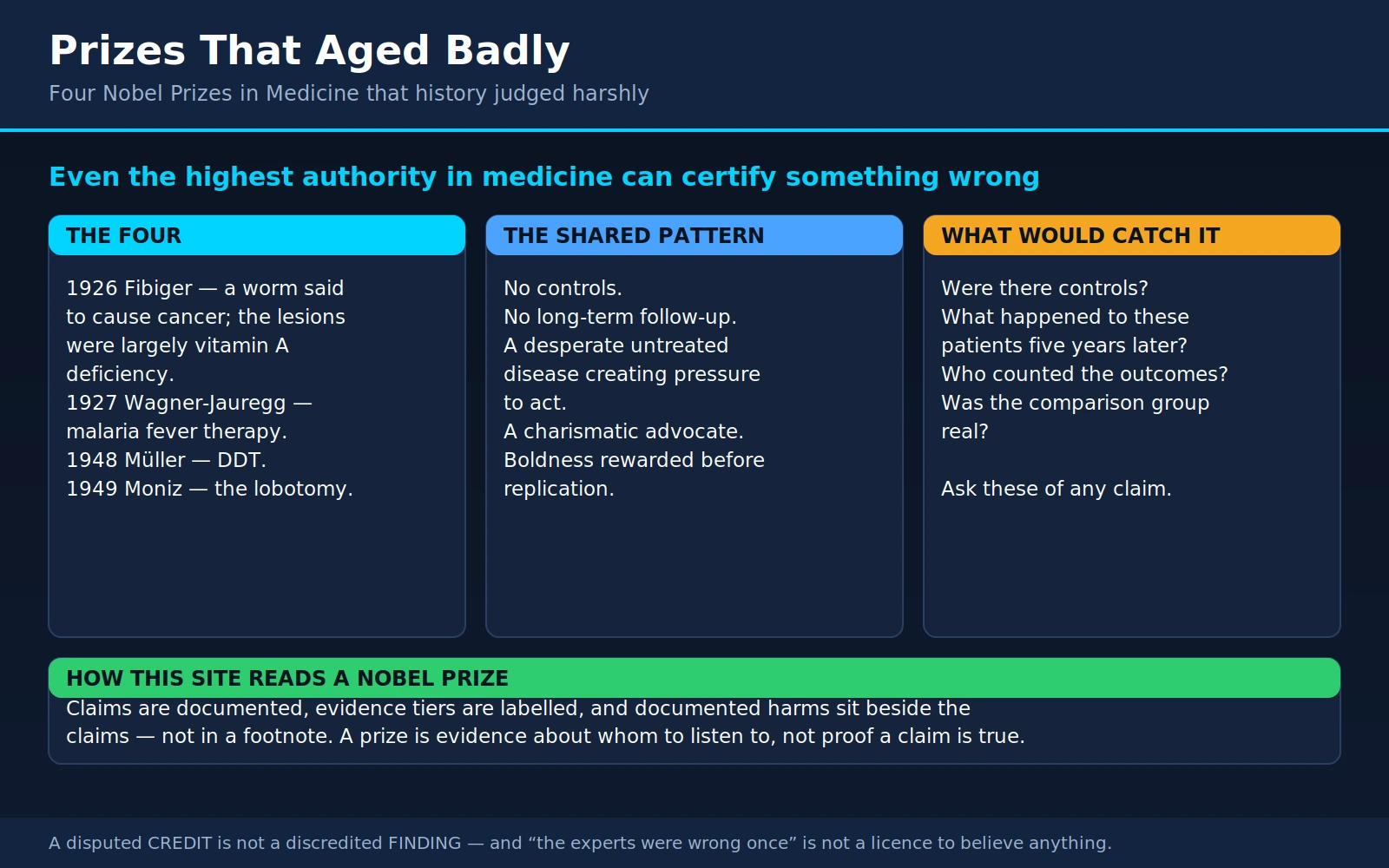
Table of Contents
- Why This Page Exists
- 1926: Fibiger and the Worm That Did Not Cause Cancer
- 1927: Wagner-Jauregg and Malaria Fever Therapy
- 1948: Müller and DDT
- 1949: Egas Moniz and the Prefrontal Leucotomy
- What These Four Have in Common
- The Prizes People Argue About — That Are Not in This Category
- What This Means for Reading Medical Claims Today
- Where Mainstream Medicine Agrees / What Is Still Argued
- Key Research Papers
- Connections
- Featured Videos
1. Why This Page Exists
This site documents claims and labels the evidence behind them. It does not settle questions by asking who said it. That policy has an obvious objection: surely at some point a credential is good enough to just believe? And if any credential were, it would be the Nobel Prize in Physiology or Medicine.
So this page answers it with the strongest available counter-example: four Nobel Prizes in Medicine that the field itself now regards as wrong, harmful, or badly misjudged. One was awarded for a cause-and-effect relationship that did not exist. One for deliberately infecting psychiatric patients with a potentially lethal parasite. One for a chemical that saved millions of lives and then proved to persist in fat, milk and food chains for decades. And one for an operation performed on tens of thousands of people on the strength of twenty cases with no control group.
This is not an argument against science. It is the best argument for it. All four were overturned — in each case from the inside, by other scientists, using the ordinary machinery of publication, replication and measurement. Nothing outside the enterprise corrected these; the enterprise corrected itself, which is exactly what authority alone can never do.
One structural fact shapes everything below: the Nobel Foundation has never rescinded a prize and has no mechanism to do so. When relatives of lobotomy patients petitioned in the early 2000s to have Egas Moniz's award revoked, the Foundation declined — not on the merits, but because revocation is not something the institution does. The correction does not live in the prize list. It lives in the literature, the textbooks, and what clinicians actually do.
2. 1926: Johannes Fibiger and the Worm That Did Not Cause Cancer
Johannes Andreas Grib Fibiger (1867–1928) was a Danish pathologist at the University of Copenhagen. Around 1907, dissecting rats from a sugar refinery, he found tumour-like growths in the forestomach and, inside the lesions, a nematode worm — Spiroptera neoplastica, later reclassified Gongylonema neoplasticum, which passes through cockroaches as an intermediate host.
Fibiger bred cockroaches, infected them, fed them to laboratory rats, and produced the lesions on demand. This appeared to be the first time anyone had deliberately caused cancer in a healthy animal — not observed it, not transplanted it, but produced it from a known cause. When cancer's origins were entirely mysterious, that was a landmark. The 1926 prize was initially reserved and then awarded to Fibiger the following year, announced alongside the 1927 award, "for his discovery of the Spiroptera carcinoma."
What went wrong
First, the lesions were probably not cancers. Fibiger read them as squamous cell carcinomas with metastases; later pathologists judged most to be florid hyperplasia and metaplasia — thickened, keratinizing epithelium that looks alarming under a microscope but is a reaction, not a malignancy.
Second, and decisively, the diet did it. Fibiger's rats were kept on a bread-and-water regimen severely deficient in vitamin A, which regulates epithelial differentiation: deprive an epithelium of it and the tissue converts to exactly the keratinizing squamous phenotype Fibiger was photographing. In 1952 Hitchcock and Bell replicated the work: the parasite on an adequate diet produced little, while a deficient diet produced the lesions with or without the worm. Stolt, Klein and Jansson later found in the Nobel archives that the evaluation had been contested and reservations set aside.
The laureates who should have had it
In 1926 somebody had genuinely induced cancer experimentally, and it was not Fibiger. In 1915 Yamagiwa Katsusaburô and Ichikawa Kôichi painted coal tar on rabbits' ears for months and produced true carcinomas. They were nominated and passed over in favour of the worm; Yamagiwa died in 1930, and the prize is not awarded posthumously. What survived is the idea both men were reaching for — that cancer can be caused on purpose in a laboratory, and is therefore something with findable causes rather than a spontaneous derangement. Fibiger's experiment was the wrong evidence for the right idea; Yamagiwa's coal tar founded chemical carcinogenesis.
What survived
Chronic infection as a genuine carcinogenic route. Fibiger's intuition — that an organism sitting in a tissue for years can end in cancer — is now unambiguously correct, just not for his worm in his rats. Barry Marshall and Robin Warren took the 2005 prize for Helicobacter pylori, and Harald zur Hausen the 2008 prize for HPV and cervical cancer; Schistosoma haematobium causes bladder cancer. What Fibiger lacked was a control group — rats on the same diet and no cockroaches.
3. 1927: Julius Wagner-Jauregg and Malaria Fever Therapy
General paresis of the insane, also called dementia paralytica, is late-stage neurosyphilis appearing ten to twenty-five years after infection: progressive dementia, grandiose delusions, personality disintegration, tremor, seizures and paralysis. Before antibiotics it was essentially uniformly fatal, typically within three to five years, and it filled asylum beds across Europe and North America. There was no treatment. Patients were admitted, deteriorated, and died.
Julius Wagner-Jauregg (1857–1940), an Austrian psychiatrist in Vienna, had noticed that psychiatric patients sometimes improved after a high fever from an intercurrent infection. In June 1917 he inoculated a small group of paretic patients with blood from a soldier infected with Plasmodium vivax; after a set number of fever paroxysms the malaria was terminated with quinine.
Some patients got better. Not marginally: some went into remission, left the asylum, and returned to work. In a disease with a near-100% death rate that did not need statistics to be visible, and fever therapy became the standard treatment worldwide within a few years. Wagner-Jauregg received the 1927 prize "for his discovery of the therapeutic value of malaria inoculation in the treatment of dementia paralytica" — the first Nobel awarded to a psychiatrist.
The honest accounting
P. vivax was chosen deliberately: far less lethal than P. falciparum, and quinine-responsive, so the physician retained a means of stopping the treatment. But it still killed people. Inducing repeated high fevers in patients already neurologically damaged, often malnourished and frequently carrying syphilitic cardiovascular disease is not gentle. Reported mortality varied substantially between series and eras, and no single figure fairly characterises the practice — itself a symptom of the problem, since the data were collected by the clinicians advocating the treatment.
A historical cohort study of 105 general-paresis patients admitted to a Dutch psychiatric hospital between 1924 and 1954 found the therapy applied broadly, inoculation performed by transferring infected blood from patient to patient, and treated patients surviving significantly longer than untreated ones. That is a real signal — but the groups were never randomly assigned, so it cannot separate the treatment's effect from the possibility that healthier patients were selected for it.
Two further facts belong here. Patient-to-patient inoculation meant the malaria strain was maintained as a living culture inside a population of institutionalized patients in no position to consent. And Wagner-Jauregg was a documented supporter of eugenics, including compulsory sterilization; in 1938, after the annexation of Austria, he applied for Nazi party membership, and the application was rejected because his first wife was Jewish. That belongs beside the prize, and it does not by itself make the clinical finding false.
What ended it, and what survived
Penicillin. Alexander Fleming observed the mould's antibacterial effect in 1928; Florey and Chain made it a usable drug; penicillin was shown to treat syphilis in 1943, and Treponema pallidum never developed meaningful resistance. Within roughly two decades of the Nobel, the disease the prize was for had become a curable outpatient problem.
What survived is that fever is a real immune mechanism, not just a symptom. Elevated core temperature accelerates leukocyte trafficking, enhances lymphocyte function and impairs replication of temperature-sensitive pathogens, including spirochetes — which informs the modern reluctance to suppress every fever, and underlies hyperthermia as an investigational adjunct in oncology.
Malariotherapy also produced human data on malaria that could never be generated again, advancing what was known about incubation, relapse and immunity — knowledge obtained, as one modern review puts it, by a method no ethics committee would now permit. Which is the lesson: a desperate disease creates enormous pressure to act, and that is precisely the condition under which consent, controls and honest outcome-counting get skipped. The desperation was real. So was the harm.
4. 1948: Paul Hermann Müller and DDT
Paul Hermann Müller (1899–1965) was a Swiss chemist at J.R. Geigy in Basel, hunting a contact insecticide that was cheap, long-lasting and non-toxic to mammals. In 1939 he identified the insecticidal properties of dichlorodiphenyltrichloroethane, first synthesized in 1874 by Othmar Zeidler, who had no idea what it did. Müller received the 1948 prize "for his discovery of the high efficiency of DDT as a contact poison against several arthropods."
The it-saved-lives case, at its strongest
In the winter of 1943–44 a typhus epidemic broke out in newly liberated Naples. Typhus is louse-borne and had historically killed on the scale of the fighting itself. Allied authorities dusted over a million people with DDT powder and the epidemic stopped — the first time a winter typhus epidemic had been halted rather than allowed to burn out. Malaria control was larger still: indoor residual spraying was central to eliminating malaria from the United States, most of Europe and large parts of Asia. The benefit was enormous, immediate, and measured in human lives.
What went wrong
The properties that made DDT excellent made it dangerous, and they are the same properties. It is chemically stable and slow to break down — which is why one spraying lasts a season — and it is fat-soluble. Persistence plus lipophilicity equals bioaccumulation: it concentrates up food chains, so a residue trivial in water becomes substantial in the birds at the top. It is stored in adipose tissue, crosses the placenta, and appears in human breast milk.
Because DDT looked harmless to mammals in acute testing, it was used as if harmless in every other sense: on crops, on livestock, in homes, over whole towns from aircraft, and directly onto people. In 1962 the marine biologist Rachel Carson published Silent Spring, which effectively started the modern environmental movement. The most rigorous strand was eggshell thinning: DDE interferes with calcium deposition in the eggshell gland, so birds of prey laid eggs that broke under the incubating parent. Bald eagle, peregrine falcon and brown pelican populations collapsed, then recovered after withdrawal. The United States banned agricultural use in 1972.
The complications an honest page has to state
The human health evidence is graded, not settled. The International Agency for Research on Cancer classifies DDT as probably carcinogenic to humans — Group 2A, upgraded from 2B in 2015 — meaning limited evidence in humans plus sufficient evidence in animals, deliberately short of the Group 1 category holding tobacco smoke and asbestos. The broader literature on breast cancer, preterm birth, semen quality and neurodevelopment is genuinely mixed. The 2009 Pine River statement concluded the data warranted restricting use to settings of real need. That is the accurate position: documented ecological harm, plausible human harm, not a settled catastrophe.
DDT is not banned for disease control, and not banned everywhere. The 1972 US ban covered agricultural use and explicitly preserved public-health exemptions. The 2001 Stockholm Convention restricted DDT rather than eliminating it, retaining a specific exemption for disease vector control, and the WHO has continued to endorse indoor residual spraying with DDT in defined settings where it remains effective and alternatives are inadequate.
And the claim that environmentalism caused millions of malaria deaths is not supportable as stated. The eradication programme was already faltering before Silent Spring appeared, for a reason with nothing to do with politics: mosquitoes evolved resistance to DDT, in some places within a few years of heavy spraying, and agricultural use accelerated it. Collapse also tracked funding withdrawal, weak health systems and war. Resistance is a general problem — the same dynamic now erodes pyrethroid bed nets.
What survived
Müller's prize is the one here least like a mistake and most like a lesson in scope. He was awarded for a specific, correct finding: this compound kills arthropods on contact with unusual efficiency. What aged badly was the assumption bolted onto it — that a chemical which does not visibly poison a mammal in the short term is safe to disperse forever. Persistence, bioaccumulation, biomagnification and body burden are the concepts that came out of the reckoning, and they underpin this site's Toxins section and its pesticides pages.
5. 1949: Egas Moniz and the Prefrontal Leucotomy
This is the worst of the four, and it is not close.
António Caetano de Abreu Freire Egas Moniz (1874–1955) was a Portuguese neurologist of real distinction, and that should be said first: in 1927 he developed cerebral angiography, the ancestor of every modern cerebral angiogram and of interventional neuroradiology. He was nominated for the Nobel on that basis. He did not receive it for that.
In 1935 Moniz attended a conference presentation on frontal-lobe ablation in chimpanzees, in which an animal that became agitated during a difficult task was placid afterwards. Within months he had a neurosurgical colleague, Almeida Lima, operating on human psychiatric patients — Moniz's hands were disabled by gout, so he directed rather than operated. The prefrontal leucotomy severed the white-matter tracts connecting the prefrontal cortex to the rest of the brain.
The evidence base, stated exactly
Moniz published on his first twenty patients in 1936, reporting roughly a third cured, a third improved and a third unchanged. There was no control group, no blinded assessment — outcomes were judged by the team that performed the operation — and no standardized rating before or after. Follow-up was often measured in days to weeks, which for a chronic relapsing illness is not follow-up at all. And "improvement" meant reduced agitation, which a procedure that blunts affect satisfies by construction.
On this basis the operation spread across Europe and the Americas within three years, and on this basis the Karolinska committee awarded Moniz half of the 1949 prize "for his discovery of the therapeutic value of leucotomy in certain psychoses." The other half went to Walter Rudolf Hess for mapping the functional organization of the interbrain — separate, uncontroversial work with nothing to do with any of this.
Freeman, and industrialization
In the United States the neurologist Walter Freeman, with the neurosurgeon James Watts, adopted and radically simplified the procedure. In 1946 Freeman introduced transorbital leucotomy: an instrument — initially, literally, an ice pick from his kitchen drawer — driven through the thin bone of the eye socket above the eyeball and swept to sever the frontal connections. It required no neurosurgeon, no theatre and no general anaesthetic; Freeman used electroconvulsive shock and worked in offices and state hospital wards. He performed on the order of three and a half thousand, and the US total is approximately forty to fifty thousand.
Rosemary Kennedy is the case that eventually made the public understand what was being done. In 1941, at twenty-three, she was lobotomized by Freeman and Watts at her father's arrangement, to control mood swings and behaviour the family found unmanageable. She emerged permanently and severely incapacitated — unable to speak intelligibly or walk properly — and spent the remaining sixty-four years of her life in institutional care.
What the operation actually did to people
In the good outcomes it traded a florid symptom for a permanent flattening; in the bad outcomes it destroyed the person. Documented consequences included blunted emotional range and loss of initiative, apathy, impaired planning and abstraction, disinhibition, seizures, and in the worst cases incontinence, mutism and a vegetative state. Operative mortality was not negligible. And the changes were irreversible — cutting connections that do not grow back demands the strongest possible evidence, and had close to none.
Who received it is as damning as what it did. It was performed on children — Howard Dully was twelve when Freeman operated on him in 1960 at his stepmother's request. It was performed on institutionalized people whose confinement was social rather than medical, in documented instances including people institutionalized for homosexuality, and on disproportionately many women. In every case the person consenting was not the person being operated on.
What ended it
Chlorpromazine. Synthesized in 1950 and introduced into psychiatric practice in 1952 by Delay and Deniker in Paris, it was the first drug that could reduce psychotic symptoms without destroying tissue — and, decisively, if it did not work you could stop giving it. Lobotomy rates fell steeply through the later 1950s. Freeman continued regardless; in 1967 a patient died of cerebral haemorrhage during one of his transorbital procedures and his surgical privileges were revoked.
Petitions to strip Moniz of the prize have been raised more than once, most visibly in the early 2000s by relatives of lobotomy patients. The Nobel Foundation declined; its statutes contain no provision for revocation and no appeal, so the 1949 award stands on the official list exactly as made. The record is not corrected at the source; it is corrected everywhere else.
What survived
Of the operation itself, essentially nothing. It is not a treatment that fell out of fashion; it is one shown not to have been justified in the first place.
What does exist is a small, tightly constrained field — anterior cingulotomy and capsulotomy for severe refractory obsessive-compulsive disorder, and deep brain stimulation, in which thin electrodes deliver adjustable current to targeted structures. This is not the lobotomy under a new name, and the reason is the evidentiary regime rather than the anatomy. DBS is reversible; targets come from imaging and circuit models rather than a chimpanzee anecdote; candidates must have failed multiple documented trials of medication and psychotherapy; selection goes through review boards and consent comes from the patient; outcomes are scored on validated instruments by raters who did not operate; and pivotal designs have included sham-controlled, blinded on/off crossover periods. It remains a last-resort intervention, its effect sizes are debated, and ethical scrutiny of new indications is sharp.
6. What These Four Have in Common
Line the four up and the same structure appears in each — and it is not a historical pattern.
- No control group. Fibiger fed rats a deficient diet and a parasite together, with no arm receiving the diet alone. Moniz operated on twenty patients and compared them to nothing. Without a comparison, "the patient improved" and "the treatment worked" are indistinguishable statements.
- No long-term follow-up. Leucotomy outcomes at three weeks and at three years are different findings about different things; DDT's profile after one season and after twenty years in a food chain are functionally different chemicals. Short follow-up flatters an intervention, because harms accumulate and enthusiasm decays.
- A desperate, untreated disease creating pressure to act. General paresis was fatal, chronic psychosis meant permanent institutionalization, typhus and malaria killed on an epidemic scale, and cancer was a black box. When there is nothing to lose, "try it" is overwhelming — and that is exactly when people stop measuring.
- A charismatic, energetic advocate. Freeman is the clearest instance, demonstrating the procedure and courting journalists before the evidence supported it. Advocacy propagates a claim far faster than replication can test it.
- Outcomes counted by people who wanted a particular answer. No blinding, no independent adjudication, no pre-specified endpoint. "Improved" was defined after the fact, using criteria the intervention was almost guaranteed to satisfy.
- A committee rewarding boldness before replication. The Nobel rewards being first. That incentive points toward the striking new result and away from the patient confirmation where errors of this kind are caught.
They share one more thing, and it is partly exculpatory. Three of these four prizes were awarded before the randomized controlled trial existed. The Medical Research Council's 1948 trial of streptomycin in tuberculosis, designed by Austin Bradford Hill, is generally taken as the first properly randomized, concurrently controlled trial in the modern sense — sealed-envelope allocation, a genuine concurrent control arm, and radiographs read by assessors blind to assignment. Streptomycin came from Selman Waksman's laboratory, and that trial is the hinge on which this page turns: it is the moment medicine acquired the instrument that would have caught Fibiger's confounded diet and Moniz's uncontrolled twenty. Müller's prize was awarded the same year it was published.
7. The Prizes People Argue About — That Are Not in This Category
The four above are cases where the finding was wrong, harmful or misjudged. There is a much longer list of Nobel controversies about something entirely different: who got the credit. Conflating the two is the most common way this subject gets misused. A disputed credit is not a discredited finding. If two people discovered something and only one was honoured, the injustice is to a person. The science is untouched.
- 1923 — Insulin. The prize went to Frederick Banting and John Macleod. Charles Best, who did much of the bench work, and James Collip, who solved the purification problem, were omitted; Banting split his money with Best, Macleod his with Collip. The dispute is entirely about attribution. Insulin works.
- 1952 — Streptomycin. Awarded to Selman Waksman alone. Albert Schatz, who performed the isolation, sued and settled with royalties and recognition as co-discoverer, but no share of the prize. Streptomycin's validity has never been in question.
- 1962 — The structure of DNA. Awarded to Watson, Crick and Wilkins. Rosalind Franklin's diffraction data — Photograph 51 and her unpublished measurements — were essential, and were seen without her knowledge or agreement. She had died in 1958 at thirty-seven, and the prize is not awarded posthumously. The double helix is correct.
- 1998 — Nitric oxide signalling. Awarded to Furchgott, Ignarro and Murad; many consider Salvador Moncada's contribution of equal weight. That nitric oxide is a signalling molecule is not in dispute.
- 2015 — Artemisinin. Tu Youyou was honoured for a discovery that emerged from Project 523, involving hundreds of Chinese researchers, many of whom contributed materially. Artemisinin is the most effective antimalarial ever found.
Two structural rules generate most of these: the prize may be shared no more than three ways, and it is not awarded posthumously. Modern biomedical discovery is done by large collaborations over long periods, and a three-slot award is the wrong shape for that. Every year the rule bites, somebody real is left out.
A third category is different again: a sound prize whose laureate later pushed a theory past his evidence. Otto Warburg's 1931 award was well earned, and his observation that many tumours favour glycolysis even with oxygen available is real and still studied. His later insistence that damaged respiration was the cause of cancer went beyond what he had shown. The prize was not the error; the extrapolation was — a pattern more common than a wrong prize, and one that happens in the present tense.
8. What This Means for Reading Medical Claims Today
Authority is evidence about whom to listen to. It is not evidence about whether a claim is true. A Nobel laureate, a specialist society, a professor at a famous institution — each is a reasonable prior about where to spend attention, because expertise does raise the base rate of being right. But no credential substitutes for what actually settles whether a claim is true: what happened when somebody tested it against a comparison.
The four questions
All four prizes would have failed these, and they need no technical training to ask:
- Was there a control group? Compared to what — untreated people, in the same period, with the same illness?
- What happened to these patients five years later? Not five weeks. Chronic conditions relapse, harms accumulate, enthusiasm fades.
- Who counted the outcomes, and did they want a particular answer? Was the assessor blinded? Was the endpoint chosen before the study or after the results came in?
- Was the comparison group real? Randomly assigned, or self-selected? A historical control, a healthier group chosen for treatment, or uneven dropout can manufacture any result you like.
The mirror-image warning
"The experts were wrong about lobotomy" is a true statement. It is not a general licence to believe any claim that lacks evidence. That an authority can be wrong tells you nothing whatsoever about whether a specific alternative claim is right. Those are unrelated propositions, and treating the first as support for the second is the most common reasoning error in this area.
Look again at what the four failures consisted of: no control group, no long-term follow-up, a desperate patient population, a charismatic advocate, and outcomes counted by the person selling the treatment. That is not a description of institutional medicine as such. It is a description, almost line for line, of much of what is sold to people who have concluded institutional medicine cannot be trusted — the testimonial, the protocol with no comparison arm, the treatment whose failures go uncounted because the people it did not help stopped coming back. The same four questions that demolish the lobotomy also demolish most of its supposed alternatives.
Both failure modes are real and both cause harm. Over-trusting authority is how roughly forty thousand Americans were lobotomized on the strength of twenty uncontrolled cases. Abandoning evidence altogether is how people with treatable disease spend their remaining time on something never compared to anything. The way out of both is identical: ask what the comparison was. And note that every correction on this page came from inside science. A system that produces errors and corrects them is not the same as a system that cannot be trusted.
9. Where Mainstream Medicine Agrees / What Is Still Argued
Where there is broad agreement
- Fibiger's parasite did not cause the cancers he reported; the lesions were largely vitamin-A-deficiency-driven hyperplasia, and the 1926 prize is widely described as an error. Yamagiwa and Ichikawa's coal-tar work was the genuine first experimental induction of cancer.
- Prefrontal and transorbital leucotomy were not supported by adequate evidence, caused serious and irreversible harm, were applied to people who could not consent, and are not performed today.
- Malaria fever therapy is obsolete, superseded by penicillin, and could not be conducted ethically now.
- DDT is persistent and bioaccumulative, DDE causes eggshell thinning in raptors, and affected bird populations recovered after withdrawal; agricultural use is restricted or banned in most countries.
- DDT's disease-control benefit was real and large — the Naples typhus intervention and the malaria campaigns saved lives on a scale not seriously disputed.
- Chronic infection is an established cause of some cancers — H. pylori, HPV, hepatitis B and C, Schistosoma haematobium — so the general idea Fibiger was reaching for was correct.
What is still argued
- How much harm DDT does to humans at real-world exposure levels. IARC's Group 2A classification states concern, not certainty, and the epidemiology is heterogeneous, with the strongest signals from early-life exposure.
- Whether DDT should still be used for indoor residual spraying where malaria burden is high and alternatives are failing — an argument turning on local vector resistance, cost, and how one weighs a certain present benefit against a diffuse future risk.
- Whether malaria fever therapy had a real biological effect on neurosyphilis beyond selection and natural history. The historical cohorts were not randomized.
- Whether some of Fibiger's lesions were true carcinomas. Most reviewers say largely not; a minority allow that a few may have been, with the parasite as an irritant co-factor.
- Whether modern psychosurgery is a genuine break from the lobotomy or a continuation under better rules. Most clinicians say the former, citing reversibility, targeting, consent and blinded assessment; some ethicists press the question hard.
Key Research Papers
- Stolt CM, Klein G, Jansson AT. An analysis of a wrong Nobel Prize — Johannes Fibiger, 1926: a study in the Nobel archives. Adv Cancer Res 2004;92:1-12. — PubMed PMID: 15530554
- Hitchcock CR, Bell ET. Studies on the nematode parasite, Gongylonema neoplasticum (Spiroptera neoplasticum), and avitaminosis A in the forestomach of rats: comparison with Fibiger's results. J Natl Cancer Inst 1952;12(6):1345-87. — PubMed PMID: 14939031
- Sekiya T. The first artificial cancer in the internal organs of experimental animals. Proc Jpn Acad Ser B Phys Biol Sci 2024;100(10):558-578. — PubMed PMID: 39662943
- Snounou G, Pérignon JL. Malariotherapy — insanity at the service of malariology. Adv Parasitol 2013;81:223-55. — PubMed PMID: 23384625
- Daey Ouwens IM, Lens CE, Fiolet ATL, et al. Malaria fever therapy for general paralysis of the insane: a historical cohort study. Eur Neurol 2017;78(1-2):56-62. — PubMed PMID: 28633136
- Raju TN. The Nobel chronicles. 1949: Walter Rudolf Hess (1881-1973); and Antônio Egas Moniz (1874-1955). Lancet 1999;353(9160):1281. — PubMed PMID: 10217124
- Gross D, Schäfer G. Egas Moniz (1874-1955) and the "invention" of modern psychosurgery: a historical and ethical reanalysis under special consideration of Portuguese original sources. Neurosurg Focus 2011;30(2):E8. — PubMed PMID: 21284454
- Tan SY, Yip A. António Egas Moniz (1874-1955): lobotomy pioneer and Nobel laureate. Singapore Med J 2014;55(4):175-6. — PubMed PMID: 24763831
- Caruso JP, Sheehan JP. Psychosurgery, ethics, and media: a history of Walter Freeman and the lobotomy. Neurosurg Focus 2017;43(3):E6. — PubMed PMID: 28859561
- Eskenazi B, Chevrier J, Rosas LG, et al. The Pine River statement: human health consequences of DDT use. Environ Health Perspect 2009;117(9):1359-67. — PubMed PMID: 19750098
- Giordano U, Mizera J, Żak E, et al. Surgical treatment methods in the course of psychiatric disorders: deep brain stimulation — novel insights and indications. Indian J Psychiatry 2023;65(8):799-807. — PubMed PMID: 37736228
PubMed Topic Searches
11. Connections
- All Notable Doctors
- The Nobel Prize in Medicine — the full roll of laureates, and the record these four still sit on
- Barry Marshall — H. pylori and gastric cancer: chronic infection as a carcinogen, done with real evidence
- Harald zur Hausen — HPV and cervical cancer: the virus-causes-cancer case that produced a vaccine
- Alexander Fleming — penicillin, which made malaria fever therapy obsolete within two decades
- Selman Waksman — streptomycin, and the 1948 MRC trial that gave medicine the tool these four lacked
- Frederick Banting — insulin: a disputed credit, and an entirely undisputed finding
- Otto Warburg — a sound prize, and a later theory that outran its evidence
- Toxins — persistence, bioaccumulation and body burden: the concepts DDT taught the field
- Pesticides — what replaced DDT, and how the same questions apply to the replacements
- Vitamin A — the nutrient whose absence, not a parasite, drove Fibiger's lesions
- Psychiatry — the field the lobotomy was performed on, and the one that ended it
- Schizophrenia — the condition most often cited to justify leucotomy, and how it is treated now
- Depression — another lobotomy indication, and the modern evidence base for treating it
- Covered in depth on its own page: Malaria