Frederick Banting: Insulin and the First Great Cure of Modern Medicine
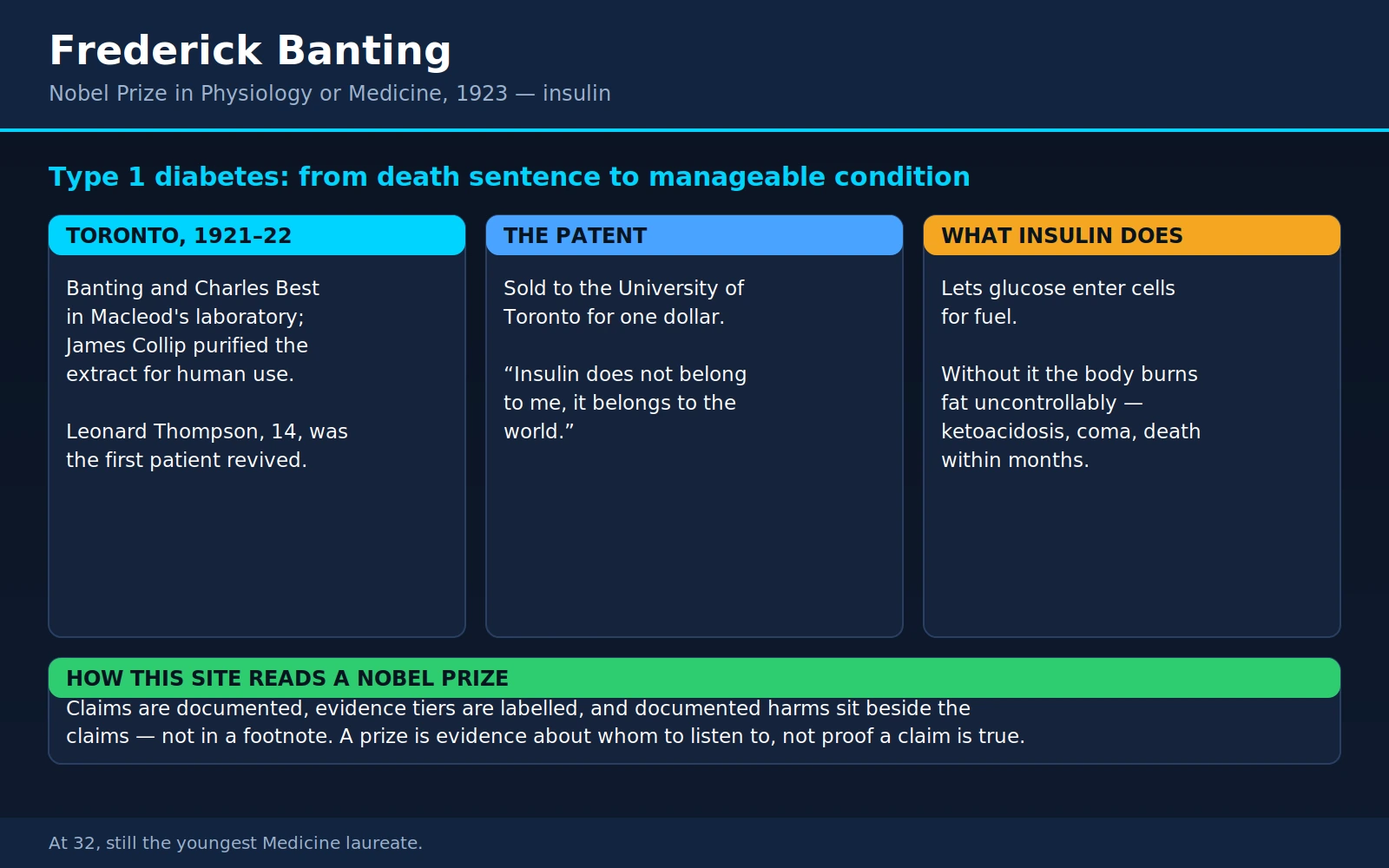
Table of Contents
- Overview
- Before Insulin — What a Diagnosis Meant
- The Idea in the Night
- The Toronto Summer
- Leonard Thompson, January 1922
- A Dollar for the Patent
- The 1923 Nobel Prize
- After Insulin
- Insulin Today — and Three Myths Worth Retiring
- What It Means for Readers Today
- Key Research Papers
- Connections
- Featured Videos
1. Overview
Sir Frederick Grant Banting (1891–1941) was a Canadian surgeon who, in a borrowed Toronto laboratory between May 1921 and the spring of 1922, led the work that isolated insulin and turned type 1 diabetes from a certain death sentence into a manageable lifelong condition. He did it with a medical-student assistant named Charles Best, under the supervision and resources of physiology professor J.J.R. Macleod, and with the purification chemistry of biochemist James Collip — four very different men whose uneasy collaboration produced what is often called the first great cure of modern medicine.
Before insulin, a child diagnosed with what we now call type 1 diabetes often died within a year or two of diagnosis. By early 1922 dying patients in Toronto were receiving injections and recovering their strength, and by 1923 insulin was being manufactured at scale in North America and licensed to makers in Europe. The Nobel Prize in Physiology or Medicine followed in October 1923; the Nobel Prize organisation lists Banting, awarded the prize at age 31, as the youngest medicine laureate to date. Banting, Best, and Collip assigned their patent rights to the University of Toronto for a token sum, usually reported as one dollar each, so that the university rather than a private holder would control how insulin was made.
This page tells the story in plain language: what diabetes meant before insulin, how a small-town surgeon with no research training talked his way into a laboratory, what actually happened that summer, who the first patients were, and what a century of insulin since then does — and does not — mean for people living with diabetes today.
2. Before Insulin — What a Diagnosis Meant
To understand what happened in Toronto, it helps to understand the two conditions that share the name diabetes. In type 1 diabetes, the immune system destroys the insulin-producing beta cells of the pancreas. Insulin is the hormone that lets glucose leave the bloodstream and enter cells for fuel; without it, blood sugar climbs while the body literally starves, burning fat into acidic ketones until the blood itself turns dangerously acidic (diabetic ketoacidosis). Type 1 usually appears in childhood or young adulthood, comes on fast, and involves an absolute lack of insulin. In type 2 diabetes — by far the more common form today — the body still makes insulin but responds to it poorly, and production gradually falls behind demand. Type 2 develops slowly, usually in adults, and is influenced by weight, muscle, diet, activity, genetics, and age.
In 1920, none of that vocabulary existed, but the clinical picture of the childhood form was brutally clear. A child would begin drinking and urinating constantly, losing weight no matter how much they ate, and then waste away. Pre-insulin patients generally survived only one to two years after diagnosis, and children often died within a year. The only treatment that extended life at all was the so-called starvation or undernutrition diet, developed most famously by Frederick Allen and used by leading diabetes physicians such as Elliott Joslin: severe restriction of food — especially carbohydrate — that kept the urine free of sugar at the cost of keeping the patient on the edge of starvation, and that, in one recent review's words, merely delayed coma and death from ketoacidosis. It worked, in the narrowest sense: it could buy months, occasionally a year or more. But children on the Allen diet dwindled to skeletal weights, and families faced a choice between watching a child starve slowly or sicken quickly. That is the world insulin arrived into, and it is why the events of 1922 read less like a research milestone and more like a rescue.
3. The Idea in the Night
In the autumn of 1920, Frederick Banting was an unlikely candidate to solve one of medicine's great problems. A farm boy from Alliston, Ontario, he had served as a battlefield medical officer in the First World War — wounded at Cambrai and decorated with the Military Cross — then trained in surgery and opened a practice in London, Ontario, that was struggling badly. To make ends meet he took part-time teaching work at the University of Western Ontario (the Nobel Prize biography describes it as teaching in orthopaedics). On the night of October 31, 1920, preparing a lecture for medical students on the pancreas, he read a journal article by pathologist Moses Barron, published in Surgery, Gynecology and Obstetrics, describing how blockage of the pancreatic ducts caused the digestive tissue of the pancreas to wither while the islets of Langerhans — the hormone-producing cell clusters — survived.
Researchers had suspected for decades that the islets made an anti-diabetic “internal secretion,” but every attempt to extract it from whole pancreas had failed, and many believed the gland's digestive enzymes were destroying the hormone during extraction. Unable to sleep, Banting scribbled a now-famous note to himself proposing to tie off (ligate) the pancreatic ducts of dogs, wait for the digestive tissue to degenerate, and then extract the internal secretion from the surviving islets. The note itself — misspellings and all — is one of medicine's treasured documents, and the story of the sleepless night is Banting's own account, retold so often it has become legend; historians note his memory of details shifted over the years, but the notebook page is real and dated.
Banting brought the idea to John James Rickard Macleod, professor of physiology at the University of Toronto and a leading international authority on carbohydrate metabolism. Macleod doubted that Banting could succeed — earlier attempts to isolate the internal secretion had failed — but he granted Banting laboratory space, experimental dogs, and a student helper for the summer of 1921, and the experiments began in May 1921. Two student assistants were available; by the traditional account, Charles Best and fellow student Clark Noble flipped a coin to decide who would work with Banting first, and Best stayed on for the whole summer. Best brought what Banting lacked: skill in measuring blood and urine sugar.
4. The Toronto Summer
The work that summer was crude and often heartbreaking — dogs regularly died from surgical complications before the techniques were perfected. But the logic of the experiment held. Banting and Best ligated pancreatic ducts and waited weeks for the digestive tissue to degenerate; they surgically removed the pancreas from other dogs to make them diabetic; and through the summer of 1921 they injected extracts of the degenerated pancreas into the diabetic dogs. The extract — which they called “isletin” — lowered blood and urine sugar in diabetic dogs, whereas extracts of liver or spleen did not, and it also cleared ketones from the urine. One depancreatized dog, Marjorie, became the best-known animal of the experiments.
When Macleod returned from Scotland at the end of the summer he raised legitimate questions about the work, but found the results promising enough to continue and to give the project more resources; the name was later settled as insulin, from the Latin insula (island), a coinage that had in fact been proposed independently by European physiologists years earlier. Two practical advances made the project scalable: the team found that duct ligation was unnecessary — extracts of fetal calf pancreas, first tried in November 1921, and then of whole adult beef pancreas extracted with alcohol, worked as well — which meant slaughterhouses could supply raw material in quantity.
The last problem was purity, and it was solved by the least-remembered member of the team. James Bertram Collip, a biochemist on leave from the University of Alberta, joined the work in December 1921 and used fractionation with alcohol to isolate a far cleaner extract — clean enough to inject into a human being without the fevers and abscesses that crude pancreatic extracts caused. Collip's rabbit experiments also showed insulin's chief danger: too much drives blood sugar so low that convulsions follow, an effect the team then used as a first way to measure the extract's strength. Banting presented the work at the American Physiological Society meeting in New Haven on December 30, 1921, which Macleod, Best, and Collip also attended. The resentments of that winter — Banting versus Macleod, Banting versus Collip — would flare for years; the historian Michael Bliss traces Banting's hostility to Macleod to an almost total personality conflict.
5. Leonard Thompson, January 1922
Leonard Thompson was 14 years old, a charity patient at Toronto General Hospital, and dying. First diagnosed in December 1919 and kept on a starvation diet, he weighed only about 65 pounds (29.5 kg), drifting toward the ketoacidosis that ended every story like his. On January 11, 1922, he received the first injections of Banting and Best's pancreatic extract given to a person with diabetes. The result was a failure by the team's own standards: his blood sugar fell only modestly, his urine still carried sugar and ketones, and a sterile abscess formed at an injection site. The extract was simply not pure enough.
On January 23, 1922, Thompson was injected with Collip's purified extract — and this time the effect was unmistakable. In the clinical figures behind the team's March 1922 paper in the Canadian Medical Association Journal, as historians have summarised them, his blood sugar fell from 520 mg/dL on January 23 to 120 mg/dL by January 24, sugar in the urine fell sharply, ketones disappeared, and the boy became brighter and more active. Leonard Thompson lived thirteen more years on insulin and died of pneumonia in 1935, at 27.
By February 1922 six more patients had been treated, all with favourable results. Word spread quickly, and desperate families began arriving in Toronto. Among the famous early patients were Elizabeth Hughes, the skeletal 14-year-old daughter of U.S. Secretary of State Charles Evans Hughes, who began insulin in August 1922, regained her weight and health, and lived to age 73 with, by the commonly cited count, some 42,000 injections behind her; and Teddy Ryder, photographed before starting treatment in July 1922, who lived until 1993. Popular retellings sometimes compress these months into a single scene of a ward of comatose children waking one by one; the recoveries recorded in the early reports were of individual patients treated over weeks and months.
Supply was the next crisis: in the spring of 1922 production in Toronto fell far short of demand, and patients continued to die for lack of insulin. The solution was industrial. In May 1922 the University of Toronto signed a one-year experimental contract with Eli Lilly and Company of Indianapolis, whose chemist George Walden developed isoelectric precipitation, a step that raised the purity of the preparation between 10 and 100 times; Toronto's Connaught Laboratories, under an agreement signed on January 25, 1922, made insulin for the Canadian market. By 1923, insulin was moving from a laboratory curiosity to a pharmacy staple across North America and Europe.
6. A Dollar for the Patent
The discoverers patented insulin — not to profit, but to control quality and to keep another laboratory from patenting a different extraction process. At the time the academic and medical world was broadly opposed to patents on medical discoveries; the Toronto group took one because the university wanted to keep control over the purity of the product. Banting, Best, and Collip, named as the inventors, assigned the insulin patents to the Board of Governors of the University of Toronto for a token sum, usually reported as one dollar each; the United States patents were granted in September and October 1923. The university's Insulin Committee first gave Eli Lilly and Company a one-year exclusive, experimental US contract in May 1922, and one year later began awarding non-exclusive contracts to manufacturers in the United Kingdom, Europe, and further afield, using the patent to hold them to potency and purity standards. Banting is often quoted as saying that “insulin does not belong to me, it belongs to the world” — the sentence is widely attributed rather than firmly documented, but it states exactly the position he took in fact.
A century later, the price of insulin became a major public-policy controversy. Historians of the patent note that later incremental changes to insulin brought new patents and higher costs, often making insulin less accessible, and the token sale of the original patent is regularly invoked in that debate. The historical point stands on its own: the patent's royalties went to the university to support research, not to the discoverers.
7. The 1923 Nobel Prize
In October 1923 the Nobel Prize in Physiology or Medicine was awarded jointly to Frederick Banting and J.J.R. Macleod “for the discovery of insulin,” each with a half share. It is often cited as one of the fastest routes from discovery to Nobel recognition in the prize's history. The Nobel Prize organisation's own facts page lists Banting, awarded the prize at age 31, as the youngest laureate in Physiology or Medicine to date. He was also the first Canadian to receive a Nobel Prize.
Banting was outraged that Macleod, and not Best, had been selected, and he briefly threatened to refuse the award. He then announced that he was giving half of his share of the prize money to Best and publicly acknowledged Best's contribution; Macleod followed by giving half of his to Collip. Years later, the official history of the Nobel Committee admitted that Best should have been awarded a share. Since Michael Bliss's 1982 history The Discovery of Insulin, which reconstructed the work day by day from the team's records, scholars have generally credited the discovery to all four: the idea and drive were Banting's, the measurements Best's, the resources and scientific direction Macleod's, and the purification that made insulin safe to inject was Collip's. The Nobel Foundation's own summary of the 1923 prize is here: nobelprize.org — The Nobel Prize in Physiology or Medicine 1923.
The credit is still disputed, and the disputes are part of the documented record. Banting's denigration of Macleod lasted the rest of his life; Bliss (2013) describes how campaigns by Banting and later by Best tarnished Macleod's posthumous reputation, and writes that its rehabilitation, which his 1982 book began, had become complete at the University of Toronto and in Canada by 2012. A separate priority claim belongs to the Romanian physiologist Nicolae Paulescu, who in 1921 published experiments in which a pancreatic extract he called pancreine lowered blood sugar, urinary sugar and ketones in diabetic dogs, and who wrote to the Nobel committee in November 1923 to protest the award. In a 2023 historical review, de Leiva-Hidalgo and de Leiva-Pérez conclude that Paulescu's work was published at least eight months before Banting and Best's first article and that the Nobel award ignored it; other historians hold that Toronto's priority rests on the purified extract that worked in Leonard Thompson on January 23, 1922.
8. After Insulin
In 1923 the Ontario legislature endowed the Banting and Best Chair of Medical Research for him, and he went on to head the Banting and Best Department of Medical Research at the University of Toronto. His later projects never repeated the insulin result, but they ranged widely: according to his Nobel Prize biography he worked on silicosis, the lung-scarring disease of miners breathing rock dust, on cancer, and on the mechanism of drowning, and in the Second World War on problems of flying such as blackout. He organized research in Canadian universities on pilot safety in air warfare, and in his department Wilbur Franks developed the Franks flying suit, a water-filled anti-G suit that the Royal Air Force adopted; later gas-inflated designs supplied the principle that modern anti-G suits still use. He was knighted in 1934, and when the Second World War broke out he served as a liaison officer between the British and North American medical services.
On the evening of February 20, 1941, Banting boarded a Lockheed Hudson bomber in Gander, Newfoundland, crossing the Atlantic on a wartime medical-research mission to Britain. Minutes after takeoff the plane developed mechanical problems and crashed near Musgrave Harbour; Banting survived the impact but died of his injuries in the snow the next day, February 21, 1941, at age 49. His birthday, November 14, is now World Diabetes Day. At Banting House in London, Ontario — the house where he woke with the idea — a Flame of Hope burns beside the museum, lit in 1989, to be extinguished only when diabetes is cured.
9. Insulin Today — and Three Myths Worth Retiring
The insulin of 1922 was drawn from cattle and pigs; today's is made by engineered microbes. Recombinant human insulin, the first human protein manufactured by recombinant DNA techniques, reached the market in 1982, followed from the 1990s by analog insulins — molecules lightly redesigned to act faster at meals (lispro, aspart, glulisine) or to hold a flat background level for a day or more (glargine, detemir, degludec). Around the molecule has grown a technology ecosystem Banting could not have imagined: insulin pumps that infuse continuously, continuous glucose monitors (CGMs) that read glucose every few minutes through a skin sensor, and hybrid closed-loop systems that link the two so software adjusts the insulin automatically. In the landmark Diabetes Control and Complications Trial (DCCT, 1993), 1,441 people with type 1 diabetes were followed for a mean of 6.5 years; intensive therapy that kept glucose closer to normal reduced the risk of developing retinopathy by 76 percent in the group that started without it and reduced clinical neuropathy by 60 percent, at the cost of a two-to-threefold increase in severe hypoglycemia.
And yet insulin is management, not cure. A person with type 1 diabetes without insulin is, a century later, in the same danger Leonard Thompson was in. Three points follow from the research:
- Insulin does not cause diabetic complications. In the DCCT, the group whose glucose was kept closer to normal with more intensive insulin therapy had fewer eye, kidney, and nerve complications, not more.
- Needing insulin with type 2 diabetes is not a personal failure. Type 2 is generally a progressive condition in which insulin-producing capacity declines over years, and many people with type 2 diabetes are treated with insulin at some point. Starting it is a treatment decision, not a verdict on character.
- No supplement, herb, or diet has been shown to replace insulin in type 1 diabetes. In type 1 the body's own insulin supply is largely or entirely gone, so there is nothing for a supplement to “support” or “boost”; only injected or infused insulin replaces it. As the pre-insulin record on this page shows, type 1 diabetes without insulin progresses to ketoacidosis, which is fatal untreated. Diet and activity affect glucose control alongside insulin, not as a substitute for it.
10. What It Means for Readers Today
For people living with diabetes, Banting's story is more than history — it is the origin of much of today's treatment. The condition itself — types, symptoms, diagnosis, and the treatment landscape — is covered on the main Diabetes page. The lifestyle side — what research shows about food, movement, sleep, and monitoring for glucose control in type 2 diabetes, and alongside (never in place of) insulin in type 1 — is covered in the Blood Sugar hub. The newest chapter is GLP-1 Receptor Agonists — the semaglutide/tirzepatide drug class descended from incretin science, the study of gut hormones that shape insulin release.
There is also a lesson in how the discovery happened. Insulin came from an outsider's stubborn idea plus an establishment's resources and rigor — Banting needed Macleod and Collip as surely as they needed him. The idea in the night was necessary; the controlled experiments, the purification chemistry, and the industrial partnership were what turned it into medicine that could be trusted in a child's bloodstream. A century of diabetes care since has rested on the same pairing: bold ideas, honestly tested.
Key Research Papers
- Banting FG, Best CH. The internal secretion of the pancreas. 1922 (reprinted). Indian J Med Res 2007;125(3):251-66 — the landmark 1922 Journal of Laboratory and Clinical Medicine paper reporting the dog experiments, available via this indexed reprint. — PubMed PMID: 17582843
- Banting FG, Best CH, Collip JB, Campbell WR, Fletcher AA. Pancreatic extracts in the treatment of diabetes mellitus. Can Med Assoc J 1922;12(3):141-146. (The first clinical report, including Leonard Thompson's recovery; the 1922 original is indexed in PubMed with a scanned copy in PubMed Central.) — PubMed PMID: 20314060
- Rosenfeld L. Insulin: discovery and controversy. Clin Chem 2002;48(12):2270-88. — PubMed PMID: 12446492
- Bliss M. The eclipse and rehabilitation of JJR Macleod, Scotland's insulin laureate. J R Coll Physicians Edinb 2013;43(4):366-73. — PubMed PMID: 24350324
- Li A. Rethinking the “discovery” of insulin. CMAJ 2021;193(42):E1636-E1637. — PubMed PMID: 34697100
- de Leiva-Hidalgo A, de Leiva-Pérez A. On the occasion of the centennial of the Nobel Prize in Physiology or Medicine, 1923: Nicolae C. Paulescu—between scientific creativity and political fanatism. Acta Diabetol 2023;60(11):1513-1530. — PubMed PMID: 37407772
- de Leiva-Hidalgo A, de Leiva-Pérez A. The Nobel Prize of Physiology or Medicine, 1923: controversies on the discovery of the antidiabetic hormone. Acta Diabetol 2023;60(9):1241-1256. — Search PubMed
- de Leiva-Hidalgo A, de Leiva-Pérez A. On the occasion of the centennial of insulin therapy (1922-2022), II-Organotherapy of diabetes mellitus (1906-1923): Acomatol. Pancreina. Insulin. Acta Diabetol 2023;60(2):163-189. (Source of the Thompson blood-sugar figures, the patent dates and the crash account.) — PubMed PMID: 36585966
- Wright JR Jr. Frederick Banting's actual great idea: the role of fetal bovine islets in the discovery of insulin. Islets 2021;13(5-6):121-133. — PubMed PMID: 34499012
- Rogol AD, Laffel LM, Bode B, Sperling MA. Celebration of a century of insulin therapy in children with type 1 diabetes. Arch Dis Child 2023;108(1):3-10. — PubMed PMID: 35725290
- Ball CM, Featherstone PJ. The commercialisation of insulin. Anaesth Intensive Care 2023;51(5):312-315. — PubMed PMID: 37565612
- Levetan C. Frederick Banting's observations leading to the potential for islet neogenesis without transplantation. J Diabetes 2022;14(2):104-110. — PubMed PMID: 34967992
- Sen M, Honavar SG. Taming of the Sugar: The Story of the Mellitus Men. Indian J Ophthalmol 2021;69(11):2928-2930. — PubMed PMID: 34708724
- Das T, Rani PK, Sivaprasad S, Raman R. The blue circle and 100 years of insulin discovery. Indian J Ophthalmol 2021;69(11):2920-2924. — PubMed PMID: 34708722
- Sharma Y, Kannan A, Lee JM, Coffman F, Mittal R. Frederick G Banting (1891-1941): a pioneer in diabetes treatment. Cureus 2024;16(11):e73806. — PubMed PMID: 39691108
- Brook WH. The development of the Australian anti-G suit. Aviat Space Environ Med 1990;61(2):176-82. — PubMed PMID: 2178602
- Lambert C, Delgado E. 100 Years since the Discovery of Insulin, from Its Discovery to the Insulins of the Future. Biomedicines 2024;12(3):533. — PubMed PMID: 38540146
- Diabetes Control and Complications Trial Research Group; Nathan DM, Genuth S, Lachin J, Cleary P, Crofford O, Davis M, Rand L, Siebert C. The effect of intensive treatment of diabetes on the development and progression of long-term complications in insulin-dependent diabetes mellitus. N Engl J Med 1993;329(14):977-86. — PubMed PMID: 8366922
- Nobel Prize Outreach. Frederick G. Banting – Biographical; Nobel Prize facts (youngest laureates). NobelPrize.org. — nobelprize.org biography
PubMed Topic Searches
Connections
- All Notable Doctors
- Diabetes — the condition insulin transformed: types, symptoms, and modern management
- Endocrinology — the hormone-disorder category insulin founded as a therapeutic field
- Blood Sugar — lifestyle and nutrition approaches to glucose control, alongside (never instead of) insulin
- GLP-1 Receptor Agonists — the modern drug class descended from incretin science
- Ketogenic Diet — the pre-insulin starvation diets were distant ancestors of carbohydrate restriction; a historical note, not an equivalence
- Dr. Abram Hoffer — another Canadian who treated a biochemical idea as testable medicine