Gerson Therapy Research: The Record as Gerson Reported It
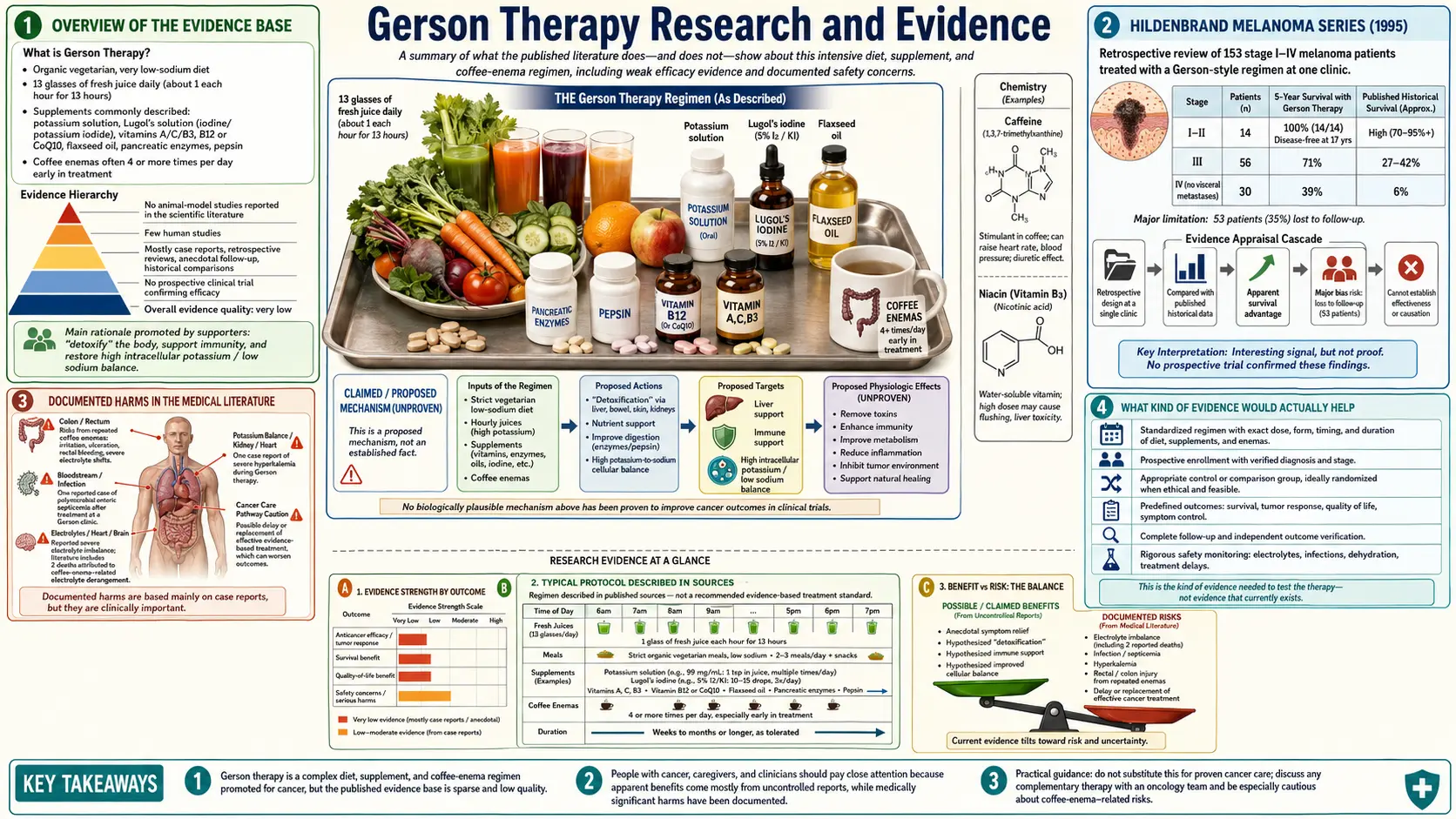
Table of Contents
- Overview: The Record Gerson Assembled
- The Sauerbruch–Herrmannsdorfer–Gerson Tuberculosis Trial (1929)
- Gerson’s 1946 Senate Testimony
- Gerson’s Own Published Papers (1945–1978)
- Gerson’s Fifty Cases (1958)
- Gerson’s Metabolic Explanation of His Results
- Hildenbrand Melanoma Series (1995)
- Case Follow-Ups Reported in the Book
- Patients’ Own Accounts: Molassiotis and Peat (2007)
- Healing Reactions and Supervision, as the Book Describes Them
- Key Research Papers
- Connections
- Featured Videos
Overview: The Record Gerson Assembled
Dr. Max Gerson documented his results over roughly three decades, first in Germany and then in New York. His record, as he and later Charlotte Gerson presented it, runs from the 1929 skin-tuberculosis trial at Ferdinand Sauerbruch’s Munich clinic, through his testimony before a United States Senate subcommittee in July 1946, a series of journal papers between 1945 and 1954, and his 1958 book A Cancer Therapy: Results of Fifty Cases. After his death in 1959 the record was extended by a 1995 retrospective review of melanoma patients and by the patient case histories collected in The Gerson Therapy (Charlotte Gerson and Morton Walker, D.P.M.).
This page sets out that record document by document, in the words and figures Gerson and his successors used, so a reader can go to the primary sources directly.
The Sauerbruch–Herrmannsdorfer–Gerson Tuberculosis Trial (1929)
The book describes how Gerson’s diet began as his own treatment for severe migraine, and how a migraine patient who also had lupus vulgaris (skin tuberculosis) recovered from both. News of that result reached Professor Ferdinand Sauerbruch, M.D., in Munich. According to the book, after long discussions with Gerson on dietary concepts, Sauerbruch set up a clinical trial of the method, treating 450 “incurable” skin-tuberculosis patients; 446 recovered fully. The book states that Sauerbruch was “deeply impressed” and reported the trial and its results in his autobiography, Master Surgeon.
The results were published with Herrmannsdorfer in the German medical literature in 1929. Gerson then reasoned, the book says, that if lupus vulgaris could be healed with diet, other forms of tuberculosis might respond too, and he extended the treatment to tuberculosis of the bones, kidneys, eyes and lungs.
Gerson’s 1946 Senate Testimony
From July 1 to 3, 1946, a subcommittee of the Senate Committee on Foreign Relations of the 79th Congress, chaired by Senator Claude Pepper (D-Florida), heard testimony on Senate Bill 1875, the Pepper–Neely anticancer proposal, which would have appropriated $100 million for cancer research. The book reports that two investigators, a physician and an attorney, reported back to Senator Pepper on Gerson’s work, and that the subcommittee then invited him to testify. Gerson brought five of his recovered cancer patients in person and the records of five more.
The book reprints the most pertinent portions of his testimony. In it Gerson stated that the diet was developed first for his own migraine, then applied to allergic conditions such as asthma, to diseases of the intestinal tract and the liver–pancreas apparatus, and, after a chance cure of lupus vulgaris, to all kinds of tuberculosis. He listed favorable results in arthritis, heart disease, chronic sinusitis, chronic ulcers including colitis, high blood pressure, psoriasis and multiple sclerosis, and said “the most striking results were seen in the restoration of various kinds of liver and gall bladder diseases.” On cancer he testified: “The first cancer patient (bile ducts) was treated in 1928 with success. Seven favorable cases followed out of twelve and remain free of symptoms up to seven years.” He added: “My experience leads me to believe that the liver is the center of the restoration process in those patients who improve strikingly. If the liver is too far destroyed, then the treatment cannot be effective.”
The broadcaster Raymond Gram Swing described the hearing on his radio news program the same evening, July 3, 1946; the book reprints that broadcast in its preface. The book records that the bill did not pass.
Gerson’s Own Published Papers (1945–1978)
Alongside his books, Gerson reported his cancer work in medical journals:
- 1945, Review of Gastroenterology — “Dietary considerations in malignant neoplastic diseases; a preliminary report,” his first American journal report on applying the diet to cancer.
- 1949, Experimental Medicine and Surgery — “Effects of a combined dietary regime on patients with malignant tumors,” an illustrated report of treated cases.
- 1954, Medizinische Klinik — two German-language papers, translated in PubMed as “No cancer in normal metabolism; results of special therapy” and “Cancer, a problem of metabolism,” setting out his view that cancer arises from a disturbed whole-body metabolism rather than as a purely local event.
- 1978, Physiological Chemistry and Physics — “The cure of advanced cancer by diet therapy: a summary of 30 years of clinical experimentation,” published posthumously, summarizing his clinical experience across three decades.
Gerson’s Fifty Cases (1958)
The book calls A Cancer Therapy: Results of Fifty Cases “the largest body of evidence offering proof of the Gerson Therapy’s value.” It states that almost all of the patients had been biopsied before starting treatment, by different accredited medical institutions around the United States; that all but two of the fifty were in terminal condition; and that they survived a minimum of five years, with at least a dozen remaining alive forty-five years after they began treatment. The book has been reissued in multiple editions and translated into other languages. Individual cases are discussed on the Cancer Treatment page.
Gerson’s Metabolic Explanation of His Results
In his Senate testimony Gerson, “aware of the imperfection of this as well as any other theory,” condensed his explanation of the results into three components:
- The elimination of toxins and poisons, and the return of the displaced “extracellular” sodium group — connected, he said, with toxins, edema and destructive inflammation — out of the tissues, tumors and organs where it does not belong.
- Bringing back the lost intracellular potassium group, together with vitamins and enzymes, into the liver, muscles, heart, brain and kidney cortex; on this basis, he said, iodine, “ineffective before, is made effective.”
- Restoring differentiation, tonus, tension and oxidation by activated iodine, where before there were growing tumors and metastases.
The book states that Gerson found the basic problem underlying all chronic disease to be twofold: deficiency and toxicity. Hourly organic vegetable juices answered the deficiency; coffee enemas, given in the early stages as often as every four hours, helped the liver release the toxins mobilized from the tissues. Patients, the book reports, experienced pain relief as the liver cleared, which allowed Gerson to discontinue painkillers, and high blood pressure usually came down in about five days.
In 1978 Freeman Cope, M.D., linked the sodium–potassium idea to cell physiology. The book quotes him: “The high potassium, low sodium diet of the Gerson Therapy has been observed experimentally to cure many cases of advanced cancer in man, but the reason was not clear.” Cope proposed, drawing on the laboratory of Gilbert Ling, that high-potassium, low-sodium environments can partially return damaged cell proteins to their normal configuration.
Hildenbrand Melanoma Series (1995)
The book describes the 1995 review by G. L. Hildenbrand, L. Christeene Hildenbrand, Karen Bradford and Shirley W. Cavin, conducted by members of the Gerson Institute and a University of California cancer prevention program in San Diego, as the one cancer for which Gerson results have been documented statistically in a peer-reviewed journal. It covered 153 adult melanoma patients treated between 1975 and July 1990, almost all at Gerson facilities in the Tijuana area (records were examined from four hospitals), on a lacto-vegetarian, low-sodium, low-fat, low-protein diet with hourly juices, thyroid, and coffee enemas as needed. The review included all patients, nonresponders as well.
The reported five-year survival figures, set against published comparison series:
- Stages I and II: 100% of 14 Gerson patients, against 79% of 15,798 patients in the comparison literature.
- Stage IIIA: 82% of 17, against 39% of 103.
- Stages IIIA plus IIIB: 71% of 33, against 41% of 134.
- Stage IVA: 39% of 18, against 6% of 194.
The book notes that survival was stage-related, that men and women fared alike in the earlier stages while women had a strong survival advantage in stage IVA, and that stage IVB was not assessed because the authors could find no comparable treatment group anywhere to compare against. Some patients were lost to follow-up through unrelated deaths or loss of contact.
Case Follow-Ups Reported in the Book
The book acknowledges that, outside melanoma, the Gerson Institute’s results take the form of individual recovered cases, “all with prior biopsies and long-term survival,” and that exact figures are not available because recovered patients tend to stop communicating and get on with their lives. To keep contact it describes a Patient Support Network run by the Institute’s Client Services department. Examples the book reports include:
- Stage IV melanoma (Dael Mintz): metastasized melanoma with tumor masses, treated first under supervision and then at home; she was one of the 153 patients in the 1995 review.
- Lung adenocarcinoma (John Peters): a non-smoker diagnosed in November 1989 at stage IIA, whose recovery opens the book’s chapter of success stories.
- Long-term survivor follow-up: one patient writes that a cancer center sent a yearly survey asking whether she was still alive, that each year it was returned, and that by 1988 she had outlived their thirty-year study.
- Heart disease (GF): a woman who needed oxygen to sleep followed the therapy in hospital and at home; on re-examination two years later, the book reports, her doctor found her arteries 100 percent clear.
Patients’ Own Accounts: Molassiotis and Peat (2007)
Molassiotis and Peat, writing in Integrative Cancer Therapies, analyzed six case studies of people with cancer who followed the Gerson Therapy and were surviving against the odds. The paper records the patients’ own experience of the regimen — why they chose it, how they lived with its demands, and what they felt it gave them, including a strong sense of agency in their own care. It is a study of patient-reported experience rather than of tumor measurements.
Healing Reactions and Supervision, as the Book Describes Them
The book describes “healing reactions” or flare-ups as an expected part of recovery: nausea, diarrhea, headaches, increased swelling or pain, loss of appetite, and sometimes a healing fever, which it says should not be suppressed unless it rises above 104.5°F. It attributes them to increased bile secretion and the release of toxins from breaking-down tissue, and reports that after each flare-up patients feel easier and improve both physically and mentally. Its practical guidance:
- If a patient reduces detoxification too soon and feels ill, toxic or headachy, return to the more intensive schedule for a while, then try reducing again.
- With diarrhea, use perhaps two chamomile tea enemas daily, then reintroduce coffee enemas gradually as the colon calms.
- With heavy bile release causing nausea and vomiting, omit coffee enemas, drink peppermint tea, eat oatmeal gruel, and use only chamomile tea enemas until the vomiting has stopped completely.
- The melanoma patients in the 1995 review began the therapy under medical supervision before continuing at home, and the book’s case histories repeatedly describe treatment supervised by a physician or hospital staff.
Key Research Papers
- Sauerbruch F, Herrmannsdorfer A, Gerson M (1929). Reports on the dietary treatment of skin tuberculosis. Münchener Medizinische Wochenschrift.
- Gerson M (1946). Testimony during hearings on Senate Bill 1875, Pepper–Neely Subcommittee of the Committee on Foreign Relations, 79th Congress, U.S. Senate, July 1–3, 1946.
- Gerson MB (1945). Dietary considerations in malignant neoplastic diseases; a preliminary report. Rev Gastroenterol 12:419–424. — PubMed PMID: 21005988
- Gerson M (1949). Effects of a combined dietary regime on patients with malignant tumors. Exp Med Surg 7(4):299–317. — PubMed PMID: 15396126
- Gerson M (1954). [No cancer in normal metabolism; results of special therapy]. Med Klin 49(5):175–179. — PubMed PMID: 13144228
- Gerson M (1954). [Cancer a problem of metabolism]. Med Klin 49(26):1028–1032. — PubMed PMID: 13202917
- Gerson M (1958). A Cancer Therapy: Results of Fifty Cases.
- Gerson M (1978). The cure of advanced cancer by diet therapy: a summary of 30 years of clinical experimentation. Physiol Chem Phys 10(5):449–464. — PubMed PMID: 751079
- Cope FW (1978). A medical application of the Ling association-induction hypothesis: the high potassium, low sodium diet of the Gerson cancer therapy. Physiol Chem Phys 10(5):465–468. — PubMed PMID: 751080
- Hildenbrand GL, Hildenbrand LC, Bradford K, Cavin SW (1995). Five-year survival rates of melanoma patients treated by diet therapy after the manner of Gerson: a retrospective review. Altern Ther Health Med 1(4):29–37. — PubMed PMID: 9359807
- Molassiotis A, Peat P (2007). “Surviving against all odds: analysis of 6 case studies of patients with cancer who followed the Gerson therapy.” Integrative Cancer Therapies. — PubMed PMID: 17351030
- Gerson C, Walker M. The Gerson Therapy.