Prof. Werner Kollath and Whole-Food Nutrition
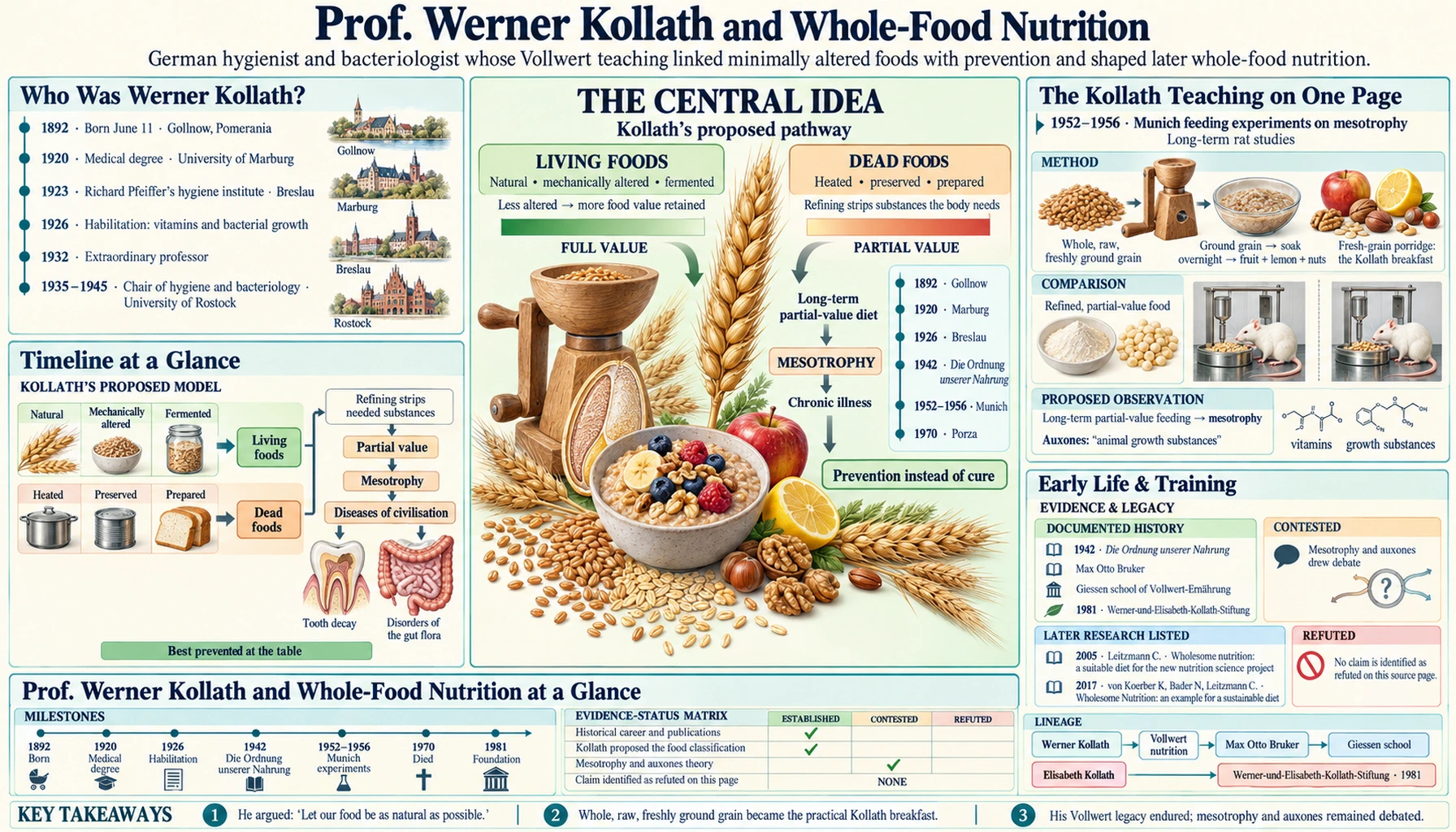
Werner Kollath (1892–1970) was a German professor of hygiene and bacteriology whose work on vitamins and growth substances led him to a simple rule: “Let our food be as natural as possible.” In Die Ordnung unserer Nahrung (1942) he divided foods into living foods — natural, mechanically altered or fermented — and dead foods that had been heated, preserved or prepared, and argued that a diet of refined, partial-value food leaves people in a hidden state of semi-nutrition he called mesotrophy. Out of his teaching came the Kollath breakfast of fresh-ground raw grain, and the whole-food (Vollwert) nutrition movement carried on by Max Otto Bruker and the Giessen school.
This hub gathers six deep-dive articles on his life and work, drawn from his own books and papers and from the historians of his work, and presented as he stated it. His documented record during the National Socialist years is set out factually on the Life and Career page.
Table of Contents
Deep-Dive Articles
1. Life and Career
From Pomerania to Breslau under Richard Pfeiffer, the Rostock chair of hygiene, the political record of 1933–1945, Hannover, Stockholm, Freiburg and the Munich experiments, and the Kollath foundation — with a timeline.
Read the deep dive →2. Die Ordnung unserer Nahrung
The 1942 book and its editions, “let our food be as natural as possible,” living foods and dead foods, the six value grades, full value and partial value, and what processing takes away.
Read the deep dive →3. Mesotrophy and Auxones
Semi-nutrition: the 1926 work on vitamins and bacterial growth, the “animal growth substances” he called auxones, the long-term rat studies, and the debate his theory drew.
Read the deep dive →4. The Kollath Breakfast
Fresh-grain porridge: freshly ground raw grain soaked overnight with fruit, lemon and nuts, how it differs from Bircher muesli, and the studies of its effects from 1955 to 1998.
Read the deep dive →5. Diseases of Civilisation
From partial-value food to chronic disease: the 1958 book, teeth as a measure of deficiency, “dysbacteria” of the gut flora and the word probiotic, cancer and the natural diet.
Read the deep dive →6. Whole-Food Legacy
His books in date order, Max Otto Bruker, the Giessen school of Vollwert-Ernährung, the Werner-und-Elisabeth-Kollath-Stiftung, and whole-food nutrition in German-speaking countries today.
Read the deep dive →Who Was Werner Kollath?
Kollath was born on June 11, 1892, in Gollnow, Pomerania. He took his medical degree at Marburg in 1920 and from 1923 worked in Breslau under the bacteriologist Richard Pfeiffer, qualifying as a lecturer in 1926 with a study of vitamins and the growth of bacteria and becoming an extraordinary professor in 1932. From 1935 to 1945 he held the chair of hygiene and bacteriology at the University of Rostock, where in 1942 he published Die Ordnung unserer Nahrung. He was dismissed in 1945.
After the war he worked in Hannover, in Stockholm and, from 1949, as a teacher in Freiburg, and in the 1950s he continued long-term feeding experiments in Munich on what he called mesotrophy. His later books included Zivilisationsbedingte Krankheiten und Todesursachen (1958), Getreide und Mensch (1964) and Die Ernährung als Naturwissenschaft (1967). He died on November 19, 1970, in Porza, Switzerland. His widow, Elisabeth Kollath, established the Werner-und-Elisabeth-Kollath-Stiftung in 1981.
The Kollath Teaching on One Page
- Let our food be as natural as possible. The less food is altered, the more of its value it keeps.
- Living foods and dead foods. Natural, mechanically altered and fermented foods are living foods; heated, preserved and prepared foods are dead foods, mere nutriments.
- Full value and partial value. Refining strips food of substances the body needs, leaving only part of its value.
- Mesotrophy. A long diet of partial-value food produces a hidden state between health and deficiency disease that leads, over years, to chronic illness.
- Fresh-ground whole grain. Grain eaten whole, raw and freshly ground — as in the Kollath breakfast — carries the growth substances that refined flour has lost.
- Prevention instead of cure. The diseases of civilisation, from tooth decay to disorders of the gut flora, are best prevented at the table.
Timeline at a Glance
- 1892 — Born June 11 in Gollnow, Pomerania.
- 1920 — Medical degree, University of Marburg.
- 1923 — Joins Richard Pfeiffer’s hygiene institute in Breslau.
- 1926 — Habilitation on vitamins and the growth of bacteria.
- 1935–1945 — Chair of hygiene and bacteriology, University of Rostock.
- 1942 — Publishes Die Ordnung unserer Nahrung.
- 1945 — Dismissed from the Rostock chair.
- 1947–1949 — Hannover, then Stockholm; teaching in Freiburg from 1949.
- 1952–1956 — Feeding experiments on mesotrophy in Munich.
- 1958–1967 — Books on diseases of civilisation, grain and nutrition as a natural science.
- 1970 — Dies November 19 in Porza, Switzerland.
- 1981 — The Werner-und-Elisabeth-Kollath-Stiftung is founded.
Key Research Papers
- Kollath W. [Imperfect life; discovery of a new physiological way of life]. Wendepunkt Leben Leiden. 1946;23(2):38-44. — PubMed PMID: 20277819
- Kollath W. [The whole food and its determination by growth and cell replacement]. Z Gesamte Inn Med. 1947;2(1-2):31-6. — PubMed PMID: 20254358
- Kollath W. [The importance of the full value of food for hygiene]. Zentralbl Bakteriol Orig. 1949;153(1-2):43-60. — PubMed PMID: 18114869
- Kollath W. [The practical importance of auxones (animal growth substances) for the food industry, especially for grain processing]. Z Lebensm Unters Forsch. 1949;89(1):38. — PubMed PMID: 18224939
- Kollath W. [Chemical nature of the animal growth factor, and conditions prerequisite to the development of mesotrophy (semi-nutrition)]. Zentralbl Bakteriol Orig. 1950;155(8):383-91. — PubMed PMID: 14782660
- Kollath W. [The attitude of man toward his food; a contribution to attitude research]. Hippokrates. 1955;26(22):661-8. — PubMed PMID: 13294716
- Kollath W. [The phases of the nutritional process; on the significance of mastication]. Int Z Vitaminforsch. 1967;37(2):212-25. — PubMed PMID: 5595593
- Leitzmann C. Wholesome nutrition: a suitable diet for the new nutrition science project. Public Health Nutr. 2005;8(6A):753-9. — PubMed PMID: 16236212
- von Koerber K, Bader N, Leitzmann C. Wholesome Nutrition: an example for a sustainable diet. Proc Nutr Soc. 2017;76(1):34-41. — PubMed PMID: 27502053