Nobel Prize in Physiology or Medicine: Every Laureate, 1901-2026
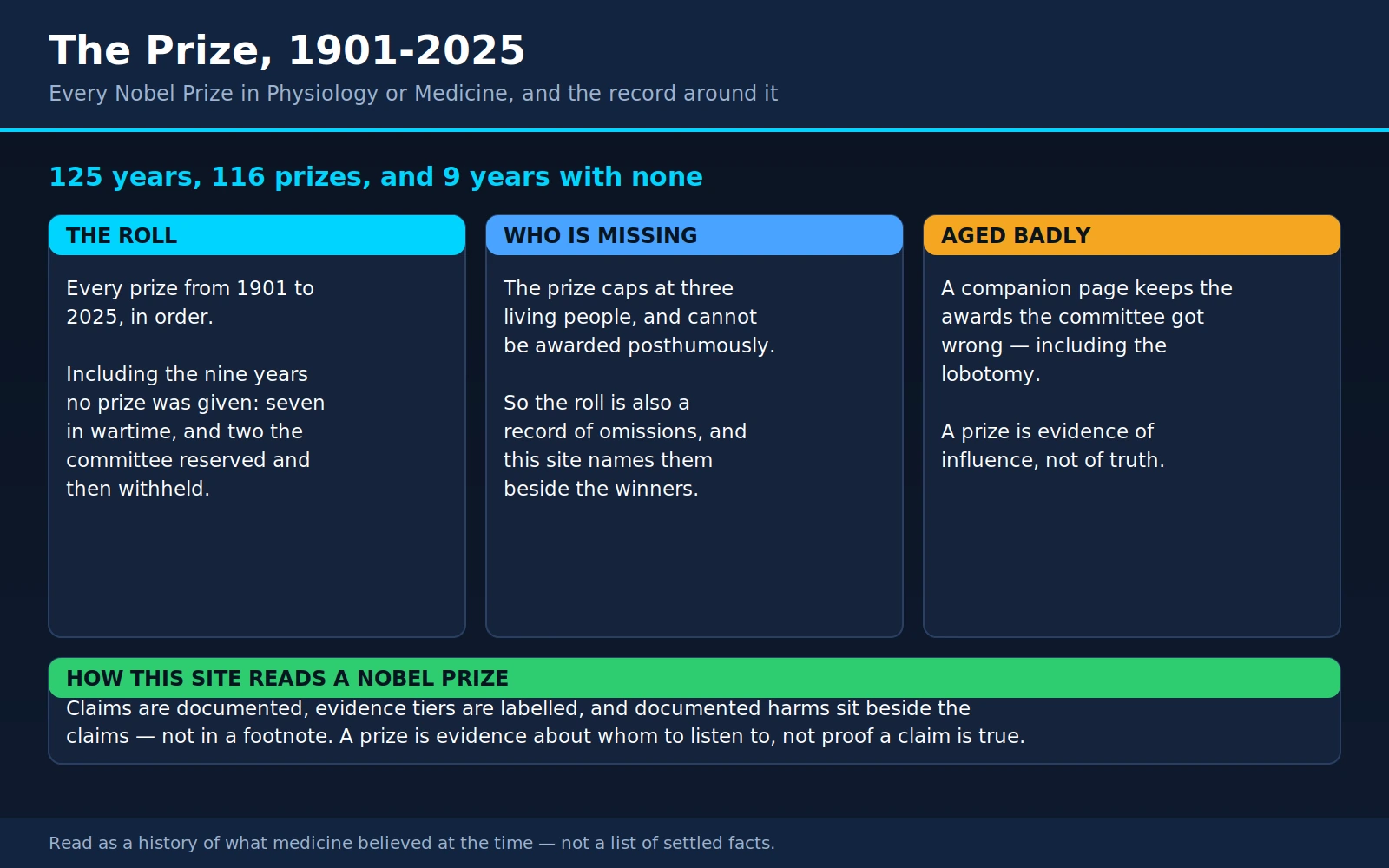
The Nobel Prize in Physiology or Medicine is one of the five prizes established in Alfred Nobel's 1895 will, awarded since 1901 to those who have "conferred the greatest benefit to humankind" in the science of life and health. The laureates are chosen by the Nobel Assembly at the Karolinska Institutet in Stockholm, announced each October, and honored on 10 December, the anniversary of Nobel's death. At most three people may share a year's prize, and between 1901 and 2026 it has been awarded 117 times to 235 laureates — a roll that runs from serum therapy for diphtheria to optogenetics, and that doubles as a history of how modern medicine came to exist. The youngest laureate on the roll, Frederick Banting, was 31 when the 1923 prize was awarded; the oldest, Peyton Rous, was 87 — and had waited more than half a century to be believed.
This page is the complete record: every prize year from 1901 through 2026 appears below exactly once — including the nine years when no prize was given — with a one-to-two-line plain-language summary of what was discovered and why it mattered to ordinary people's health. Selected laureates have full biography hubs on this site — Robert Koch, Frederick Banting, Christiaan Eijkman, Albert Szent-Györgyi, Alexander Fleming, Barry Marshall, Tu Youyou, Satoshi Ōmura, and William Campbell — and their names are linked in place wherever they appear in the list. For the official archive of citations, lectures, and biographies, see NobelPrize.org. Names are spelled as the Nobel Foundation records them; where an award has aged badly, the entry and the notes below record what later research and historians have found.
Table of Contents
The 1900s
The first decade of the prize honored the germ-theory generation: the researchers who proved that microbes and parasites cause disease, that the body can be armed against them, and that the nervous system could be studied cell by cell. Life expectancy in the industrialized world was still in the forties, and infectious disease was the main reason why.
- 1901 — Emil von Behring — Serum therapy against diphtheria: antitoxin raised in immunized animals could neutralize the toxin in a sick child, turning one of the era's leading child-killers — a disease that suffocated children by the tens of thousands every year — into a treatable condition. This was the first Nobel Prize in Medicine ever awarded, building on groundwork von Behring had laid with Shibasaburo Kitasato on tetanus antitoxin. Antitoxin serums of the same family are still the emergency treatment for diphtheria, botulism and snakebite.
- 1902 — Ronald Ross — Proved that malaria is carried by mosquitoes: working as an army surgeon in India, he found the parasite developing in the stomach wall of an Anopheles mosquito and traced its full life cycle in birds. Every mosquito-control campaign since — bed nets, drainage, spraying — rests on this discovery. He spent the rest of his life campaigning, often bitterly, for mosquito control to be taken seriously.
- 1903 — Niels Ryberg Finsen — Light therapy: concentrated light radiation could treat lupus vulgaris, tuberculosis of the skin, a disfiguring disease with no other effective remedy at the time. Finsen, chronically ill for most of his career, was too sick to attend the ceremony and died the following year at 43. The Finsen Institute he founded in Copenhagen carried the work on for decades.
- 1904 — Ivan Pavlov — The physiology of digestion: using surgically created fistulas that let him watch digestion in living, healthy dogs, he showed how the nervous system controls the stomach and digestive glands. Along the way, his salivating dogs made the "conditioned reflex" the most famous experiment in physiology. Conditioned reflexes went on to shape behavioral psychology and the treatment of phobias.
- 1905 — Robert Koch — Tuberculosis: he had isolated the bacterium behind a disease then causing roughly one in seven European deaths, and with his famous postulates he set the rules of proof that a specific germ causes a specific disease — the foundation of medical bacteriology. His tuberculin, a failed cure for TB, survives instead as the tuberculin skin test for exposure.
- 1906 — Camillo Golgi and Santiago Ramón y Cajal — The structure of the nervous system: Golgi's silver stain made single nerve cells visible, and Cajal used it to show that the brain is built of individual neurons rather than one continuous web. Famously, the two disagreed to the end — Golgi used his Nobel lecture to argue against Cajal's neuron doctrine, which is nevertheless the one that proved correct.
- 1907 — Alphonse Laveran — Discovered that protozoa — single-celled parasites — can cause human disease: in 1880, in Algeria, he had spotted the malaria parasite itself moving in a soldier's blood, the first protozoan ever tied to a human illness. He gave half his prize money to found a tropical-medicine laboratory at the Pasteur Institute.
- 1908 — Ilya Mechnikov and Paul Ehrlich — The two halves of immunity: Mechnikov discovered the cell-eating phagocytes of innate immunity, while Ehrlich explained antibodies and antitoxins — the chemical arm of the immune response. What looked like two rival theories both turned out to be true, and Ehrlich went on to invent the "magic bullet" concept behind targeted drug therapy.
- 1909 — Emil Theodor Kocher — The physiology, pathology and surgery of the thyroid gland: across thousands of operations he drove the death rate of goiter surgery from over ten percent to under one percent, and by observing patients after total removal he produced the first clear picture of hypothyroidism. His surgical instruments, including the Kocher forceps, are still on operating trays under his name.
The 1910s
Five prizes honored the eye, the inner ear, allergy, surgery and the chemistry of the nucleus — and then the First World War silenced the roll for four straight years. It is the list's first lesson in how completely war can stop science.
- 1910 — Albrecht Kossel — The chemistry of the cell nucleus: he isolated the nucleic-acid building blocks — adenine, guanine, cytosine, thymine and uracil — that would later turn out to be the letters of the genetic code, and he also discovered the histones, the proteins DNA wraps around. He worked out this chemistry decades before anyone suspected nucleic acids carried heredity — most scientists of his day bet on proteins.
- 1911 — Allvar Gullstrand — The dioptrics of the eye: how the living lens bends and focuses light, and how it reshapes itself to focus near and far. His inventions, above all the slit lamp, are still standard equipment in every eye clinic in the world. Eyeglass prescription and cataract-lens design still rest on the optical theory he built.
- 1912 — Alexis Carrel — Vascular suturing and the transplantation of blood vessels and organs: the sewing techniques that, decades later, made bypass surgery and organ transplantation technically possible. He also pioneered keeping living tissue alive outside the body — a sensation in its day and an ancestor of modern cell culture.
- 1913 — Charles Richet — Anaphylaxis: a second exposure to a foreign protein can trigger sudden, violent, sometimes fatal shock. Richet coined the word after experiments with marine toxins showed a tiny repeat dose could kill a dog that had easily tolerated the first. The discovery founded allergy science and explains why some reactions kill within minutes. Epinephrine auto-injectors exist because of the mechanism he named.
- 1914 — Robert Bárány — The vestibular apparatus: how the inner ear's balance organ works and fails. His caloric test — irrigating the ear canal with warm and cool water and watching the eyes respond — is still used to investigate dizziness. He learned of the prize while held in a Russian prisoner-of-war camp, and was released with the help of the Red Cross to accept it.
- 1915 — No prize awarded — World War I.
- 1916 — No prize awarded — World War I.
- 1917 — No prize awarded — World War I.
- 1918 — No prize awarded — World War I.
- 1919 — Jules Bordet — Discoveries relating to immunity: he found complement, the blood proteins that help antibodies destroy bacteria. Complement fixation became the basis of a whole family of diagnostic blood tests, including the Wassermann test for syphilis. He also discovered Bordetella pertussis, the whooping-cough bacterium that carries his name.
The 1920s
The decade of insulin and the vitamins — two discoveries ordinary families could feel in their own kitchens and sickrooms — and of two years when the committee held the prize back rather than force a choice. Insulin reached dying patients within months of its discovery — a bench-to-bedside speed the roll has rarely seen since.
- 1920 — August Krogh — The capillary motor mechanism: the body opens and closes its smallest blood vessels moment to moment, matching blood supply to each tissue's changing need for oxygen. Two years later, Krogh — whose own wife had diabetes — carried the new insulin process home from Toronto and co-founded a Danish insulin-producing laboratory.
- 1921 — No prize awarded — reserved by the committee and then withheld; not a war year (the Nobel Prize organisation records that the prize money was allocated to the special fund of this prize section).
- 1922 — Archibald Hill and Otto Meyerhof — How muscle produces work: Hill measured its heat production and gave us the concept of "oxygen debt," while Meyerhof tied the muscle's oxygen consumption to lactic-acid metabolism. Exercise physiology starts here. Every VO2-max test and lactate-threshold session in modern sports medicine descends from their measurements.
- 1923 — Frederick Banting and John Macleod — Insulin, from the Toronto work of 1921–22 (the first successful patient injections were in January 1922), honored with the prize in October 1923 “for the discovery of insulin”: type 1 diabetes, until then usually fatal within a year or two of diagnosis, became a treatable condition. Banting, 31 at the award, is listed by the Nobel Prize organisation as the youngest Medicine laureate. The division of credit is a documented dispute: Banting objected that his assistant Charles Best had been passed over and gave him half his prize money, and Macleod gave half of his to the biochemist James Collip. Historians since Michael Bliss's 1982 history The Discovery of Insulin generally credit all four, and Bliss (2013) describes how Banting's and later Best's campaigns against Macleod shaped his reputation for decades.
- 1924 — Willem Einthoven — The mechanism of the electrocardiogram: his string galvanometer turned the heart's electrical activity into a readable tracing, and the letters he assigned its waves — P, QRS and T — are still read aloud in every cardiology ward. The ECG remains among the first tests run on almost every chest-pain patient. Smartwatch ECGs a century later still draw the waves he lettered.
- 1925 — No prize awarded — reserved and then withheld again; like 1921, not a war year.
- 1926 — Johannes Fibiger — Awarded for "Spiroptera carcinoma": the claim that a parasitic worm causes stomach cancer in rats. Later work showed the lesions were not true parasite-caused cancers at all, and a 2004 study of the Nobel archives by Stolt, Klein and Jansson calls it “a wrong Nobel Prize” — see Notes on the Record. The episode is often cited as a reason for the committee's later caution with cancer claims — Peyton Rous waited until 1966.
- 1927 — Julius Wagner-Jauregg — Malaria fever therapy for neurosyphilis: deliberately infecting patients so that sustained fever would arrest otherwise-fatal late-stage syphilis. The first psychiatrist to win a Nobel, he was honored for a treatment that sometimes worked but was abandoned entirely once penicillin arrived — see below.
- 1928 — Charles Nicolle — Epidemic typhus is transmitted by body lice: at the Pasteur Institute of Tunis he noticed that patients stopped infecting others the moment they were bathed and given clean clothes at hospital admission. Delousing could therefore stop the epidemics that had trailed every war and famine in history. His other legacy is the concept of the "inapparent infection" — people who carry and spread a germ without ever falling ill.
- 1929 — Christiaan Eijkman and Frederick Gowland Hopkins — The discovery of vitamins: in Java, Eijkman traced beriberi to a factor missing from polished white rice — thiamine, vitamin B1, still present in the bran layer that polishing removes — and Hopkins proved with feeding experiments that foods contain trace "accessory factors" without which animals sicken and die on otherwise complete diets.
The 1930s
Blood groups, heredity, the embryo and chemical nerve transmission: classical physiology's richest decade, ending with a laureate forbidden by his own government to accept the prize. Nearly every entry here is now chapter one of a textbook: transfusion, genetics, embryology, neurotransmission.
- 1930 — Karl Landsteiner — Human blood groups: the A, B, AB and O types, discovered back in 1901, made blood transfusion safe instead of a lethal gamble. A decade after his prize he helped discover the Rh factor as well — the second thing every blood bank checks. Years earlier he had also helped show that polio is a transmissible virus infection.
- 1931 — Otto Warburg — The respiratory enzyme: the machinery by which cells consume oxygen, measured with manometers of his own design. His name survives in the "Warburg effect," the altered sugar metabolism of cancer cells that researchers still probe today.
- 1932 — Charles Sherrington and Edgar Adrian — How the nervous system computes: Sherrington worked out spinal reflexes and gave the "synapse" its name; Adrian recorded the electrical impulses traveling in single nerve fibers and showed that nerves signal intensity by firing faster, not stronger.
- 1933 — Thomas Hunt Morgan — Chromosomes carry heredity: his fruit-fly room at Columbia located genes on specific chromosomes and turned genetics into a mapped, experimental science. He quietly split his prize money with his longtime co-workers Calvin Bridges and Alfred Sturtevant. The fruit fly has remained one of medicine's favorite laboratory animals ever since.
- 1934 — George Whipple, George Minot and William Murphy — Liver therapy for pernicious anemia, a disease that until then had been uniformly fatal: patients ate up to half a pound of liver a day and lived. The curative factor in liver was later identified as vitamin B12. Whipple's dog experiments pointed to liver; Minot and Murphy carried the finding to patients.
- 1935 — Hans Spemann — The "organizer effect": a small region of the early embryo instructs the rest to form a body plan, shown by delicate tissue transplants between newt embryos. The decisive experiment was performed by his doctoral student Hilde Mangold, who died young in an accident and could not be honored with him.
- 1936 — Henry Dale and Otto Loewi — Nerves communicate with chemicals: Loewi's famous experiment — designed in a dream — showed that a frog's stimulated vagus nerve releases a substance (acetylcholine) that slows a second heart bathed in the same fluid. Most drugs acting on the brain, heart and gut work on this principle. Two years later the Nazis forced Loewi, a Jew, to surrender his prize money to leave Austria.
- 1937 — Albert Szent-Györgyi — Biological combustion: how cells burn fuel, with special reference to vitamin C — which he had isolated, famously extracting kilograms of it from Hungarian paprika — and the catalysis of fumaric acid, groundwork for the citric-acid cycle.
- 1938 — Corneille Heymans — The body's oxygen sensors: the carotid-sinus and aortic mechanisms that monitor blood oxygen and pressure and adjust breathing to match, demonstrated in elegant cross-circulation experiments in dogs. Sleep-apnea and blood-pressure medicine still lean on this physiology.
- 1939 — Gerhard Domagk — Prontosil, the first sulfonamide antibacterial: the first drug that could cure once-routinely-fatal streptococcal infections, and among its earliest beneficiaries was Domagk's own daughter, saved from a severe infection. The Nazi regime forced him to decline the prize; he received his medal after the war.
The 1940s
Three silent war years, then the antibiotic dawn — penicillin, vitamin K, cortisone's forerunners — and, at the decade's end, two of the most debated awards in the roll. Penicillin and DDT bracket the decade's lesson: chemistry could now save whole populations, and carry costs no one had yet measured.
- 1940 — No prize awarded — World War II.
- 1941 — No prize awarded — World War II.
- 1942 — No prize awarded — World War II.
- 1943 — Henrik Dam and Edward Doisy — Vitamin K: Dam discovered the clotting vitamin — he named it K for "Koagulation" — and Doisy worked out its chemical nature and synthesized it. A vitamin K shot is still given to virtually every newborn to prevent dangerous bleeding in the first weeks of life. Dam had first noticed mysterious bleeding in chicks on fat-free experimental diets — a reminder that deficiency diseases were still being discovered within living memory.
- 1944 — Joseph Erlanger and Herbert Gasser — Nerve fibers are specialists: adapting the cathode-ray oscilloscope to physiology, they showed that different fibers conduct at different speeds and carry different kinds of signal — part of why touch, pain and temperature feel distinct, and the basis of the nerve-conduction tests used for neuropathy today.
- 1945 — Alexander Fleming, Ernst Boris Chain and Howard Florey — Penicillin: Fleming's chance observation on a contaminated culture plate in 1928, turned by Chain and Florey's Oxford team into a purified, mass-produced drug. By the last years of the war it was being mass-produced and used to treat wounded soldiers; the antibiotic era — and the modern expectation of surviving bacterial infection — begins here.
- 1946 — Hermann Joseph Muller — X-rays cause mutations: radiation damages genes, permanently and cumulatively, as he showed in fruit flies in 1927. Radiation protection in medicine and industry is built on this warning, and Muller spent his later years publicly pressing the point about nuclear fallout.
- 1947 — Carl Cori and Gerty Cori, with Bernardo Houssay — The Coris, a husband-and-wife team who shared a laboratory their whole careers, mapped how the body converts glycogen, its stored sugar; Houssay — the first Latin American science laureate — showed the pituitary gland's role in blood-sugar control. Gerty Cori was the first woman ever to win this prize.
- 1948 — Paul Hermann Müller — DDT kills insects on contact: it stopped a typhus epidemic in wartime Naples in mid-outbreak — a first in history — and crushed malaria across whole regions, decades before the compound's environmental persistence and toll were understood. See How to Read This List.
- 1949 — Walter Rudolf Hess, with António Egas Moniz — Hess mapped how the interbrain (hypothalamus) coordinates the internal organs, using fine electrodes in freely moving cats. Moniz — who had earlier invented cerebral angiography, an unambiguous contribution — received his half “for his discovery of the therapeutic value of leucotomy in certain psychoses” — the lobotomy, widely described as the most criticized award in the prize's history. See below.
The 1950s
Antibiotics, steroid hormones, virus culture and vaccines: the decade in which medicine industrialized. Cortisone, streptomycin, the first antihistamines and the groundwork of the polio vaccines were all honored in these ten years — and most are still in pharmacies today.
- 1950 — Edward Kendall, Tadeus Reichstein and Philip Hench — The adrenal cortex hormones: isolating cortisone and showing, in a famous 1948 demonstration at the Mayo Clinic, that it could switch off the inflammation of rheumatoid arthritis — bedridden patients walked within days. Steroid medicine begins here; so does the long lesson of its side effects.
- 1951 — Max Theiler — The 17D yellow-fever vaccine, made by passaging the virus until it lost its virulence — work made personal when Theiler himself caught yellow fever in the laboratory and survived. The 17D strain is still in use. Norrby (2007) called it the only Nobel Prize for a virus vaccine — true until the 2023 prize for the nucleoside modifications that enabled mRNA vaccines against COVID-19.
- 1952 — Selman Waksman — Streptomycin, found by systematically screening soil microbes: the first antibiotic effective against tuberculosis, until then the great untreatable infection. The prize went to Waksman alone. His graduate student Albert Schatz, who performed the isolation, was legally recognized as streptomycin's co-discoverer after a lawsuit and received a share of the royalties. The balance of credit remains a documented dispute among historians: Wainwright (1991) presents archival evidence for Schatz's role, while Kingston (2004) argues that the credit rightly went to Waksman's screening programme.
- 1953 — Hans Krebs and Fritz Lipmann — The central machinery of metabolism: the citric-acid (Krebs) cycle and coenzyme A — the chemistry by which every cell turns food into usable energy. Krebs, a refugee from Nazi Germany working in England, had seen his cycle paper rejected by Nature in 1937 for lack of space. Lipmann also gave biology its "energy currency" picture of ATP.
- 1954 — John Enders, Thomas Weller and Frederick Robbins — Grew poliovirus in ordinary tissue culture. That unglamorous-sounding feat is what made the polio vaccines possible within the decade — though Salk and Sabin, who built them, never received a Nobel themselves.
- 1955 — Hugo Theorell — The nature and mode of action of oxidation enzymes: how cells handle hydrogen and electrons when they burn nutrients for energy. Among his enzymes was alcohol dehydrogenase — the one that clears alcohol from the blood, and the basis of enzymatic blood-alcohol testing.
- 1956 — André Cournand, Werner Forssmann and Dickinson Richards — Cardiac catheterization: in 1929, as a junior doctor, Forssmann threaded a catheter into his own heart through an arm vein to prove it could be done — and was disciplined for it, leaving the field. Cournand and Richards turned the stunt into the everyday diagnostic and treatment tool of modern cardiology.
- 1957 — Daniel Bovet — Synthetic drugs that block the body's own signaling chemicals: the first antihistamines for allergy, and curare-like muscle relaxants that made modern surgical anesthesia safer. The antihistamine chemistry he opened also fed directly into the discovery of the first antipsychotic drugs.
- 1958 — George Beadle and Edward Tatum, with Joshua Lederberg — "One gene, one enzyme": genes act by directing specific chemical reactions, shown in bread mold. Lederberg — just 33 when the prize came — showed that bacteria can exchange genes with each other, founding bacterial genetics and, with it, our understanding of how antibiotic resistance spreads.
- 1959 — Severo Ochoa and Arthur Kornberg — Enzymes that build RNA and DNA in the test tube: the first time humans could synthesize the molecules of heredity — an early step on the road to genetic engineering. (Kornberg's son Roger later won a Nobel of his own, in Chemistry.)
The 1960s
The double-helix decade: the structure and code of DNA, the rules of cellular immunity, and molecular biology installed permanently at the center of medicine. Remarkably, much of it was done with squid, chickens, bacteriophages and fruit flies — cheap organisms, permanent truths.
- 1960 — Frank Macfarlane Burnet and Peter Medawar — Acquired immunological tolerance: the immune system learns early in life what belongs to the body — predicted by Burnet's theory and proved by Medawar's skin-graft experiments in mice, work begun amid the skin-graft failures of burned WWII airmen. This is the insight that made organ transplantation conceivable.
- 1961 — Georg von Békésy — How the cochlea hears: sound travels as a wave along the inner ear, each pitch peaking at its own location. Békésy was not a physician at all but a communications engineer who began in a telephone laboratory — and his physics of hearing underlies modern hearing tests and, later, cochlear implants.
- 1962 — Francis Crick, James Watson and Maurice Wilkins — The double helix: the molecular structure of DNA and what that structure implies about how genetic information is copied and passed on — often described as the most consequential biological discovery of the century. The X-ray photographs and measurements made by Rosalind Franklin, with her student Raymond Gosling, were the experimental foundation the model rested on, and how her contribution was credited in 1953 is a documented dispute among historians. She died in 1958, four years before the prize, and the prize is not awarded posthumously.
- 1963 — John Eccles, Alan Hodgkin and Andrew Huxley — The nerve impulse decoded: sodium and potassium ions flowing across the cell membrane make neurons fire, worked out with electrodes inside the giant nerve fiber of the squid. Bedrock for neurology, cardiology and anesthetics ever since. Local anesthetics, anti-seizure drugs and heart-rhythm medicines all act on the ion channels they described.
- 1964 — Konrad Bloch and Feodor Lynen — How the body manufactures cholesterol and fatty acids, tracing a synthesis dozens of chemical steps long — the metabolic pathway that statin drugs would later block at its rate-limiting enzyme. Bloch traced every one of cholesterol's carbon atoms back to simple acetate.
- 1965 — François Jacob, André Lwoff and Jacques Monod — Genes are switched on and off: the operon model of gene regulation, built at the Pasteur Institute, showing that cells carry far more genetic information than they use at any given moment. How genes are controlled — not just what they encode — became a founding question of modern medicine. Jacob had fought with the Free French and been gravely wounded before he ever entered a laboratory.
- 1966 — Peyton Rous, with Charles Huggins — Rous: viruses can cause cancer — a discovery he had made 55 years earlier with a chicken sarcoma, one of the longest waits in the prize's history; at 87 he was then the oldest laureate ever honored. Huggins: hormone therapy for prostate cancer, showing that hormones could control the spread of a cancer.
- 1967 — Ragnar Granit, Haldan Keffer Hartline and George Wald — How the eye sees: Wald showed that vitamin A chemistry sits at the heart of vision — which is why deficiency causes night blindness — while Granit and Hartline showed how the retina turns light into coded nerve signals.
- 1968 — Robert Holley, Har Gobind Khorana and Marshall Nirenberg — Cracked the genetic code: beginning with Nirenberg's celebrated poly-U experiment, they worked out how DNA's four-letter alphabet spells the twenty amino acids from which every protein is built, and how transfer RNA reads it.
- 1969 — Max Delbrück, Alfred Hershey and Salvador Luria — How viruses replicate and carry their genes, worked out in bacteriophages by the famous "phage group" — the experimental school, led in part by a physicist, in which a generation of molecular biologists was trained.
The 1970s
From nerve chemistry to the CT scanner: the decade in which discovery began turning into diagnostic hardware, and in which the tools of genetic engineering were forged. Restriction enzymes and reverse transcriptase — two of this decade's prizes — are still the working tools of every biotech laboratory.
- 1970 — Bernard Katz, Ulf von Euler and Julius Axelrod — How nerves release, reabsorb and inactivate their chemical messengers: von Euler identified noradrenaline as the transmitter of the sympathetic nerves, Katz showed transmitters are released in discrete packets, and Axelrod discovered reuptake — the mechanism on which most antidepressants act.
- 1971 — Earl Sutherland — Cyclic AMP, the "second messenger": how a hormone arriving at a cell's surface changes what happens deep inside it, found while working out how adrenaline mobilizes sugar from the liver. This is how adrenaline actually does its work — and a signaling principle now known to run through nearly all of biology.
- 1972 — Gerald Edelman and Rodney Porter — The chemical structure of antibodies: working independently, and cleaving the molecule with enzymes to see its parts, they revealed the Y-shaped protein at the center of every vaccination and every modern antibody drug.
- 1973 — Karl von Frisch, Konrad Lorenz and Nikolaas Tinbergen — Animal behavior: the honeybee dance language, imprinting in young birds, and the organization of instinct — a rare Medicine prize for the study of behavior, awarded “for their discoveries concerning organization and elicitation of individual and social behaviour patterns.”
- 1974 — Albert Claude, Christian de Duve and George Palade — The cell's inner anatomy: with the electron microscope and the centrifuge they discovered and mapped organelles — de Duve coined the very words "lysosome" and "peroxisome" — turning the cell from a featureless blob into a mapped city. Dozens of "lysosomal storage" diseases are understood through this work.
- 1975 — David Baltimore, Renato Dulbecco and Howard Temin — Tumor viruses and reverse transcriptase: genetic information can flow from RNA back into DNA. Temin's "provirus" idea was ridiculed for a decade before the enzyme proved him right — and the discovery underpins HIV medicine and a large part of biotechnology.
- 1976 — Baruch Blumberg and D. Carleton Gajdusek — Blumberg discovered the hepatitis B virus — via a telltale antigen first spotted in one Australian blood sample — opening the way to blood-bank screening and the first hepatitis B vaccine; Gajdusek showed that kuru, a fatal brain disease of New Guinea's Fore people spread by funerary rites, was transmissible — the trail that later led to prions.
- 1977 — Roger Guillemin and Andrew Schally, with Rosalyn Yalow — The brain's own hormones: the hypothalamic releasing hormones that command the pituitary, isolated from literally tons of animal brain tissue. Yalow — only the second woman honored in this category, thirty years after Gerty Cori — invented radioimmunoassay, able to measure hormones in almost unimaginably small amounts: the ancestor of the modern hormone blood test.
- 1978 — Werner Arber, Daniel Nathans and Hamilton Smith — Restriction enzymes: the "molecular scissors" that cut DNA at chosen sequences — the tool that launched genetic engineering. Within four years of the prize, the first genetically engineered medicine — human insulin — reached patients.
- 1979 — Allan Cormack and Godfrey Hounsfield — Computed tomography: the CT scanner, the first machine that could show soft tissue inside the living body in cross-section, transforming the diagnosis of stroke, cancer and trauma. Neither winner was a physician — one was a physicist, the other an engineer.
The 1980s
Immunology's engineering decade: transplant matching, monoclonal antibodies, growth factors and oncogenes — the parts list from which today's blockbuster drugs are built. Half the decade's prizes went wholly or partly to immunology and cancer biology — the fields that now dominate new drug approvals.
- 1980 — Baruj Benacerraf, Jean Dausset and George Snell — The MHC (HLA) system: the genetically determined surface markers by which the immune system tells self from non-self. Tissue typing built on this is why donor organs and bone marrow are "matched" — and why some people's immune genes predispose them to particular diseases.
- 1981 — Roger Sperry, with David Hubel and Torsten Wiesel — Sperry: the brain's two hemispheres specialize, shown in split-brain patients whose connecting bundle had been cut. Hubel and Wiesel: how the visual cortex processes sight, and why a child's lazy eye responds to treatment only early in life, while the cortex is still wiring itself — a finding that changed pediatric eye care worldwide.
- 1982 — Sune Bergström, Bengt Samuelsson and John Vane — Prostaglandins: the short-range tissue hormones behind pain, fever, inflammation and clotting. Vane showed that aspirin works by blocking their production — explaining, a lifetime later, medicine's oldest everyday drug — and Samuelsson mapped the leukotrienes that drive asthma.
- 1983 — Barbara McClintock — Mobile genetic elements: genes can move within and between chromosomes, discovered in the patterns of Indian corn at Cold Spring Harbor and dismissed for decades. She eventually won the prize unshared — the only woman to do so in this category.
- 1984 — Niels Jerne, Georges Köhler and César Milstein — Immune-system theory and the invention of monoclonal antibodies. Köhler and Milstein famously never patented the technique — which today underlies dozens of the world's most-prescribed drugs, every medicine whose name ends in "-mab."
- 1985 — Michael Brown and Joseph Goldstein — The LDL receptor and how cells regulate cholesterol, worked out in children with familial hypercholesterolemia who suffered heart attacks in childhood. The discovery explained inherited early heart disease and set the stage for the statins. Statins have since become among the most-prescribed drugs on Earth.
- 1986 — Stanley Cohen and Rita Levi-Montalcini — Growth factors: nerve growth factor and epidermal growth factor, the body's own "grow now" signals, now central to cancer research and wound-healing medicine. Levi-Montalcini had begun the work in a bedroom laboratory in wartime Turin, barred from her university by Italy's race laws; she lived to 103.
- 1987 — Susumu Tonegawa — How a modest number of genes shuffle and recombine to generate millions of different antibodies — the genetic trick behind the immune system's diversity, and the answer to a puzzle that had stumped immunology for a generation. He did the decisive experiments in Basel and later turned his laboratory to the neuroscience of memory.
- 1988 — James Black, Gertrude Elion and George Hitchings — “Important principles for drug treatment”: beta-blockers and the first H2 ulcer drug (Black), and the purine medicines azathioprine, allopurinol and acyclovir (Elion and Hitchings) — designing drugs from biology rather than finding them by luck. Elion, who never earned a doctorate, became one of the most honored drug designers in history.
- 1989 — J. Michael Bishop and Harold Varmus — Oncogenes: cancer genes are our own normal growth genes, corrupted — every cell carries "proto-oncogenes" that mutation can turn against us. The conceptual foundation of targeted cancer therapy.
The 1990s
The working-parts decade: ion channels, phosphorylation switches, split genes and G-proteins — the cell's control systems, one prize at a time. When a modern drug advertisement names a "pathway," the odds are good that one of these prizes mapped it.
- 1990 — Joseph Murray and E. Donnall Thomas — Transplantation becomes treatment: Murray performed the first successful kidney transplant, between identical twins, in 1954; Thomas developed bone-marrow transplantation, which turned some leukemias from death sentences into curable diseases. Murray's twin operation needed no immunosuppression — identical genes attack nothing — and the drugs that came later opened transplantation to everyone else.
- 1991 — Erwin Neher and Bert Sakmann — The patch clamp: recording the electrical current through a single ion channel — the technique that turned cell electricity from theory into measurement. Cystic fibrosis, some heart-rhythm disorders and many drug actions are understood channel by channel because of it.
- 1992 — Edmond Fischer and Edwin Krebs — Reversible protein phosphorylation: the universal on/off switch by which cells control their proteins, discovered in the enzymes of muscle. It is the mechanism a whole generation of cancer drugs — the kinase inhibitors — now targets. Imatinib, the leukemia pill that proved targeted cancer therapy could work, blocks exactly this kind of switch.
- 1993 — Richard Roberts and Phillip Sharp — Split genes: our genes are stored in pieces (exons) separated by non-coding stretches (introns) and spliced together — a double discovery the two made independently in 1977. Errors of splicing underlie many inherited diseases, and some modern therapies work by correcting them.
- 1994 — Alfred Gilman and Martin Rodbell — G-proteins: the relay switches that carry a signal from a cell-surface receptor to the machinery inside. A large share of modern medicines — for blood pressure, allergy, pain, psychiatry — act on receptors coupled to them. Cholera toxin causes disease by jamming one of these switches open — one of the clues that helped reveal them.
- 1995 — Edward Lewis, Christiane Nüsslein-Volhard and Eric Wieschaus — The genes that lay out the embryo's body plan, found by systematically breaking them in tens of thousands of fruit-fly lines. The same gene families sculpt the human embryo — a framework for understanding how birth defects arise.
- 1996 — Peter Doherty and Rolf Zinkernagel — How killer T cells recognize a virus-infected cell: they must see the viral fragment and the body's own MHC marker together — the rulebook of cellular immunity, and a cornerstone of vaccine design and transplant medicine.
- 1997 — Stanley Prusiner — Prions: infectious agents made only of misfolded protein, with no genes at all — the cause of Creutzfeldt-Jakob disease and "mad cow" disease. He coined the word in 1982 and weathered fifteen years of open skepticism before the heresy proved correct. The same misfolding-template idea now guides research on Alzheimer's and Parkinson's.
- 1998 — Robert Furchgott, Louis Ignarro and Ferid Murad — Nitric oxide — a gas — as a signaling molecule in the cardiovascular system: why nitroglycerin has relieved angina since the 1800s, how blood vessels relax, and the science that led directly to sildenafil.
- 1999 — Günter Blobel — Every newly made protein carries an address tag that tells the cell where to deliver it. Proteins sent to the wrong address are at the root of several inherited diseases — and Blobel donated his entire prize to the rebuilding of Dresden, the city whose destruction he had fled as a child.
The 2000s
The genome era arrives: cell-cycle engines, gene silencing, MRI in every hospital — and two prizes for infectious causes of diseases long blamed on lifestyle or fate. It is also the decade the prize caught up with clinical imaging, MRI joining the 1979 CT award on the roll.
- 2000 — Arvid Carlsson, Paul Greengard and Eric Kandel — Signal transduction in the nervous system: dopamine as a transmitter and its loss in Parkinson's disease — the discovery behind L-dopa, still the mainstay treatment — how neurons respond to transmitters, and how synapses physically change as memories form (worked out by Kandel in a sea slug).
- 2001 — Leland Hartwell, Tim Hunt and Paul Nurse — The engine of the cell cycle: the cyclins and kinases that decide when a cell divides, discovered in yeast and sea-urchin eggs — and what has broken when cancer cells never stop dividing. Drugs aimed at this engine are now standard in breast cancer.
- 2002 — Sydney Brenner, H. Robert Horvitz and John Sulston — Programmed cell death: the body deletes cells on purpose, by a genetic program, worked out cell by cell in the transparent worm C. elegans — an animal Brenner chose precisely so that every one of its cells could be tracked. Fundamental to normal development and to cancer. Sulston went on to lead the British arm of the Human Genome Project and fought to keep its data free to all.
- 2003 — Paul Lauterbur and Peter Mansfield — Magnetic resonance imaging: Lauterbur showed how to turn magnetic resonance into an image; Mansfield made the mathematics fast enough for clinical scanning. The result: detailed pictures of brain, spine, joints and organs with no ionizing radiation at all. Lauterbur's founding paper was initially rejected by Nature before being accepted on resubmission.
- 2004 — Richard Axel and Linda Buck — The odorant receptors: a family of roughly a thousand receptor genes by which the nose and brain tell thousands of smells apart — one of the largest gene families in the mammalian genome, unknown until their 1991 paper.
- 2005 — Barry Marshall and Robin Warren — Helicobacter pylori causes gastritis and peptic ulcers: an ulcer is usually an infection curable with antibiotics, not a product of stress. Marshall famously drank a culture of the bacteria to help prove it, and the pair endured more than a decade of skepticism before mainstream medicine accepted the cure.
- 2006 — Andrew Fire and Craig Mello — RNA interference: double-stranded RNA can silence a chosen gene. The 1998 discovery was honored within eight years — one of the fastest recognitions in the prize's history — and within two decades it had become an approved class of medicines.
- 2007 — Mario Capecchi, Martin Evans and Oliver Smithies — Gene targeting in mice: embryonic stem cells plus homologous recombination yield "knockout" mice with a single chosen gene disabled — the standard way to learn what any gene does in a living mammal, applied since to thousands of genes. Smithies, a lifelong tinkerer, had earlier invented the gel-electrophoresis method used in every genetics laboratory.
- 2008 — Harald zur Hausen, with Françoise Barré-Sinoussi and Luc Montagnier — zur Hausen: human papillomavirus causes cervical cancer — pursued against years of doubt, and the discovery behind the HPV vaccine. Barré-Sinoussi and Montagnier: the identification of HIV. The omission of Robert Gallo, whose laboratory published evidence in 1984 that the virus causes AIDS and developed a blood test for it, is a documented and still-debated dispute over credit.
- 2009 — Elizabeth Blackburn, Carol Greider and Jack Szostak — Telomeres and telomerase: the protective caps on chromosome ends and the enzyme that rebuilds them, first worked out in a pond ciliate — basic science with no obvious payoff that became ground zero for research on cellular aging and cancer.
The 2010s
Immunotherapy's decade: the immune system aimed at cancer, mature cells reprogrammed, the brain's own map found — and two drugs from nature honored side by side. Unusually, several of its prizes honored treatments already in worldwide use: IVF, ivermectin and the first checkpoint drugs among them.
- 2010 — Robert Edwards — In vitro fertilization: the science behind the birth of the first "test-tube baby" in 1978. Millions of people alive today were conceived this way. His clinical partner Patrick Steptoe had died in 1988 and, under the rules, could not share the honor.
- 2011 — Bruce Beutler and Jules Hoffmann, with Ralph Steinman — How immunity is switched on: the activation receptors of innate immunity (Beutler and Hoffmann) and the dendritic cells that launch the adaptive response (Steinman). Steinman died three days before the announcement — treating his own pancreatic cancer partly with a therapy built on his discovery — and the Nobel Foundation let his award stand, because the decision had been made in the belief that he was alive.
- 2012 — John Gurdon and Shinya Yamanaka — Mature cells can be reprogrammed: Gurdon had cloned frogs from adult cells back in 1962 — a fifty-year wait — and Yamanaka showed in 2006 that four genes can return an adult cell to an embryonic-like state (iPS cells), reopening the entire field of regenerative medicine.
- 2013 — James Rothman, Randy Schekman and Thomas Südhof — The cell's shipping system: how cargo-filled vesicles bud, travel and fuse to deliver hormones and neurotransmitters to precisely the right place at precisely the right time — the machinery underlying insulin release and every nerve signal.
- 2014 — John O'Keefe, May-Britt Moser and Edvard Moser — The brain's inner GPS: O'Keefe found the hippocampal place cells in 1971; the Mosers — a married couple sharing the prize, like the Coris in 1947 — found the grid cells that give the map its coordinates. These circuits are among the first to fail in Alzheimer's disease.
- 2015 — William Campbell and Satoshi Ōmura, with Tu Youyou — Two drugs from nature: avermectin — parent of ivermectin, from a soil microbe Ōmura collected — which rolled back river blindness and lymphatic filariasis across whole continents; and artemisinin from sweet wormwood, recovered by Tu from a 1,600-year-old Chinese medical text, which transformed malaria treatment.
- 2016 — Yoshinori Ohsumi — Autophagy: how a cell recycles its own worn-out parts, worked out almost single-handedly in baker's yeast — machinery now linked to infection, cancer, neurodegeneration and the biology of fasting. Ohsumi has said he chose the problem precisely because nobody else was working on it.
- 2017 — Jeffrey Hall, Michael Rosbash and Michael Young — The molecular clock: the gene circuit — first isolated in the fruit fly's period gene — that runs the 24-hour circadian rhythm governing sleep, hormones, body temperature and metabolism. Shift work, jet lag and "social jet lag" are its disorders.
- 2018 — James Allison and Tasuku Honjo — Immune checkpoint therapy: releasing the immune system's built-in brakes (CTLA-4 and PD-1) so it can attack cancer. The first checkpoint drug reached patients in 2011, and some advanced melanomas — once uniformly fatal — now go into long remission.
- 2019 — William Kaelin Jr., Peter Ratcliffe and Gregg Semenza — How cells sense and adapt to oxygen: the HIF switch that retunes the body when oxygen runs low — in altitude, anemia, heart disease and the interior of tumors — now targeted by approved drugs for anemia and kidney cancer.
The 2020s
A pandemic-shadowed decade so far: hepatitis's last great virus closed out, the sense of touch decoded, ancient DNA read, the mRNA platform vindicated in the most public way imaginable, and a light-switched ion channel from an alga turned into a tool for studying the brain. Its first entries were announced into a world locked down by a virus, and the 2023 prize honored the platform that helped bring that emergency under control.
- 2020 — Harvey Alter, Michael Houghton and Charles Rice — The hepatitis C virus: found, cloned, and proven to cause the transfusion hepatitis that had haunted blood banks for decades — the last of the major hepatitis viruses to be identified. Hepatitis C is now curable with short courses of tablets, and the blood supply is screened for it. Alter had tracked the mystery "non-A, non-B" hepatitis in transfused patients for decades before the virus finally had a name.
- 2021 — David Julius and Ardem Patapoutian — The receptors for temperature and touch: TRPV1 — found using capsaicin, the burn in chili peppers — and the PIEZO pressure sensors that serve touch, balance, blood pressure and a full bladder. How the physical world becomes nerve signals, and a new map of targets for treating pain.
- 2022 — Svante Pääbo — The genomes of extinct humans: sequencing Neanderthal DNA and discovering the Denisovans from a sliver of finger bone. Archaic gene variants still influence immunity and disease risk in people alive today — and Pääbo is the son of a laureate, the 1982 winner Sune Bergström.
- 2023 — Katalin Karikó and Drew Weissman — Nucleoside base modifications that let messenger RNA slip past the immune system's alarm — the foundational trick that made the mRNA COVID-19 vaccines possible. Karikó had spent years demoted and grant-starved for insisting the approach could work. The 2023 prize in detail.
- 2024 — Victor Ambros and Gary Ruvkun — MicroRNA: tiny RNAs that fine-tune gene activity after the message is transcribed — an entire hidden layer of gene regulation. First found in 1993 in a millimeter-long worm and dismissed by many as a worm curiosity, microRNAs turned out to run through human biology.
- 2025 — Mary E. Brunkow, Fred Ramsdell and Shimon Sakaguchi — Peripheral immune tolerance: Sakaguchi found the regulatory T cells that police the immune system, and Brunkow and Ramsdell traced a devastating mouse and human autoimmune syndrome to the FOXP3 gene that builds them — the basis of a new generation of autoimmune and cancer therapies.
- 2026 — Karl Deisseroth, Peter Hegemann and Georg Nagel — Light-gated ion channels and optogenetics: Hegemann and Nagel found channelrhodopsin, a light-switched ion channel in a single-celled alga, and Deisseroth turned it into a light switch for nerve cells — the method that lets researchers test which brain circuits drive which behaviours, now in early trials aimed at restoring some sight in retinitis pigmentosa.
The Years With No Prize
Nine years in the roll carry no laureate. Seven fell to the World Wars — 1915, 1916, 1917 and 1918 during World War I, and 1940, 1941 and 1942 during World War II. The other two, 1921 and 1925, were not war years at all: the Nobel statutes allow the committee to reserve a prize for a year when no candidate is judged to meet the bar, and if it is still not awarded the following year, it is withheld. That is what happened in both cases; for these years, and for the war years, the Nobel Prize organisation records the prize money as allocated to the prize section's funds. The nine blank years are the only gaps: in every other year since 1901 a prize was awarded.
Notes on the Record
The prize rewards discoveries, often decades late. The year a prize was awarded is rarely the year the work was done. Peyton Rous waited 55 years after showing a virus could cause cancer; Barbara McClintock waited some 35 years; Karikó and Weissman's key experiments were published in 2005, eighteen years before their prize. The roll is therefore a history of when discoveries were honored, not when they were made.
"Physiology or Medicine" is bigger than doctors. The roll includes a pharmaceutical chemist (Tu Youyou), physicists and engineers (Cormack and Hounsfield, for the CT scanner), zoologists (von Frisch, Lorenz and Tinbergen), and biochemists in every generation, Karikó among them. What unites them is not a medical degree but a discovery that changed what medicine can do.
Some prizes have been criticized or overturned by later research. The 1926 prize to Johannes Fibiger was for a "discovery" — a worm that supposedly causes stomach cancer — that later work showed to be wrong. The 1927 prize honored malaria fever therapy for neurosyphilis, a treatment that deliberately infected patients with malaria and was abandoned once penicillin became available. The 1948 prize for DDT was awarded for genuine, epidemic-stopping insecticidal power, years before the compound's environmental persistence and ecological damage were understood. And the 1949 half-prize for the prefrontal leucotomy — the lobotomy — honored a procedure that was soon abandoned and is now remembered as a cautionary tale. None of these awards has been revoked; the Nobel statutes make no provision for revoking a prize.
Other rules shape the roll. A prize may be shared by at most three people, which has repeatedly forced hard choices about who is left out. It cannot be awarded posthumously — the 2011 award to Ralph Steinman, who died three days before the announcement, stood because the Nobel Foundation judged that the decision had been made in good faith, in the belief that he was alive. The Nobel Prize organisation's laureate records also show the roll's imbalance: of 235 laureates through 2026, fourteen have been women, the first of them Gerty Cori in 1947.
The roll is also a record of who is missing. The no-posthumous rule and the three-person cap have left famous gaps beside the names that made it: Rosalind Franklin (died 1958, four years before the DNA prize), penicillin's Norman Heatley, insulin's Charles Best and James Collip, IVF's Patrick Steptoe (died 1988), streptomycin's Albert Schatz — and Jonas Salk and Albert Sabin, who built the polio vaccines and were never chosen.
Key Research Papers
Peer-reviewed history and analysis of the prize itself — including the celebrated Lancet "Nobel chronicles" series by Tonse N. K. Raju, which profiled the twentieth century's awards year by year.
- Raju TN. The Nobel chronicles. 1901: Emil Adolf von Behring (1854–1917). Lancet 1998;352(9121):75. — PubMed PMID: 9800790
- Raju TN. The Nobel chronicles. 1923: Frederick G Banting (1891–1941), John J R Macleod (1876–1935). Lancet 1998;352(9138):1482. — PubMed PMID: 9808029
- Bliss M. The eclipse and rehabilitation of JJR Macleod, Scotland's insulin laureate. J R Coll Physicians Edinb 2013;43(4):366-73. — PubMed PMID: 24350324
- Raju TN. The Nobel chronicles. 1929: Christiaan Eijkman (1858–1930) and Frederick Hopkins (1861–1947). Lancet 1998;352(9143):1868. — PubMed PMID: 9851427
- Raju TN. The Nobel chronicles. 1945: Sir Alexander Fleming (1881–1955); Sir Ernst Boris Chain (1906–79); and Baron Howard Walter Florey (1898–1968). Lancet 1999;353(9156):936. — PubMed PMID: 10094026
- Raju TN. The Nobel chronicles. 1962: Francis Harry Compton Crick (b 1916); James Dewey Watson (b 1928); Maurice Hugh Frederick Wilkins (b 1916). Lancet 1999;354(9173):171. — PubMed PMID: 10408525
- Stolt CM, Klein G, Jansson AT. An analysis of a wrong Nobel Prize — Johannes Fibiger, 1926: a study in the Nobel archives. Adv Cancer Res 2004;92:1-12. — PubMed PMID: 15530554
- Norrby E. Yellow fever and Max Theiler: the only Nobel Prize for a virus vaccine. J Exp Med 2007;204(12):2779-84. — PubMed PMID: 18039952
- Wainwright M. Streptomycin: discovery and resultant controversy. Hist Philos Life Sci 1991;13(1):97-124. — PubMed PMID: 1882032
- Kingston W. Streptomycin, Schatz v. Waksman, and the balance of credit for discovery. J Hist Med Allied Sci 2004;59(3):441-62. — PubMed PMID: 15270337
- Tan SY, Yip A. António Egas Moniz (1874–1955): lobotomy pioneer and Nobel laureate. Singapore Med J 2014;55(4):175-6. — PubMed PMID: 24763831
PubMed Topic Searches
Connections
- All Notable Doctors
- Robert Koch — 1905 laureate: tuberculosis, and the rules of proof for the germ theory of disease
- Frederick Banting — 1923 laureate: the discovery of insulin
- Christiaan Eijkman — 1929 laureate: beriberi, polished rice, and the trail to the first vitamin
- Albert Szent-Györgyi — 1937 laureate: vitamin C and the chemistry of cellular combustion
- Alexander Fleming — 1945 laureate: penicillin and the antibiotic era
- Barry Marshall — 2005 laureate: H. pylori, and the self-experiment that rewrote ulcer medicine
- Tu Youyou — 2015 laureate: artemisinin, from a 1,600-year-old herbal clue
- Satoshi Ōmura — 2015 laureate: the soil microbe behind avermectin and ivermectin
- William Campbell — 2015 laureate: turning avermectin into the medicine ivermectin
- Linus Pauling — a double Nobel laureate, though never in Medicine: Chemistry 1954 and Peace 1962, both unshared
- Abram Hoffer — the psychiatrist behind niacin therapy and orthomolecular medicine
- Morley Robbins — copper, magnesium, and the Root Cause Protocol
- Bryan Ardis — biography hub in the Notable Doctors wing