Karikó & Weissman: The mRNA Discovery, Its Vaccines, and the Honest Record
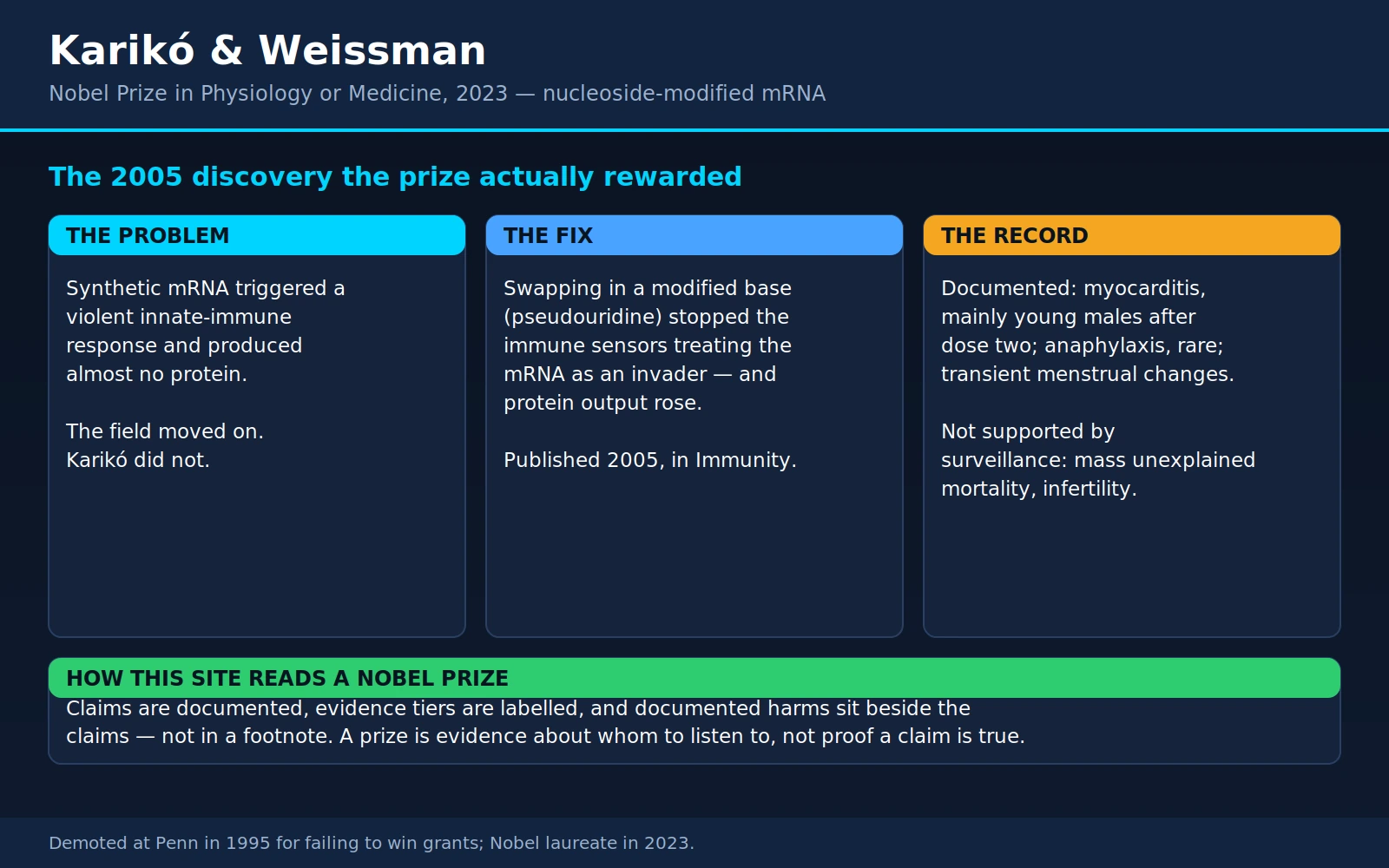
How this page works: it follows the same rules as our ivermectin-and-COVID record — every claim documented, every piece of evidence labeled by how strong it actually is, harms stated beside benefits, the strongest version of each side's argument given before it is weighed. Some of our readers received these vaccines and are glad; some refused and are glad; some believe they were harmed. This page is written to be honest with all three. Documenting a claim is not an endorsement of it — in either direction.
Table of Contents
- The Prize and the Two Scientists
- Why mRNA Was Considered a Dead End
- The 2005 Discovery: Pseudouridine
- From Lab Curiosity to Platform
- The 2020 Trials — What Held, What Didn't
- The Safety Record, Honestly
- The Mandates Are Not the Molecule
- Where the Critics Were Right — and Wrong
- Beyond COVID: The Real Pipeline
- What Karikó's Story Teaches
- Where Mainstream Medicine Agrees / What Remains Genuinely Debated
- Key Research Papers
- Connections
- Featured Videos
1. The Prize and the Two Scientists
On October 2, 2023, the Nobel Assembly at the Karolinska Institute awarded the Nobel Prize in Physiology or Medicine jointly to Katalin Karikó and Drew Weissman — in the committee's exact words, "for their discoveries concerning nucleoside base modifications that enabled the development of effective mRNA vaccines against COVID-19." Note what that citation actually rewards: not a vaccine, but a chemical discovery made in 2005, fifteen years before anyone had heard of SARS-CoV-2. That distinction matters throughout this page.
Katalin Karikó was born in 1955 in Szolnok, Hungary, and grew up in the small town of Kisújszállás in a one-room adobe house without running water. Her father was a butcher; she has said watching him work was her first biology lesson. She earned her PhD at the University of Szeged and worked at Hungary's Biological Research Centre until 1985, when the lab lost its funding and let her go. She, her husband Béla Francia, and their two-year-old daughter Susan left for America that year; Hungary's communist government restricted how much currency citizens could take abroad, so the family sold their car on the black market and sewed the proceeds — about $1,200 — inside Susan's teddy bear. It was everything they had.
At the University of Pennsylvania, where she landed in 1989, her conviction that messenger RNA could be turned into medicine met decades of rejection. Grant after grant was turned down. In 1995, Penn demoted her from the faculty track for failing to bring in funding — a demotion that arrived, as she later told the New York Times, in the same stretch of weeks as a cancer scare and with her husband stranded in Hungary by a visa problem. Most scientists would have changed fields or employers. She stayed, at a salary she has said never reached $60,000, and kept working on mRNA. (Persistence runs in the family: her daughter Susan Francia rowed in the American women's eight that won Olympic gold in 2008 and 2012.)
Drew Weissman, born in 1959 in Lexington, Massachusetts, is in most ways Karikó's temperamental opposite — a quiet, methodical physician-immunologist who avoids the spotlight. Diagnosed with type 1 diabetes at age five, he grew up understanding what it means to depend on a biomedical discovery every day of your life. He trained at Brandeis and Boston University, then spent his fellowship years at the NIH studying HIV in Anthony Fauci's laboratory before joining Penn in 1997 to hunt for an HIV vaccine.
The two met at a departmental photocopier shortly after Weissman arrived — in the late 1990s scientists still photocopied journal articles, and the two kept competing for the machine. Karikó made an offer: she could synthesize any mRNA he wanted. Weissman wanted an HIV vaccine. Neither got what they were looking for; what they got instead was the discovery that made mRNA medicine possible. By the time the Nobel came, Karikó had received the Lasker Award (2021) and the Breakthrough Prize (2022), and became the thirteenth woman ever to win the Medicine Nobel — twenty-eight years after the university sharing her stage had demoted her.
2. Why mRNA Was Considered a Dead End
The idea behind mRNA medicine is seductively simple. Messenger RNA is the cell's working copy of a gene — the instruction slip carried from the DNA archive to the protein factories. Inject a synthetic instruction slip, and the patient's own cells manufacture the therapeutic protein: no protein bioreactors, no viruses grown in eggs. In 1989, Robert Malone and colleagues showed mRNA packaged in fatty droplets could enter cells and be translated; in 1990, Jon Wolff's team showed even naked mRNA injected into mouse muscle produced protein. The concept worked.
The practice did not. Three problems buried the field for a generation:
- Synthetic mRNA triggered violent inflammation. The innate immune system — the body's ancient, hair-trigger first line of defense — treated lab-made mRNA as an invading virus. Animals given it developed inflammatory reactions; in some experiments mice became visibly sick. For a drug meant to be given to healthy people, this looked disqualifying.
- It made almost no protein. The same immune alarm that caused inflammation also shut down the cell's translation machinery, so the injected instructions were barely read before being destroyed. Tiny yield, big side effects — the worst possible ratio.
- Delivery was unsolved. mRNA is one of the most fragile molecules in biology; enzymes in blood shred it in minutes, and it cannot cross cell membranes on its own.
By the mid-1990s the field's verdict was in: DNA vaccines were the future; mRNA was a curiosity — too inflammatory, too unstable, too weak. Funding agencies agreed, which is why Karikó's grants kept failing and why her demotion looked, to her institution, like rational management. Note that the consensus was not stupid — synthetic mRNA genuinely was inflammatory and genuinely did underperform. It was wrong only in treating an unsolved problem as an unsolvable one. Her stubbornness was not a refusal to see the data; it was a refusal to accept that the data was the end of the story.
3. The 2005 Discovery: Pseudouridine
The breakthrough came from asking the question the field had stopped asking: why does the immune system attack synthetic mRNA when every cell in the body is full of its own mRNA and tolerates it completely? What is the difference between the mRNA a cell makes and the mRNA a machine makes?
Karikó and Weissman found the answer in a control experiment. When they exposed immune sentinel cells (dendritic cells) to different RNAs, transfer RNA — the small adapter that ferries amino acids — provoked almost no reaction, while their synthetic mRNA set off every alarm. The telling detail: tRNA is the most heavily chemically modified RNA in the cell. Natural RNA is not made of the four plain textbook bases; cells decorate it after synthesis with dozens of small alterations. One of the most common is pseudouridine (Ψ) — the same uridine base, rotated to connect to the sugar backbone through a carbon instead of a nitrogen. A tiny change, invisible to the protein-making machinery, visible to the immune system.
Their 2005 paper in Immunity showed that the innate immune system's pattern-recognition sensors — the Toll-like receptors (TLR3, TLR7, TLR8) that evolved to detect microbial RNA — are triggered by unmodified RNA and stand down when the RNA carries natural modifications like pseudouridine. Swap plain uridine for pseudouridine in synthetic mRNA and the molecule stops looking like a virus. The alarm goes quiet. And — as they showed in a follow-up paper in Molecular Therapy in 2008 — with the alarm quiet, the cell's translation machinery is no longer suppressed, so the modified mRNA produces far more protein while causing far less inflammation. Both halves of the field's death sentence on mRNA were reversed by the same single atom-level substitution.
The reception was a lesson in how science actually works. Karikó has recounted that Nature rejected the manuscript within 24 hours as incremental. After further rejections it appeared in Immunity — and was then largely ignored for years, cited only a handful of times. Two groups read it and understood. Stem-cell biologist Derrick Rossi used modified mRNA to reprogram cells in 2010 and co-founded a company named for the idea — Moderna, from "modified RNA." And Germany's cancer-vaccine company BioNTech licensed the work and in 2013 hired Karikó herself, after Penn declined to reinstate her and, in her telling, pushed her out of her lab space; colleagues mocked her move to a company that, she noted, did not even have a website. The COVID-19 vaccines from both companies carry a slight variant of the discovery — N1-methylpseudouridine — in every dose. This 2005 chemistry, not the 2020 emergency, is what the Nobel rewarded.
4. From Lab Curiosity to Platform
Modified mRNA solved the immunity problem but not delivery: the molecule still could not survive the bloodstream or enter cells on its own. That solution came from a different research lineage — lipid nanoparticles (LNPs), microscopic fat droplets of four components (an ionizable lipid that turns positively charged only in acidic environments, a PEG-lipid, cholesterol, and a structural phospholipid), grown out of decades of work by Pieter Cullis's Vancouver group and others on delivering gene-silencing RNA; the first LNP drug, patisiran, was approved in 2018. Wrap modified mRNA in an LNP and you have the full platform: an instruction slip the immune system tolerates, inside an envelope that delivers it into cells. Karikó and Weissman published the nucleoside-modified mRNA-LNP vaccine approach in the mid-2010s, and BioNTech and Moderna built their pipelines on that foundation.
Then came the demonstration of what a platform technology means. On January 10–11, 2020, Chinese and Australian scientists posted the genetic sequence of the new Wuhan coronavirus on the open internet. Because an mRNA vaccine is software — the "hardware" of modified mRNA plus LNP stays the same and only the encoded protein changes — Moderna finalized its vaccine design within about two days of the sequence appearing, before a single case had been confirmed in the United States. Sixty-six days later, on March 16, 2020, the first trial volunteer was dosed. BioNTech ran its own "Project Lightspeed" and partnered with Pfizer for trials and manufacturing. No previous vaccine technology had ever moved at a fraction of that speed.
Honesty requires stating that the vaccines were a stack of discoveries, not one: the base modification (Karikó and Weissman), the LNP delivery system (Cullis and many others), and the "2P" trick of locking the coronavirus spike protein in its prefusion shape — worked out for other coronaviruses years earlier by Barney Graham, Jason McLellan, Kizzmekia Corbett and colleagues — without which the vaccines would have shown the immune system a floppy, wrong-shaped target. Nobel prizes flatten teams into names; the record should not.
5. The 2020 Trials — What Held, What Didn't
The pivotal randomized trials were, by any standard, large, and their initial results striking. The Pfizer-BioNTech trial (Polack et al., NEJM) randomized 43,548 people: 8 symptomatic COVID cases in the vaccine arm versus 162 on placebo — 95.0% efficacy, with 9 of 10 severe cases in the placebo group. The Moderna trial (Baden et al., NEJM) randomized 30,420: 11 cases versus 185 — 94.1% efficacy, with all 30 severe cases on placebo. These are the numbers "95% effective" came from, and as randomized, placebo-controlled evidence against the strains circulating in 2020, they were real.
What happened afterward needs to be stated just as plainly, in both directions:
- Protection against infection and transmission did not last. As Delta and then Omicron arrived and months passed, effectiveness against catching and spreading the virus fell steeply. A large Qatari study (Chemaitelly et al., NEJM) found protection against infection peaked around 77% in the first month and fell to roughly 20% by months 5–7 — before Omicron pushed it lower still; a systematic review (Feikin et al., Lancet) measured an average drop of over 20 percentage points against symptomatic disease by six months. Early official statements that vaccinated people "do not carry the virus," that the virus would hit "a dead end," and the US president's July 2021 "you're not going to get COVID if you have these vaccinations" were wrong, and had to be walked back. Vaccinated people could and did become infected and transmit, especially from Delta onward.
- Protection against severe disease and death held up far better. The same Qatari data showed protection against severe, critical, or fatal COVID above 90% for six months; the Lancet review found effectiveness against severe disease declining only modestly where effectiveness against infection collapsed. Through the Delta and Omicron waves, unvaccinated adults — especially older adults — were hospitalized and died at substantially higher rates than vaccinated ones in surveillance from many countries. This is the claim that survived contact with reality.
- Boosters restored protection partially and temporarily — durably enough to matter for older and high-risk people, briefly and marginally enough in the young and healthy that reasonable regulators later diverged on recommending them (Section 6).
A fair summary of the efficacy record: the headline promise of stopping symptomatic infection proved temporary and variant-sensitive, while the protection that mattered most — against dying — proved substantial and durable, greatest in the oldest and sickest. Both the reader who feels misled by "95%" and the reader whose elderly parents came through the Delta wave vaccinated and alive are reading the same record.
6. The Safety Record, Honestly
These vaccines were given to billions of people, so the safety record is enormous in both senses: enormous reassurance on the catastrophic claims, and enough statistical power to detect real harms that 30,000–44,000-person trials could never see. Per site policy, each claim below is given in its strongest form, then labeled by what the evidence shows.
Documented harms — real, replicated, accepted by regulators
- Myocarditis and pericarditis (inflammation of the heart muscle and its lining), predominantly in males roughly 12–29, after the second dose, typically within a week of injection. US surveillance (Oster et al., JAMA) found rates around 71 cases per million second doses in 12–15-year-old boys and 106 per million in 16–17-year-old boys — far above background. The typical course was a short hospitalization with chest pain and elevated troponin, resolving with rest; deaths were rare. Context cuts both ways. On one side, COVID infection itself causes myocarditis, generally at higher rates than vaccination (Patone et al., Nature Medicine). On the other, in men under 40 the same group's Circulation follow-up found a second Moderna dose associated with more excess myocarditis than infection — roughly 97 versus 16 cases per million — which is why Sweden, Finland, Norway, Denmark and Iceland restricted Moderna in young people in October 2021. Genuinely unresolved: cardiac MRI abnormalities persist in a subset of affected patients at follow-up, of uncertain long-term significance — "mostly mild and resolving" is accurate; "proven harmless" is not. See our Myocarditis and Pericarditis pages.
- Anaphylaxis — severe allergic reaction, on the order of a few cases per million doses (early estimates ran around 11 per million and settled lower), occurring within minutes — the reason for the 15–30-minute observation period. Real, rare, manageable where epinephrine is on hand.
- Menstrual-cycle changes — documented, and initially wrongly dismissed. A prospective cycle-tracking cohort (Edelman et al., Obstetrics & Gynecology) confirmed an average cycle lengthening of under one day, larger in women who got two doses within a single cycle, resolving within a cycle or two. The harm was transient; the early official reflex to wave off tens of thousands of women's reports as having "no plausible mechanism" was a self-inflicted credibility wound.
- For clarity of the record: the blood-clotting syndrome (thrombosis with thrombocytopenia) and Guillain-Barré signals belonged to the adenovirus-vector vaccines (AstraZeneca, J&J), not the mRNA products. These harms are often attributed to "the COVID vaccines" as one category; the platforms differ, and the signals did too.
Claims large surveillance did not support
- Mass unexplained deaths ("died suddenly"). The strongest version: vaccination caused a wave of excess mortality visible in national statistics. It has failed every careful audit. Record-linkage studies across multiple countries found no excess non-COVID mortality among mRNA vaccinees (all-cause mortality was, if anything, lower — partly a healthy-vaccinee artifact, so the honest conclusion is "no signal," not "proof of benefit"); excess-death curves track COVID waves in time, appear in 2020 before any vaccine existed, and were steepest where vaccination was lowest. Individual deaths after vaccination exist and some myocarditis deaths are documented — but a hidden mortality wave of the claimed scale would be unmissable in actuarial data, and it is not there.
- Fertility destruction. Prospective studies of couples trying to conceive found no reduction in conception rates for vaccinated women or men; sperm-parameter studies found no post-vaccination decline; miscarriage rates in large registries were not elevated. (The same cohort work tied SARS-CoV-2 infection in men to a short-term fertility dip — the claim's opposite.)
- "Shedding." The mRNA vaccines contain no virus and cannot replicate; there is no mechanism and no documented instance of a vaccinated person transmitting spike protein or vaccine material to others. This claim is simply false.
- "It rewrites your DNA." mRNA does not enter the cell nucleus, and human cells lack the machinery to copy it into the genome. Critics cite one 2022 in-vitro study in which a liver-cancer cell line showed reverse-transcription signals when flooded with vaccine — a real paper, and also a petri-dish observation in a cancer cell line, with no demonstrated genomic integration in any vaccinated human. Persistence is a separate, real nuance: early messaging said the mRNA disappears within days, while later work found vaccine mRNA and spike protein detectable in lymph-node germinal centers for up to about 60 days — longer than advertised, without evidence of harm from the persistence itself.
Still argued in good faith
- Benefit versus risk of later boosters, by age and sex. Not a conspiracy theory — a live disagreement among regulators reading the same data. For a healthy 20-year-old male, the absolute risk of severe COVID by 2022–2023 was very small, the myocarditis risk after mRNA doses is concentrated in exactly that group, and the infection-blocking benefit of an extra dose is brief. Denmark stopped offering routine vaccination to healthy under-50s in autumn 2022; the UK, Norway and Sweden narrowed booster eligibility; the WHO's advisory group re-classified healthy children and adolescents as "low priority" in 2023; and in 2025 the US moved to restrict routine boosters to older adults and those with risk factors — a change supporters called overdue alignment with Europe and critics called removal of choice. Document it as what it is: real regulatory divergence on a genuinely close call.
- Repeat-dose immunology. A documented shift toward IgG4 antibody responses after the third mRNA dose is real and its clinical significance — harmful tolerance, harmless adaptation, or nothing — is unknown. Related debates about "immune imprinting" (early exposures shaping later responses) are active in the mainstream literature, not fringe.
- Residual DNA fragments in vials. Independent labs reported plasmid-DNA fragments, including an SV40 promoter sequence, in some Pfizer vials; regulators (FDA, EMA, Health Canada) acknowledged the fragments' presence, stated the quantities fall within long-standing limits by their measurement methods, and found no evidence of harm; critics dispute the measurement methodology. Unresolved as a quality-control argument; no demonstrated clinical harm as of this writing.
7. The Mandates Are Not the Molecule
The Nobel Prize honored a piece of chemistry. Vaccine mandates — employment requirements, travel passes, school rules — were policy decisions made by governments and employers, and no molecule can be blamed or credited for them. This site's readers hold strong views here, and the two things this page most wants to keep separate are the science and the coercion.
The honest case against the mandates: their peak enforcement came in late 2021 and 2022, precisely as waning infection-blocking eroded the strongest rationale — "your vaccination protects others"; they largely refused to recognize recovered patients' natural immunity, which the same journals publishing the trials had documented as substantial; they applied uniform requirements to young healthy men, in whom the risk-benefit calculus was closest and the myocarditis signal concentrated; and people lost jobs over a dose that, within a year, several national regulators would stop even recommending for their age group. For many readers the mandates turned a medical option into a loyalty test, and the resulting resentment is rational, documented, and still depressing confidence — including in routine childhood vaccines that have nothing to do with mRNA.
The honest case for the institutions: those decisions were made in a mass-casualty emergency, by officials watching hospitals overflow, on the information available at the time — which in early-to-mid 2021 genuinely showed large reductions in infection and transmission against the then-circulating strains; mandates measurably raised uptake in the groups at highest risk of dying; and waiting for complete data is itself a decision with a body count when ICUs are full.
Where that leaves this page: a reader can hold the 2005 discovery as brilliant, the 2020 trials as real, the myocarditis signal as real, and the mandates as overreach — without contradiction. The molecule and the mandate must be judged separately. The failure to keep them separate — officials treating doubts about policy as doubts about chemistry, critics treating objections to coercion as proof the chemistry was fake — damaged trust in both directions.
8. Where the Critics Were Right — and Wrong
Mirroring our ivermectin scorecard, here is the ledger for both camps, stated without flinching in either direction.
What the institutions got right
- The vaccines' protection against severe disease and death in high-risk groups was real, large, and repeatedly confirmed across countries and study designs — the central claim held.
- The development-and-trial speed did not come from skipped safety steps in the trials themselves: the phase 3 trials were among the largest in vaccine history and their headline results were independently replicated by post-rollout data.
- The surveillance systems critics called window dressing actually worked: the myocarditis signal was detected by Israeli health authorities and US military and VAERS-based monitoring within months and publicly confirmed by June 2021.
What the institutions got wrong
- Overpromising on transmission — "you can't get it," "dead end for the virus" — claims the trials had never tested and the variants demolished. This handed critics a legitimate grievance that outlasted the pandemic.
- Dismissing menstrual-change reports for months before the data vindicated the reporters.
- Minimizing natural immunity long after the evidence for it was strong, with mandate policies that ignored it entirely.
- Treating close calls as settled ones: presenting booster recommendations for healthy young men as beyond debate while European regulators were narrowing them on the same evidence.
- Heavy-handed moderation of dissent — including of scientists arguing positions (focused protection, lab-origin plausibility, myocarditis concern) that were debatable rather than debunked — which converted scientific disagreements into censorship stories and made every later official claim harder to believe.
What the critics got right
- Myocarditis in young males was real, dose-related, and concentrated after dose two — the people raising it in spring 2021 were ahead of the official acknowledgment.
- Menstrual changes were real; the reporting women were right and the initial dismissals were wrong.
- Waning was real: the "95%" framing did not survive, and skeptics who predicted breakthrough infections at scale were correct.
- The risk-benefit question for boosters in the young and healthy was legitimate — multiple governments eventually adopted, in substance, the narrowing critics had demanded.
- Mandates on the previously infected had a weak evidentiary basis, as later recognition of infection-derived immunity confirmed.
What the critics got wrong
- "Died suddenly" mass-mortality claims failed every audit of actuarial and record-linkage data (Section 6); the tallies circulated rest on treating raw VAERS reports — which anyone can file and which record events, not causes — as verified vaccine deaths.
- Infertility predictions were falsified by prospective conception data.
- "Shedding," graphene oxide, microchips, magnetism, and self-assembling structures: no mechanism, no evidence, flatly false — and their circulation alongside the legitimate criticisms made the legitimate ones easier for officials to dismiss, a cost borne by the honest critics.
- "It changes your DNA" as a claim about vaccinated humans has no supporting evidence (the in-vitro cancer-cell-line paper is the closest thing, and it does not show it).
- The "depopulation" framing is irreconcilable with the observed mortality record, in which the excess deaths clustered among the unvaccinated during the Delta wave.
The pattern, as on our ivermectin page, is symmetrical: each camp was most reliable exactly where it claimed the other could not be trusted, and least reliable where its own identity was at stake. The institutions were right about the molecule and wrong about their own certainty; the critics were right about several harms and wrong about the catastrophe.
9. Beyond COVID: The Real Pipeline
Whether mRNA medicine is a one-pandemic wonder or a durable platform is being decided now, in trials. The honest status report, with evidence tiers stated:
- Melanoma — the strongest result so far (randomized phase 2b). In KEYNOTE-942 (Weber et al., Lancet 2024), patients with resected high-risk melanoma received a personalized mRNA cancer vaccine (mRNA-4157/V940, encoding up to 34 mutations from the patient's own tumor) plus the checkpoint drug pembrolizumab, versus pembrolizumab alone: 18-month recurrence-free survival 78.6% versus 62.2% — roughly a 44% cut in risk of recurrence or death. Genuinely exciting; also genuinely a 157-patient phase 2b, with the decisive phase 3 still running and no approval yet. (Background: Melanoma; the checkpoint half of the combination is the story of our Allison & Honjo page.)
- RSV — the platform's first non-COVID approval. Moderna's RSV vaccine (mRNA-1345, mResvia) was FDA-approved in May 2024 for adults 60 and over, on roughly 84% initial efficacy against RSV lower-respiratory disease. Honest footnote: its protection appeared to wane faster over subsequent seasons than the competing protein-based RSV vaccines — the platform's speed advantage does not automatically confer a durability advantage.
- CMV — the platform's first big phase 3 miss. Moderna's cytomegalovirus vaccine, the lead non-COVID infectious-disease program for years, reported in January 2025 that its phase 3 trial fell well short of its efficacy target. A real failure, worth stating as plainly as the successes.
- Influenza — phase 3, mixed-to-promising. mRNA flu candidates have shown strong immune responses against influenza A strains and initially weaker responses against influenza B, since reformulated; the pitch — updating strains in weeks instead of the six months egg-based production needs — remains plausible and unproven at the approval line.
- Early-stage (phase 1) — promising signals, no efficacy evidence yet: malaria (BioNTech), HIV (germline-targeting immunogens produced the intended rare antibody-precursor responses — a genuine step, far from a vaccine, and one trial logged an unexpectedly high rate of hives-type skin reactions), tuberculosis, Zika, Epstein-Barr virus, and personalized pancreatic-cancer vaccines, where a small uncontrolled study found patients who mounted immune responses recurred later than those who did not — hypothesis-generating, not proof.
- Therapeutics beyond vaccines: mRNA-encoded protein replacement (e.g., for propionic acidemia) and in-vivo CAR-T engineering are in early trials — the more radical long-term use of the chemistry, entirely unproven in outcomes.
Two forces now pull on this pipeline from opposite directions: oncology results strong enough to attract enormous investment, and a political turn — including the 2025 cancellation of roughly half a billion dollars of US federal mRNA vaccine-development funding — celebrated by the platform's critics as accountability, condemned by its developers as retribution. The trials will outlast both readings.
10. What Karikó's Story Teaches
Strip away the pandemic and the politics, and what remains is one of the cleanest persistence stories in science. A scientist is told for decades, by every gatekeeping mechanism her profession has — grant committees, tenure committees, journal editors — that her idea is a dead end. She is demoted for it in 1995. She is, by her own account, pushed out of her lab and toward retirement in 2013. She joins a foreign startup without a website. And the idea she refused to abandon becomes the fastest-deployed vaccine technology in history, while the institution that demoted her earns hundreds of millions licensing her patents and then celebrates her Nobel as its own. Karikó has been notably unbitter about it, crediting the stress research of fellow Hungarian Hans Selye for her habit of focusing only on what she could control — the next experiment — not the verdicts of committees.
The uncomfortable lesson is about the credit-and-funding system rather than about her. Peer review and grant scoring are consensus machines: superb at filtering out most bad ideas, structurally blind to the rare unfashionable idea that is right, because reviewers are drawn from the consensus the idea contradicts. Nature's reported 24-hour rejection of the 2005 paper as "incremental" belongs in the same museum as the rejections that greeted Tu Youyou's artemisinin work and Barry Marshall's ulcer bacterium. The system also flattens credit: the Nobel names two people for a stack of discoveries that also required the LNP chemists and the spike-stabilization biologists (Section 4) — and one early contributor, Robert Malone, whose 1989 transfection experiments are part of the documented pre-history and who later became one of the vaccines' most prominent critics, publicly contends his role was erased. Readers will judge that dispute themselves; his early work and the Nobel committee's chosen citation — which honors the base-modification discovery specifically — are both part of this record.
And there is a symmetry worth naming on a site like this one: the same lesson — consensus can be wrong, and the record must stay open to the stubborn dissenter with data — is claimed today by critics of these very vaccines. The lesson is real, and Karikó's career teaches its second half too: she won not by insisting louder but by producing controlled experiments that survived every attempt to knock them down. That standard applies to everyone in this story — institutions and critics alike.
11. Where Mainstream Medicine Agrees / What Remains Genuinely Debated
Where mainstream medicine agrees
- The 2005 nucleoside-modification discovery is real, replicated, and foundational — the Nobel was uncontroversial within science.
- The 2020 randomized trials showed ~94–95% efficacy against symptomatic COVID from the strains then circulating, and protection against severe disease and death proved substantial and more durable than protection against infection.
- Protection against infection and transmission waned significantly with time and variants; early official claims to the contrary were wrong.
- Myocarditis/pericarditis after mRNA vaccination is a real, causally accepted harm concentrated in young males after dose two — usually short-course and resolving, with follow-up of MRI findings ongoing.
- Anaphylaxis (rare) and transient menstrual-cycle changes are documented harms; fertility harm, DNA alteration in humans, "shedding," and vaccine-driven mass mortality are not supported by the evidence.
- The platform is medically real beyond COVID: one approved RSV vaccine, one strongly positive randomized melanoma result, one failed CMV phase 3, everything else early.
What remains genuinely debated
- Booster benefit-risk for healthy young people, especially young males — the question on which national regulators visibly diverged and still do.
- Long-term significance of post-myocarditis cardiac MRI abnormalities in the affected subset.
- IgG4 class-switching and immune imprinting after repeated doses — documented phenomena, unknown clinical meaning.
- Residual DNA-fragment content in some vials — a live measurement-methodology dispute with no demonstrated clinical harm.
- How much transmission early vaccination actually blocked in the pre-Delta window, and how much of the 2021–2022 policy edifice that estimate could legitimately support.
- How to apportion the measured post-2021 decline in general vaccine confidence between institutional overreach and misinformation — the trust question underneath everything else on this page.
12. Key Research Papers
- Karikó K, Buckstein M, Ni H, Weissman D. Suppression of RNA recognition by Toll-like receptors: the impact of nucleoside modification and the evolutionary origin of RNA. Immunity 2005;23(2):165-75
- Karikó K, Muramatsu H, Welsh FA, et al. Incorporation of pseudouridine into mRNA yields superior nonimmunogenic vector with increased translational capacity and biological stability. Mol Ther 2008;16(11):1833-40
- Pardi N, Hogan MJ, Porter FW, Weissman D. mRNA vaccines — a new era in vaccinology. Nat Rev Drug Discov 2018;17(4):261-279
- Polack FP, Thomas SJ, Kitchin N, et al. Safety and Efficacy of the BNT162b2 mRNA Covid-19 Vaccine. N Engl J Med 2020;383(27):2603-2615
- Baden LR, El Sahly HM, Essink B, et al. Efficacy and Safety of the mRNA-1273 SARS-CoV-2 Vaccine. N Engl J Med 2021;384(5):403-416
- Oster ME, Shay DK, Su JR, et al. Myocarditis Cases Reported After mRNA-Based COVID-19 Vaccination in the US From December 2020 to August 2021. JAMA 2022;327(4):331-340
- Patone M, Mei XW, Handunnetthi L, et al. Risks of myocarditis, pericarditis, and cardiac arrhythmias associated with COVID-19 vaccination or SARS-CoV-2 infection. Nat Med 2022;28(2):410-422
- Edelman A, Boniface ER, Benhar E, et al. Association Between Menstrual Cycle Length and Coronavirus Disease 2019 (COVID-19) Vaccination: A U.S. Cohort. Obstet Gynecol 2022;139(4):481-489
- Chemaitelly H, Tang P, Hasan MR, et al. Waning of BNT162b2 Vaccine Protection against SARS-CoV-2 Infection in Qatar. N Engl J Med 2021;385(24):e83
- Feikin DR, Higdon MM, Abu-Raddad LJ, et al. Duration of effectiveness of vaccines against SARS-CoV-2 infection and COVID-19 disease: results of a systematic review and meta-regression. Lancet 2022;399(10328):924-944
- Weber JS, Carlino MS, Khattak A, et al. Individualised neoantigen therapy mRNA-4157 (V940) plus pembrolizumab versus pembrolizumab monotherapy in resected melanoma (KEYNOTE-942): a randomised, phase 2b study. Lancet 2024;403(10427):632-644
Live PubMed Searches
- Nucleoside-modified mRNA vaccines
- mRNA vaccine myocarditis surveillance
- COVID vaccine effectiveness waning
- mRNA cancer vaccine trials
- Lipid nanoparticle mRNA delivery
Connections
- All Notable Doctors
- Nobel Prize in Medicine — every laureate documented on this site, and how the prize itself works
- Emil von Behring — vaccination's first Nobel (1901): serum therapy against diphtheria, and its own honest record
- Ivermectin & COVID: The Honest Record — this page's companion: the same discipline applied to the other side of the COVID treatment wars
- James Allison & Tasuku Honjo — checkpoint immunotherapy, the other immune-system revolution, and the partner drug in the melanoma mRNA trial
- Bryan Ardis — the site's documentation of COVID-era counter-narratives
- Vaccine Injury Recovery Claims — the recovery protocol claims this site documents
- Immunology — the immune-system background: the innate sensors and antibody responses this whole story turns on
- Myocarditis — the condition at the center of the mRNA safety record: causes, course, and recovery
- Pericarditis — the companion signal: inflammation of the heart's lining
- Melanoma — the cancer where the mRNA platform's post-COVID results are strongest so far
- Tu Youyou — another rejected-then-vindicated Nobel story: decades ignored, then artemisinin