Gerhard Domagk: Prontosil, the Sulfa Drugs, and the Nobel He Was Forced to Refuse
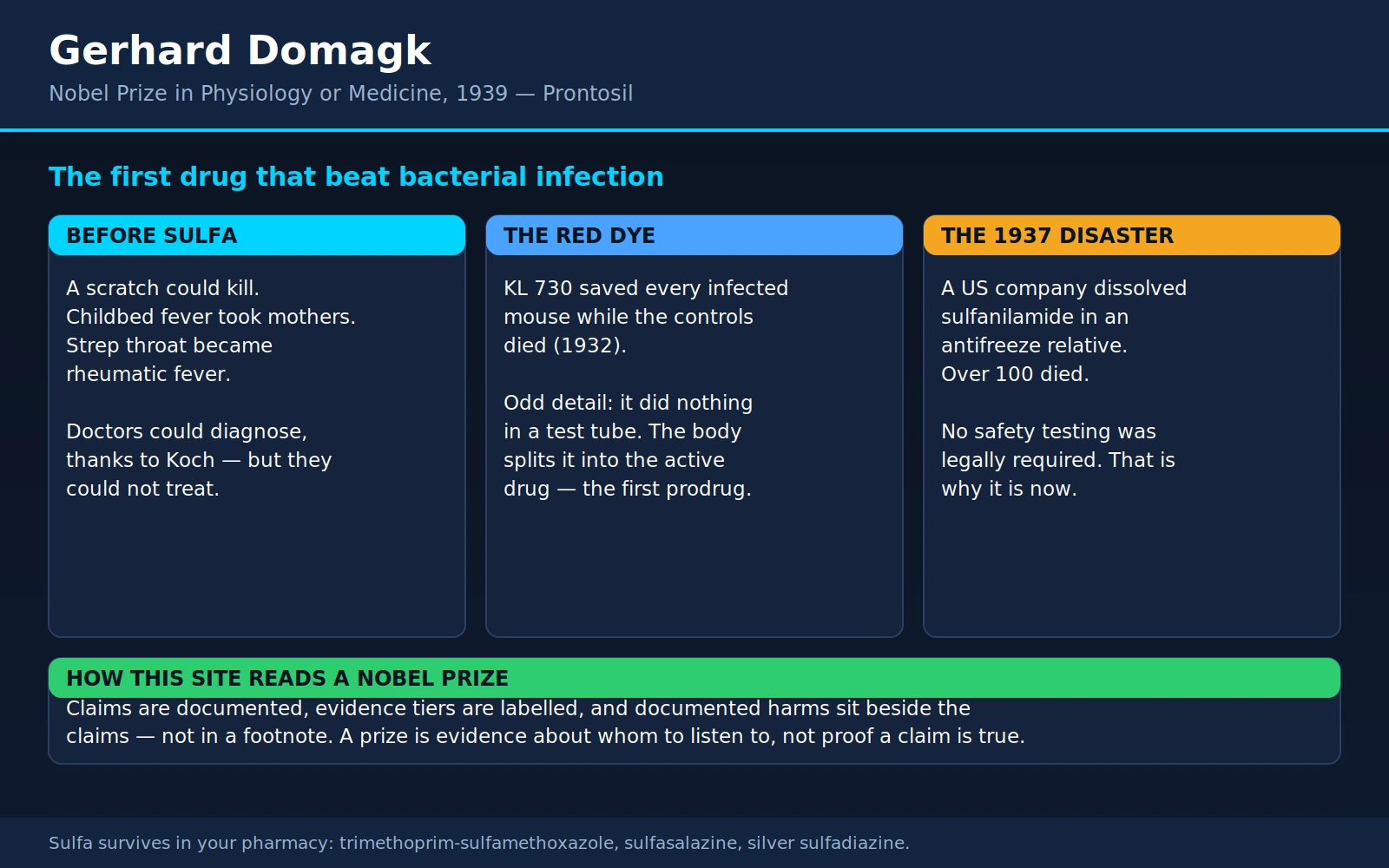
Table of Contents
- Who Gerhard Domagk Was
- The World Before Sulfa
- The Ehrlich Playbook, Industrialized
- KL 730: The Red Dye That Should Not Have Worked
- Hildegard
- The French Twist: It Was Never the Dye
- The Sulfa Craze and Its Casualties
- The Nobel and the Gestapo
- After Sulfa — and Where Sulfa Lives in Your Pharmacy Today
- Where Mainstream Medicine Agrees / What the Record Complicates
- Key Research Papers
- Connections
- Featured Videos
1. Who Gerhard Domagk Was
Gerhard Domagk (1895–1964) was a German pathologist who found the first medicine in human history that could reliably beat a bacterial infection already spreading inside the body. Before his red dye, a doctor facing blood poisoning could clean the wound, drain the abscess, and wait. After it, the doctor could treat. Nearly every antibiotic prescription written today — and the entire idea of screening thousands of chemicals to find a drug — runs downstream of what happened in his laboratory between 1927 and 1932.
He was born on October 30, 1895, in Lagow, a small town in Brandenburg (today Łagów, Poland), the son of a schoolteacher. He had barely started medical school at Kiel when the First World War began, and like tens of thousands of German students he volunteered. He was eighteen; he turned nineteen in the trenches. In December 1914 his unit was thrown into the slaughter around Ypres in Flanders, where the student regiments were cut down in ranks — most of the friends he enlisted with did not survive the war's first winter. Domagk was wounded, and after recovering he was transferred to the medical corps, serving in field hospitals on the Eastern Front, including cholera wards in Russia.
What he saw there set the course of his life. The surgeons around him could set bones and close wounds with real skill — and then watch, helpless, as men who had survived shellfire died over days from wound infections: gas gangrene, streptococcal sepsis, infections no medicine on Earth could touch. Domagk said later that he swore an oath to himself in those wards to find an answer. It is worth taking that seriously rather than treating it as biography-polish: he then spent thirteen unglamorous years doing exactly that.
After the war he finished his medical degree at Kiel (1921), trained as a pathologist, and worked at the universities of Greifswald and Münster, studying how the body's own defenses — the reticuloendothelial system, the cells that swallow bacteria — fight infection. In 1927 the Bayer laboratories at Elberfeld (by then part of the giant IG Farben chemical conglomerate) hired him to direct a new institute of experimental pathology and bacteriology, with one standing assignment: find a chemical that kills bacteria inside a living body. He kept his academic post at Münster, but the hunt itself now had industrial money, industrial chemists, and industrial patience behind it.
2. The World Before Sulfa
To feel why this story mattered, you have to recover a world most living people have never experienced: a world where a scratch could kill you, and everyone knew someone it had killed.
In 1924 the son of a sitting American president — sixteen-year-old Calvin Coolidge Jr. — got a blister playing tennis on the White House lawn. The blister let in Staphylococcus aureus; the infection reached his blood; and the best physicians in America could do nothing but watch him die, seven days later, with the full resources of the White House behind them. That was not medical failure. That was medicine, in 1924, at its best.
The routine tolls were worse than the famous ones. Childbed fever (puerperal fever) — a streptococcal infection of the womb after delivery — killed thousands of new mothers every year in every industrialized country, striking within days of a normal birth. An ordinary strep throat could smolder into rheumatic fever and wreck a child's heart valves for life. Erysipelas, a painful spreading skin infection with a fiery raised edge, filled hospital wards. Scarlet fever closed schools. Wound sepsis turned minor farm and kitchen injuries into amputations and funerals. Nearly all of it traced to one organism above the rest: Streptococcus pyogenes, the hemolytic strep.
The cruelest part was that medicine could now name the killer but not stop it. Robert Koch and his school had proven which germ caused which disease; laboratories could culture the strep from a dying mother's blood and tell the family precisely what was killing her. Emil von Behring's antitoxin serums worked against diphtheria and tetanus — but serum therapy was expensive, risky, and useless against most bacteria. And Paul Ehrlich's celebrated “magic bullet,” Salvarsan, worked against exactly one disease, syphilis. By the late 1920s many senior scientists had concluded the whole magic-bullet idea was a dead end: bacteria and human cells were too alike, they argued, for any chemical to kill one and spare the other. Domagk's employers were betting money that the consensus was wrong.
3. The Ehrlich Playbook, Industrialized
Ehrlich had found Salvarsan by testing arsenic compound number 606 after 605 failures — brute-force screening, done by hand, by a small academic team. What Bayer built at Elberfeld was that playbook turned into a machine.
On one side sat two gifted synthetic chemists, Fritz Mietzsch and Josef Klarer, cranking out variation after variation of azo dyes — the nitrogen-linked dye molecules that were IG Farben's home territory, the chemistry the company knew better than anyone alive. The dye idea was not arbitrary: dyes visibly bind to things (that is what makes them dyes), some dyes were known to bind bacteria, and Ehrlich himself had started as a dye chemist. On the other side sat Domagk with a brutally standardized test: mice injected with a strain of hemolytic streptococcus so virulent that untreated animals died, essentially without exception, within days. Every new compound went into infected mice. Almost every compound failed. The chemists made hundreds; Domagk tested them for five years; nothing worked well enough to matter.
Notice the shape of this method, because it became the template for twentieth-century drug discovery: a reliable animal model of the disease, plus a firehose of candidate chemicals, plus the stubbornness to run the test thousands of times. It is the same shape as Selman Waksman pointing a screening program at soil microbes and pulling out streptomycin, and Satoshi Ōmura bagging soil near a Japanese golf course and finding the microbe behind ivermectin. None of these discoveries was a lightning bolt. All of them were conveyor belts, run by people who refused to stop.
A detail that mattered enormously, and was Domagk's own methodological conviction: he insisted on testing compounds in living animals, not just in test-tube cultures. A compound that killed bacteria in glass but not in a body was useless; more importantly — and nobody yet knew how importantly — a compound might work in a body while doing nothing at all in glass. Had Elberfeld screened in test tubes first, as common sense suggested, they would have thrown the winner away.
4. KL 730: The Red Dye That Should Not Have Worked
In the autumn of 1932, Klarer tried something chemists had done before for other purposes: he attached a sulfonamide side group — a sulfur-nitrogen appendage well known in dye chemistry for making colors bind fast to wool — onto one of the failing azo dyes. The result was a brick-red compound logged as KL 730, later patented and sold under the name Prontosil.
In Domagk's mouse room in December 1932, KL 730 did what no substance in recorded history had done. In the decisive experiment, every infected, untreated control mouse died on schedule — and every mouse given the red dye lived. Domagk's laboratory protocol recording the result is dated to the last days of December 1932; people who retell this story like to note that the mice that would change medicine were alive in their cages at Christmas. Bayer filed for a patent that same week.
Two strange facts then shaped everything that followed.
First, the public heard nothing for over two years. Domagk's paper — Ein Beitrag zur Chemotherapie der bakteriellen Infektionen, a masterpiece of understatement — did not appear in Deutsche Medizinische Wochenschrift until February 15, 1935. In the gap, German clinicians quietly tried Prontosil in desperate human cases (the first published report, in 1933, described a ten-month-old boy dying of staphylococcal blood poisoning who recovered), and the patent position was consolidated. Why the delay? Domagk's defenders say he wanted human evidence before making an unbelievable claim; skeptics have always suspected the patent lawyers' calendar mattered more than the scientific one. The honest answer is that both pressures existed, the archives support both readings, and the delay remains one of the genuinely debated points of the story — we come back to it in section 10.
Second — the fact everyone underestimated — Prontosil did nothing in a test tube. Pour it into a dish of thriving streptococci and the bacteria ignored it. It killed strep only inside a living body. At Elberfeld this was treated as a curiosity, perhaps evidence that the drug worked by rousing the body's own defenses. It was actually a loaded clue, and the people who picked it up were not in Germany.
5. Hildegard
In December 1935, Domagk's six-year-old daughter Hildegard fell on the stairs at home while carrying a sewing needle. The needle drove into her hand and broke. A surgeon removed the fragment, and the puncture did what punctures did in 1935: it became a severe streptococcal infection that climbed her arm. She was operated on repeatedly as the infection advanced; she grew septic and delirious; and her surgeons reached the standard last resort of the pre-antibiotic era — amputation of the arm was on the table, and even that often failed to stop a strep already in the blood.
Her father was, at that moment, one of the only people on Earth who possessed something that had cured streptococcal infection in mice and in a handful of published human cases — and it was still an experimental compound, not an approved medicine. As his own records and his biographers document, Domagk took Prontosil from the laboratory and gave his daughter large doses. Her fever broke. The infection retreated. Hildegard recovered, arm intact.
Domagk did not include his daughter's case in his publications — a father dosing his own child is testimony, not evidence, and he knew it. The story is told here because it is documented and because it compresses the era into a single household: the world's leading expert on antibacterial chemotherapy, watching his child face amputation over a sewing needle, with the cure sitting in a jar at his workplace and no body of human trials to tell him the dose. Within five years, needle-stick infections like Hildegard's would be a pharmacy errand. That is the size of what changed.
6. The French Twist: It Was Never the Dye
Once the 1935 paper appeared, laboratories everywhere jumped on the red dye — none more consequentially than a team at the Pasteur Institute in Paris: Jacques and Thérèse Tréfouël, Federico Nitti, and Daniel Bovet, working under Ernest Fourneau. They took the test-tube paradox seriously. If Prontosil killed strep in a body but not in glass, they reasoned, perhaps the body was changing the drug — perhaps the azo bond holding the molecule together was being snapped by the body's own chemistry, releasing a fragment that was the true killer.
Late in 1935 they proved it. The body cleaves Prontosil in two, and the active half is sulfanilamide — a small, plain, colorless molecule. The majestic red dye was a delivery vehicle; the dye part was baggage. Modern pharmacology has a name for what Prontosil turned out to be: a prodrug, an inactive compound the body converts into the real medicine. Prontosil was the first famous one, and the test-tube paradox dissolved instantly — a dish of bacteria has no liver enzymes, so in glass the trigger was never pulled.
The commercial consequence was seismic. Sulfanilamide had been synthesized in 1908 by a Viennese chemistry student named Paul Gelmo, for dye work, with no idea it touched bacteria. Any patent on it had expired decades before. Bayer's carefully constructed position around the red dye was suddenly worth very little: any company, anywhere, could manufacture the colorless active drug for pennies. Within two years dozens of firms in dozens of countries were doing exactly that, under dozens of names. For Bayer's ledgers this was a disaster; for the world's patients it was a miracle of pricing — the first true antibacterial drug arrived cheap, and nobody could corner it.
How does sulfanilamide actually work? It is a molecular impostor. It closely resembles PABA (para-aminobenzoic acid), a building block bacteria must use to manufacture their own folate — the same folate family you know as a B vitamin. Bacteria grab the impostor, their folate assembly line jams, and they stop multiplying, giving the immune system time to win. Human cells are untouched by this trick for a beautifully simple reason: we don't make folate at all — we eat it. A pathway bacteria have and humans lack is the cleanest kind of drug target, and sulfa found it first.
7. The Sulfa Craze and Its Casualties
What followed was the fastest transformation in the history of medicine to that point.
In London, Leonard Colebrook at Queen Charlotte's maternity hospital — a man who had spent his career losing mothers to childbed fever — gave Prontosil to women with established puerperal streptococcal infection and published the results in 1936. In his treated series, deaths fell from roughly one mother in four or five to fewer than one in twenty. Numbers like that, in that disease, had never been seen. National maternal mortality curves in England and Wales, flat for a century, bent downward from the late 1930s and never came back up. The disease that had killed mothers since before Semmelweis begged doctors to wash their hands was, quite suddenly, treatable.
America's conversion came with a celebrity patient. In December 1936, Franklin D. Roosevelt Jr., the president's son, lay seriously ill in Boston with a streptococcal throat infection spreading into his sinuses — precisely the kind of “strep gone wrong” that killed young people routinely. His physician treated him with sulfanilamide (sold as Prontylin), and his rapid recovery ran on the front page of the New York Times: “Young Roosevelt Saved by New Drug.” Demand exploded. Sulfa entered common speech, dinner-table conversation, and — because the law of 1936 permitted it — essentially unregulated mass manufacture.
Then came the disaster that taught the modern world what drug regulation is for. In 1937 the S.E. Massengill Company of Bristol, Tennessee, decided to sell sulfanilamide as a sweet liquid for children and patients who couldn't swallow tablets. Sulfanilamide dissolves poorly, so the company's chief chemist dissolved it in diethylene glycol — a sweetish industrial solvent chemically related to antifreeze, and a deadly kidney poison. The raspberry-flavored “Elixir Sulfanilamide” was taste-tested for flavor and shipped across the country. It was never tested for safety, because no law required any safety testing whatsoever before selling a drug in the United States. More than one hundred people died — a great many of them children being treated for sore throats — over days of agonizing kidney failure. When federal agents scrambled to seize the remaining bottles, the only charge available was mislabeling: an “elixir” legally implied alcohol, and this poison contained none. Had it been called a “solution,” the government would have had no case at all. The company paid a fine and insisted it had broken no law — which was, damningly, true. Its chemist took his own life before trial.
Public fury drove Congress to pass the Food, Drug, and Cosmetic Act of 1938: for the first time anywhere, a manufacturer had to prove a drug safe before selling it. (Proof of effectiveness came later, in 1962, after thalidomide.) Readers of this site should sit with this story for a moment, because it cuts both ways and honesty requires saying so. This law is the origin of the modern regulatory divide: drugs must clear premarket safety and efficacy gates precisely because of graves filled in 1937, while supplements live under a separate, far lighter framework (DSHEA, 1994) that assumes safety unless proven otherwise. Whatever you think of how those lines are drawn today — and there are fair criticisms in both directions — the “prove it before you sell it” principle was not invented by bureaucrats to obstruct healing. It was written in response to a raspberry-flavored bottle that killed children because no one had to check.
8. The Nobel and the Gestapo
In late October 1939 — weeks after Germany invaded Poland — the Karolinska Institute announced that the Nobel Prize in Physiology or Medicine for 1939 went to Gerhard Domagk, “for the discovery of the antibacterial effects of Prontosil.”
There was a problem, and it had nothing to do with medicine. In 1935 the Nobel Peace Prize had been awarded to Carl von Ossietzky, a German pacifist journalist then held in a concentration camp. Hitler's rage at that award produced a 1937 decree forbidding any German citizen from accepting any Nobel Prize, ever. Domagk, a pathologist who had spent his life on infection rather than politics, now held the most dangerous honor in the Reich.
He did something almost painfully modest: he wrote a courteous letter to the Karolinska Institute, thanking the committee for the honor and noting that he would need to consult his government about accepting. For this — for politely thanking a scientific committee — the Gestapo arrested him. He was taken from his home in front of his family and held for a week; after his release he was compelled to sign a prepared letter formally refusing the prize. It is one of history's purer illustrations of a regime's priorities: the man who had just handed humanity its first cure for bacterial infection, jailed over a thank-you note.
The story has a quiet, decent ending. In 1947, with the war over, Domagk traveled to Stockholm, delivered the Nobel lecture he had been forbidden to give, and received his gold medal and diploma. The prize money, under the Nobel Foundation's statutes, had long since reverted to the funds — he never received it. By every account he bore all of it, the arrest and the lost fortune alike, with the same undemonstrative steadiness he brought to his mouse protocols.
9. After Sulfa — and Where Sulfa Lives in Your Pharmacy Today
Sulfa drugs owned medicine for barely a decade — and what a decade. Soldiers on both sides of the Second World War carried sulfa powder in their first-aid kits to shake into wounds; military wound-infection deaths fell to a fraction of the 1914–18 rate that had set Domagk on his path. Then penicillin — more powerful, bactericidal, effective against more organisms — arrived at scale from 1943–45 and took the crown, followed by streptomycin against tuberculosis. It is fair, and most historians say it plainly: sulfa's success created the expectation, the funding, and the industrial model that made the antibiotic era possible at all. Penicillin had been discovered in 1928 and left on the shelf; it was the proof-from-sulfa that chemicals could cure infection which helped convince anyone to mass-produce it.
Domagk himself was not finished. After the war he turned his screening machine against the greatest infectious killer left standing, tuberculosis, and with his chemists developed the thiosemicarbazones (marketed as Conteben) — genuinely active against TB, though hard on patients. That chemical lineage fed directly into the discovery of isoniazid in 1952 — still a first-line TB drug today, found in part because it was an intermediate on the thiosemicarbazone synthesis bench. He spent his final years working on chemotherapy against cancer, the same logic aimed at a harder target, and died on April 24, 1964.
And sulfa never actually left. Check a modern pharmacy shelf:
- Trimethoprim-sulfamethoxazole (Bactrim, Septra) — a sulfonamide paired with a second folate-pathway blocker, hitting the assembly line at two points. It remains a workhorse for urinary tract infections, one of the go-to oral drugs for community MRSA skin infections, and standard prevention for Pneumocystis pneumonia in immunosuppressed patients.
- Sulfasalazine — a sulfa joined to an aspirin relative, used for inflammatory bowel disease and as a disease-modifying drug in rheumatoid arthritis. Fittingly, it is another prodrug split apart by the body — in this case by your gut bacteria.
- Silver sulfadiazine cream — a burn-ward staple for preventing infection in damaged skin.
- Sulfacetamide eye drops and washes for eye and skin infections.
One honest safety note belongs here, because it affects real decisions. “Sulfa allergy” is among the most commonly reported drug allergies. Most reactions are a rash days into treatment; rare ones (Stevens-Johnson syndrome and related severe skin reactions) are medical emergencies. If you have ever reacted to a sulfa antibiotic, make sure it is written in your chart and tell every clinician and pharmacist you see. Two useful refinements from the research: a sulfa antibiotic allergy does not reliably predict trouble with non-antibiotic sulfonamide drugs (some diuretics and diabetes medicines) — the large studies suggest people who react to one drug class are simply more allergy-prone in general — and sulfa drugs also deserve respect for interactions, notably with blood thinners and some blood-pressure and diabetes medicines. None of this is a reason to fear a properly chosen prescription; it is a reason to keep your allergy history accurate.
10. Where Mainstream Medicine Agrees / What the Record Complicates
Where everyone agrees. The mainstream verdict on Domagk's science is about as unanimous as history of medicine gets. Prontosil was the first drug demonstrated to cure systemic bacterial infection; the mortality collapses in childbed fever, meningitis, pneumonia, and wound sepsis in the late 1930s are among the best-documented treatment effects ever recorded; the 1939 Nobel was earned; and the Elberfeld screening model became the standard architecture of pharmaceutical discovery. Even accounts that criticize everything around the discovery do not dispute the discovery.
What the record complicates — the company. Domagk's laboratory belonged to Bayer, and Bayer belonged to IG Farben, and IG Farben became one of the most compromised corporations of the twentieth century: a pillar of the Nazi war economy, an employer of slave labor at its Auschwitz-Monowitz plant, part-owner of the firm that sold Zyklon B. After the war the conglomerate was broken up and several of its executives convicted at Nuremberg. Separately, in 1942–43, SS doctors at the Ravensbrück concentration camp deliberately wounded and infected Polish women prisoners to test sulfonamide drugs — atrocities exposed at the Nuremberg Doctors' Trial. Domagk had no role in those experiments, and the trial record does not implicate him; but they were done with the class of drug he discovered, in the country where he kept working, and an honest page does not hide that proximity. As for the man himself: he never joined the Nazi Party, was arrested by the Gestapo, and stayed in his laboratory through the war working on infection and tuberculosis. He was neither a resister nor a collaborator of any documented enthusiasm — a scientist who kept his head down inside a criminal state and an implicated industry. Readers can weigh that as they see fit; the facts above are the facts.
What the record complicates — the delay. The two-year gap between the December 1932 mouse protocol and the February 1935 publication has never been fully explained. The suspicious reading: Bayer sat on a life-saving discovery while patent protection was arranged, and people died of treatable infections in the interval. The sympathetic reading: Domagk insisted on accumulating human clinical evidence before publishing an extraordinary claim, early clinical reports were in fact appearing from 1933, and nothing about 1930s publishing moved quickly. Historians who have worked through the Bayer archives find support for both motives and no smoking gun for either. We present the question rather than the verdict — noting only that the French discovery of off-patent sulfanilamide made the commercial question moot within months of publication, which is perhaps the story's neatest irony.
11. Key Research Papers
- Domagk G. Ein Beitrag zur Chemotherapie der bakteriellen Infektionen. Deutsche Medizinische Wochenschrift 1935;61:250-3 — the original Prontosil paper, which predates PubMed's coverage. Related records on PubMed
- Otten H. Domagk and the development of the sulphonamides. J Antimicrob Chemother 1986;17(6):689-96
- Bentley R. Different roads to discovery; Prontosil (hence sulfa drugs) and penicillin (hence beta-lactams). J Ind Microbiol Biotechnol 2009;36(6):775-86
- Raju TN. The Nobel chronicles. 1939: Gerhard Domagk (1895-1964). Lancet 1999;353(9153):681
- Dunn PM. Dr Leonard Colebrook, FRS (1883-1967) and the chemotherapeutic conquest of puerperal infection. Arch Dis Child Fetal Neonatal Ed 2008;93(3):F246-8
- Wax PM. Elixirs, diluents, and the passage of the 1938 Federal Food, Drug and Cosmetic Act. Ann Intern Med 1995;122(6):456-61
- Aminov RI. A brief history of the antibiotic era: lessons learned and challenges for the future. Front Microbiol 2010;1:134
- Sköld O. Sulfonamide resistance: mechanisms and trends. Drug Resist Updat 2000;3(3):155-160
- Ho JM, Juurlink DN. Considerations when prescribing trimethoprim-sulfamethoxazole. CMAJ 2011;183(16):1851-8
- Strom BL, Schinnar R, Apter AJ, et al. Absence of cross-reactivity between sulfonamide antibiotics and sulfonamide nonantibiotics. N Engl J Med 2003;349(17):1628-35
- Riva MA. From milk to rifampicin and back again: history of failures and successes in the treatment for tuberculosis. J Antibiot (Tokyo) 2014;67(9):661-5
Live PubMed Searches
- Prontosil and sulfanilamide history
- Domagk sulfonamide discovery
- Puerperal fever, sulfonamides, and Colebrook
- Elixir Sulfanilamide 1937 disaster
- Trimethoprim-sulfamethoxazole in clinical use
12. Connections
- All Notable Doctors
- Paul Ehrlich — the “magic bullet” idea and the screening playbook Domagk industrialized
- Robert Koch — the germ theory that let doctors name the killers sulfa finally stopped
- Emil von Behring — serum therapy, the only systemic weapon before chemotherapy
- Alexander Fleming — penicillin, the discovery sulfa's success pulled off the shelf
- Selman Waksman — streptomycin and the screening machine aimed at soil
- Satoshi Ōmura — the same method, decades on: ivermectin from a soil sample
- The Nobel Prize in Medicine — how the prize works, and the laureates on this site
- Streptococcus pyogenes — the organism behind childbed fever, erysipelas, and Domagk's mouse model
- Staphylococcus aureus — from Calvin Coolidge Jr.'s blister to today's MRSA, still treated with sulfa combinations
- Mycobacterium tuberculosis — the target of Domagk's second act and the road to isoniazid
- All Bacteria — the site's full bacteriology section
- Urinary Tract Infections — where trimethoprim-sulfamethoxazole still earns its keep
- Rheumatoid Arthritis — sulfasalazine, the sulfa that became an arthritis drug