Frederick Banting: Insulin and the First Great Cure of Modern Medicine
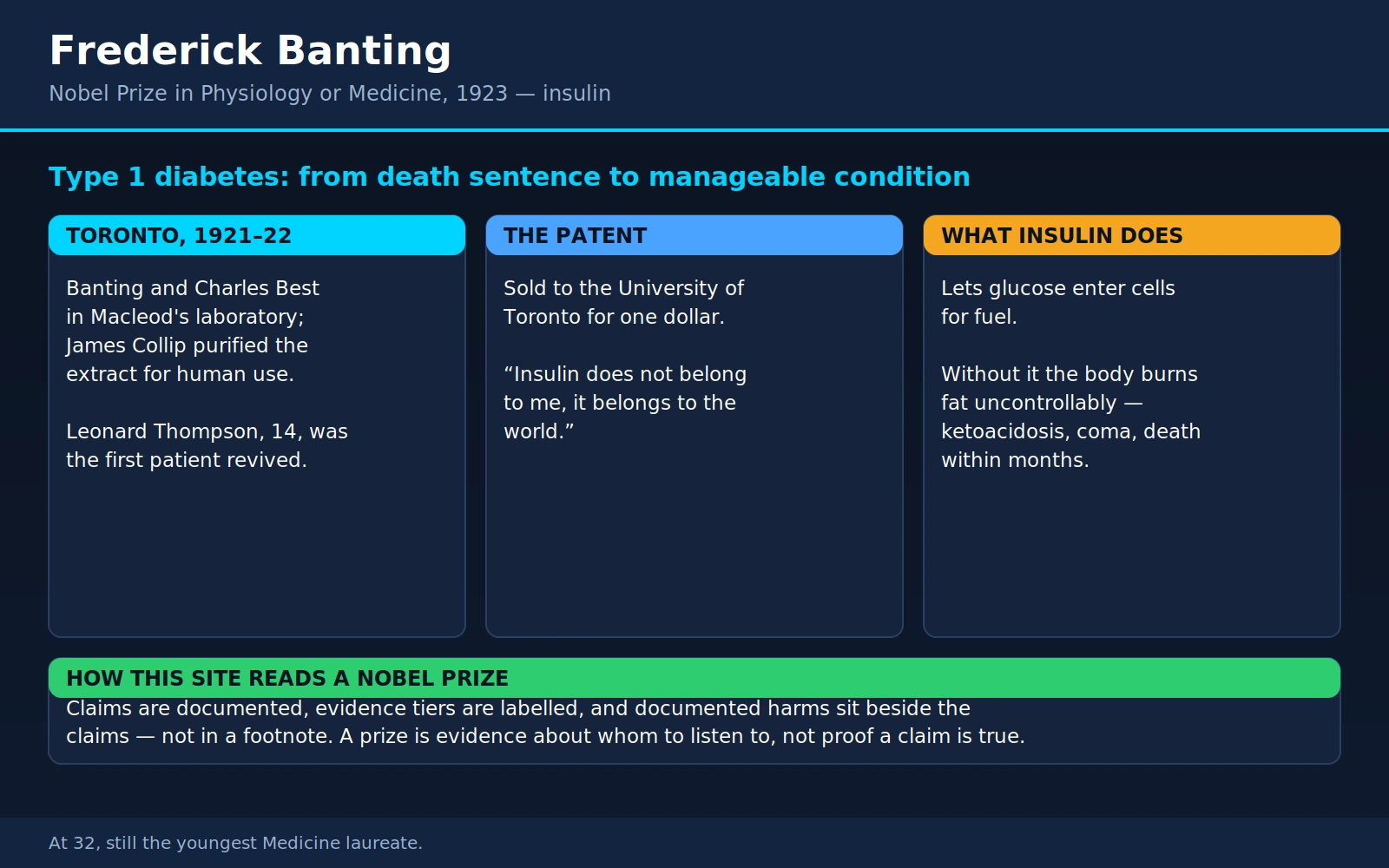
Table of Contents
- Overview
- Before Insulin — What a Diagnosis Meant
- The Idea in the Night
- The Toronto Summer
- Leonard Thompson, January 1922
- A Dollar for the Patent
- The 1923 Nobel Prize
- After Insulin
- Insulin Today — and Three Myths Worth Retiring
- What It Means for Readers Today
- Key Research Papers
- Connections
- Featured Videos
1. Overview
Sir Frederick Grant Banting (1891–1941) was a Canadian surgeon who, in a borrowed Toronto laboratory over roughly eighteen months in 1921–22, led the work that isolated insulin and turned type 1 diabetes from a certain death sentence into a manageable lifelong condition. He did it with a 22-year-old student assistant named Charles Best, under the supervision and resources of physiology professor J.J.R. Macleod, and with the purification chemistry of biochemist James Collip — four very different men whose uneasy collaboration produced what is often called the first great cure of modern medicine.
Before insulin, a child diagnosed with what we now call type 1 diabetes could expect to live a year or two. Within eighteen months of Banting's first idea, dying children were receiving injections and recovering their strength; within two years, insulin was being mass-produced and shipped across North America and Europe. The 1923 Nobel Prize in Physiology or Medicine followed with almost unheard-of speed, making Banting — at 32 — the youngest person ever to receive the medicine prize, a record that still stands. Just as remarkably, Banting, Best, and Collip signed away their patent rights to the University of Toronto for one dollar each, on the stated principle that insulin belonged to the world.
This page tells the story in plain language: what diabetes meant before insulin, how a small-town surgeon with no research training talked his way into a laboratory, what actually happened that summer, who the first patients were, and what a century of insulin since then does — and does not — mean for people living with diabetes today.
2. Before Insulin — What a Diagnosis Meant
To understand what happened in Toronto, it helps to understand the two conditions that share the name diabetes. In type 1 diabetes, the immune system destroys the insulin-producing beta cells of the pancreas. Insulin is the hormone that lets glucose leave the bloodstream and enter cells for fuel; without it, blood sugar climbs while the body literally starves, burning fat into acidic ketones until the blood itself turns dangerously acidic (diabetic ketoacidosis). Type 1 usually appears in childhood or young adulthood, comes on fast, and involves an absolute lack of insulin. In type 2 diabetes — by far the more common form today — the body still makes insulin but responds to it poorly, and production gradually falls behind demand. Type 2 develops slowly, usually in adults, and is influenced by weight, muscle, diet, activity, genetics, and age.
In 1920, none of that vocabulary existed, but the clinical picture of the childhood form was brutally clear. A child would begin drinking and urinating constantly, losing weight no matter how much they ate, and then waste away. From diagnosis, most children survived roughly a year, sometimes two. The only treatment that extended life at all was the so-called starvation or undernutrition diet, developed most famously by Frederick Allen and used by leading diabetes physicians such as Elliott Joslin: restrict food — especially carbohydrate — to a few hundred calories a day, keeping the urine free of sugar at the cost of keeping the patient on the edge of starvation. It worked, in the narrowest sense: it could buy months, occasionally a year or more. But children on the Allen diet dwindled to skeletal weights, and families faced a choice between watching a child starve slowly or sicken quickly. That is the world insulin arrived into, and it is why the events of 1922 read less like a research milestone and more like a rescue.
3. The Idea in the Night
In the autumn of 1920, Frederick Banting was an unlikely candidate to solve one of medicine's great problems. A farm boy from Alliston, Ontario, he had served as a battlefield medical officer in the First World War — wounded at Cambrai and decorated with the Military Cross — then trained in surgery and opened a practice in London, Ontario, that was struggling badly. To make ends meet he took part-time work demonstrating physiology at the University of Western Ontario. On the night of October 31, 1920, preparing a lecture on carbohydrate metabolism, he read a journal article by pathologist Moses Barron describing how blockage of the pancreatic ducts caused the digestive tissue of the pancreas to wither while the islets of Langerhans — the hormone-producing cell clusters — survived.
Researchers had suspected for decades that the islets made an anti-diabetic “internal secretion,” but every attempt to extract it from whole pancreas had failed, and many believed the gland's digestive enzymes were destroying the hormone during extraction. Unable to sleep, Banting scribbled a now-famous note to himself proposing to tie off (ligate) the pancreatic ducts of dogs, wait for the digestive tissue to degenerate, and then extract the internal secretion from the surviving islets. The note itself — misspellings and all — is one of medicine's treasured documents, and the story of the sleepless night is Banting's own account, retold so often it has become legend; historians note his memory of details shifted over the years, but the notebook page is real and dated.
Banting brought the idea to John James Rickard Macleod, professor of physiology at the University of Toronto and a leading international authority on carbohydrate metabolism. Macleod was openly skeptical — better-trained researchers had failed at exactly this — but the experiment was cheap, the summer lab would otherwise sit idle, and the hypothesis was testable. He granted Banting laboratory space, experimental dogs, and a student helper for the summer of 1921. Two undergraduate assistants were available; by the traditional account, Charles Best won the job on a coin toss with fellow student Clark Noble — a flip Noble later joked about ruefully. Best, 22, brought exactly what Banting lacked: skill in measuring blood and urine sugar.
4. The Toronto Summer
The work that summer was hot, crude, and often heartbreaking — early surgical failures and infections cost the lives of a number of the dogs, a fact Banting himself felt keenly. But the logic of the experiment held. Banting and Best ligated pancreatic ducts and waited weeks for the digestive tissue to degenerate; they surgically removed the pancreas from other dogs to make them acutely diabetic; and on July 30, 1921, they injected a chilled saline extract of degenerated pancreas into a diabetic dog and watched its blood sugar fall. Through August the pattern repeated: the extract — which they called “isletin” — lowered blood sugar, cleared urine sugar, and visibly revived dying animals. One depancreatized dog, Marjorie, was kept alive for weeks on injections and became the lab's quiet proof of concept.
When Macleod returned from Scotland he pressed for rigor — repeated experiments, controls, better record-keeping — and the name was later settled as insulin, from the Latin insula (island), a coinage that had in fact been proposed independently by European physiologists years earlier. Two practical advances made the project scalable: the team found that duct ligation was unnecessary — extracts of fetal calf pancreas, and then of whole adult beef pancreas prepared in cold acidified alcohol, worked as well — which meant slaughterhouses could supply raw material in quantity.
The last problem was purity, and it was solved by the least-remembered member of the team. James Bertram Collip, a biochemist visiting on sabbatical from the University of Alberta, joined in December 1921 and applied differential alcohol precipitation to isolate a far cleaner extract — clean enough to inject into a human being without the fevers and abscesses the crude material caused. Collip's rabbit experiments also revealed insulin's chief danger: too much drives blood sugar so low that convulsions and coma follow — the first demonstration of hypoglycemic shock, and a warning every insulin user's family still learns today. When Banting and Best presented the summer's work at the American Physiological Society meeting at Yale on December 30, 1921, the reception was rough — and by most accounts Banting, a nervous speaker, seethed as the polished Macleod fielded the questions. The resentments seeded that winter — Banting versus Macleod, Banting versus Collip — would flare for years, a reminder that world-changing science is done by human beings.
5. Leonard Thompson, January 1922
Leonard Thompson was 14 years old, a charity patient at Toronto General Hospital, and dying. After more than two years of diabetes managed by starvation dieting he weighed about 65 pounds (30 kg), drifting toward the ketoacidosis that ended every story like his. On January 11, 1922, he received the first injections of Banting and Best's pancreatic extract given to a person with diabetes. The result was a failure by the team's own standards: his blood sugar fell only modestly, his urine still carried sugar and ketones, and a sterile abscess formed at an injection site. The extract was simply not pure enough.
Twelve days later, on January 23, 1922, Thompson was injected with Collip's purified extract — and this time the effect was unmistakable. As reported in the team's March 1922 paper in the Canadian Medical Association Journal, his blood sugar dropped from roughly 520 to around 120 mg/dL within about a day, sugar in the urine nearly vanished, ketones disappeared, and the listless boy brightened, ate, and grew stronger. Leonard Thompson lived thirteen more years on insulin, dying of pneumonia in 1935 — not of diabetes.
Through February 1922 six more patients were treated, all with clear benefit. Word spread with astonishing speed, and desperate families began arriving in Toronto. Among the famous early patients were Elizabeth Hughes, the skeletal 14-year-old daughter of U.S. Secretary of State Charles Evans Hughes, who began insulin in August 1922, regained her weight and health, and lived to age 73 with some 42,000 injections behind her; and little Teddy Ryder, who reached his 76th year. A word about the most beloved image of this era — the ward of comatose children awakening one by one as doctors moved down the row with syringes: that scene, as usually told, is a later legend. It is built on something real — individual children genuinely were pulled back from the edge of death, again and again, in those months — but the recoveries were staggered over weeks in different wards and cities, not a single cinematic morning. The truth needed no embellishment.
One crisis nearly wrecked everything: in the spring of 1922 the purification process temporarily failed — Collip could not reproduce his own method for a stretch, and supply collapsed while patients waited. The solution was industrial. In May 1922 the University of Toronto partnered with Eli Lilly and Company of Indianapolis, whose chemists (notably George Walden, with his isoelectric precipitation method) stabilized and massively scaled production, while Toronto's Connaught Laboratories supplied Canada. By 1923, insulin was moving from a laboratory curiosity to a pharmacy staple across North America and Europe.
6. A Dollar for the Patent
The discoverers patented insulin — not to profit, but to control quality and prevent anyone else from locking it up. Banting initially refused to have his name on a patent at all, believing it violated a physician's ethics; he was persuaded that an unpatented process would simply be patented by someone else. In 1923 Banting, Best, and Collip assigned the insulin patent to the Board of Governors of the University of Toronto for one dollar each. The university licensed production non-exclusively, using oversight to hold manufacturers to potency and purity standards. Banting is often quoted as saying that “insulin does not belong to me, it belongs to the world” — the sentence is widely attributed rather than firmly documented, but it states exactly the position he took in fact.
A century later, the price of modern insulin — particularly patented analog insulins in the United States in the 2000s and 2010s — became a major public-policy controversy, and the dollar-a-piece patent of 1923 is regularly invoked in that debate; the contrast is often noted. This page's purpose is the history, and the history is plain: the people who discovered insulin declined to get rich from it.
7. The 1923 Nobel Prize
In October 1923 — barely eighteen months after Leonard Thompson's recovery — the Nobel Prize in Physiology or Medicine was awarded jointly to Frederick Banting and J.J.R. Macleod “for the discovery of insulin.” It remains one of the fastest routes from discovery to Nobel recognition in the prize's history, and it made Banting, at 32, the youngest Nobel laureate in Physiology or Medicine ever — a record unbroken a century later. It was also Canada's first Nobel Prize in the sciences, and the country erupted in pride.
Banting himself erupted differently: he was furious that Charles Best had been passed over and, by most accounts, initially talked of refusing the prize before colleagues persuaded him otherwise. His answer was characteristically blunt — he publicly announced he would split his prize money equally with Best. Macleod, in turn, split his share with Collip. However imperfectly the Nobel committee divided the credit, the four-way split of the money has come to stand as the fairer verdict of history: the idea and drive were Banting's, the measurements Best's, the resources and scientific discipline Macleod's, and the chemistry that made insulin safe for a child's arm was Collip's. The Nobel Foundation's own summary of the 1923 prize is here: nobelprize.org — The Nobel Prize in Physiology or Medicine 1923.
8. After Insulin
Banting spent the rest of his life trying to be worthy of a discovery he half-suspected he had lucked into. The Ontario legislature endowed a research chair for him, and he headed what became the Banting and Best Department of Medical Research at the University of Toronto. His later projects never repeated the insulin miracle, but some mattered: he investigated silicosis, the lung-scarring disease of miners breathing rock dust; dabbled seriously if unsuccessfully in cancer research; and became a driving organizer of Canadian aviation medicine. As the Second World War approached, his department studied the blackouts fighter pilots suffered under high g-forces, and it was under Banting's wing that Wilbur Franks developed the Franks flying suit, an ancestor of the modern G-suit. He was knighted in 1934, and by 1939 he was in uniform again, coordinating wartime medical research.
On February 20, 1941, Banting boarded a Lockheed Hudson bomber in Gander, Newfoundland, crossing the Atlantic on a wartime medical-research liaison mission to Britain. The plane crashed shortly after takeoff near Musgrave Harbour; Banting survived the impact but died of his injuries the next day, February 21, 1941, at age 49. His birthday, November 14, is now World Diabetes Day. At Banting House in London, Ontario — the house where he woke with the idea — a Flame of Hope burns beside the museum, lit in 1989, to be extinguished only when diabetes is cured.
9. Insulin Today — and Three Myths Worth Retiring
The insulin of 1922 was drawn from cattle and pigs; today's is made by engineered microbes. Recombinant human insulin arrived in 1982 as the first genetically engineered pharmaceutical, followed from the 1990s by analog insulins — molecules lightly redesigned to act faster at meals (lispro, aspart, glulisine) or to hold a flat background level for a day or more (glargine, detemir, degludec). Around the molecule has grown a technology ecosystem Banting could not have imagined: insulin pumps that infuse continuously, continuous glucose monitors (CGMs) that read glucose every few minutes through a skin sensor, and hybrid closed-loop systems that link the two so software adjusts the insulin automatically. Landmark research such as the Diabetes Control and Complications Trial (DCCT, 1993) proved that keeping glucose closer to normal sharply reduces long-term eye, kidney, and nerve damage — which is what all this technology is for.
And yet the honest sentence Banting's heirs still must say is this: insulin is management, not cure. A person with type 1 diabetes who stops insulin is, a century later, in exactly the danger Leonard Thompson was in. That reality anchors three plain safety points:
- Insulin does not cause diabetic complications. Years of poorly controlled high blood glucose cause complications; insulin, used well, is what prevents them. Blaming the fire brigade for the fire gets this exactly backwards.
- Needing insulin with type 2 diabetes is not a personal failure. Type 2 is a progressive condition in which insulin-producing cells lose capacity over years; many people eventually need insulin despite doing everything right. Starting it is a treatment decision, not a verdict on character.
- No supplement, herb, or diet replaces insulin in type 1 diabetes. This is a safety matter, stated plainly: in type 1 there is no insulin to “support” or “boost” — the supply is gone, and only injected or infused insulin substitutes for it. Stopping insulin in favor of any natural protocol leads to ketoacidosis within days, and ketoacidosis kills. Lifestyle and nutrition matter enormously alongside insulin — never instead of it.
10. What It Means for Readers Today
If you or someone you love lives with diabetes, Banting's story is more than history — it is the origin of every option on the table today. Start with our main Diabetes page for the condition itself: types, symptoms, diagnosis, and the treatment landscape. For the lifestyle side — the food, movement, sleep, and monitoring habits that improve glucose control in type 2 diabetes and support (never replace) insulin in type 1 — see the Blood Sugar hub. And for the newest chapter, see GLP-1 Receptor Agonists — the semaglutide/tirzepatide drug class descended from incretin science, the study of gut hormones that shape insulin release, a research thread nearly as old as insulin itself.
There is also a lesson in how the discovery happened. Insulin came from an outsider's stubborn idea plus an establishment's resources and rigor — Banting needed Macleod and Collip as surely as they needed him. The idea in the night was necessary; the controlled experiments, the purification chemistry, and the industrial partnership were what turned it into medicine that could be trusted in a child's bloodstream. A century of diabetes care since — and this site's whole approach to evaluating remedies — runs on that same pairing: bold claims, honestly tested.
11. Key Research Papers
- Banting FG, Best CH. The internal secretion of the pancreas. 1922 (reprinted). Indian J Med Res 2007;125(3):251-66 — the landmark 1922 Journal of Laboratory and Clinical Medicine paper reporting the dog experiments, available via this indexed reprint.
- Banting FG, Best CH, Collip JB, Campbell WR, Fletcher AA. Pancreatic extracts in the treatment of diabetes mellitus. Can Med Assoc J 1922;12:141-146. (The first clinical report, including Leonard Thompson's recovery; the 1922 original is not PubMed-indexed.)
Live PubMed Searches
- Insulin discovery history
- Banting and Best insulin
- Type 1 diabetes insulin therapy
- Insulin analogs in type 1 diabetes
- Continuous glucose monitoring in type 1 diabetes
Connections
- All Notable Doctors
- Diabetes — the condition insulin transformed: types, symptoms, and modern management
- Endocrinology — the hormone-disorder category insulin founded as a therapeutic field
- Blood Sugar — lifestyle and nutrition approaches to glucose control, alongside (never instead of) insulin
- GLP-1 Receptor Agonists — the modern drug class descended from incretin science
- Ketogenic Diet — the pre-insulin starvation diets were distant ancestors of carbohydrate restriction; a historical note, not an equivalence
- Dr. Abram Hoffer — another Canadian who treated a biochemical idea as testable medicine