Christiaan Eijkman: Beriberi, Brown Rice, and the Birth of the Vitamin
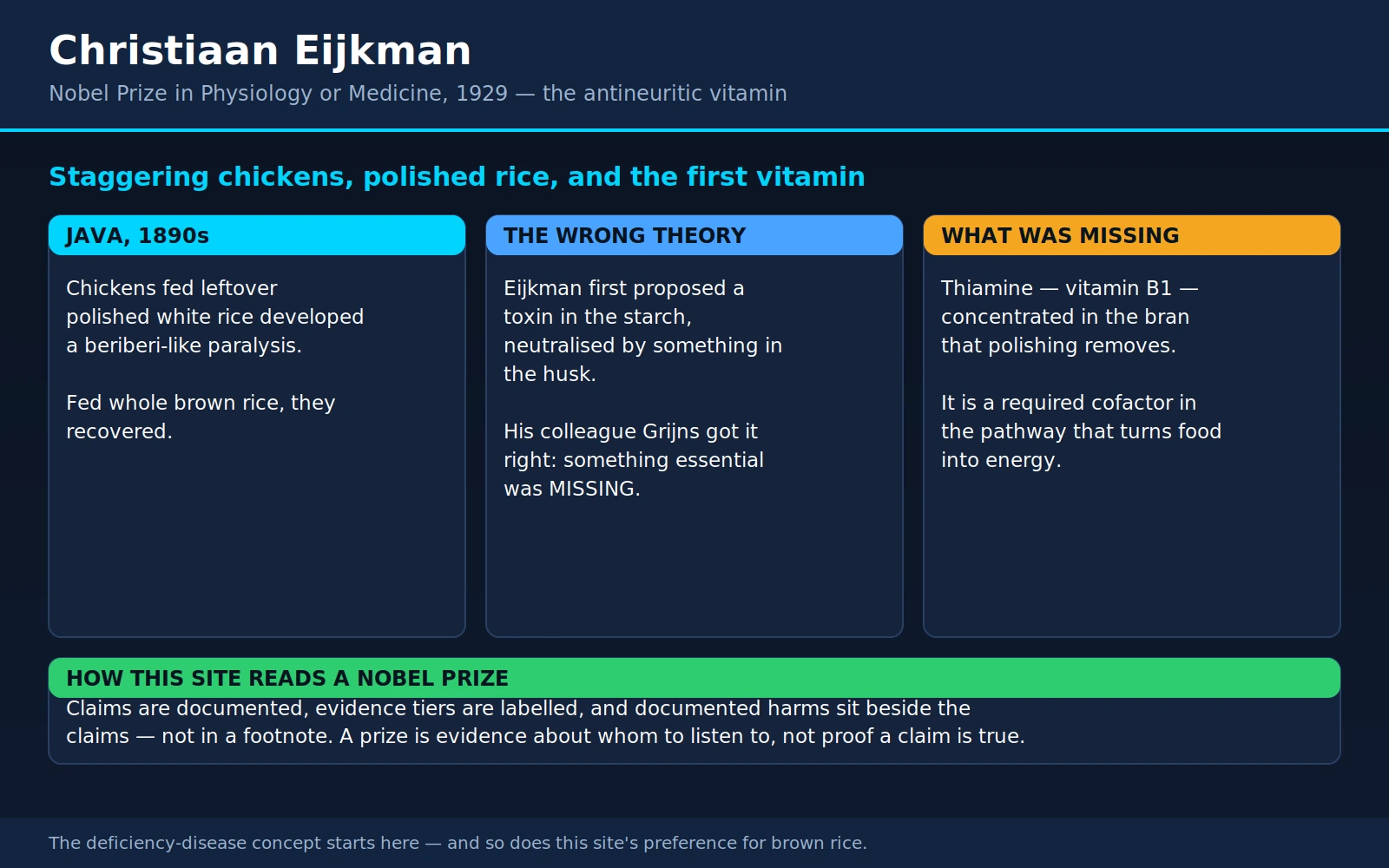
Table of Contents
- Overview
- Beriberi: The Disease That Stalked Asia
- To Java Hunting a Microbe
- The Chickens That Staggered
- The Right Data, the Wrong First Theory
- From “Anti-Beriberi Factor” to Thiamine
- The 1929 Nobel Prize
- Brown Rice vs. White Rice, Then and Now
- Beriberi Today
- What Eijkman Teaches
- Key Research Papers
- Connections
- Featured Videos
1. Overview
Christiaan Eijkman (1858–1930) was a Dutch military physician who went to colonial Java in the 1880s to find the microbe that caused beriberi — and instead found the first hard evidence that a disease could be caused by something missing from food. His famous chicken experiments in the 1890s traced beriberi to polished white rice, and the substance later isolated from the discarded rice husk became thiamine, vitamin B1 — the very first vitamin to be identified, isolated, and synthesized.
That reversal — from “what germ is attacking these patients?” to “what nutrient are these patients not getting?” — sounds small and was enormous. In the 1890s, medicine had just learned from Pasteur and Koch that invisible microbes cause disease, and that framework was so successful it swallowed everything. The idea that a food could be deadly not because of what it contained but because of what had been removed from it had no place in the science of the day. Eijkman's data forced that place open, and the entire concept of the vitamin — and with it the cures for scurvy, rickets, pellagra, and beriberi — walked through it.
For this work, Eijkman shared the 1929 Nobel Prize in Physiology or Medicine with the English biochemist Sir Frederick Gowland Hopkins, whose laboratory studies had shown that animals cannot live on purified protein, fat, carbohydrate, and minerals alone. Eijkman had found the missing-nutrient disease in the field; Hopkins had proven the missing nutrients existed on the bench. Together they mark the birth of the vitamin era. Eijkman was too ill to travel to Stockholm and died the following year, in 1930.
2. Beriberi: The Disease That Stalked Asia
Beriberi is what severe thiamine deficiency does to the human body. Thiamine is the spark plug of carbohydrate metabolism — without it, cells cannot efficiently turn the food you eat into usable energy — and the two hungriest tissues in the body, nerves and heart muscle, fail first. Nineteenth-century physicians described two overlapping forms:
- Dry beriberi attacks the nerves. It starts with numbness, tingling, and burning in the feet, then climbing weakness: the legs give out, the wrists drop, walking becomes impossible. In advanced cases patients were left paralyzed and wasted.
- Wet beriberi attacks the heart. The heart enlarges and fails, fluid pools in the legs, lungs, and body cavities, and death can come suddenly — sometimes in previously fit young men who had seemed merely tired days before. A fulminant form could kill within days.
- Infantile beriberi struck breastfed babies of deficient mothers, and it killed quickly. In parts of Asia it was a leading killer of infants well into the twentieth century.
Beriberi was ancient in Asia, but the late nineteenth century turned it into an epidemic, because steam-powered rice mills made polished white rice cheap and universal. Milling strips off the bran and germ — exactly where the grain keeps its thiamine — leaving shelf-stable, quick-cooking, prestigious white rice that is nutritionally hollow. Anywhere people ate monotonous white-rice rations, beriberi followed: armies, navies, prisons, plantations, asylums, ships. The Japanese navy was crippled by it on long voyages; naval surgeon Kanehiro Takaki showed in the 1880s that changing the sailors' rations (adding barley, meat, and vegetables) nearly eliminated it, though he attributed the effect to protein rather than to a missing nutrient.
And here is the trap the era set for itself: this was the golden age of germ theory. Koch had just identified the anthrax, tuberculosis, and cholera organisms. Every mysterious disease was presumed to have a microbe, and beriberi — which swept through barracks and prisons like an infection, appearing in outbreaks, clustering in institutions — looked exactly like one. The obvious question was not “what is wrong with the food?” It was “where is the germ?”
3. To Java Hunting a Microbe
Eijkman was born in 1858 in Nijkerk, the Netherlands, trained as an army medical officer, and served in the Dutch East Indies (today's Indonesia) until malaria invalided him home. During his recovery in Europe he did something that shaped everything after: he went to Berlin and trained in bacteriology in Robert Koch's laboratory — the very center of germ theory. When the Dutch government assembled a commission in 1886 to find the cause of beriberi, which was devastating its colonial army, Eijkman joined it as the bacteriologically trained man.
The commission, led by professors Cornelis Pekelharing and Cornelis Winkler, worked in Batavia (modern Jakarta) and did what good microbe hunters did: examined patients, cultured samples, injected animals. They convinced themselves a bacterium was probably involved and went home in 1887. Eijkman stayed. He was appointed director of a small new medical research laboratory in Batavia — set up on the grounds of the military hospital — and of the school that trained Javanese physicians, and he kept hunting the beriberi germ.
For years the hunt went nowhere. Inject material from beriberi patients into rabbits and monkeys: nothing reproducible. Culture the supposed organism: nothing that behaved like a cause. This is worth sitting with, because it is the part of science nobody celebrates — a competent, Koch-trained bacteriologist spending years failing to confirm the theory everyone knew must be true. What broke the deadlock was not a better microscope. It was a piece of luck in the hospital chicken yard — and a scientist honest enough to follow it.
4. The Chickens That Staggered
In 1889, the chickens Eijkman kept for laboratory work began to get sick. They staggered, struggled to perch, developed a weakness that climbed from the legs until they could no longer stand, then lay on their sides dying. Eijkman recognized the picture at once: under the microscope their peripheral nerves were degenerating, just like the nerves of his beriberi patients. He called the condition polyneuritis gallinarum — nerve inflammation of chickens — and assumed his birds had caught the beriberi infection.
Then, before he could pin down the “infection,” the disease vanished on its own. Sick birds recovered; new cases stopped. A finding that appears and disappears by itself is a researcher's nightmare, and this is where Eijkman did the thing that earned the Nobel: instead of shrugging, he asked what had changed. The answer was the kitchen. For several months, the man keeping the chickens had been feeding them leftover cooked white rice from the military hospital's kitchen — polished rice, the patients' ration. Then a new cook took over, and he refused to hand out “military rice” to civilian chickens. The birds went back to ordinary cheap feed rice — unpolished, husk still on. The disease had arrived with the polished rice and left with it.
A lesser scientist had been handed a coincidence; Eijkman turned it into an experiment. Through the early 1890s he ran the comparison deliberately, over and over: chickens fed cooked polished rice developed polyneuritis, usually within weeks. Chickens fed unpolished rice stayed healthy on otherwise identical terms. Paralyzed birds fed the rice polishings — the bran and silverskin the mill had removed — recovered, often dramatically. He showed the protective something in the husk could be extracted with water, and that it was destroyed by prolonged high heat. Diet was not merely associated with the disease; diet, changed on purpose, turned the disease on and off.
Eijkman published the work beginning in 1890 in the colonial medical journal Geneeskundig Tijdschrift voor Nederlandsch-Indië, with further reports through 1896. It is one of history's great accidental experiments — but “accidental” undersells it. The accident happened in front of a man who had spent years watching for anything that moved the disease, and who was willing to take the chicken yard as seriously as the microscope.
5. The Right Data, the Wrong First Theory
What Eijkman got wrong is almost as instructive as what he got right. A trained bacteriologist to his bones, he first explained his own results in germ-theory terms: perhaps the starch of polished rice fostered a microbe or fermentation in the gut that produced a nerve toxin, and the rice husk contained an antidote that neutralized it. The data were his; the interpretation still belonged to the old century. The idea that the husk simply supplied something the body could not live without — that the disease was an absence — was not yet thinkable to him.
Two colleagues finished the argument. First, Eijkman enlisted Adolphe Vorderman, inspector of the civil health service, to test whether the chicken finding held for humans. Vorderman surveyed roughly a hundred prisons across Java — institutions differing in which rice they served but otherwise housing prisoners under broadly similar conditions. The result was devastatingly clear: beriberi concentrated overwhelmingly in the prisons serving polished white rice, and was rare to absent where prisoners got rice with the husk layers still on — on the order of one prisoner in forty affected in the polished-rice prisons versus roughly one in ten thousand where the rice was unpolished. Published in 1897, this was, for its time, a remarkably strong piece of human epidemiology — an accidental controlled comparison run on thousands of people.
Second came the reinterpretation. Eijkman went home to the Netherlands in 1896, his health broken again, and handed the Batavia laboratory to his younger colleague Gerrit Grijns. Grijns repeated and extended the feeding experiments, systematically ruling out the toxin story, and in 1901 stated plainly what the data had been saying all along: natural foods contain small amounts of substances the nervous system cannot do without, and beriberi results when a diet lacks such a substance — as polished rice does, because milling has removed it. This is generally counted the first clear statement of a deficiency disease in the modern sense. Eijkman resisted at first, then came around; he spent his later career as a professor of hygiene at Utrecht, and lived to see the deficiency concept he had seeded — and initially argued against — conquer medicine.
6. From “Anti-Beriberi Factor” to Thiamine
Once the question became “what is the protective substance in the husk?”, the race was on to catch it in a bottle. In 1911 the Polish biochemist Casimir Funk, working in London with rice polishings and Eijkman-style polyneuritic pigeons, extracted concentrates that cured the birds. Convinced the active substance was a vital amine — a nitrogen-containing compound essential to life — he coined a word for this whole new class of nutrients in 1912: “vitamine.” The chemistry of the name turned out slightly wrong (not all vitamins are amines, so the final “e” was later dropped), but the concept stuck, and beriberi's anti-beriberi factor became the founding member: vitamin B1.
Purifying it took another generation of stubborn chemistry. In 1926, the Dutch chemists Barend Jansen and Willem Donath — working in Eijkman's old laboratory in Batavia, a fitting full circle — isolated the anti-beriberi factor as pure crystals. In the 1930s its structure was worked out, and in 1936 Robert R. Williams in the United States achieved full chemical synthesis, naming the compound thiamine for its sulfur-containing ring. A disease that had filled Asian hospital wards for centuries could now be reversed with milligrams of a factory-made crystal costing pennies.
What thiamine actually does in the body — its role as the essential cofactor for burning carbohydrates, why nerves and heart fail without it, food sources, dosing, and deficiency testing — is covered in depth on this site's Vitamin B1 (Thiamine) page. The short version: every carbohydrate-burning cell you own runs on enzymes that cannot work without it, and your body stores only a few weeks' supply.
7. The 1929 Nobel Prize
The 1929 Nobel Prize in Physiology or Medicine was awarded jointly: to Christiaan Eijkman “for his discovery of the antineuritic vitamin,” and to Sir Frederick Gowland Hopkins “for his discovery of the growth-stimulating vitamins.” The pairing was deliberate, and it tells you how the committee understood what had happened. Eijkman represented the clinical half of the vitamin idea: a real human disease, traced in the field to a missing dietary factor, with animal experiments and prison epidemiology to prove it. Hopkins represented the laboratory half: his meticulous feeding studies, published in 1912, showed that young animals fail to grow — and sicken — on chemically “complete” purified diets unless tiny amounts of normal food are added, proving that foods contain unknown “accessory food factors” essential to life.
Either half alone had been resistible. A colonial chicken disease could be dismissed as veterinary curiosity; a rat growth-chart anomaly could be dismissed as laboratory artifact. Together they were one unanswerable argument: deficiency disease was real, measurable at the bedside and reproducible on the bench. By 1929 the vitamin era was in full flood — vitamins A, C, and D had been characterized, rickets and scurvy were understood as deficiencies, and thiamine's crystals had been isolated three years earlier.
There is a human footnote. Eijkman was 71 and gravely ill; he could not make the journey to Stockholm and never delivered his lecture in person. Grijns, whose 1901 reinterpretation had turned Eijkman's data into the deficiency concept, and Vorderman, whose prison survey had carried it to humans, were not included — Vorderman had died in 1902, and the prize's three-person limit and long memory being what they are, Grijns's contribution is one history books have had to restore. Eijkman died on November 5, 1930.
8. Brown Rice vs. White Rice, Then and Now
The lesson at the center of this story is one this site takes seriously: the whole grain carries its own nutrition, and milling throws much of it away. Brown rice is the intact grain minus only the inedible outer hull — bran, germ, and starchy endosperm all present. White rice is what remains after the bran and germ are polished off: mostly starch. The thiamine, along with most of the grain's magnesium, fiber, B vitamins, and healthy fats, leaves with the parts the mill removes. That is not an opinion about food; it is the entire mechanism of the beriberi epidemic.
Two honest modern qualifications. First, in many countries white rice today is enriched — sprayed or dusted with added thiamine, niacin, iron, and folic acid precisely because of the history told on this page — so white rice eaten in an enriched-food country is no longer the beriberi hazard the colonial ration was. (Enrichment is also uneven worldwide, and washing or discarding cooking water carries some of it away, since thiamine dissolves in water.) Second, nobody develops beriberi from enjoying white rice within a varied diet; the disease required monotony — polished rice as nearly the whole plate, every day. The danger was never the food; it was the food standing alone.
Practical guidance, in the site's usual non-dogmatic spirit:
- Favor brown rice as the default. You get the grain's own thiamine, magnesium, and fiber as nature packaged them, rather than a starch with a partial factory patch.
- If you eat white rice, let it be the enriched kind eaten alongside real food — legumes, vegetables, eggs, meat, fish — so the rest of the plate supplies what the mill removed.
- Remember thiamine's fragility: it is water-soluble and heat-sensitive, so heavy rinsing, discarded cooking water, and prolonged boiling all tax it — one reason monotonous diets of heavily washed polished rice were so dangerous.
- The principle generalizes: the beriberi story is the archetype of what refining staple foods does — the same logic behind preferring whole grains generally, covered across this site's Food section.
9. Beriberi Today
Beriberi did not stay in the nineteenth century. The rice-ration epidemics are largely gone, but thiamine deficiency quietly persists wherever intake falls or demand spikes — and modern medicine mostly sees it wearing different clothes:
- Alcohol-related deficiency (Wernicke-Korsakoff syndrome). The most common form in wealthy countries. Heavy alcohol use cuts thiamine absorption and intake at once. Wernicke encephalopathy — confusion, unsteady gait, abnormal eye movements — is an emergency treated with injected thiamine; missed or undertreated, it can harden into Korsakoff syndrome, a largely irreversible destruction of memory.
- Refeeding syndrome. When a starved or malnourished person is suddenly fed — especially carbohydrates or IV glucose — the metabolic restart consumes what little thiamine remains and can precipitate acute deficiency. This is why hospitals give thiamine before glucose in at-risk patients.
- Bariatric surgery. Weight-loss operations shrink intake and bypass absorptive gut; thiamine deficiency can develop within weeks to months after surgery, particularly with persistent vomiting, and is a recognized cause of post-bariatric neuropathy and Wernicke encephalopathy.
- Other high-risk settings: severe or prolonged vomiting (including hyperemesis gravidarum in pregnancy), dialysis, chronic diuretic therapy in heart failure, and cancer or critical illness with poor intake.
- Refined-staple diets, still. Classic dietary beriberi — including infantile beriberi — still occurs in populations living on polished rice or refined flour with little else: reported in recent decades among refugees and displaced populations dependent on unfortified rations, and in regions where infants are breastfed by thiamine-deficient mothers. Eijkman's disease is history only where diets or fortification made it so.
When to suspect it: unexplained burning, numb, or weak feet and legs; unexplained heart failure in a drinker or in someone with recent bariatric surgery, prolonged vomiting, or severe malnutrition; any confusion or eye-movement abnormality in those same settings. Why it is an emergency: the nerve and brain damage of advanced deficiency becomes permanent quickly, while early treatment can reverse it within days — and the treatment is thiamine itself, given promptly and parenterally in serious cases, not diet alone. Brown rice prevents beriberi; it does not treat Wernicke encephalopathy. Suspected cases belong in medical hands the same day.
10. What Eijkman Teaches
Evidence over expectation. Eijkman went to Java carrying the best theory of his era and the training of Koch's own laboratory, looking for a germ. When the chicken yard produced data that pointed away from the germ, he followed the chickens. That sounds easy; it is the hardest move in science. He spent years failing to confirm the fashionable theory, noticed the one variable that actually moved the disease — a kitchen's rice policy — and had the discipline to convert an anecdote into controlled, repeated experiments. The observation was rescued from coincidence by a man prepared to take it seriously.
Discovery is a relay, not a solo. Eijkman's own first interpretation of his data was wrong — a toxin-and-antidote story, germ-theory thinking in a new costume. It took Vorderman's prison survey to carry the finding from chickens to thousands of humans, and Grijns's 1901 reinterpretation to say plainly that the disease was an absence, not a poison — the deficiency concept itself. Funk named the class of substances, Jansen and Donath crystallized the factor in Eijkman's old lab, and Williams synthesized it. None of this diminishes Eijkman: the experiments were his, and everything else grew from them. It is simply normal science working well — data outliving their first explanation, colleagues correcting and completing each other across forty years.
And the practical lesson has not aged a day: when a staple food is stripped and refined, what is removed can matter as much as what remains. One observant physician, a stubborn set of feeding experiments, and a flock of staggering chickens taught medicine that some diseases are cured not by killing something in the body, but by restoring something to the plate.
11. Key Research Papers
- Eijkman C. Polyneuritis in chickens. Geneeskundig Tijdschrift voor Nederlandsch-Indië 1890;30:295-334. (The original report, in Dutch; followed by further reports in the same journal in 1892 and 1896. The colonial-era journal is not PubMed-indexed.)
- Grijns G. Over polyneuritis gallinarum (On polyneuritis gallinarum). Geneeskundig Tijdschrift voor Nederlandsch-Indië, 1901. (The first clear statement of the deficiency-disease concept; not PubMed-indexed.)
- Funk C. On the chemical nature of the substance which cures polyneuritis in birds induced by a diet of polished rice. J Physiol 1911;43(5):395-400
- Pietrzak K. Christiaan Eijkman (1856-1930). J Neurol 2019;266(11):2893-2895 (The birth year in the article's title is the journal's own slip — Eijkman was born in 1858.)
- Mukhopadhyay AK. Military rice, civilian chicken, and Christiaan Eijkman (1858-1930): The beginning of the vitamin era. Clin Dermatol 2026;44(3):410-414
- Carpenter KJ. The discovery of thiamin. Ann Nutr Metab 2012;61(3):219-23
- Sechi G, Serra A. Wernicke's encephalopathy: new clinical settings and recent advances in diagnosis and management. Lancet Neurol 2007;6(5):442-55
- Whitfield KC, Bourassa MW, Adamolekun B, et al. Thiamine deficiency disorders: diagnosis, prevalence, and a roadmap for global control programs. Ann N Y Acad Sci 2018;1430(1):3-43
Live PubMed Searches
- Eijkman and beriberi
- History of thiamine deficiency
- Wernicke-Korsakoff and thiamine
- Whole grains and thiamine
- Refeeding syndrome and thiamine
Connections
- All Notable Doctors
- Vitamin B1 (Thiamine) — the nutrient Eijkman's chickens revealed, and what it does in the body today
- All Vitamins — the entire category his work founded
- Dr. Abram Hoffer — a later B-vitamin researcher who carried niacin into psychiatry
- Albert Szent-Györgyi — fellow vitamin-era Nobel laureate, isolator of vitamin C
- Food — whole foods and staple grains, where the beriberi lesson lives on