— March 26, 2026
· America's Choline Deficiency Crisis


Table of Contents
- Choline Intake in the United States: Most Adults Fall Below the Adequate Intake
- Lion's Mane Mushroom: What the Published Cognitive Trials Show
- Leafy Greens, Nitrate and Cognitive Decline in Older Adults
- Gut Microbiome Differences Identified in Fibromyalgia
- Magnesium and Sleep: What a Meta-Analysis Found
- Key Research Papers
- Connections
- Featured Videos
Choline Intake in the United States: Most Adults Fall Below the Adequate Intake
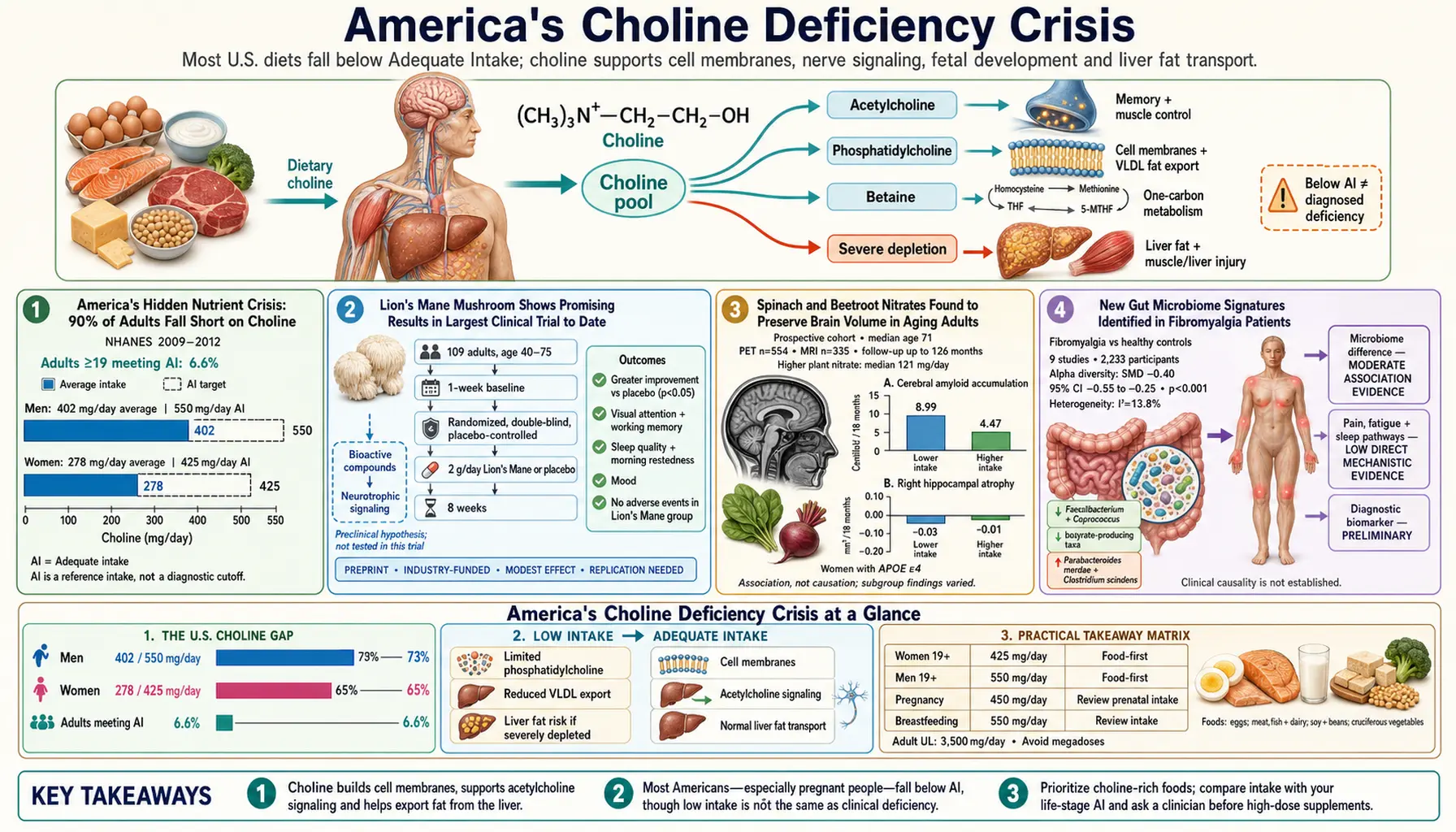
Analyses of the National Health and Nutrition Examination Survey (NHANES) show how few Americans reach the adequate intake (AI) for choline, which the Food and Nutrition Board set in 1998 at 550 mg/day for adult men and 425 mg/day for adult women. Using NHANES 2009–2014 data, Wallace and Fulgoni (2017) reported that only 8.03% of adults met the AI; their earlier analysis of NHANES 2009–2012 put the figure at 6.6% of adults aged 19 and over (15.6% of males and 6.1% of females of all ages from 2 up). A 2018 review in Nutrition Today describes approximately 90% of Americans as well below the AI and calls choline "the underconsumed and underappreciated essential nutrient". "Crisis" is the headline's word; the surveys themselves describe "suboptimal intakes".
Choline is needed for liver, muscle and brain function, lipid metabolism and cell membranes, and it is the precursor of acetylcholine, the neurotransmitter involved in memory, learning and muscle movement. Because choline comes mainly from animal-derived foods, the 2018 review notes that vegetarians and vegans may be at greater risk of inadequacy and puts vegetarians' intake at about 192 mg/day, the lowest of any US group. In the 2017 NHANES analysis, 57.3% of adults who ate eggs met the AI, against 2.43% of those who did not, and egg eaters' usual intake was 525 mg/day against 294 mg/day. Foods the review lists include chicken liver (247 mg per 3 oz), salmon (187 mg per 3 oz) and one large egg with yolk (147 mg). The review also notes that gut microbes turn choline into trimethylamine, which the liver converts to TMAO, a candidate risk factor for cardiovascular disease, and states that the choline–TMAO connection is not yet established. The review was funded in part by egg- and beef-industry groups and a choline ingredient supplier.
During pregnancy the AI is 450 mg/day (550 mg/day during lactation). In NHANES 2005–2014, 8.51% of pregnant women met it (Wallace and Fulgoni, 2017), and a 2021 review of 26 publications found average intakes in most studies of the childbearing years between 233 and 383 mg/day, with intakes no higher in pregnant or lactating women than in other women. In a Cornell controlled-feeding trial (Caudill et al., 2018), 26 women entering the third trimester were randomized to 480 or 930 mg of choline a day until delivery; the 24 infants tested at 4, 7, 10 and 13 months had faster average reaction times on information-processing tasks when their mothers had been in the 930 mg group. The trial was small and was funded in part by egg and beef industry groups. The 2018 review reports that the American Medical Association recommended choline as a component of all prenatal vitamin supplements (2017) and that the American Academy of Pediatrics reaffirmed its importance in pregnancy and lactation; the 2021 review called for considering formal advocacy of choline supplements for women planning a pregnancy, pregnant or breastfeeding.
Lion's Mane Mushroom: What the Published Cognitive Trials Show
An earlier version of this item described a 612-person, 48-week trial of lion's mane mushroom (Hericium erinaceus) presented at a neurology congress in Vienna, with a named principal investigator and a quotation. No such trial or presentation could be found in PubMed, so those details have been removed. The human trials that are published are small.
In a Japanese double-blind, placebo-controlled trial (Mori et al., 2009), 30 adults aged 50–80 with mild cognitive impairment were randomized into two groups of 15. One group took four 250 mg tablets of 96% dried lion's mane powder three times a day for 16 weeks. That group scored significantly higher than placebo on a cognitive scale based on the Revised Hasegawa Dementia Scale at weeks 8, 12 and 16. Four weeks after intake stopped the scores had fallen significantly, and laboratory tests showed no adverse effect. In a Taiwanese pilot double-blind trial (Li et al., 2020), people with mild Alzheimer's disease took three 350 mg capsules a day of erinacine A-enriched lion's mane mycelia, or placebo, for 49 weeks. The authors reported an improved Mini-Mental State Examination score in the mycelia group and a decline on another cognitive screening scale in the placebo group. Both trials were run with or by mushroom producers.
The compounds behind this research were described by Hirokazu Kawagishi of Shizuoka University, whose group discovered the hericenones (C to H, from the fruiting bodies) and the erinacines (A to I, from the cultured mycelia). He describes them as antidementia compounds, and the clinical studies were designed around them. Laboratory work has examined these compounds for effects on nerve growth factor (NGF). No large, long-term trial in people with cognitive impairment has been published.
Leafy Greens, Nitrate and Cognitive Decline in Older Adults
An earlier version of this item described a Neurology cohort of 1,158 adults followed for 5.2 years with brain MRI, reporting 24% and 32% less decline, together with a quotation from Martha Clare Morris of Rush University. Those figures and that quotation could not be matched to a published paper. The closest published study is by Morris and colleagues in Neurology (2018). It followed 960 participants of Rush's Memory and Aging Project, aged 58–99, who completed a food frequency questionnaire and had at least two cognitive assessments over a mean of 4.7 years. The abstract reports no MRI data.
Green leafy vegetables such as spinach were associated with slower cognitive decline. The decline rate for the highest fifth of intake (median 1.3 servings a day) was slower by 0.05 standardized units, which the authors describe as the equivalent of being 11 years younger. Each nutrient studied except β-carotene was individually associated with slower decline: vitamin K (phylloquinone), lutein, folate, α-tocopherol, nitrate and kaempferol. For nitrate, the highest versus lowest fifth differed by β = 0.04 (p = 0.002). The models were adjusted for age, sex, education, cognitive and physical activity, smoking, and seafood and alcohol intake. The study did not examine beetroot, another nitrate-rich food.
Dietary nitrate can be converted to nitric oxide in the body, which is the reason it is studied for blood-vessel and brain effects. This was an observational study. It shows an association, and because several nutrients in the same foods were each associated with slower decline, it cannot show which one, if any, is responsible.
Gut Microbiome Differences Identified in Fibromyalgia
An earlier version of this item described a Nature Medicine study of 368 patients and 523 controls with a list of altered species. The study that matches this work was published in Pain in 2019 by Amir Minerbi and colleagues at McGill University. They compared the gut microbiomes of 77 women with fibromyalgia and 79 control participants using 16S rRNA gene amplification and whole-genome sequencing, and found significant differences in several bacterial taxa.
Fibromyalgia-related variables explained more of the variation in microbiome composition than any other innate or environmental variable, and the composition correlated with clinical measures of the condition. Some butyrate-metabolising species were altered, and serum tests confirmed differences in butyrate and propionate levels in the patients. A machine-learning model given only the microbiome data separated patients from controls with a receiver-operating-characteristic area under the curve of 87.8%. The authors describe this as the first demonstration of gut microbiome alteration in a non-visceral pain condition. They say it opens the way to studies of the condition's causes, possible diagnostic aids and new treatments.
The study shows an association in one group of women. It does not show that the microbiome causes fibromyalgia or that changing it changes symptoms. Gut healing protocols and probiotic supplementation are covered on their own pages. The earlier statement that probiotic trials for fibromyalgia were under way at several institutions could not be verified and has been removed.
Magnesium and Sleep: What a Meta-Analysis Found
An earlier version of this item described a Sleep Medicine Reviews meta-analysis of 19 trials and 2,462 participants with a quotation from a named USDA researcher. That analysis and the quotation could not be found. The published meta-analysis that reports a 17-minute figure is by Mah and Pitre in BMC Complementary Medicine and Therapies (2021; a correction followed in 2024). It identified three randomized controlled trials comparing oral magnesium with placebo in 151 older adults with insomnia, in three countries. After treatment, sleep onset latency (the time taken to fall asleep) was 17.36 minutes shorter with magnesium than with placebo (95% CI 7.44 to 27.27 minutes). Total sleep time was 16.06 minutes longer, a difference that was not statistically significant.
All three trials were at moderate-to-high risk of bias, and the authors graded the evidence as low to very low quality. They concluded that the literature is "substandard for physicians to make well-informed recommendations" on oral magnesium for insomnia in older adults. They added that, since oral magnesium is cheap and widely available, trial evidence may support doses under 1 g up to three times a day for insomnia symptoms. The abstract does not compare forms of magnesium such as magnesium glycinate. Earlier claims ranking magnesium forms, a quoted list of mechanisms, and the phrase "first-line natural approach" have been removed because no source for them was found. Non-supplement approaches are described under sleep optimization.
Key Research Papers
This digest was revised on 2026-10-13. Several details in the original version (journals, named researchers, quotations and study sizes) could not be matched to any published paper. They were replaced with the published studies below, each checked against its PubMed abstract.
- Wallace TC, Fulgoni VL 3rd (2016). Assessment of Total Choline Intakes in the United States. Journal of the American College of Nutrition 35(2):108-112. — PubMed PMID: 26886842
- Wallace TC, Fulgoni VL (2017). Usual Choline Intakes Are Associated with Egg and Protein Food Consumption in the United States. Nutrients 9(8):839. — PubMed PMID: 28783055
- Wallace TC, Blusztajn JK, Caudill MA, Klatt KC, Natker E, Zeisel SH, Zelman KM (2018). Choline: The Underconsumed and Underappreciated Essential Nutrient. Nutrition Today 53(6):240-253. — PubMed PMID: 30853718
- Derbyshire E, Obeid R, Schön C (2021). Habitual Choline Intakes across the Childbearing Years: A Review. Nutrients 13(12):4390. — PubMed PMID: 34959942
- Caudill MA, Strupp BJ, Muscalu L, Nevins JEH, Canfield RL (2018). Maternal choline supplementation during the third trimester of pregnancy improves infant information processing speed: a randomized, double-blind, controlled feeding study. FASEB Journal 32(4):2172-2180. — PubMed PMID: 29217669
- Mori K, Inatomi S, Ouchi K, Azumi Y, Tuchida T (2009). Improving effects of the mushroom Yamabushitake (Hericium erinaceus) on mild cognitive impairment: a double-blind placebo-controlled clinical trial. Phytotherapy Research 23(3):367-372. — PubMed PMID: 18844328
- Li IC, Chang HH, Lin CH, Chen WP, Lu TH, Lee LY, et al. (2020). Prevention of Early Alzheimer's Disease by Erinacine A-Enriched Hericium erinaceus Mycelia Pilot Double-Blind Placebo-Controlled Study. Frontiers in Aging Neuroscience 12:155. — PubMed PMID: 32581767
- Kawagishi H (2021). Chemical studies on bioactive compounds related to higher fungi. Bioscience, Biotechnology, and Biochemistry 85(1):1-7. — PubMed PMID: 33577664
- Morris MC, Wang Y, Barnes LL, Bennett DA, Dawson-Hughes B, Booth SL (2018). Nutrients and bioactives in green leafy vegetables and cognitive decline: Prospective study. Neurology 90(3):e214-e222. — PubMed PMID: 29263222
- Minerbi A, Gonzalez E, Brereton NJB, Anjarkouchian A, Dewar K, Fitzcharles MA, et al. (2019). Altered microbiome composition in individuals with fibromyalgia. Pain 160(11):2589-2602. — PubMed PMID: 31219947
- Mah J, Pitre T (2021). Oral magnesium supplementation for insomnia in older adults: a Systematic Review & Meta-Analysis. BMC Complementary Medicine and Therapies 21(1):125. — PubMed PMID: 33865376
PubMed Topic Searches
- Clinical trials on choline deficiency in adults — PubMed search
- Clinical trials on lion's mane and cognitive impairment — PubMed search
- Clinical trials on dietary nitrate and brain aging — PubMed search
- Clinical trials on fibromyalgia and gut microbiome — PubMed search
- Clinical trials on magnesium and sleep quality — PubMed search
- Clinical trials on magnesium glycinate — PubMed search
Connections
Featured Videos