 — February 13, 2026
A Weak Body Clock Was Linked to Higher Dementia Risk — What a January 2026 Study Actually Found
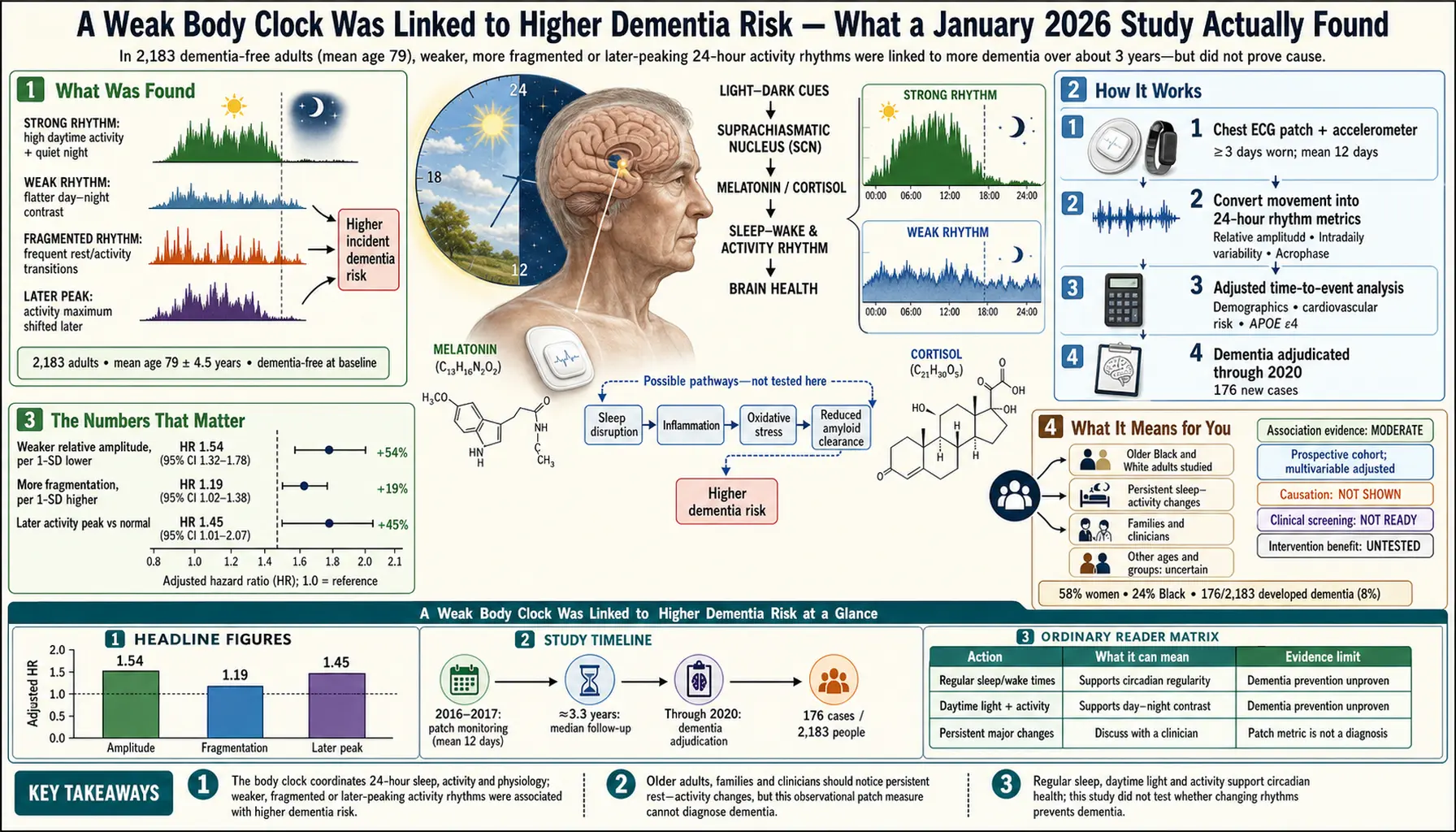
A study published in the journal Neurology — online on December 29, 2025 and in the print issue of January 27, 2026 — reported that older adults whose 24-hour rest-activity rhythm was weakest went on to develop dementia at a higher rate than those with the strongest rhythms. In plain terms, the people whose days and nights showed the least contrast — less active by day, less settled at night — were the most likely to be diagnosed over the following years. The study is observational, and its authors describe limits on what it can show (set out below).
What the researchers actually did
The work came from the long-running Atherosclerosis Risk in Communities (ARIC) study, a US community cohort, and was led by Wendy Wang of UT Southwestern Medical Center and colleagues. The analysis included 2,183 older adults — mean age 79, 58% women, 24% Black — who were free of dementia at the start. Rather than relying on a sleep questionnaire, the researchers used the accelerometer built into a long-term continuous ECG monitoring patch worn on the chest in 2016–17. Participants were included if they wore it for at least 3 days; the mean wear time was 12 days. From that continuous record the researchers measured the strength, fragmentation, consistency and timing of each person's daily rhythm, then tracked who developed dementia, with cases adjudicated through 2020. Over a median follow-up of 3 years, 176 people (8%) developed dementia.
What the numbers showed
The clearest signal came from a measure called relative amplitude — essentially how sharp the contrast is between a person's most active stretch of the day and their most restful stretch of the night. The study's authors call it a measure of rhythm strength. In this study, after multivariable adjustment, each one-standard-deviation drop in relative amplitude was associated with a 54% higher risk of dementia (95% confidence interval 32%–78%). Each one-standard-deviation increase in rhythm fragmentation (“intradaily variability”) was associated with a 19% greater risk (95% CI 2%–38%). Two cosinor measures of rhythm strength were also associated with higher risk per one-standard-deviation decrement: amplitude (hazard ratio 1.43, 95% CI 1.15–1.78) and mesor (1.33, 95% CI 1.08–1.63). A later daily activity peak (“acrophase”) was associated with 1.45 times the risk compared with a normal peak time (95% CI 1.01–2.07). Rhythm consistency from day to day (“interdaily stability”) showed no significant association. Comparing the third of participants with the lowest relative amplitude with the third with the highest, the full paper reports a hazard ratio of 2.48 (95% CI 1.59–3.88). The fully adjusted models accounted for age, sex, race/center, education, APOE ε4 (a genetic risk factor for Alzheimer's disease), body mass index, blood pressure and its treatment, diabetes, smoking, alcohol, coronary heart disease, stroke and heart failure.
What the rhythm measures capture
The study measured the shape of the 24-hour activity pattern rather than hours of sleep. The measures most consistently linked to dementia were those of rhythm strength — the contrast between active days and restful nights — along with rhythm fragmentation and a later activity peak. The authors give daytime sleepiness and nighttime arousals as examples of what a more fragmented rhythm reflects. They also note that rest-activity rhythms reflect patterns of physical activity and the sleep-wake cycle.
Limits of the study
First, the study is observational: it can show that weak rhythms and later dementia travel together, but it cannot prove that one causes the other. Second — and this is the big one — reverse causation is a real possibility. Earlier research found rest-activity rhythm fragmentation in cognitively normal adults who already carried Alzheimer's-type amyloid pathology (a 2018 study of 189 people), and a post-mortem study linked weaker activity rhythms to fewer neurons in the suprachiasmatic nucleus, the brain's master clock. The ARIC authors write that they “cannot exclude the possibility of reverse causality” and that alterations in rest-activity rhythms may be early signs of dementia. With a median follow-up of three years, some people with weak rhythms may already have been in the early, undiagnosed phase of disease — a fading rhythm may be an early sign as much as a cause. In a sensitivity analysis that excluded 409 participants with mild cognitive impairment, the measures of rhythm strength remained associated with dementia. Third, this was an older cohort (average age 79), so the findings may not transfer neatly to midlife. The study had 176 dementia cases and one recording period per person (mean 12 days). The authors list as limitations the lack of dementia subtype data and of objective sleep-disorder measurements such as for obstructive sleep apnea. The study did not test any intervention: the authors write that “further research to determine whether circadian rhythm interventions can reduce dementia risk is warranted.”
Questions the research leaves open
Whether changing a person's rest-activity rhythm changes dementia risk is untested. In their discussion, the ARIC authors name candidate approaches for future research: light therapy, melatonin, and lifestyle changes such as time-restricted eating or scheduled sleep and exercise routines, noting that prior research suggests light therapy may help maintain circadian rhythms. Background research describes the suprachiasmatic nucleus as the pacemaker that synchronizes the body's rhythms with the external day-night cycle. Sleep disorders were not measured objectively in this study; insomnia and other sleep-wake problems are covered elsewhere in the library.
Related background is on the pages on circadian rhythm sleep-wake disorders and sleep hygiene. Decisions about sleep, medicines and supplements belong with a clinician.
Sources
- Wang W, et al. Association Between Circadian Rest-Activity Rhythms and Incident Dementia in Older Adults: The Atherosclerosis Risk in Communities Study. Neurology. Online December 29, 2025; print January 27, 2026. DOI: 10.1212/WNL.0000000000214513
- American Academy of Neurology press release: Do our body clocks influence our risk of dementia?
Key Research Papers
- Wang W, Wanigatunga AA, Etzkorn LH, Rabinowitz JA, Palta P, Pike JR, et al. (2026). Association Between Circadian Rest-Activity Rhythms and Incident Dementia in Older Adults: The Atherosclerosis Risk in Communities Study. Neurology 106(2):e214513. — PubMed PMID: 41461059
- Musiek ES, Bhimasani M, Zangrilli MA, Morris JC, Holtzman DM, Ju YS (2018). Circadian Rest-Activity Pattern Changes in Aging and Preclinical Alzheimer Disease. JAMA Neurology 75(5):582-590. — PubMed PMID: 29379963
- Wang JL, Lim AS, Chiang WY, Hsieh WH, Lo MT, Schneider JA, et al. (2015). Suprachiasmatic neuron numbers and rest-activity circadian rhythms in older humans. Annals of Neurology 78(2):317-322. — PubMed PMID: 25921596