 — February 3, 2026
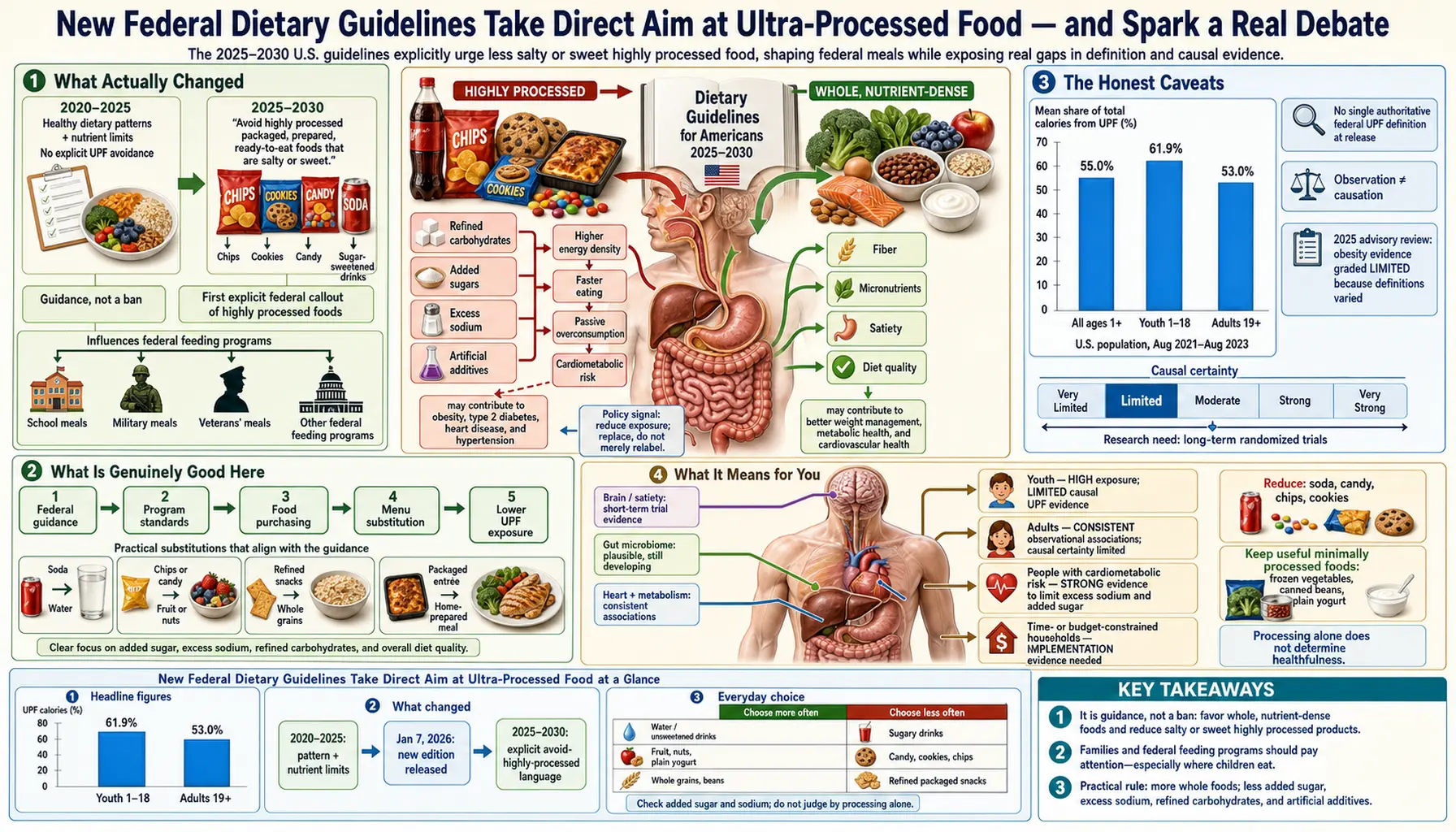
New Federal Dietary Guidelines Take Direct Aim at Ultra-Processed Food — and Spark a Real Debate
Every five years, the U.S. government publishes a document that quietly shapes what ends up on tens of millions of plates: the Dietary Guidelines for Americans. Many Americans are unfamiliar with it, but it directly informs food standards in schools and child-care facilities, military dining, federal cafeterias, and nutrition assistance programs such as SNAP and WIC. On January 7, 2026, the Department of Health and Human Services (Secretary Robert F. Kennedy Jr.) and the Department of Agriculture (Secretary Brooke Rollins) released the 2025–2030 edition. The departments’ joint press release announced a “Historic Reset of U.S. Nutrition Policy” that would “Put Real Food Back at Center of Health” and called the edition “the most significant reset of federal nutrition policy in decades”; the Secretaries’ message inside the document says “in our nation’s history.” Outside reviews, summarized below, were mixed.
What Actually Changed
The change that drew the most attention is a section titled “Limit Highly Processed Foods, Added Sugars, & Refined Carbohydrates.” In it the guidelines tell readers to “avoid highly processed packaged, prepared, ready-to-eat, or other foods that are salty or sweet, such as chips, cookies, and candy,” to “avoid sugar-sweetened beverages, such as sodas, fruit drinks, and energy drinks,” and to limit foods and beverages containing artificial flavors, petroleum-based dyes, artificial preservatives, and low-calorie non-nutritive sweeteners. The grains section calls for a significant reduction in highly processed, refined carbohydrates such as white bread, packaged breakfast options, flour tortillas, and crackers. Harvard’s Nutrition Source described this edition as “the first to call out a broader category of ‘highly processed foods,’” and AJMC’s summary of a JAMA Perspective called it “the first-ever explicit recommendation to limit or avoid highly processed, packaged, or ready-to-eat foods.” According to that summary, earlier editions avoided discouraging specific foods or food categories, emphasizing moderation and nutrient targets instead — an approach the Perspective said implicitly permitted soda, processed meats, and refined-grain snacks within a “healthy eating pattern.”
Several other numbers moved, compared with the 2020–2025 edition:
- Added sugars: the new edition states that “no amount of added sugars or non-nutritive sweeteners is recommended or considered part of a healthy or nutritious diet” and that “one meal should contain no more than 10 grams of added sugars.” The previous limit was less than 10% of daily calories (about 50 grams a day on a 2,000-calorie diet); Harvard’s review describes the change as a reduction.
- Protein: the goal is 1.2–1.6 grams per kilogram of body weight per day, from both animal and plant sources — up from the previously recommended minimum of 0.8 g/kg, which Harvard’s review describes as 50 to 100 percent more.
- Full-fat dairy: the dairy section says to “include full-fat dairy with no added sugars,” with a goal of 3 servings a day on a 2,000-calorie pattern; NBC News noted that the previous edition recommended fat-free or low-fat milk and yogurt. Red meat is listed among the animal protein foods, and for cooking fats the document says to “prioritize oils with essential fatty acids, such as olive oil,” adding that “other options can include butter or beef tallow.”
- Saturated fat kept its long-standing ceiling: the document says it “should not exceed 10% of total daily calories” (about 22 grams at 2,000 calories), that significantly limiting highly processed foods will help meet that goal, and that more high-quality research is needed to determine which types of dietary fats best support long-term health. Sodium stayed at less than 2,300 mg per day for ages 14 and up, with lower limits for younger children.
- Alcohol: the previous limits (up to two drinks a day for men and one for women) were replaced with “Consume less alcohol for better overall health,” with no specific number attached. The document lists “people who should completely avoid alcohol”: pregnant women, people recovering from alcohol use disorder or unable to control the amount they drink, and people taking medications or with medical conditions that can interact with alcohol.
Where Reviewers Found Agreement With the Research
The focus on ultra-processed food lines up with a large body of observational research. A 2024 umbrella review in The BMJ pooled 45 analyses from earlier meta-analyses (about 9.9 million participants) and found direct associations between ultra-processed food exposure and 32 of the health measures examined, spanning mortality, cancer, and mental, respiratory, cardiovascular, gastrointestinal, and metabolic health. The evidence was graded convincing for cardiovascular-disease deaths and type 2 diabetes, and highly suggestive for deaths from any cause, heart-disease deaths, and obesity; under the GRADE system most of the pooled analyses were rated low or very low quality, as is common for observational data. Stanford Medicine’s nutrition review said the guidelines’ messages to eat more vegetables and fruits, choose whole grains over refined grains, limit added sugars and excess sodium, and reduce highly processed foods “are consistent with decades of research.” Harvard’s Nutrition Source quoted the chair of the school’s Department of Nutrition: the guidelines “move in the right direction by reinforcing the importance of reducing added sugars and cutting back on refined grains and other highly processed foods.”
Criticisms and Open Questions
A guideline is not a study. It is a synthesis of evidence, filtered through policy choices — and reviews of this edition raised several points.
“Highly processed” is not defined in the document. Research such as the BMJ umbrella review classifies foods with the Nova system, while the guidelines use their own term without a definition. Harvard’s review called the terminology “somewhat vague on the surface (food processing is a spectrum after all),” and Stanford’s review said it “offers inadequate practical guidance for schools, institutions, and policymakers.” The 2025 Dietary Guidelines Advisory Committee’s own systematic review graded the evidence linking diets higher in foods classified as ultra-processed to greater body fat and risk of overweight or obesity as “limited” in children, adolescents, and adults, and found too little evidence to draw any conclusion for infants and young children, pregnancy, or the postpartum period.
Reviewers saw a tension on saturated fat. Harvard’s analysts worked through the arithmetic: on a 2,000-calorie diet the 10% limit is roughly 22 grams of saturated fat; three full-fat dairy servings (a cup of whole milk, ¾ cup of full-fat Greek yogurt, and an ounce of cheddar) come to about 17 grams; and one tablespoon of butter (7 grams) or beef tallow (6 grams), both listed as cooking-fat options, would pass the limit before any other food that day. Stanford’s review called the guidelines “internally inconsistent” on this point. On the protein target, Harvard’s review noted that the guidelines do not distinguish between protein sources and quoted the department chair: “Evidence continues to suggest that plant-based proteins and fish are associated with more favorable health outcomes than diets high in red meat.” Stanford’s review added that most Americans already consume enough protein and that fiber, a nutrient most Americans fall short on, is downplayed.
The alcohol message is less specific. Harvard’s review called it “vague,” and NBC News reported that it was weaker than some experts anticipated, given a federal report released in January 2025 that, in NBC’s description, suggested at least one daily drink could increase the risk of liver cirrhosis, esophageal cancer, and oral cancer. The process itself drew scrutiny. According to Harvard’s Nutrition Source, the administration rejected the 2025 Dietary Guidelines Advisory Committee’s scientific report, and a supplemental scientific analysis was produced instead by a group selected through a “federal contracting process”; a member of that advisory committee told Harvard Chan News there had been no transparency “in who wrote the new DGAs” or in the methodology used. NBC News reported that four of the nine scientists involved in crafting and reviewing the new guidelines disclosed financial ties to the dairy and meat industries, including research grants and consulting and speaker’s fees; Harvard’s review notes that the ties are disclosed in the supplemental analysis.
Key Points
Across the reviews summarized above, the parts of the guidelines with the broadest agreement are the emphasis on whole foods, fewer sugar-sweetened drinks and packaged snacks, more vegetables and fruit, whole grains in place of refined grains, and less added sugar and sodium. Those themes overlap with the Mediterranean and anti-inflammatory eating patterns. The protein target is contested: Harvard’s and Stanford’s reviews questioned the emphasis on protein and the absence of guidance on which protein sources to favor.
The saturated-fat ceiling did not change: the document keeps the 10%-of-calories limit while listing butter and beef tallow among cooking-fat options and recommending full-fat dairy, and the reviewers’ arithmetic shows how quickly full-fat animal foods approach that limit within a single day. The document itself states that more high-quality research is needed to determine which types of dietary fats best support long-term health. Because these guidelines govern institutional food, their largest real-world effect over the next five years may be felt less in home kitchens than in school and federal cafeteria menus — where “limit highly processed foods” will have to be turned into an actual, workable definition. AJMC’s summary of the JAMA Perspective calls implementation “the most critical uncertainty.”
Sources
- USDA / HHS press release: “Kennedy, Rollins Unveil Historic Reset of U.S. Nutrition Policy, Put Real Food Back at Center of Health,” January 7, 2026. usda.gov press release
- Dietary Guidelines for Americans, 2025–2030 — official site. dietaryguidelines.gov (also published at realfood.gov; full text: Dietary Guidelines for Americans, 2025–2030, PDF)
- Harvard T.H. Chan School of Public Health, The Nutrition Source: “Dietary Guidelines for Americans 2025–2030: progress on added sugar, protein hype, saturated fat contradictions,” January 9, 2026. nutritionsource.hsph.harvard.edu
- AJMC: “New HHS Dietary Guidelines Take Hard Line on Processed Foods for First Time,” 2026. ajmc.com
- NBC News: “New U.S. dietary guidelines: 6 biggest changes to know,” 2026. nbcnews.com
- Stanford Medicine: “What the 2025–2030 Dietary Guidelines Get Right—and Where They Fall Short.” med.stanford.edu
- National CACFP Association summary, January 8, 2026. cacfp.org
- Background evidence — Lane MM, et al. “Ultra-processed food exposure and adverse health outcomes: umbrella review of epidemiological meta-analyses.” BMJ. 2024. PMID 38418082
Key Research Papers
Papers and reviews checked while fact-checking this article; each entry was confirmed against PubMed and Crossref. The guideline document itself and the news coverage are listed under Sources.
- Lane MM, Gamage E, Du S, Ashtree DN, McGuinness AJ, Gauci S, et al. (2024). Ultra-processed food exposure and adverse health outcomes: umbrella review of epidemiological meta-analyses. BMJ 384:e077310. — PubMed PMID: 38418082
- Stanford FC, Taylor C, Booth S, Hoelscher DM, Anderson CAM, Deierlein A, et al. (2024). Dietary Patterns with Ultra-Processed Foods and Growth, Body Composition, and Risk of Obesity: A Systematic Review. 2025 Dietary Guidelines Advisory Committee; USDA Nutrition Evidence Systematic Review, Alexandria (VA). — PubMed PMID: 39817921
- Mozaffarian D (2026). The 2025-2030 Dietary Guidelines for Americans. JAMA 335(7):575-577. — PubMed PMID: 41533498 (Perspective with no abstract in PubMed; its points are reported here as AJMC summarized them)
- Peltier MR, Chander G, Jones HE, Chang G, McKee SA (2026). Less than what? Response to alcohol consumption recommendations in the 2025-2030 dietary guidelines for Americans. Lancet Regional Health – Americas 60:101510. — PubMed PMID: 42630529