 — January 27, 2026
· “Pseudo Leukotrienes” and the Free-Radical Rethink of Severe Asthma
— January 27, 2026
· “Pseudo Leukotrienes” and the Free-Radical Rethink of Severe Asthma
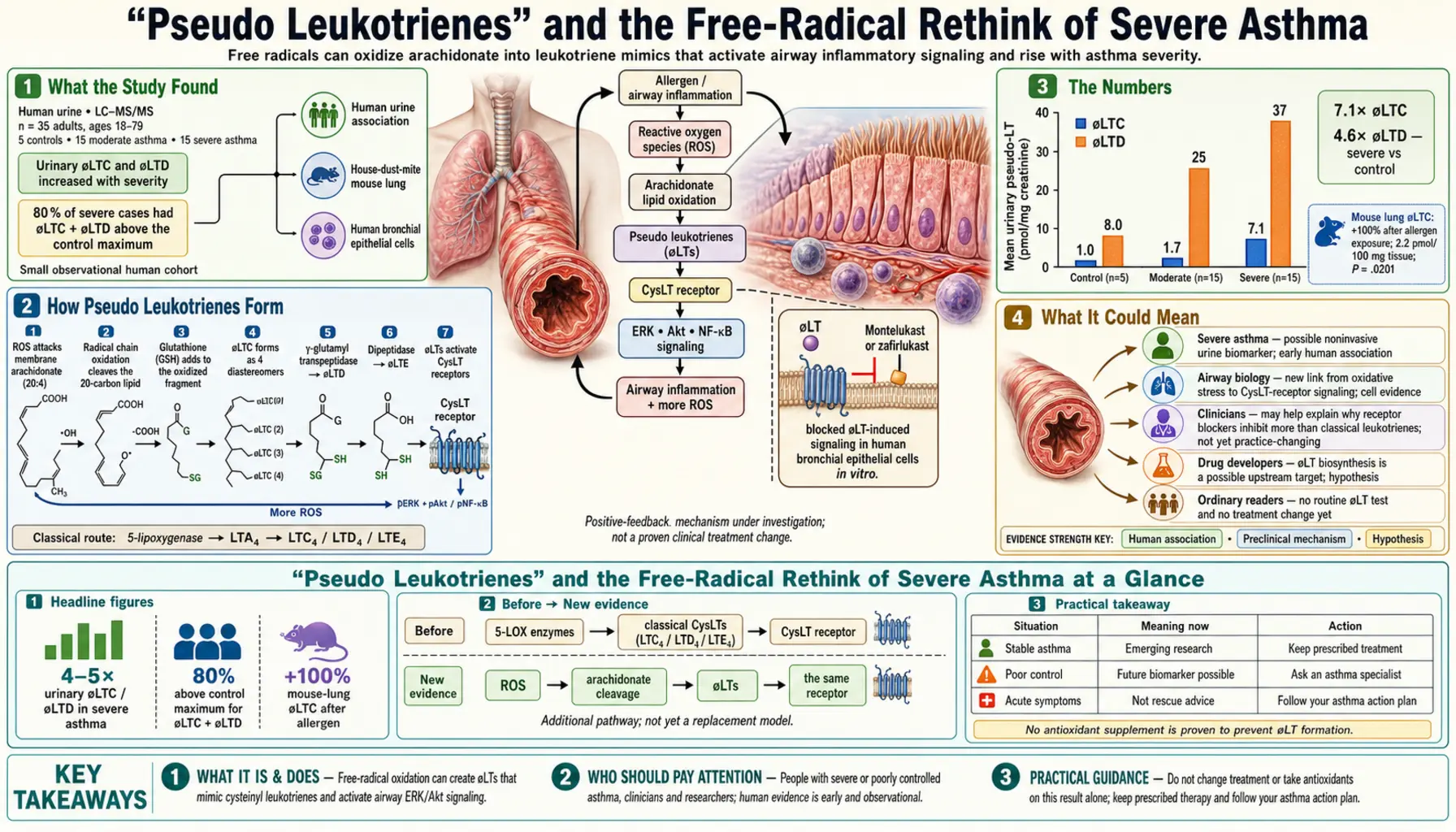
For decades, a family of inflammatory molecules called leukotrienes has been a central part of the scientific story of severe asthma — they are the target of drugs such as montelukast. A study in the January 2026 issue of the Journal of Allergy and Clinical Immunology, which drew wide news coverage in late January, argues that a second set of look-alike molecules, made by a different chemical route, may be doing a large share of the damage. The researchers call them “pseudo leukotrienes,” and the twist is that the body does not build them with enzymes at all — they form by accident, through uncontrolled free-radical chemistry.
Table of Contents
1. What the Study Found
A team led by chemist Robert Salomon (the Charles Frederic Mabery Professor of Research in Chemistry at Case Western Reserve University), working with collaborators at the University of Toledo and Cleveland Clinic Children’s Hospital, studied a previously overlooked family of molecules they named pseudo leukotrienes (abbreviated øLTs), which the same group first described in 2023 in laboratory-grown human retinal cells under oxidative stress. These compounds closely mimic the structure of the classic cysteinyl leukotrienes — LTC4, LTD4, and LTE4 — that have anchored asthma science for decades. In laboratory tests on a human bronchial epithelial cell line, the look-alikes switched on the same inflammatory signaling (the ERK and Akt pathways) that classic leukotrienes trigger, and the receptor-blocking drugs montelukast and zafirlukast inhibited it — cell-culture evidence that they act through the same cellular receptor. In those cells they were slightly less potent than the classic molecule (200 nM øLTD raised ERK activation 1.7-fold, against 2.1-fold for 100 nM LTD4). Classic cysteinyl leukotrienes are potent airway constrictors, stimulate mucus secretion and draw eosinophils, a type of inflammatory cell, into the airway lining; whether pseudo leukotrienes do the same in the human lung was not tested.
2. How Pseudo Leukotrienes Form
The mechanism is the paper’s central point. Genuine cysteinyl leukotrienes are manufactured on a controlled enzymatic assembly line: the enzyme 5-lipoxygenase acts on arachidonic acid, a fatty acid in cell membranes, to produce a precise product. Pseudo leukotrienes skip that assembly line entirely. Instead, free radicals attack the same fatty acid in an uncontrolled reaction — a process called radical-induced lipid oxidation, or lipid peroxidation — that breaks it into fragments; one fragment then combines with glutathione, an antioxidant that scavenges lipid free radicals, to form the look-alikes.
A useful analogy: the enzyme pathway is a factory carefully stamping out one part, while the free-radical pathway is a fire in the warehouse that happens to spit out debris shaped like that same part. Because pseudo leukotrienes are made without 5-lipoxygenase, the group wrote in 2023 that drugs that block that enzyme, such as zileuton, are not expected to stop them from forming. Receptor-blocking drugs are a different case: in the new cell experiments, montelukast and zafirlukast blocked the pseudo leukotriene signal, and the authors write that the benefit of these drugs may include blocking pseudo leukotriene activity previously credited only to classic leukotrienes. The paper states that “the therapeutic utility of CysLTR antagonists is unaffected by our discoveries.”
3. The Numbers
The team measured these molecules in morning urine from 35 adults aged 18 to 79: 5 healthy controls, 15 people with moderate asthma and 15 with severe asthma. According to the abstract, people with severe asthma had mean urinary øLTC and øLTD levels four to five times higher than the controls (the results section gives creatinine-adjusted ratios of 7.1-fold for øLTC and 4.6-fold for øLTD). The combined øLTC+øLTD level rose with severity and separated the controls from both the moderate and the severe group, and 80% of the people with severe asthma had combined levels above the highest control value. The paper also sets these levels beside urinary classic leukotriene levels reported in an earlier study and finds the pseudo leukotrienes more than 100 times as abundant — a cross-study comparison the authors say still has to be confirmed by measuring both in the same people. In mice given house dust mite allergen, lung øLTC levels doubled, an animal result. As background, the paper cites earlier research showing weaker antioxidant defenses in asthma: airway glutathione is depleted in severe asthma, and activity of the antioxidant enzyme superoxide dismutase is lower in asthmatic lungs and falls within minutes of an allergen challenge. The full paper, “Radical-induced lipid oxidation produces a torrent of leukotriene-like agonists in severe asthma,” appears in Journal of Allergy and Clinical Immunology 2026;157(1):99-109 (published online October 15, 2025), DOI 10.1016/j.jaci.2025.09.027.
4. What It Could Mean
The authors point to two directions. The first is measurement. Because pseudo leukotrienes show up in urine and rise with severity, the authors describe them as new biomarkers that may allow non-invasive assessment of asthma severity and of how well treatments work, and they suggest that monitoring them could help identify early disease and support correcting defective antioxidant defenses before the disease progresses.
The second is strategy. The abstract states that “inhibiting the biosynthesis of øLTs may provide new therapeutic strategies for preventing asthmatic inflammation”; no such drug was tested in the study. In the university’s press release, Salomon said: “The real importance of this discovery is the possibility of treating these diseases with drugs that prevent the free radical process or moderate it rather than drugs that block the receptor.” The release adds that the team plans to examine whether pseudo leukotrienes play a role in RSV infection, bronchiolitis in babies and COPD, and that the findings could bear on other inflammatory conditions.
5. Honest Caveats
The study has clear limits:
- It is an association, not a cure. The study shows that pseudo leukotrienes are elevated and correlate with severity. It does not show that lowering them makes asthma better — that would require a treatment trial that has not yet been done.
- It does not show that antioxidant supplements treat asthma. The study tested no supplement, including vitamin C, vitamin E, or N-acetylcysteine. Trials of antioxidant vitamins in asthma have been small and inconclusive: a 2014 Cochrane review of vitamin C and E supplementation found five trials with 214 participants in total and concluded the evidence was insufficient for robust conclusions, and a randomized trial in 72 adults with mild to moderate asthma found that 500 mg of natural vitamin E daily for six weeks had no effect on airway responsiveness or any other measure of asthma control. This paper offers a mechanism that could explain a benefit; it is not evidence that over-the-counter antioxidants control the disease.
- There is no clinical test yet. Urinary pseudo leukotrienes are measured with a research laboratory method (liquid chromatography–tandem mass spectrometry), not a test offered in clinical practice. The urine study was small — 35 adults, only 5 of them healthy controls — so the size of the difference is uncertain until larger groups are studied.
- The study tested no change in treatment. Inhaled steroids, bronchodilators, biologics, and leukotriene blockers remain the standard of care, and the paper reports no data on stopping or changing any of them; its authors write that the therapeutic usefulness of leukotriene receptor blockers is unaffected by their findings.
6. Key Points
The paper’s contribution is conceptual: it shifts part of the asthma story from “block the receptor” toward “prevent the chemistry that keeps flipping the switch.” The authors suggest this could eventually yield a urine test for severity and therapies aimed at stopping pseudo leukotrienes from forming; neither has yet been validated or tested in a clinical trial. The study offers no evidence for changing an existing asthma action plan, and decisions about asthma medicines belong with a clinician.
Sources
- Liu SY, Linetsky M, et al.; senior author Salomon RG. Radical-induced lipid oxidation produces a torrent of leukotriene-like agonists in severe asthma. Journal of Allergy and Clinical Immunology. 2026;157(1):99-109. DOI 10.1016/j.jaci.2025.09.027 — full text at jacionline.org
- ScienceDaily. “Scientists may have been wrong about what causes asthma.” January 27, 2026. sciencedaily.com/releases/2026/01/260127010147.htm
- U.S. News & World Report (HealthDay). “New Discovery Could Change How Asthma Is Treated, Scientists Say.” January 28, 2026. usnews.com
- Respiratory Therapy. “‘Pseudo Leukotrienes’ May Cause Asthma.” January 2026. respiratory-therapy.com
Key Research Papers
The primary paper and the studies used to check this article, each verified against its PubMed record and abstract.
- Liu SY, Linetsky M, Hite A, Cheng YS, Miyagi M, Zhu SC, et al. (2026). Radical-induced lipid oxidation produces a torrent of leukotriene-like agonists in severe asthma. Journal of Allergy and Clinical Immunology 157(1):99-109. — PubMed PMID: 41101738
- Linetsky M, Mondal A, Liu SY, Hite AM, Enduri S, Cheng YS, et al. (2023). Cysteinyl leukotriene-like metabolites are generated in retinal pigment epithelial cells through glutathionylation/reduction of an oxidatively truncated fragment of arachidonate. Results in Chemistry 6:100995. — PubMed PMID: 38855016
- Bisgaard H (2001). Pathophysiology of the cysteinyl leukotrienes and effects of leukotriene receptor antagonists in asthma. Allergy 56(Suppl 66):7-11. — PubMed PMID: 11421935
- Comhair SA, Bhathena PR, Dweik RA, Kavuru M, Erzurum SC (2000). Rapid loss of superoxide dismutase activity during antigen-induced asthmatic response. Lancet 355(9204):624. — PubMed PMID: 10696986
- Fitzpatrick AM, Jones DP, Brown LA (2012). Glutathione redox control of asthma: from molecular mechanisms to therapeutic opportunities. Antioxidants & Redox Signaling 17(2):375-408. — PubMed PMID: 22304503
- Wilkinson M, Hart A, Milan SJ, Sugumar K (2014). Vitamins C and E for asthma and exercise-induced bronchoconstriction. Cochrane Database of Systematic Reviews 2014(6):CD010749. — PubMed PMID: 24936673
- Pearson PJ, Lewis SA, Britton J, Fogarty A (2004). Vitamin E supplements in asthma: a parallel group randomised placebo controlled trial. Thorax 59(8):652-656. — PubMed PMID: 15282383