 — January 10, 2026
Fat or Muscle? A Large New Study Weighs What You Actually Lose on GLP-1 Drugs and After Surgery
Since GLP-1 drugs such as semaglutide and tirzepatide — the active ingredients in several brand-name diabetes and weight-loss medicines — came into wide use, the recurring question has not been whether they take weight off. Large randomized trials (STEP 1 for semaglutide, SURMOUNT-1 for tirzepatide) showed that they do. The question is what kind of weight. Every pound lost is some mix of fat and fat-free mass (the muscle, bone, organ and water that make up everything that is not fat), and losing too much muscle is a recognized concern: the study’s authors describe sarcopenic obesity (low muscle mass and function alongside excess fat) as a growing problem among older adults, and note that women are more prone than men to losing lean mass during calorie restriction. A study published January 9, 2026 in JAMA Network Open is a large real-world look (3,066 patients) at exactly that trade-off, comparing body-composition changes after GLP-1 drugs versus after bariatric surgery.
What the researchers did
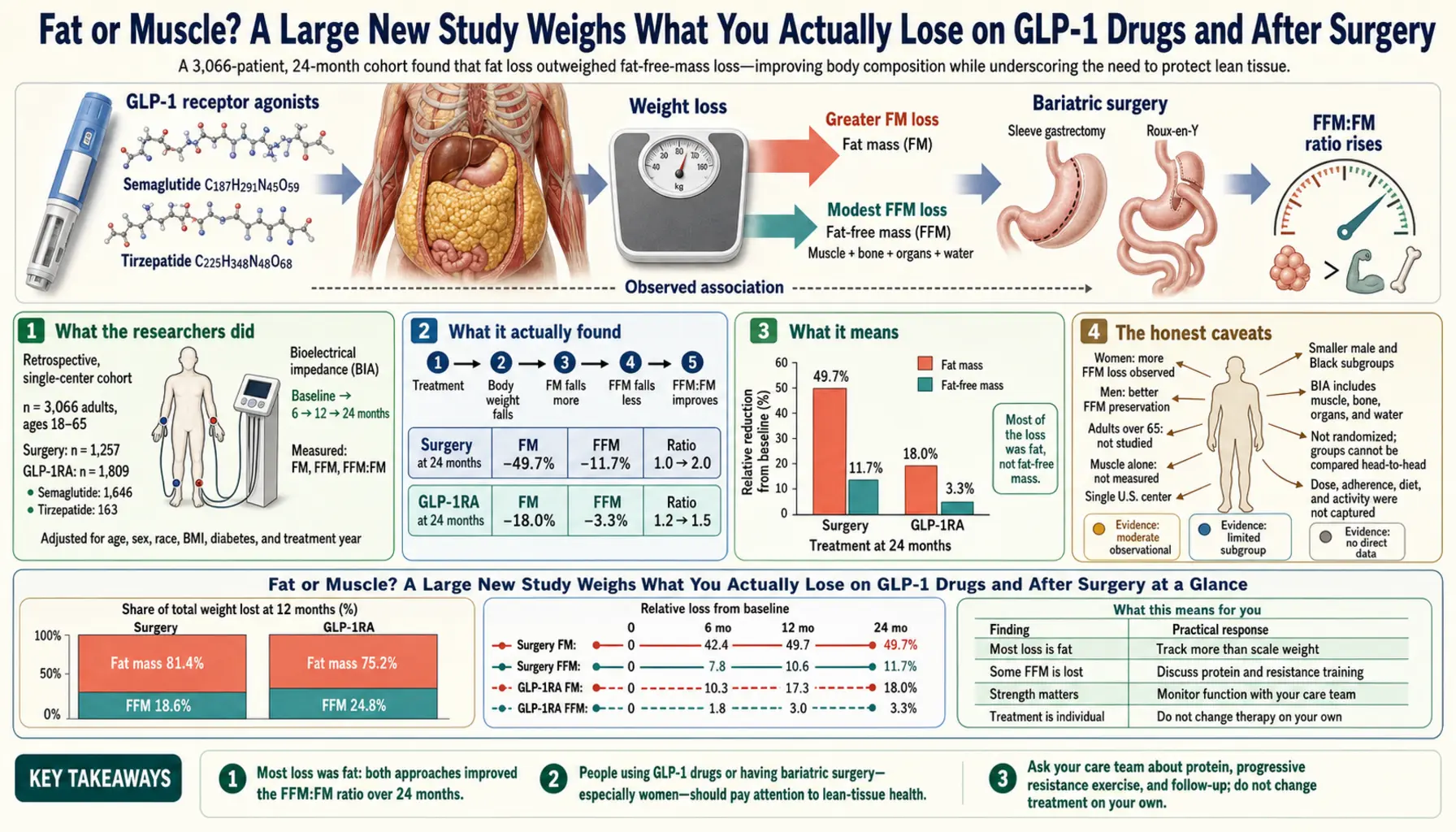
The team — led by Zicheng Wang with senior author Danxia Yu at Vanderbilt University Medical Center — ran a retrospective cohort study using electronic health records from a single U.S. academic medical center. They followed 1,257 adults who had bariatric surgery and 1,809 adults treated with a GLP-1 receptor agonist (1,646 on semaglutide, 163 on tirzepatide) for 24 months; all were aged 18 to 65. Both groups were roughly four-fifths women (82.2% and 80.5%) with mean ages in the early-to-mid 40s (43.4 and 45.4 years). Body composition — fat mass (FM) and fat-free mass (FFM) — was estimated using bioelectrical impedance analysis (BIA). The metric that carries the message is the FFM-to-FM ratio: a higher ratio means a leaner body composition, and the authors read a rising ratio as a favorable shift. They cite a pooled analysis of 7 prospective cohorts (16,155 adults) in which higher fat-free mass was associated with lower total mortality and high fat mass with higher mortality.
What it actually found
Over 24 months, both approaches moved body composition in the favorable direction — fat fell much faster than lean mass:
- Bariatric surgery cut fat mass by 49.7% (95% CI, 47.8–51.5) while fat-free mass dropped 11.7% (95% CI, 10.4–12.9).
- GLP-1 drugs cut fat mass by 18.0% (95% CI, 16.4–19.7) with fat-free mass down 3.3% (95% CI, 2.1–4.4).
Because fat came off far faster than lean tissue in both groups, the FFM/FM ratio rose in both — from 1.0 to about 2.0 after surgery and from 1.2 to 1.5 with GLP-1 drugs — which the authors describe as a favorable shift in body composition, not merely a lighter body. Measured another way, as the share of total weight lost that was fat-free mass, FFM made up 18.6% of the loss at 12 months after surgery and 24.8% at 12 months on the drugs.
The study also reported a sex gap. Men preserved fat-free mass better than women, and the authors’ summary says this was especially so after GLP-1 drug treatment: men showed no significant fat-free-mass reduction at 6 months after either treatment and kept that through 12 to under 24 months on the drugs, while women had significant reductions after both. As a share of total weight lost, the gap was widest after surgery: fat-free mass accounted for 19.9% of total weight lost in women versus 10.6% in men at 12 months — nearly twice as large a share in women (on the drugs, 25.3% versus 22.0%). Men were a small subgroup (224 surgical and 352 drug-treated patients), so their estimates are imprecise (95% CI for the 10.6%: 5.6–15.6), and the authors call it a potential sex difference to be interpreted with caution.
Reading the Evidence
In this dataset, neither GLP-1 drugs nor surgery was associated with lean-mass loss that outpaced fat loss: in both groups fat loss dominated, and the study’s main measure is that proportion. Some fat-free-mass loss is expected when the body gets smaller, since a lighter body carries less structural tissue and water; a randomized trial of calorie restriction described the lean-mass decline that came with modest (~7%) weight loss as possibly “physiologically appropriate for a reduced body weight.” The sex difference is the finding the authors single out: women, about four-fifths of both groups here, lost a larger fraction of their weight as fat-free mass. What that means for function is less settled. A review of diet-induced weight loss found that it reduces muscle mass without adversely affecting muscle strength, and that weight loss improves overall physical function, most likely through the loss of fat. The same review found that high protein intake helps preserve lean and muscle mass during weight loss but does not improve strength and could have adverse effects on metabolic function, and that endurance and resistance training both help preserve muscle mass, with resistance exercise also improving strength. The study’s authors name tailored strategies for preserving fat-free mass in women — more dietary protein, resistance training or both, alongside drug or surgical treatment — as something future interventions could test.
The honest caveats
This is not a head-to-head trial; the authors state that the study was not designed for direct comparisons between the two groups, so the numbers do not show that “surgery beats drugs.” It was retrospective and observational: the two groups were different people who chose (or were selected for) different treatments, and surgical patients started heavier (mean BMI 46.8 versus 41.0) and typically lose far more total weight, which enlarges every surgical percentage. Body composition was estimated by bioelectrical impedance, not measured with the gold-standard DXA scan or MRI; BIA is convenient but less precise, its readings shift with hydration, recent food or water intake, physical activity and temperature, and it cannot separate skeletal muscle from bone, organ tissue and body water. And the data came from a single academic medical center, so the exact figures may not transfer to other populations. The authors also note that the health records held no data on diet, physical activity or other weight-management programs, that drug dose and adherence were not accounted for, and that the study did not link the body-composition changes to clinical outcomes such as metabolic improvements or quality of life.
Key Points
In this cohort, both GLP-1 drugs and weight-loss surgery were associated with a shift toward a higher fat-free-to-fat ratio, not just a lower number on the scale. Lean-mass loss was not zero: fat-free mass made up roughly a fifth to a quarter of the weight lost at 12 months, and women lost a larger share than men. The question weighs most for older adults, in whom age-related muscle loss (sarcopenia) is already a concern, and this study included no one over 65. Whether added protein or resistance training changes the picture for people on these treatments is an open question the authors name for prospective studies; this record-based study did not capture diet or exercise. Decisions about weight-loss treatment, exercise and diet belong with a clinician.
Sources
- Wang Z, Wang L, Zhang X, et al; Yu D (senior author). Body Composition Changes After Bariatric Surgery or Treatment With GLP-1 Receptor Agonists. JAMA Network Open. January 9, 2026. doi:10.1001/jamanetworkopen.2025.53323
- Full text (open access): jamanetwork.com — JAMA Network Open fullarticle 2843518
- Vanderbilt University Medical Center news release: Weight loss drugs and bariatric surgery improve the body’s fat ‘balance’ (Jan 9, 2026)
Key Research Papers
- Wang Z, Wang L, Zhang X, Lowery BD, Shaffer LL, Chen Y, et al. (2026). Body Composition Changes After Bariatric Surgery or Treatment With GLP-1 Receptor Agonists. JAMA Network Open 9(1):e2553323. — PubMed PMID: 41511769
- Wilding JPH, Batterham RL, Calanna S, Davies M, Van Gaal LF, Lingvay I, et al. (2021). Once-Weekly Semaglutide in Adults with Overweight or Obesity. New England Journal of Medicine 384(11):989-1002. — PubMed PMID: 33567185
- Jastreboff AM, Aronne LJ, Ahmad NN, Wharton S, Connery L, Alves B, et al. (2022). Tirzepatide Once Weekly for the Treatment of Obesity. New England Journal of Medicine 387(3):205-216. — PubMed PMID: 35658024
- Sedlmeier AM, Baumeister SE, Weber A, Fischer B, Thorand B, Ittermann T, et al. (2021). Relation of body fat mass and fat-free mass to total mortality: results from 7 prospective cohort studies. American Journal of Clinical Nutrition 113(3):639-646. — PubMed PMID: 33437985
- Weiss EP, Jordan RC, Frese EM, Albert SG, Villareal DT (2017). Effects of Weight Loss on Lean Mass, Strength, Bone, and Aerobic Capacity. Medicine and Science in Sports and Exercise 49(1):206-217. — PubMed PMID: 27580151
- Cava E, Yeat NC, Mittendorfer B (2017). Preserving Healthy Muscle during Weight Loss. Advances in Nutrition 8(3):511-519. — PubMed PMID: 28507015