 — January 9, 2026
An Alzheimer's Blood Test Reaches the Clinic — and Meets the Real World
For decades, proving that someone's memory loss was actually Alzheimer's disease — and not depression, a thyroid problem, a vitamin B12 deficiency, or one of the other dementias — meant an expensive PET brain scan or a spinal tap. Both are accurate, but both are slow and costly, and a spinal tap is invasive. A blood draw that could do much of that work has been the field's long-promised shortcut. As of the start of 2026, two blood tests are FDA-cleared for people with symptoms of cognitive decline. This edition looks at what they measure, what their validation studies showed, and a late-2025 problem with one test's production lots that shows why the fine print matters as much as the headline.
What Was Actually Cleared
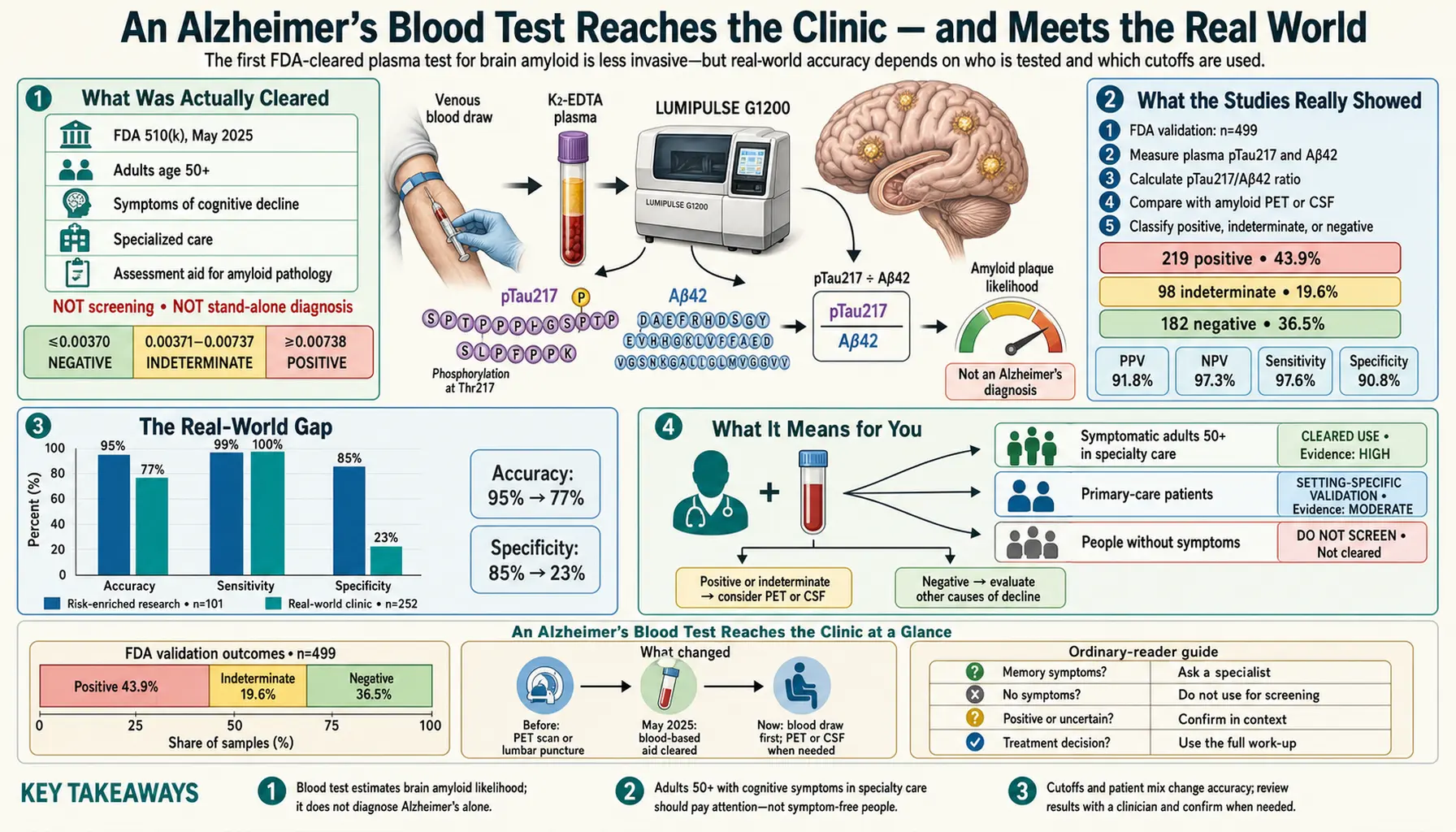
There are now two distinct tests, and they do different jobs. The first, a plasma p-tau217/beta-amyloid 1-42 ratio test, was cleared by the FDA on May 16, 2025; the agency described it as the first in vitro diagnostic device that tests blood to aid in diagnosing Alzheimer's disease. It measures the ratio of two proteins in plasma: p-tau217 (a form of tau that rises early in Alzheimer's) and beta-amyloid 1-42 (a fragment tied to the amyloid plaques that build up in the disease). The ratio between them tracks whether amyloid plaques are likely present in the brain. It is cleared for adults who already have signs and symptoms of cognitive decline and are being seen in a specialized care setting, and its labeling states that it is not intended as a screening or stand-alone diagnostic test. (The FDA's announcement gives the age range as 55 and older; the indication in the agency's 510(k) decision summary reads 50 and older.)
The second test, a plasma p-tau181 test, was cleared in October 2025 (FDA decision date October 8) for the primary-care setting; the only Alzheimer's blood test cleared before it is limited to specialized care, which made it the first cleared for primary care. Its role is narrower: it is designed to help a family doctor rule out Alzheimer's-related amyloid pathology in a patient with memory complaints. Its labeling describes a negative result as consistent with a negative amyloid PET scan and calls for investigating other causes of cognitive decline in those patients, and it states that the test is not recommended for patients who have already been referred to a specialist. It is cleared for adults 55 and older with signs, symptoms or complaints of cognitive decline.
What the Studies Really Showed
In the 499-patient study behind the ratio test's clearance, 92% of people with a positive result (201 of 219) had amyloid plaques confirmed by a PET scan or spinal fluid test, and 97% of people with a negative result (177 of 182) were confirmed to be plaque-free. Those two figures leave out the 19.6% of results (98 of 499) that fell in an in-between “indeterminate” zone, for which the labeling calls for further testing. The p-tau181 test was cleared on a 312-participant primary-care study in which 97.9% of negative results (139 of 142) matched a negative amyloid PET scan — the property a rule-out test is designed around. Its positive results were a different matter: 22.4% of them (38 of 170) matched a positive scan, and its labeling states that a positive result may not be consistent with a positive amyloid PET scan and calls for further investigation.
In these studies, a negative result on either test was usually matched by a negative scan or spinal fluid test, and a positive result on the ratio test was usually matched by a positive one. Independent research points the same way: in a 2024 Swedish study that enrolled 1,213 patients with cognitive symptoms, primary-care physicians identified clinical Alzheimer's disease with 61% accuracy after a clinical examination, cognitive testing and a CT scan, compared with 91% for a mass-spectrometry-based blood test combining p-tau217 and amyloid-beta measures. These figures come from studies run under research protocols for drawing, spinning and storing blood; the ratio test's validation used plasma samples collected in research cohorts and a clinical trial. How the tests behave in an ordinary clinic is a separate question — and that is where 2026 opens with a cautionary note.
The Real-World Gap
At the Clinical Trials on Alzheimer's Disease (CTAD) conference in San Diego in December 2025, a Mayo Clinic team reported what happened when they ran the p-tau217/beta-amyloid 1-42 ratio test, using the FDA-cleared cutoffs, on 252 patients with clinical evidence of dementia at their own tertiary neurology clinic. The test correctly flagged all 177 patients who had amyloid on PET or spinal fluid testing — but it also flagged a large share of those who did not. Among 75 patients confirmed amyloid-negative by PET or spinal fluid, 30 (40%) tested falsely positive. The share of positive results that were correct dropped from the validation study's 92% to about 75%, and overall accuracy in that cohort was about 77%. The team later published the analysis as a research letter in JAMA Neurology.
The test's manufacturer said it had identified a manufacturing problem with certain recent production lots, had placed the product on a quality hold, and believed the lots used in the Mayo study may have been among those affected; it said it was working to correct the problem and release new kits. On or about December 11, 2025, the manufacturer sent customers an urgent product-correction notice to stop using the affected lots. The FDA's recall database lists this as a voluntary, firm-initiated recall, posted and classified as Class II on February 5, 2026; it gives the reason as falsely elevated ratio results producing more positive and indeterminate classifications, and lower specificity, than spinal fluid or PET testing, with the root cause under investigation. Researchers also debated whether part of the problem lay in the cutoffs — the lead author of a 2025 Swedish accuracy study of the same automated assays noted in conference coverage that the FDA-cleared cutoffs were notably lower than the ones his group had applied — and in the known fragility of beta-amyloid 1-42, which binds to tube surfaces and is sensitive to centrifugation time, storage time and temperature. A 2025 laboratory study found that plasma beta-amyloid 42 fell by more than 15% after six hours at room temperature while p-tau217 stayed stable, which falsely raised the p-tau217/beta-amyloid 42 ratio. Whatever the exact mix of causes, the episode shows that a test that performs well in a validation study can drift in routine use, and that a faulty production lot or delayed sample handling can turn an accurate result into a misleading one.
What the Findings Show
The Alzheimer's Association's 2025 Facts and Figures report estimates that 7.2 million Americans aged 65 and older live with Alzheimer's dementia, a number it projects could reach 13.8 million by 2060. In the report's survey of 1,702 U.S. adults aged 45 and older, nearly four in five (79%) said they would want to know they had Alzheimer's disease before symptoms appeared or before symptoms interfered with daily activities. A blood draw is quicker and far less invasive than a PET scan or spinal tap. The research and the tests' own labeling attach several caveats to it:
- These are not screening tests. Both were cleared only for people who already have signs or symptoms of cognitive decline. Amyloid plaques can sit silently in the brains of cognitively normal older adults: a 2015 meta-analysis of 2,914 people with normal cognition estimated the prevalence of amyloid pathology at 10% at age 50, rising to 44% at age 90. A positive test in a symptom-free person therefore does not by itself mean Alzheimer's disease, and neither test is cleared for that use.
- A positive result is not a diagnosis. The ratio test's labeling states that a positive result “does not establish a diagnosis of Alzheimer's disease or other cognitive disorder,” and both tests' labeling says results are to be interpreted together with other clinical information. The blood test estimates amyloid biology; whether amyloid is what is causing a given person's symptoms is a question for a clinician's evaluation of the whole picture.
- What guidelines say about confirmation. The Alzheimer's Association's 2022 appropriate-use recommendations supported cautious use of blood tests in specialized memory clinics, with results confirmed by spinal fluid or PET whenever possible. Its 2025 clinical practice guideline for specialized care states that blood tests with at least 90% sensitivity and 75% specificity can be used for triage, and that tests with at least 90% sensitivity and 90% specificity can substitute for amyloid PET or spinal fluid testing; it cautions that many commercially available tests do not meet these thresholds, especially with a single cutoff. For the amyloid-lowering drugs, the 2025 appropriate-use recommendations for donanemab describe treatment candidates as having biomarker confirmation of Alzheimer's pathology by PET or spinal fluid, and lecanemab is approved for early Alzheimer's disease with confirmed brain amyloid pathology.
- Two tests, two questions. A primary-care rule-out test (p-tau181) and a specialized-care diagnostic-aid test (the p-tau217/amyloid ratio) answer different questions, and their positive results carry very different weight.
In summary: in their validation studies, negative results on both tests matched a negative reference test about 97–98% of the time in people with symptoms. Positive results on the ratio test were usually correct in its validation study but less often in the Mayo cohort, and most positive results on the p-tau181 rule-out test did not match a positive amyloid scan. Neither test is cleared for people without symptoms. Decisions about testing and treatment belong with a clinician who knows the person. Related background: the Alzheimer's disease, vascular dementia and lab tests pages.
Sources
- InvestigateTV. “FDA-approved blood test offers new hope for Alzheimer's diagnosis.” January 9, 2026. investigatetv.com/2026/01/09
- U.S. Food & Drug Administration. “FDA Clears First Blood Test Used in Diagnosing Alzheimer's Disease.” May 16, 2025 (the plasma p-tau217/β-amyloid 1-42 ratio test). fda.gov press announcement
- CNN Health. “FDA clears blood test to help rule out Alzheimer's disease in people showing symptoms.” October 13, 2025 (the plasma p-tau181 primary-care rule-out test). cnn.com/2025/10/13
- Yale Medicine. “FDA Approves First Blood Test for Alzheimer's Disease” (plain-language explainer of the 92% / 97% validation figures). yalemedicine.org
- Practical Neurology. “Accuracy of FDA-Cleared Alzheimer's Blood Test Evaluated in a Real-World Cohort.” December 3, 2025 (Algeciras-Schimnich A, et al.; CTAD 2025 data). practicalneurology.com
- ALZFORUM. Conference coverage of the CTAD 2025 Mayo Clinic cohort and the manufacturer's statement. December 6, 2025 (40% false-positive Mayo cohort; manufacturing quality hold). alzforum.org
- Nature News. “Blood tests are now approved for Alzheimer's: how accurate are they?” 2025. nature.com/articles/d41586-025-03394-w
- U.S. Food & Drug Administration. 510(k) Substantial Equivalence Determination Decision Summary, K242706 (the plasma p-tau217/β-amyloid 1-42 ratio test: indications for use, 499-patient clinical study). May 16, 2025. accessdata.fda.gov K242706
- U.S. Food & Drug Administration. 510(k) Substantial Equivalence Determination Decision Summary, K252163 (the plasma p-tau181 test: indications for use, 312-participant primary-care study). October 8, 2025. accessdata.fda.gov K252163
- U.S. Food & Drug Administration. Medical device recall database, recall Z-1301-2026 (initiated by the firm December 11, 2025; posted and classified Class II February 5, 2026). accessdata.fda.gov recall Z-1301-2026
Key Research Papers
Primary papers and guidelines behind the figures above, in story order. Each entry was checked against PubMed and Crossref before it was written down; the FDA clearance and recall records are listed under Sources.
- Palmqvist S, Tideman P, Mattsson-Carlgren N, Schindler SE, Smith R, Ossenkoppele R, et al. (2024). Blood Biomarkers to Detect Alzheimer Disease in Primary Care and Secondary Care. JAMA 332(15):1245-1257. — PubMed PMID: 39068545
- Algeciras-Schimnich A, Bornhorst JA, Figdore DJ, Rea Reyes RE, Ashrafzadeh-Kian S, Wilson R, et al. (2026). Variability in Clinical Performance of the FDA-Cleared Lumipulse P-Tau217/β-Amyloid 1-42 Plasma Ratio. JAMA Neurology 83(8):823-827. — PubMed PMID: 42223932
- Palmqvist S, Warmenhoven N, Anastasi F, Pilotto A, Janelidze S, Tideman P, et al. (2025). Plasma phospho-tau217 for Alzheimer's disease diagnosis in primary and secondary care using a fully automated platform. Nature Medicine 31(6):2036-2043. — PubMed PMID: 40205199
- Figdore DJ, Schuder BJ, Ashrafzadeh-Kian S, Gronquist T, Bornhorst JA, Algeciras-Schimnich A (2025). Differences in Alzheimer's disease blood biomarker stability: Implications for the use of tau/amyloid ratios. Alzheimer's & Dementia 21(4):e70173. — PubMed PMID: 40308118
- Alzheimer's Association (2025). 2025 Alzheimer's disease facts and figures. Alzheimer's & Dementia 21(4):e70235. — DOI: 10.1002/alz.70235
- Jansen WJ, Ossenkoppele R, Knol DL, Tijms BM, Scheltens P, Verhey FR, et al. (2015). Prevalence of cerebral amyloid pathology in persons without dementia: a meta-analysis. JAMA 313(19):1924-1938. — PubMed PMID: 25988462
- Hansson O, Edelmayer RM, Boxer AL, Carrillo MC, Mielke MM, Rabinovici GD, et al. (2022). The Alzheimer's Association appropriate use recommendations for blood biomarkers in Alzheimer's disease. Alzheimer's & Dementia 18(12):2669-2686. — PubMed PMID: 35908251
- Palmqvist S, Whitson HE, Allen LA, Suarez-Calvet M, Galasko D, Karikari TK, et al. (2025). Alzheimer's Association Clinical Practice Guideline on the use of blood-based biomarkers in the diagnostic workup of suspected Alzheimer's disease within specialized care settings. Alzheimer's & Dementia 21(7):e70535. — PubMed PMID: 40729527
- Rabinovici GD, Selkoe DJ, Schindler SE, Aisen P, Apostolova LG, Atri A, et al. (2025). Donanemab: Appropriate use recommendations. Journal of Prevention of Alzheimer's Disease 12(5):100150. — PubMed PMID: 40155270
- Cummings J, Apostolova L, Rabinovici GD, Atri A, Aisen P, Greenberg S, et al. (2023). Lecanemab: Appropriate Use Recommendations. Journal of Prevention of Alzheimer's Disease 10(3):362-377. — PubMed PMID: 37357276