 — January 7, 2026
After One CAR-T Infusion, 22 of 24 Patients With Refractory Lupus, Scleroderma or Myositis Met Their Endpoints Without Immunosuppressants
On January 7, 2026, Nature Medicine published online the results of the CASTLE trial (CAR-T cells in systemic B cell mediated autoimmune disease) — a phase 1/2a “basket” study run by the hematology-oncology and rheumatology departments of Friedrich-Alexander University Erlangen-Nürnberg in Germany (senior authors Andreas Mackensen and Georg Schett). After a single infusion of engineered immune cells, 22 of 24 patients with one of three hard-to-treat autoimmune diseases met the trial’s pre-defined efficacy endpoints, and none of the 24 needed glucocorticoids or any other immunosuppressive drug to treat their disease during the 24-week observation period; those drugs had been stopped by the time of the infusion. The same technology, first developed for blood cancers and aimed at the same molecular target, met its endpoints in diseases that are normally treated as separate problems.
What CAR-T therapy is, and why it was pointed at autoimmunity
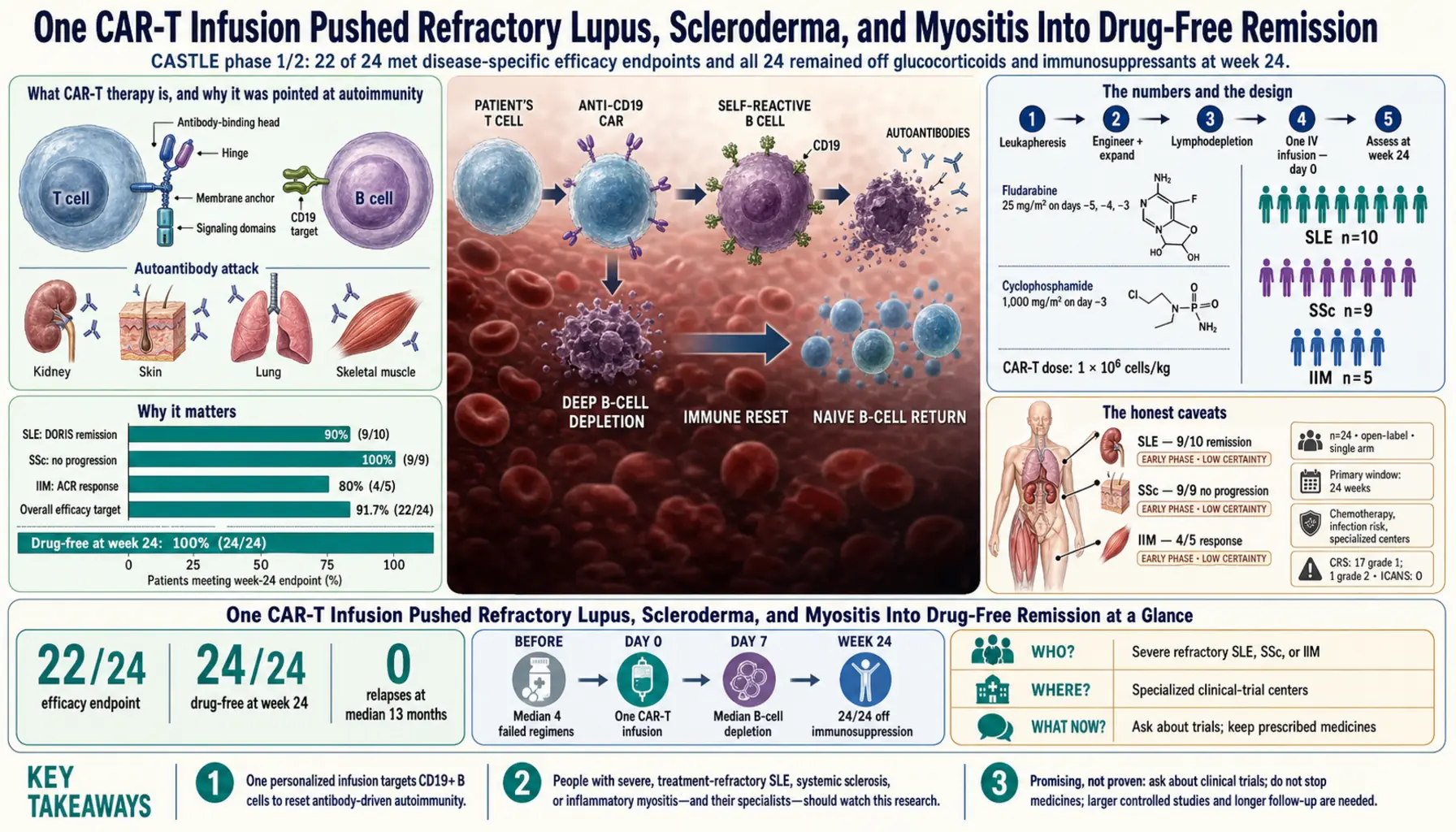
CAR-T stands for chimeric antigen receptor T-cell therapy. A patient’s own T cells are drawn out, genetically re-programmed in a lab to recognize a specific surface tag, then grown up and infused back in as a living drug that hunts down every cell carrying that tag. The U.S. FDA approved the first CAR-T product, for a form of acute lymphoblastic leukemia, on August 30, 2017; such products are now used to treat several blood cancers. The tag in this trial is CD19, a marker on B cells — the immune cells that manufacture antibodies. In lupus, systemic sclerosis, and inflammatory myositis, some of those B cells churn out autoantibodies that attack the body’s own tissues. The idea behind CASTLE is a deep “immune reset”: remove the CD19-positive B cells entirely and let the B-cell population regrow without the self-attacking clones. In the trial, B cells disappeared from the blood within a median of 7 days and stayed absent for a median of 83 days; in the 13 patients whose returning B cells could be analysed, more than 90% were naive B cells, and the memory B-cell and plasmablast compartments were virtually gone.
The numbers and the design
Between July 2023 and January 2025, CASTLE enrolled 24 patients (median age 39; 17 women) whose disease had not responded to, or who had not tolerated, a median of four earlier immunosuppressive treatments: 10 with systemic lupus erythematosus (SLE), 9 with systemic sclerosis (SSc), and 5 with idiopathic inflammatory myopathies (IIM). Each stopped immunosuppressive treatment, received lymphodepleting chemotherapy (fludarabine and cyclophosphamide), and then one infusion of autologous CD19-directed CAR T cells (1 million cells per kilogram of body weight); efficacy was assessed at week 24. The results, by the trial’s pre-defined endpoints:
- 9 of 10 lupus patients reached DORIS remission — the formal international “Definition Of Remission In SLE.” Two of the nine still had raised urine protein at month 6, but their kidney biopsies showed no active lupus nephritis and the study’s steering committee assigned them to DORIS remission; the tenth patient did not meet DORIS because urine protein did not fall below the threshold. All 10 had anti–double-stranded-DNA autoantibodies at baseline, and in all 10 they turned negative within 6 months.
- All 9 systemic sclerosis patients met the endpoint of no progression of interstitial lung disease; median lung function (forced vital capacity and DLCO) rose, and the median skin score (mRSS) fell from 26 to 12.
- 4 of 5 myositis patients reached a 2016 ACR/EULAR major or moderate response; in the fifth, muscle strength did not improve enough, which the authors attribute probably to longstanding disease and muscle atrophy.
- 22 of the 24 patients met their pre-defined efficacy endpoint, and every patient stayed off glucocorticoids and all other immunosuppressive drugs as treatment for their disease for the entire 24-week period.
On safety, the trial met its primary endpoint: no cytokine release syndrome above grade 2, and no ICANS (the neurotoxicity syndrome that can accompany CAR-T). Cytokine release syndrome is the flu-like inflammatory surge that can follow infusion. It occurred in 18 of the 24 patients — grade 1 in 17 and grade 2 in one patient with systemic sclerosis — with a median onset of 1 day after infusion and a median duration of 3 days; to manage it, 14 patients received the IL-6-receptor-blocking antibody tocilizumab and 4 received the glucocorticoid dexamethasone. Grading used the American Society for Transplantation and Cellular Therapy consensus scale (grades 0–4), on which grades 1 and 2 are the milder end.
How CASTLE Differs From Earlier Reports
Two features distinguish CASTLE from earlier reports of CAR-T in autoimmune disease, such as the same group’s 2024 case series of 15 patients with the same three diseases. First, the trial design: CASTLE was a prospective phase 1/2a basket trial with pre-specified safety and efficacy endpoints, built on a two-stage (Bryant and Day) framework with a formal power calculation, which the authors describe as unprecedented for CAR-T in autoimmune disease. Testing one intervention across three diseases under one protocol fits the idea that a shared driver (autoantibody-producing B cells) sits underneath conditions that look clinically different. Second, the endpoints were reached without drugs: patients came off the steroids and immunosuppressants, which carry their own long-term side effects, by the time of the infusion, and none restarted them for their disease during the trial. For people with treatment-refractory rheumatic disease, who often cycle through drug after drug, the open research question is whether a one-time treatment could take the place of continuous drug therapy.
Limits and Reported Risks
This is an early-phase result; the authors present it as groundwork for a pivotal study, not as a settled treatment. The limits and risks reported:
- It is small and uncontrolled. Twenty-four patients, open-label, no placebo or comparison group; the authors list the lack of a control arm as a limitation. Response rates in small, uncontrolled cohorts can shrink when an intervention is tested in larger randomized trials.
- The follow-up is short. The efficacy endpoints were assessed at 24 weeks, which speaks to inducing remission rather than to how long it lasts. The paper adds that within a median follow-up of 13 months (longest 23 months), no patient relapsed or restarted immunosuppressants or glucocorticoids. The central open question in autoimmune CAR-T is whether the self-reactive B cells eventually return — and if they do, whether the disease comes back with them; follow-up over several years has not been reported.
- It is not a gentle procedure. CAR-T requires lymphodepleting chemotherapy beforehand and carries infection risk while B cells are depleted. In CASTLE, infections were recorded 60 times, mostly mild upper-respiratory infections, and 7 patients (29%) needed intravenous immunoglobulin for low antibody levels or recurrent mild infections. None of the 15 serious adverse events was life-threatening, and all but one resolved without lasting effects; the exception was a lupus patient left with a lasting grade 3 loss of kidney function after a flare, high-dose glucocorticoids, cytomegalovirus reactivation and thrombotic microangiopathy in the kidneys. Coming off the usual drugs carried its own risk: four lupus patients flared between cell collection and infusion and were treated mainly with prednisolone. Across the CAR-T field, the FDA has required since April 2024 a boxed warning about T-cell malignancies on all approved BCMA- and CD19-directed autologous CAR-T products. Treatment is delivered at specialized centers, is expensive, and involves manufacturing cells individually for each patient.
- Only refractory disease was studied. The patients had failed or not tolerated a median of four earlier treatments; the trial did not include people with newly diagnosed or mild disease, for whom the balance of risks and benefits has not been studied.
Key Points
CASTLE reports that after a single infusion of CD19-directed CAR T cells, 9 of 10 lupus patients reached drug-free DORIS remission, all 9 systemic sclerosis patients showed no progression of lung disease, and 4 of 5 myositis patients responded, with no cytokine release syndrome above grade 2 and no ICANS. The authors write that the trial “paves the way for conducting a pivotal study,” and the results fit the idea that a B-cell “reset” can change the course of several diseases at once. Not yet shown: results from larger controlled trials, remissions that last for years, and which patients the procedure’s cost and risk are justified for. Rheumatoid arthritis (not studied in CASTLE) and lupus are currently treated with ongoing drug therapy, one drug at a time; whether an occasional immune reset could join those therapies is the question larger trials would have to answer.
Sources
- Müller F, Hagen M, Wirsching A, Kharboutli S, Aigner M, Völkl S, et al. (senior authors Mackensen A, Schett G). CD19 CAR-T cells for treatment-refractory autoimmune diseases: the phase 1/2 CASTLE basket trial. Nature Medicine. 2026 Mar;32(3):1142–1151. Epub 2026 Jan 7. doi:10.1038/s41591-025-04185-6 · PMID 41501497
- Müller F, Taubmann J, Bucci L, Wilhelm A, Bergmann C, Völkl S, et al. CD19 CAR T-Cell Therapy in Autoimmune Disease — A Case Series with Follow-up (background from the same Erlangen group). New England Journal of Medicine. 2024;390(8):687–700. doi:10.1056/NEJMoa2308917 · PMID 38381673
- U.S. Food and Drug Administration. FDA Requires Boxed Warning for T cell Malignancies Following Treatment with BCMA-Directed or CD19-Directed Autologous Chimeric Antigen Receptor (CAR) T cell Immunotherapies. April 18, 2024. fda.gov
Key Research Papers
The trial itself, the same group’s earlier case series, and the FDA’s summary of the first CAR-T approval. Each entry was checked against PubMed and, for the two Erlangen papers, Crossref.
- Müller F, Hagen M, Wirsching A, Kharboutli S, Aigner M, Völkl S, et al. (2026). CD19 CAR-T cells for treatment-refractory autoimmune diseases: the phase 1/2 CASTLE basket trial. Nature Medicine 32(3):1142-1151. — PubMed PMID: 41501497
- Müller F, Taubmann J, Bucci L, Wilhelm A, Bergmann C, Völkl S, et al. (2024). CD19 CAR T-Cell Therapy in Autoimmune Disease — A Case Series with Follow-up. New England Journal of Medicine 390(8):687-700. — PubMed PMID: 38381673
- O’Leary MC, Lu X, Huang Y, Lin X, Mahmood I, Przepiorka D, et al. (2019). FDA Approval Summary: Tisagenlecleucel for Treatment of Patients with Relapsed or Refractory B-cell Precursor Acute Lymphoblastic Leukemia. Clinical Cancer Research 25(4):1142-1146. — PubMed PMID: 30309857