Turkey Tail Mushroom: History and Traditional Use
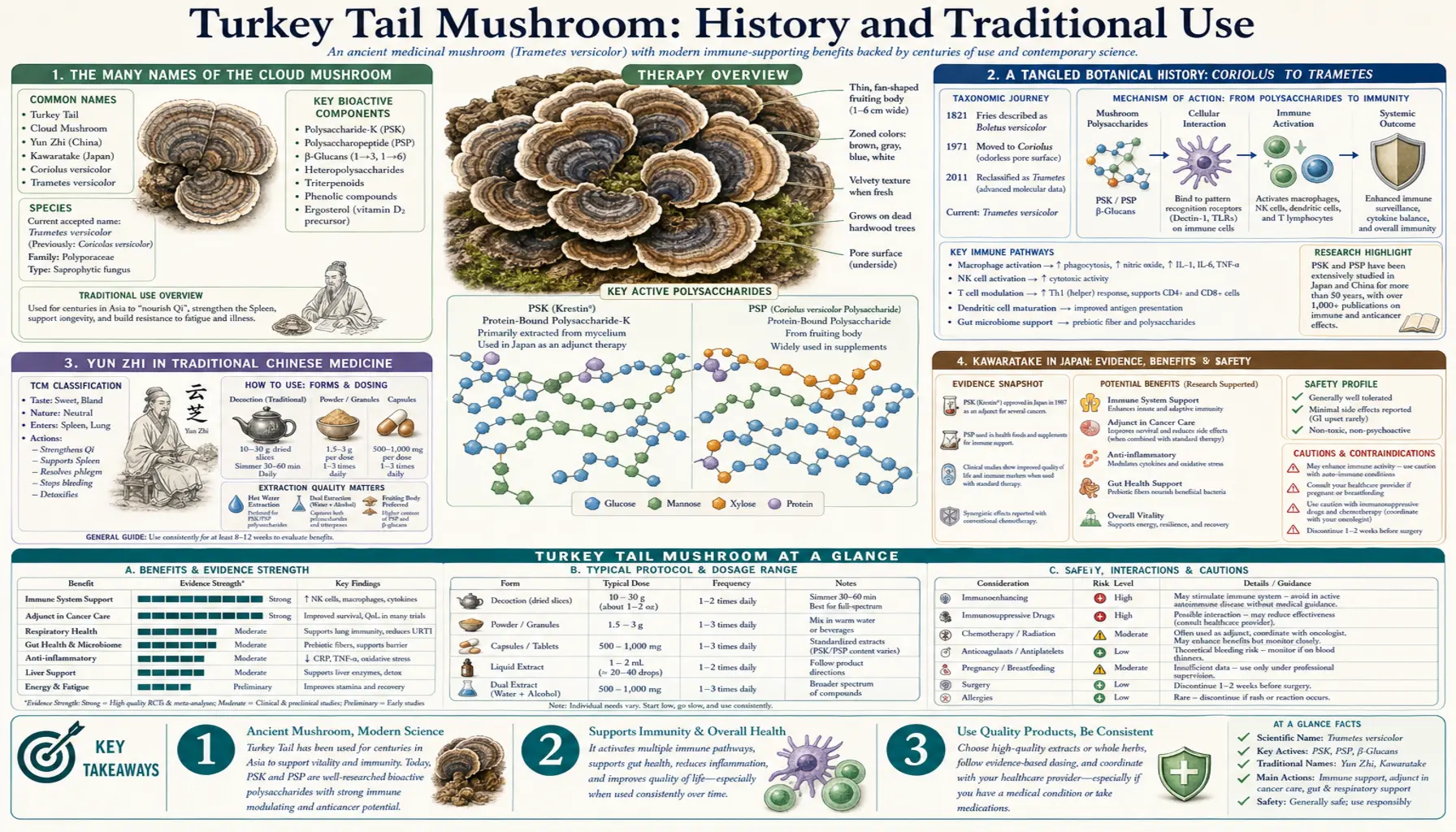
Few medicinal mushrooms carry a story as well documented as the turkey tail's. This common, brightly banded bracket fungus — Trametes versicolor, long known to scientists as Coriolus versicolor — has been gathered and brewed in East Asia for a very long time, where the Chinese knew it as yun zhi, the "cloud mushroom," and the Japanese as kawaratake. But what sets turkey tail apart from most folk remedies is what happened in the twentieth century: chemists in Japan and China isolated protein-bound polysaccharides from it — PSK (sold as Krestin) and PSP — and these became among the few mushroom-derived substances ever approved as adjuncts to cancer treatment. This article traces what the record actually supports: the meaning of the mushroom's many names, its winding botanical history, its traditional place in Chinese and Japanese medicine, and the genuinely documented modern milestones — with real dates and real people — that turned a forest polypore into a studied medicine. Where the record is firm we say so; where a claim is tradition or still uncertain, we name it as such.
Table of Contents
- The Many Names of the Cloud Mushroom
- A Tangled Botanical History: Coriolus to Trametes
- Yun Zhi in Traditional Chinese Medicine
- Kawaratake in Japan
- Folk Use Beyond East Asia
- The Modern Milestone: PSK and Krestin in Japan
- PSP and the Chinese Story
- From Tradition to the Clinic Today
- Research Papers and References
- Connections
- Featured Videos
The Many Names of the Cloud Mushroom
Turkey tail is one of those organisms that gathers a different name in every place it grows — and, as with herbs woven deeply into daily life, the spread of names is itself a kind of record. The familiar English name, turkey tail, is purely descriptive: the mushroom's thin, fan-shaped brackets, banded in concentric rings of brown, tan, grey, rust, and cream, look strikingly like the fanned tail feathers of a wild turkey. The Latin species name versicolor — "of many colours" — points at exactly the same feature.
In China, the mushroom is yun zhi (written in traditional characters as 雲芝 and in simplified form as 云芝), which is usually translated as "cloud mushroom" or "cloud fungus." The poetic name is generally explained by the wavy, layered banding on the cap, which can look like stacked rows of coloured cloud. The second character, zhi (芝), is significant in its own right: it is the same word used for the prized ling zhi (reishi), and in classical Chinese medicine the zhi were a revered class of bracket fungi associated with vitality and long life. To call the mushroom a zhi at all placed it in distinguished company.
In Japan it is known as kawaratake (written 瓦茸), most often glossed as the "roof-tile mushroom" — a reference to the way its overlapping brackets stack along a log like the curved clay tiles of a traditional roof. These three names — turkey tail, cloud mushroom, roof-tile mushroom — describe the same humble polypore through three different sets of eyes, and together they hint at how widely it was noticed long before anyone studied what was inside it.
A Tangled Botanical History: Coriolus to Trametes
For a mushroom so common, turkey tail has had a remarkably unsettled scientific name, and the shuffle is worth following because it explains why the older research literature and many supplement labels still say Coriolus while modern sources say Trametes. The species was first formally described by Carl Linnaeus in 1753, in his Species Plantarum, under the name Boletus versicolor — eighteenth-century botanists filed almost every pore-bearing bracket fungus under Boletus. In 1821 the great mycologist Elias Magnus Fries moved it to the genus Polyporus, as Polyporus versicolor.
Later in the nineteenth century, in 1886, the French naturalist Lucien Quélet placed it in the genus Coriolus, giving the name Coriolus versicolor — the name under which the mushroom became famous in twentieth-century medical research, and the reason so many papers on PSK and PSP use "Coriolus." The currently accepted name, Trametes versicolor, is generally credited to the American mycologist Curtis Gates Lloyd in 1920. (Some references attribute the modern combination to other authors, and the species has carried more than a dozen synonyms over the years; the broad sequence — from Boletus to Polyporus to Coriolus to Trametes — is what is firmly established, rather than every fine point of attribution.)
The practical upshot for a reader is simple: Trametes versicolor and Coriolus versicolor are the same mushroom. When a study from the 1970s or 1980s describes "Coriolus versicolor polysaccharide," it is describing turkey tail, and the change in genus reflects evolving fungal taxonomy — not the discovery of a different organism.
Yun Zhi in Traditional Chinese Medicine
Turkey tail's longest documented medical tradition belongs to China, where it has been used as yun zhi within traditional Chinese medicine (TCM). Chinese sources commonly describe its use as stretching back roughly two thousand years, anchoring that antiquity to the Shennong Bencaojing (often rendered The Divine Farmer's Materia Medica), one of the foundational pharmacopoeias of the tradition, which grouped the zhi fungi among the "superior" medicines — remedies thought gentle enough for long-term use to support vitality. The exact age of these claims depends on how the classical texts are dated, so this page treats turkey tail's use as genuinely old and well-rooted in the tradition rather than fixing a precise number of years or a single founding date.
Within the framework of TCM, yun zhi was understood as a remedy that helps tonify the body's vital energy and clear "dampness" and "heat," and it was traditionally associated with the spleen and lung systems. In plain terms, it belonged to the category of restoratives reached for when someone was depleted, recovering from a long illness, or troubled by chronic chest and lung complaints. It is worth being clear that these are descriptions of how classical practitioners classified and used the mushroom; they are a window into a particular cultural model of health, not modern medical claims, and a traditional indication is not the same thing as proven effectiveness.
A name often attached to turkey tail's written history is Li Shizhen, the Ming-dynasty physician whose monumental Bencao Gangmu (Compendium of Materia Medica, completed in the late sixteenth century) catalogued a vast range of traditional remedies, including the zhi mushrooms. Li Shizhen is named here as a real historical figure and his compendium as a historical primary source — evidence of how the tradition recorded and valued these fungi — rather than as a modern clinical authority.
Kawaratake in Japan
In Japan, turkey tail entered both folk practice and the herbal tradition of Kampo (the Japanese adaptation of Chinese herbal medicine) as kawaratake. As in China, it was valued as a general tonic and was commonly taken as a simple tea or decoction for everyday health and resilience rather than as a treatment for one specific disease. This unremarkable, long-standing folk use matters historically because it is the backdrop against which something quite remarkable happened in the twentieth century.
Japan is where turkey tail made its leap from traditional remedy to studied pharmaceutical. In the post-war decades, Japanese researchers became deeply interested in compounds from fungi that might support the immune systems of cancer patients, and turkey tail — an abundant, cheap, already-trusted mushroom — was a natural candidate. The work that grew out of that interest, centred on a polysaccharide called PSK, is described in the section below; it is the single most important and best-documented chapter in turkey tail's entire history, and it is firmly a Japanese story.
Folk Use Beyond East Asia
Turkey tail is one of the most cosmopolitan fungi on Earth, growing on dead hardwood across North America, Europe, and Asia, so it is reasonable to expect that people outside East Asia noticed and used it too. Here, though, the historical record is much thinner and deserves honesty. It is often stated that Indigenous peoples of North America brewed turkey tail as a tea and that European folk traditions used polypore mushrooms as wound dressings and tonics. These claims are plausible — abundant, distinctive, leathery brackets are exactly the sort of thing foragers everywhere put to use — but they are not documented with anything like the depth or the dating of the Chinese and Japanese record, and specific names, dates, and sources are hard to pin down.
So this page treats turkey tail's use beyond East Asia as probable folk practice rather than firmly documented history. The securely recorded medical tradition — the one with named texts, named practitioners, and a continuous line into modern research — is the East Asian one. That is where the story has solid ground under it, and that is where the modern science begins.
The Modern Milestone: PSK and Krestin in Japan
The turning point in turkey tail's history — and the reason it is taken seriously in oncology at all — is the development in Japan of a protein-bound polysaccharide extracted from the mushroom's cultured mycelium, known as PSK (polysaccharide-K) and marketed under the brand name Krestin. PSK was developed by the Japanese pharmaceutical company Kureha (Kureha Chemical Industry) and is prepared from a specific cultivated strain of the mushroom, designated CM-101. Chemically, PSK is a beta-glucan bound to protein, with the protein making up roughly a quarter to a third of the molecule — a structure that turns out to be central to how it interacts with the immune system. Rather than fixing a single "discovery" year for PSK (sources vary on exactly when the compound was first isolated), this page anchors the milestone to the dates that are firmly documented in the medical literature.
Those dates are well established. According to a detailed review of PSK's development by Yoshihiko Maehara and colleagues, published in Surgery Today in 2012, PSK was approved in Japan in 1976 for cancers of the digestive organs, lung, and breast, and clinical use began in 1977. After a national re-evaluation in 1989, its approved use was refined to combination with chemotherapy to prolong survival in patients with resected gastric or colorectal cancer and to prolong remission in small-cell lung cancer. PSK became one of the most widely used anticancer agents in Japan; it is widely reported that by around 1987 it accounted for roughly a quarter of the country's total national expenditure on anticancer agents.
What makes PSK historically extraordinary is not just its approval but the strength of the evidence behind one of its key uses. A landmark randomized controlled trial led by H. Nakazato, published in The Lancet in 1994, followed 262 patients across 46 institutions in central Japan who had undergone curative surgery for gastric cancer. Adding PSK to standard chemotherapy improved both the five-year disease-free rate and overall five-year survival compared with chemotherapy alone. This is the kind of rigorous, published, human-trial evidence that almost no traditional remedy ever accumulates — and it is turkey tail's strongest real milestone.
Two honest qualifications belong here. First, PSK is approved in Japan but not in the United States, where it is not licensed to treat cancer or any other condition; it is the isolated, standardized pharmaceutical PSK — not a cup of mushroom tea — that carries this evidence. Second, much of the strongest trial data comes from Japan, and the broader literature has been debated; the right way to read this history is that a traditional mushroom yielded a genuinely studied drug, not that turkey tail supplements are a proven cancer cure.
PSP and the Chinese Story
China developed its own protein-bound polysaccharide from turkey tail, and its history is more recent and better attributed to specific people than PSK's. The Chinese compound is called PSP (polysaccharopeptide, or polysaccharide-peptide), and it is extracted from a particular cultivated strain of yun zhi known as COV-1. PSP is broadly similar to PSK — both are roughly 100-kilodalton protein-bound beta-glucans that act on the immune system — but they differ in the details of their sugar and peptide composition, and they were developed independently in their respective countries.
The development of PSP is generally credited to a research team led by Professor Q. Y. Yang in Shanghai (associated with Shanghai Normal University) in the early 1980s. The COV-1 strain was selected through an extensive screen of many wild strains of yun zhi collected from across China, and a Chinese patent on the production method was granted toward the end of the decade. PSP entered routine clinical use in China as a cancer-treatment adjunct around 1987. These attributions — a named lead researcher, a named institution, a named strain, and an approximate decade — are supported by review articles on PSP's development in China; finer details, such as the precise first year of isolation, are reported with some variation across sources and are treated here as approximate.
The parallel is striking: two countries, working separately from the same humble bracket fungus, each isolated a protein-bound polysaccharide, gave it a clinical role alongside conventional cancer therapy, and built a research program around it. PSK and PSP are the twin pillars of turkey tail's modern reputation, and between them they account for the great majority of the mushroom's serious scientific literature.
From Tradition to the Clinic Today
The arc of turkey tail's history is unusually clean: a forest mushroom noticed and used for centuries across East Asia, then, in the second half of the twentieth century, the isolation of two well-characterized compounds — PSK in Japan and PSP in China — that carried it into the hospital. In recent decades the question has shifted again, this time toward whether turkey tail and its extracts hold up under Western-style clinical testing. An early and frequently cited example is a phase 1 clinical trial led by Carolyn Torkelson and Leanna Standish, conducted with Bastyr University Research Institute and published in 2012, which gave whole turkey tail extract to women recovering from breast-cancer treatment, found it well tolerated at doses up to 9 grams a day, and reported dose-related improvements in immune-cell measures. It was a small, early-stage safety study — not proof of cancer benefit — but it marked turkey tail's arrival in modern Western research.
Two cautions close any honest history like this one. First, a long tradition of use and a handful of promising trials are reasons to keep investigating a remedy — they are not the same as proof that a supplement works, and most turkey tail products sold today are whole-mushroom extracts quite different from the standardized pharmaceutical PSK studied in Japan. Second, the firmest claims in this whole story are the narrowest and best-documented ones: the approval and trial history of PSK in Japan, and the development of PSP in China. The detailed evidence, mechanisms, dosing, and cautions for turkey tail are covered in the companion Turkey Tail Benefits articles and on the main Turkey Tail Mushroom page; this article has been concerned only with how a banded woodland polypore came to be used, named, and eventually studied as a medicine.
Research Papers and References
The list below combines key peer-reviewed sources on the development and clinical study of turkey tail's polysaccharides with curated PubMed topic-search links into the historical and pharmacological literature. Historical primary texts (the Shennong Bencaojing and Li Shizhen's Bencao Gangmu) are named in the article as historical sources rather than as modern citations. Author names, titles, and journals are given as plain text; only the stable DOI, PMID, or archive link is hyperlinked, and each opens in a new tab.
- Nakazato H, Koike A, Saji S, Ogawa N, Sakamoto J. Efficacy of immunochemotherapy as adjuvant treatment after curative resection of gastric cancer. The Lancet. 1994;343(8906):1122-1126. — doi:10.1016/S0140-6736(94)90233-X · PMID: 7910230
- Maehara Y, Tsujitani S, Saeki H, et al. Biological mechanism and clinical effect of protein-bound polysaccharide K (KRESTIN): review of development and future perspectives. Surgery Today. 2012;42(1):8-28. — doi:10.1007/s00595-011-0075-7 · PMID: 22139128
- Saleh MH, Rashedi I, Keating A. Immunomodulatory properties of Coriolus versicolor: the role of polysaccharopeptide. Frontiers in Immunology. 2017;8:1087. — doi:10.3389/fimmu.2017.01087
- Chang Y, Zhang M, Jiang Y, et al. Preclinical and clinical studies of Coriolus versicolor polysaccharopeptide as an immunotherapeutic in China. Discovery Medicine. 2017;23(127):207-219. — PMID: 28595034
- Torkelson CJ, Sweet E, Martzen MR, et al. Phase 1 clinical trial of Trametes versicolor in women with breast cancer. ISRN Oncology. 2012;2012:251632. — doi:10.5402/2012/251632 · PMID: 22701186
- Trametes versicolor (Coriolus versicolor) and PSK / PSP — history and clinical use — PubMed: Coriolus versicolor PSK and PSP history
- Trametes versicolor traditional use and ethnomycology — PubMed: Trametes versicolor traditional medicine and yun zhi
External Authoritative Resources
- National Cancer Institute — Medicinal Mushrooms (PDQ), Health Professional Version
- NCI Medicinal Mushrooms (PDQ) — NCBI Bookshelf
- PubMed — All research on Trametes versicolor
Connections
- Turkey Tail Mushroom
- Turkey Tail Benefits
- All Mushrooms
- Chaga Mushroom
- Lion's Mane Mushroom
- Reishi Mushroom
- Astragalus
- Ashwagandha
- Ginseng