Reishi Mushroom: History and Traditional Use
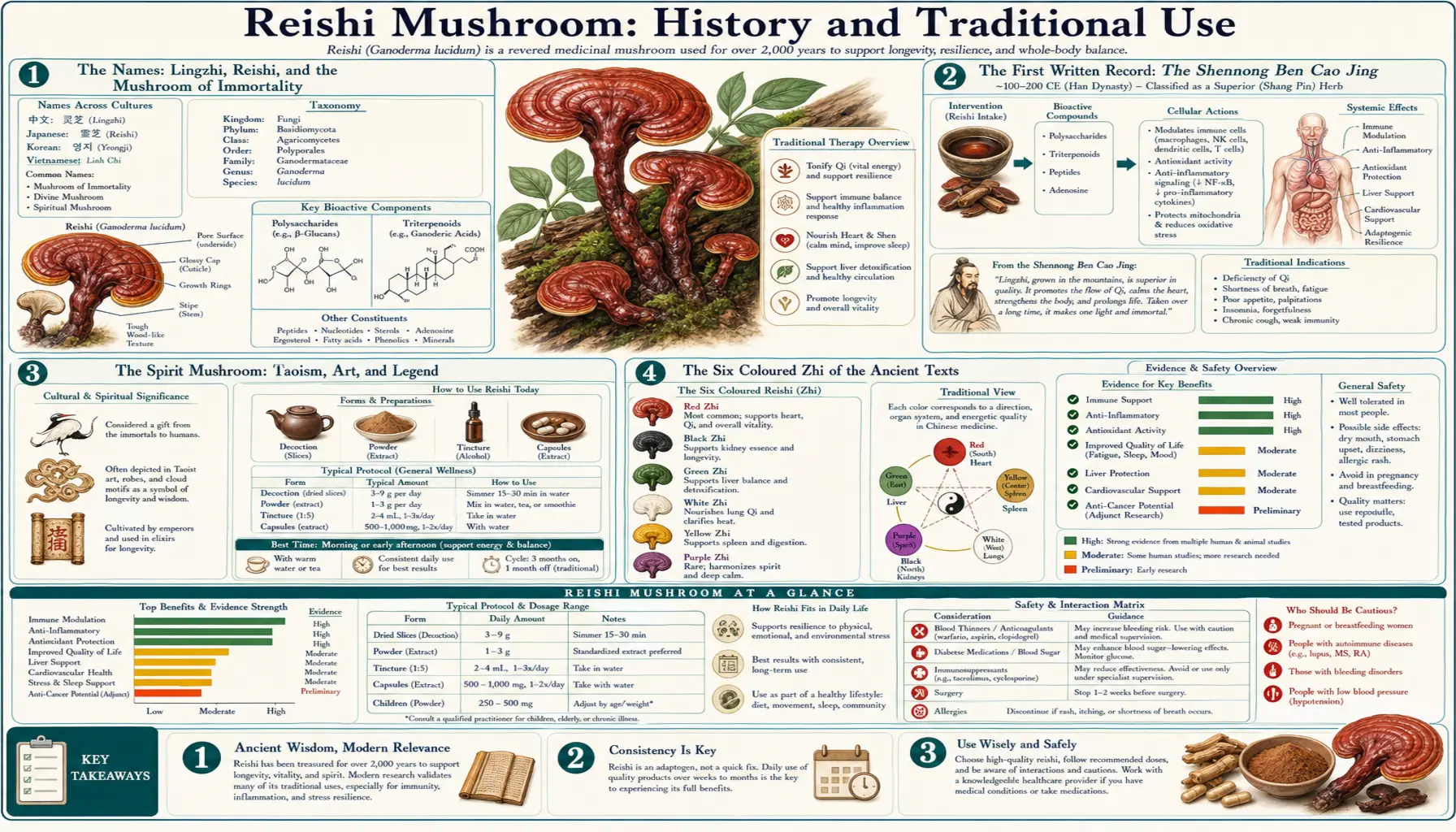
Few mushrooms carry a story as long or as storied as reishi. For more than two thousand years the glossy, woody fungus that the Chinese call lingzhi and the Japanese call reishi has been written into pharmacopoeias, painted onto palace walls, and folded into the myths of Taoist immortals as the "mushroom of immortality." This article traces what the historical record actually supports: where the plant's names come from, its place in the oldest Chinese herbal text, the legend and art that grew up around it, the "six coloured" mushrooms of the classical texts, why it was once so rare that it was reserved for emperors, how its use spread across East Asia, the cultivation breakthrough of the 1970s that turned a royal rarity into a supermarket supplement, and what modern science later discovered about its true botanical identity. Where the record is firm we say so; where a claim is legend, symbolism, or tradition, we name it as such rather than dress it up as fact.
Table of Contents
- The Names: Lingzhi, Reishi, and the Mushroom of Immortality
- The First Written Record: The Shennong Ben Cao Jing
- The Spirit Mushroom: Taoism, Art, and Legend
- The Six Coloured Zhi of the Ancient Texts
- Rare as a Blessing: A Mushroom Reserved for Royalty
- Beyond China: Japan, Korea, and Vietnam
- The Cultivation Breakthrough of the 1970s
- What Science Later Named: Identity and Modern Research
- Research Papers and References
- Connections
- Featured Videos
The Names: Lingzhi, Reishi, and the Mushroom of Immortality
The mushroom most of the English-speaking world now calls reishi has carried many names across many cultures, and the names themselves are a kind of history. Its oldest and most influential name is the Chinese lingzhi (靈芝). The word joins two characters: ling (靈), meaning "spirit," "spiritual," or "divine," and zhi (芝), an old word for a fungus or bracket mushroom. Translators usually render the whole as "spirit mushroom," "divine mushroom," or, in the most familiar phrase, the "mushroom of immortality." Scholarly sources summarise the name as representing a combination of spiritual potency and the essence of immortality — a name, in other words, that already tells you how the mushroom was regarded long before anyone analysed its chemistry.
The English word reishi comes from Japanese, where the same Chinese characters are read reishi (霊芝). The Japanese also have a vivid native name for it: mannentake (万年茸), which translates as the "ten-thousand-year mushroom" — once again binding the fungus to the idea of immense lifespan and endurance. In Korea it was embraced under the same Sino-Korean reading, and in Vietnam it is known as linh chi, a direct cognate of lingzhi. A mushroom gathers this many names only when many communities have had long reasons to talk about it.
The scientific name carries its own small story. The genus name Ganoderma is generally explained as coming from the Greek ganos, meaning "brightness" or "sheen," and derma, meaning "skin" — together, the "shiny-skinned" fungus, a reference to the lacquered, varnished look of the cap. The species name lucidum is Latin for "shining" or "brilliant," pointing at the very same glossy surface. As a later section explains, the precise botanical identity of the East Asian medicinal mushroom turned out to be more tangled than these tidy Latin names suggest, but the names themselves all circle the same striking feature: a mushroom that looks polished, almost crafted, rather than grown.
The First Written Record: The Shennong Ben Cao Jing
Reishi's documented career in writing begins with one of the foundational texts of Chinese medicine: the Shennong Ben Cao Jing (神農本草經), often translated as the Divine Farmer's Classic of Materia Medica. Scholars generally date the text's compilation to around the second century CE, during or near the Eastern Han dynasty (commonly given as roughly 200–250 CE), though like many ancient compendia it gathered material that was older still. The work is traditionally attributed to Shennong (the "Divine Farmer" or "Holy Farmer"), a legendary culture-hero credited in Chinese tradition with discovering agriculture and herbal medicine — an attribution that is itself a piece of folklore: Shennong is a mythic figure, and the book was compiled by anonymous hands writing under his name. We note that here so the legend is not mistaken for authorship.
What the text does is real and important: it organises hundreds of medicinal substances into three grades according to their perceived safety and purpose. The highest of these, the "superior" or "upper" class, was reserved for substances thought to be non-toxic, suitable for long-term use, and capable of nourishing vitality and prolonging life rather than merely treating a single ailment. Lingzhi was placed in this superior class — the most prestigious category in the entire pharmacopoeia, the same elite tier traditionally associated with herbs such as ginseng. The classical text describes the various coloured zhi in glowing terms, crediting the red variety in particular with benefiting the heart and the vital energy.
It is worth being plain about what this record is and is not. The Shennong Ben Cao Jing tells us, reliably, that by the early centuries of the common era Chinese physicians already regarded lingzhi as a supremely valued tonic and ranked it at the very top of their materia medica. That is a documented fact about how the mushroom was classified and esteemed. It is not a modern clinical finding, and the text's sweeping claims about prolonging life belong to an ancient medical philosophy, not to controlled evidence. The honest takeaway is that reishi entered the written record already wearing a crown — treated, from its first appearance, as one of the most important medicinal substances a person could take.
The Spirit Mushroom: Taoism, Art, and Legend
No part of reishi's history is richer — or more clearly the realm of legend and symbolism rather than fact — than its role in Taoism and Chinese art. In the Taoist tradition, lingzhi was far more than a tonic herb. It was a sacred object woven into the search for immortality. Folklore held that the true spirit-mushroom grew in the dwelling places of the xian — the immortals — in distant sacred mountains and on mythical islands of the blessed, and that to find and consume it was to draw on the magical energy of those immortals, lengthening life or even, in the most fervent tellings, transforming the seeker into an immortal as well. These are tales of spiritual aspiration, and we present them as exactly that: the beliefs and stories a culture told about the mushroom, not historical events.
That symbolism left a very real and very visible mark on Chinese culture. The distinctive shape of the lingzhi cap — often stylised into a cloud-like, scrolling form — became one of the most enduring auspicious motifs in Chinese decorative art, standing for longevity, good fortune, and divine favour. Its image recurs across centuries of scrolls, paintings, textiles, ceramics, carved jade, and architecture, and it appears in the imperial decorative programmes of sites such as the Forbidden City and the Summer Palace in Beijing. The mushroom is also a frequent companion of Shou Lao (also called Shouxing), the popular god of longevity, who is often depicted holding or accompanied by the sacred fungus. The familiar curved Chinese sceptre known as the ruyi is widely said to echo the lingzhi's shape, carrying the same wish for long life and the granting of desires.
The careful conclusion is that reishi's association with immortality is, above all, a cultural and spiritual phenomenon — one of the most powerful longevity symbols in East Asian history. That symbolism is a genuine historical fact: people really did revere the mushroom this way, and the art proves it. But the immortality itself was always an aspiration and a metaphor. Reading the modern phrase "mushroom of immortality" as a literal medical promise mistakes a poem for a prescription, and this page treats the immortality theme as the tradition it is.
The Six Coloured Zhi of the Ancient Texts
One of the more curious features of reishi's classical record is that the old texts did not describe a single mushroom at all, but a family of coloured ones. The Shennong Ben Cao Jing and later works distinguish six coloured varieties of zhi, each tied by colour to one of the body's organs or energies according to the symbolic scheme of traditional Chinese medicine. In the most commonly cited arrangement these are the red, the green or blue, the yellow, the white, the black, and the purple zhi, linked respectively to the heart, the liver, the spleen, the lungs, the kidneys, and the vital essence. The colour system reflects the correspondence-thinking of classical Chinese medicine, in which colours, organs, flavours, and elements were all mapped onto one another.
Among these, the red zhi — chizhi — was singled out as the most important, and it is the red form that is generally identified as the classic lingzhi of legend and the basis of most traditional use. To this day, red reishi is the variety most often cultivated, most often sold, and most often studied. The other colours, where they were used at all, were assigned more specialised roles within the traditional framework.
Modern mycology adds an important footnote that the ancient writers could not have known: these "colour varieties" almost certainly do not represent a single biological species seen in different hues, but rather several distinct species (and growth forms) within the wider Ganoderma group. The classical colour scheme is best understood as a traditional classification rooted in symbolism and appearance, not as modern taxonomy. It tells us how Chinese physicians organised and made sense of these mushrooms; it does not map neatly onto the species names a mycologist would use today — a gap the final section returns to.
Rare as a Blessing: A Mushroom Reserved for Royalty
For most of its history, the single most important fact about reishi was simply that it was almost impossible to find. Wild lingzhi grows on the trunks and roots of old hardwood trees in forests, and it does so only sparingly. A figure repeated across both traditional sources and modern reviews is striking: that only something on the order of two or three trees out of every ten thousand suitable old trees might bear the mushroom. Whether or not that ratio is exact, it captures a real truth — genuine wild reishi was a scarce, hard-won prize, found by chance in remote forests rather than gathered in any quantity.
That scarcity shaped its whole social meaning. Because the mushroom was so rare and so highly prized, it was, by tradition, largely beyond the reach of ordinary people and effectively reserved for emperors, the imperial court, the nobility, and Taoist adepts. Finding a specimen of the spirit-mushroom was treated as an auspicious omen — a sign of heavenly favour, sometimes even reported to the throne as a portent of a virtuous reign. Imperial demand is part of why the mushroom looms so large in court art and why its discovery carried such symbolic weight. Modern scholarship summarising this period notes plainly that before cultivation, wild lingzhi was so scarce that only the nobility could realistically obtain it.
This rarity is the hinge of reishi's entire story. A mushroom revered for two millennia, credited with prolonging life, painted onto palaces and pressed into the hands of immortals in legend — and yet, for almost all of that time, something hardly anyone could actually get. That tension between immense prestige and extreme scarcity is exactly what the twentieth century would finally break, as the next section describes.
Beyond China: Japan, Korea, and Vietnam
Although reishi's richest documented tradition is Chinese, its reputation travelled with Chinese medicine across East Asia, and several neighbouring cultures took it up as a supreme medicinal agent in their own right. In Japan, where it became known as reishi or mannentake, the mushroom was absorbed into Kampo — the Japanese adaptation of traditional Chinese herbal medicine — and into Japanese folk and decorative tradition, where its long-life symbolism mirrored the Chinese one. It is the Japanese name, of course, that the modern global supplement market eventually adopted.
In Korea, traditional medicine embraced the mushroom under the same Sino-Korean reading of the characters, treating it, as the Chinese did, as a top-tier tonic associated with vitality and longevity. In Vietnam it is known as linh chi — a direct linguistic descendant of lingzhi — and held a comparable place of honour. Across all of these cultures the through-line is consistent: reishi was associated with long life, with the cultivation of vital energy (the qi of Chinese tradition), and with the body's overall resilience rather than with the treatment of any single complaint.
There is a reasonable historical argument to be made that the persistence of reishi across several independent East Asian traditions, over a very long span of time, reflects a real and durable cultural valuation of the mushroom. What that shared history does not establish, on its own, is medical efficacy: a remedy can be widely and enduringly used for reasons of symbolism, prestige, and tradition as much as for measurable benefit. The fair statement is that reishi was, for many centuries and across many borders, one of the most esteemed tonic substances in all of East Asian medicine — and that this long tradition is a reason to study it carefully, not a substitute for doing so.
The Cultivation Breakthrough of the 1970s
The turning point in reishi's long history is surprisingly recent. For roughly two thousand years the mushroom had been defined by its scarcity; then, within a single decade, it became something almost anyone could buy. The change came from reliable artificial cultivation, developed especially in Japan in the early 1970s and scaled up in China through the 1980s. Modern reviews state plainly that since the early 1970s most lingzhi has been cultivated rather than gathered wild, grown on substrates such as hardwood logs, sawdust blocks, and grain.
The breakthrough in Japan is often credited to the grower Shigeaki Mori, who is widely reported to have developed a dependable method — after years of trial and error — for cultivating reishi, commonly described as using spore-inoculated wood (such as plum-wood logs or sawdust) to coax the once-elusive mushroom into fruiting on demand. We attribute this to Mori as the account that circulates throughout the modern reishi literature; the broader, securely documented fact is that practical cultivation was achieved in Japan around this period and rapidly transformed the mushroom's availability. In China, large-scale cultivation followed and grew into a major industry centred on the institutes and farms that standardised commercial production.
It is hard to overstate what this did. A mushroom that legend said grew in the gardens of immortals, that emperors sent expeditions to find, and that ordinary families could rarely hope to obtain, became — in the span of a few decades — an affordable, mass-produced commodity stocked as teas, powders, capsules, and extracts around the world. The cultivation breakthrough is the reason a substance once reserved for royalty now sits on supplement shelves, and it is the bridge between reishi's ancient story and its modern one.
What Science Later Named: Identity and Modern Research
As cultivation made reishi abundant and laboratories began studying it in earnest, a genuinely surprising problem came to light: for a long time, science had been calling the famous East Asian mushroom by the wrong name. The species name Ganoderma lucidum was originally described from European material in the eighteenth century, and that European name was then applied, by long habit, to the cultivated and wild mushrooms of China, Japan, and Korea. Careful study eventually showed that the East Asian medicinal mushroom is morphologically and genetically distinct from the true European G. lucidum.
In 2012, the mycologists Cao, Wu, and Dai formally described the East Asian medicinal mushroom as a separate species, Ganoderma lingzhi — a name chosen, fittingly, to honour the very tradition the mushroom came from. The picture has continued to be refined since: later researchers have argued that G. lingzhi is the same species as one named earlier, Ganoderma sichuanense (described in 1983), which under the rules of naming would take precedence. The naming debate is still being worked out among specialists, which is why supplement labels, older studies, and reference works variously read G. lucidum, G. lingzhi, or G. sichuanense for what is, in everyday terms, the same prized mushroom. We name this as an active, technical question rather than a settled one — the honest state of the science.
The deeper point of reishi's modern chapter is the meeting of two very different kinds of knowledge. Tradition gave the mushroom two thousand years of reverence, a place at the top of the oldest Chinese pharmacopoeia, and a wealth of symbolism — but it did not, and could not, tell us with modern precision what the mushroom is made of or what it measurably does. Modern research has begun to supply those answers, identifying classes of bioactive compounds (notably triterpenoids such as the ganoderic acids, and immune-active polysaccharides) and testing the mushroom's effects in the laboratory, in animals, and in a still-limited number of human trials. The detailed evidence, mechanisms, dosing, and cautions are covered in the companion Reishi Benefits articles and on the main Reishi Mushroom page; this history is concerned only with how the mushroom came to be so revered in the first place. The fitting last word is the one tradition itself suggests: a remedy held in the highest esteem for two millennia has earned careful investigation — and earning that investigation is not the same as having already passed it.
Research Papers and References
The list below combines key peer-reviewed reviews of Ganoderma lucidum / Ganoderma lingzhi with curated PubMed topic-search links into the historical, ethnobotanical, and taxonomic literature. Historical primary texts — above all the Shennong Ben Cao Jing — are named in the article as historical sources rather than as modern citations. Author names, titles, and journals are given as plain text; only the stable DOI, PMID, or archive link is hyperlinked, and each opens in a new tab.
- Wachtel-Galor S, Yuen J, Buswell JA, Benzie IFF. Ganoderma lucidum (Lingzhi or Reishi): A Medicinal Mushroom. In: Benzie IFF, Wachtel-Galor S, editors. Herbal Medicine: Biomolecular and Clinical Aspects. 2nd ed. Boca Raton: CRC Press/Taylor & Francis; 2011. Chapter 9. — NCBI Bookshelf: NBK92757 · PMID: 22593926
- Bishop KS, Kao CHJ, Xu Y, Glucina MP, Paterson RRM, Ferguson LR. From 2000 years of Ganoderma lucidum to recent developments in nutraceuticals. Phytochemistry. 2015;114:56-65. — PMID: 25794896 · doi:10.1016/j.phytochem.2015.02.015
- Cao Y, Wu SH, Dai YC. Species clarification of the prize medicinal Ganoderma mushroom "Lingzhi." Fungal Diversity. 2012;56(1):49-62. — doi:10.1007/s13225-012-0178-5
- Ganoderma lucidum / lingzhi history and traditional use — PubMed: Ganoderma lucidum history and traditional use
- Ganoderma taxonomy and species identity of cultivated lingzhi — PubMed: Ganoderma lingzhi / sichuanense taxonomy
External Authoritative Resources
- NCCIH — Reishi Mushroom
- NCBI Bookshelf — Ganoderma lucidum (Lingzhi or Reishi)
- PubMed — All research on Ganoderma lucidum
Connections
- Reishi Mushroom
- Reishi Benefits
- All Mushrooms
- Chaga Mushroom
- Lion's Mane Mushroom
- Turkey Tail Mushroom
- Astragalus
- Ginseng
- Schisandra