Chaga Mushroom: History and Traditional Use
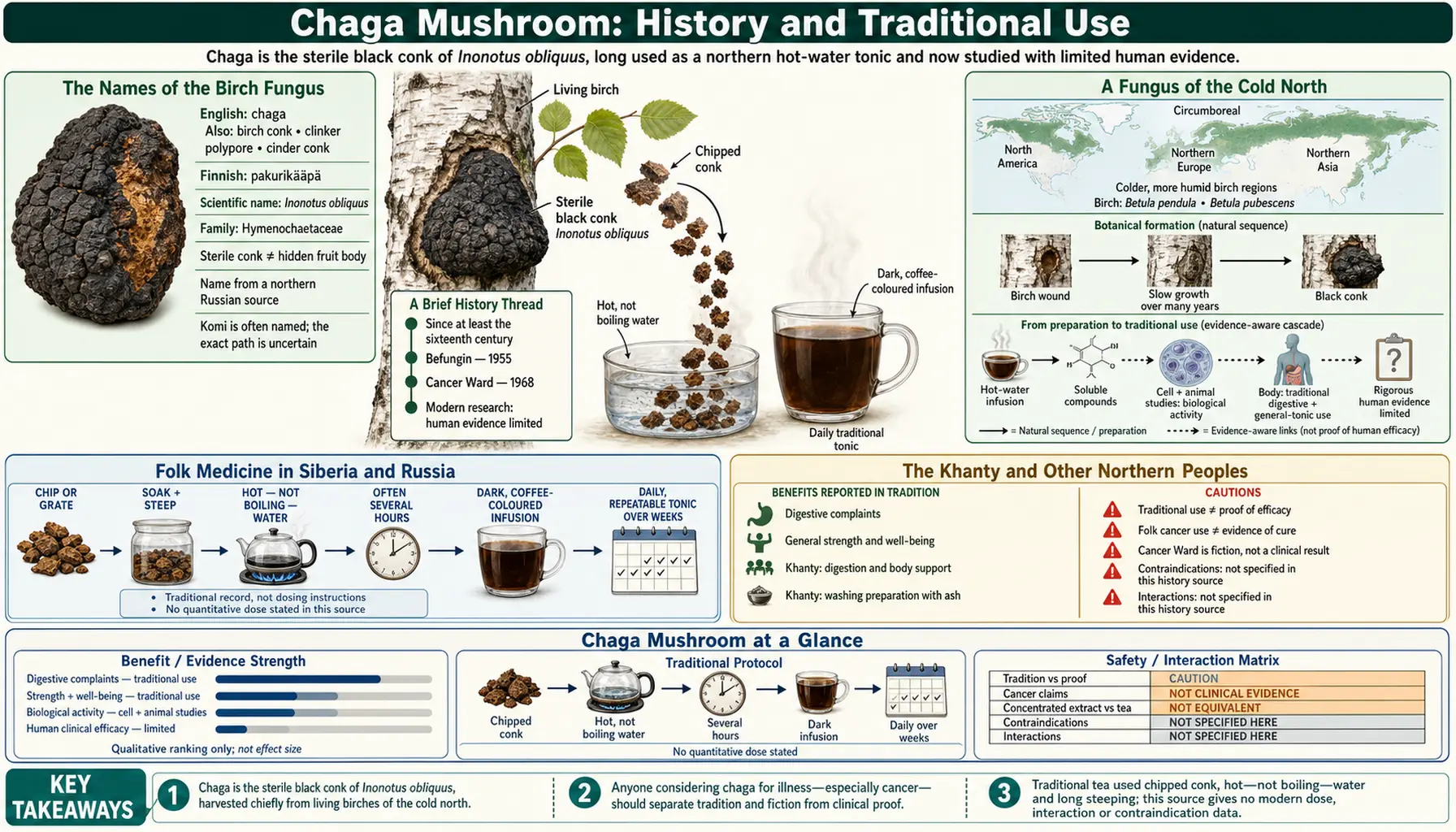
Chaga is not a mushroom in the everyday sense of a cap on a stalk. It is the hard, charcoal-black growth that forms on the trunks of birch trees in the cold forests of the far north, and for centuries people across Siberia, Russia, and the Baltic woodlands have chipped it off, simmered it into a dark tea, and drunk it as a remedy for stomach troubles and a tonic for general strength. This article tells what the historical record actually supports: where chaga grows, the long folk-medicine traditions of northern peoples, the Russian remedy made from it in the twentieth century, and the moment a famous novel carried its reputation to the wider world. Chaga's documented history is genuinely old but thinner and harder to date than that of some other healing herbs, so where a claim is firm we say so, and where it is tradition, folklore, or fiction, we name it as such rather than dressing it up as fact.
Table of Contents
- The Names of the Birch Fungus
- A Fungus of the Cold North
- Folk Medicine in Siberia and Russia
- The Khanty and Other Northern Peoples
- How It Was Traditionally Prepared
- Twentieth-Century Russia: Befungin
- Solzhenitsyn's Cancer Ward (1968)
- From Folklore to Modern Research
- Research Papers and References
- Connections
- Featured Videos
The Names of the Birch Fungus
The English word chaga is borrowed from Russian (chaga), and the Russian name is generally traced back to a word for the fungus in one of the languages of the northern peoples of European Russia — the Komi language is the source most often named. The exact path the word travelled is not certain, so it is fairer to say the name comes "from a northern Russian source" than to fix a single origin. What the borrowing does tell us is real enough: the people who named this fungus first were the forest peoples of the cold north, not the cities to the south.
The plant carries plain descriptive names in other northern tongues too. In English it is also called the birch conk, clinker polypore, or cinder conk — all of them pointing at the same thing, a hard black lump that looks like a clump of burnt coal stuck to a tree. In Finnish it is known as pakurikääpä, a name that reflects its long familiarity in Nordic forests. These everyday names matter to a history, because a thing gathers names only where people have had reason to handle it; the spread of plain words for chaga across the northern languages is itself a record of long use.
The scientific name is Inonotus obliquus, placing the fungus in the family Hymenochaetaceae among the bracket and crust fungi. The black mass that people harvest is technically a sterile conk — a hard, infertile mass of fungal tissue — rather than the true spore-producing fruit body, which forms only later, mostly hidden beneath the bark of a dying tree. For the whole of its human history, it is this sterile black conk, not the hidden fruit body, that has been chipped from living birches and used.
A Fungus of the Cold North
Chaga's history is shaped above all by where it grows. Inonotus obliquus has what botanists call a circumboreal distribution — it rings the cold northern forests right around the top of the globe, through northern Asia, northern Europe, and North America. Its great strongholds are the boreal birch forests of Russia and Siberia, Scandinavia, and northern and eastern Europe, and it grows in North America too; it becomes rarer as one moves south into warmer country. A 2008 survey of the fungus's distribution by Min-Woong Lee and colleagues describes exactly this pattern, noting that the typical conks are found chiefly on birches in colder, more humid regions.
The host tree is central to the story. Chaga grows above all on birch — principally silver birch (Betula pendula) and downy birch (Betula pubescens) — though it is occasionally reported on alder, beech, and a few other hardwoods. The fungus enters through a wound in the bark and grows slowly over many years inside the living tree, pushing out the black external conk that people collect. This tie to the birch is not just botanical trivia: birch is the defining tree of the northern forest, and the peoples who lived among birch woods were the ones who came to know and use the dark growths on their trunks.
So the map and the history line up neatly. The places with the richest documented traditions of chaga use — Siberia, Russia, the Baltic lands, and the Nordic countries — are exactly the cold birch-forest regions where the fungus is common. That is the honest centre of chaga's history; claims that reach much beyond this northern belt are weaker and are treated with more caution below.
Folk Medicine in Siberia and Russia
Chaga's best-documented role is as a remedy in the folk medicine of Russia and the surrounding northern lands. Reviews of the fungus consistently report that it has been used since at least the sixteenth century across Russia, Poland, and the Baltic states, chiefly for complaints of the digestive tract — gastritis, ulcers, and stomach trouble — and as a general tonic for strength and well-being. It was also reached for in conditions that traditional healers grouped under broad headings such as "cancer," tuberculosis, and inflammation; these are descriptions of how the remedy was used, not evidence that it cured those diseases.
The typical use was simple and domestic. The conk was chipped from a birch, broken up, and steeped in hot water to make a dark, faintly bitter, tea-like drink that was taken as a daily tonic. Among hunters and foresters in particular, chaga tea had a reputation for easing hunger, lifting tiredness, and helping a person keep working through a long day in the cold — the kind of everyday strengthening role that fits its standing as a folk tonic rather than a treatment for any one illness. Russian country healers also gave it during convalescence, as something to help a weakened body recover after sickness.
It is worth being plain about what this tradition is and is not. A long record of folk use tells us that chaga was a familiar and valued home remedy across the northern forests for many generations. It does not, by itself, prove that the drink does what it was hoped to do. Tradition is a reason to take a remedy seriously enough to study it — which, as the later sections show, is exactly what happened — not a substitute for that study.
The Khanty and Other Northern Peoples
A widely repeated thread in chaga's story credits the Khanty people of Western Siberia with some of its earliest use. The Khanty are an indigenous people of the forested basin of the Ob River, and according to accounts carried in the modern literature — including a 2018 study by Antoine Géry and colleagues that opens by noting chaga's traditional use among the Khanty — they prepared the fungus as a drink to aid digestion and support the body, and put it to practical use in other ways as well, including making a washing preparation by combining it with ash. This is best understood as ethnographic tradition: it is reported in the literature and is plausible given where the Khanty live, but the precise age of the practice is not something the written record can pin down, and figures sometimes given for it should be read as estimates rather than dates.
Beyond the Khanty, chaga or closely related birch fungi are reported to have been used by other peoples of the northern forests, and similar bracket fungi have a documented place in folk practice across Eurasia. Sources also mention use of chaga in parts of East Asia — including reports tied to Chinese, Korean, and Japanese folk traditions, the last sometimes linked to the Ainu of northern Japan. These wider claims are less firmly documented than the Russian and Siberian tradition, and the botanical surveys note that the fungus is much rarer outside the cold northern heartland, so this page reports them as traditions described in the literature rather than as established history. The securely grounded centre of chaga's human story remains the birch forests of Russia, Siberia, and northern Europe.
How It Was Traditionally Prepared
The traditional preparation of chaga is striking for its gentleness, and the method itself is part of the history. The hard black conk was first broken or grated into small pieces. These were then soaked and steeped in hot — but not boiling — water, often for several hours, to draw out the soluble compounds and produce a dark, coffee-coloured infusion. The avoidance of a hard boil is a genuinely old feature of the practice, reflecting a folk understanding that fierce heat spoiled the drink. The result was taken much like an ordinary tea: a daily, repeatable tonic rather than a single strong dose.
This water-based, low-heat method tells us something about how the remedy was understood. Chaga was treated as a nourishing, everyday drink to be taken steadily over weeks — the way one takes a tonic, not a medicine for an acute crisis. That fits its reputation among foresters and country people as something that built up strength and steadied the body over time. The traditional drink is also quite a different thing from many products sold today: chipped conk steeped in warm water is not the same as a concentrated powdered extract in a capsule, and this history describes the former.
These details are offered as a record of traditional practice, not as preparation or dosing instructions. They describe how the fungus was customarily taken in the cultures that used it longest. Anyone interested in modern forms, dosing, and cautions should see the companion Chaga Benefits articles and the main Chaga Mushroom page, which cover those questions and the relevant safety considerations.
Twentieth-Century Russia: Befungin
In the twentieth century, chaga made the step from purely folk remedy to officially recognised preparation in the Soviet Union. After a period of study in the mid-1950s, an extract of chaga was introduced into Soviet medical practice under the trade name Befungin — the date most often given for this is 1955. Befungin is a concentrated chaga extract, and it has remained available in Russia for many years as an over-the-counter preparation used chiefly for digestive complaints and as a general tonic. Chaga is also described in a monograph of the Russian pharmacopoeia, a sign of the formal standing the fungus came to hold in its homeland.
This is a meaningful turn in the history because it marks the point where chaga was taken up by an official medical system rather than left to country healers. It is worth keeping the distinction clear, though: that a remedy was approved and marketed in the mid-twentieth-century Soviet Union tells us it had become an accepted part of medical practice there; it is not the same as the kind of large, modern, controlled clinical trial that today's evidence standards expect. Befungin belongs to chaga's history as a remedy; the testing of chaga against modern standards is a separate and more recent story.
Solzhenitsyn's Cancer Ward (1968)
The single event that did most to carry chaga's name beyond Russia was a work of fiction. The Russian writer Aleksandr Solzhenitsyn — himself a cancer survivor, and later awarded the Nobel Prize in Literature in 1970 — wrote a semi-autobiographical novel, Cancer Ward (in Russian, Rakovy Korpus), which circulated and was published in the West in 1968. In the novel, the birch fungus — chaga — appears as a folk remedy: the central character, a cancer patient named Oleg Kostoglotov, learns of it through a country doctor (Dr. Maslennikov) who, the story says, had treated villagers with a tea brewed from the birch mushroom, and Kostoglotov longs to gather and brew it himself. The literary reference is genuine and is the reason chaga is so often described as the fungus made famous by Cancer Ward.
Within the story, the fictional doctor is said to have noticed that the peasants who drank the birch-fungus tea seemed to suffer less from cancer than others. This claim belongs to the novel's narrative: it is something a character believes and reports, not a documented medical finding, and it should be read as part of a work of literature rather than as evidence. Solzhenitsyn drew on real folk traditions to make his fiction vivid, but a striking line in a novel is not a clinical result, and this page is careful not to present it as one.
What is undeniable is the book's effect. Because Solzhenitsyn was a celebrated and politically charged author, Cancer Ward reached a very wide international readership, and its picture of Russian patients drinking birch-fungus tea drew lasting outside attention to chaga — helping turn a regional folk remedy into a fungus discussed and eventually studied around the world. That cultural moment, more than any single discovery, is why chaga is known beyond the northern forests today.
From Folklore to Modern Research
The modern chapter of chaga's story is the testing of an old folk remedy by contemporary science. Drawn by the long Russian tradition and the attention that followed Cancer Ward, researchers have over recent decades examined chaga's chemistry and its biological activity, and review articles — such as the 2021 overview by Konrad Szychowski and colleagues, fittingly subtitled "from folk medicine to clinical use," and a 2024 review in the journal Mycology — have gathered this work together. They describe a fungus rich in distinctive compounds and report a range of activities in laboratory and animal studies, while noting that rigorous human evidence is still limited.
That last point is the honest bridge from history to the present. Much of what modern research has found is encouraging and lines up, in a general way, with the uses the old traditions emphasised — the digestive and general-tonic roles in particular. But most of the strongest findings come from cell and animal studies rather than large human trials, and a long folk reputation, however genuine, is a reason to investigate a remedy, not proof that it works. The detailed evidence, mechanisms, modern forms, dosing, and cautions are covered in the companion Chaga Benefits articles and on the main Chaga Mushroom page; this history is concerned only with how chaga came to be used in the first place.
The thread from a forager chipping a black conk off a Siberian birch, to a steaming cup of dark tea in a peasant's hut, to a bottle of Befungin on a Soviet pharmacy shelf, to a chapter in a Nobel laureate's novel, to a paper in a modern journal, is a real and unbroken one. Following it carefully — and keeping fact, tradition, and fiction clearly apart — is the whole point of knowing the history.
Research Papers and References
The list below combines peer-reviewed reviews and studies of Inonotus obliquus that document its distribution, traditional use, and chemistry with curated PubMed topic-search links into the historical and ethnobotanical literature. Aleksandr Solzhenitsyn's novel Cancer Ward is named in the article as a work of literature, not as a medical source. Author names, titles, and journals are given as plain text; only the stable DOI, PMID, or archive link is hyperlinked, and each opens in a new tab.
- Szychowski KA, Skóra B, Pomianek T, Gmiński J. Inonotus obliquus — from folk medicine to clinical use. Journal of Traditional and Complementary Medicine. 2021;11(4):293-302. — PMID: 34195023
- Lee MW, Hur H, Chang KC, Lee TS, Ka KH, Jankovsky L. Introduction to distribution and ecology of sterile conks of Inonotus obliquus. Mycobiology. 2008;36(4):199-202. — doi:10.4489/MYCO.2008.36.4.199
- Géry A, Dubreule C, André V, et al. Chaga (Inonotus obliquus), a future potential medicinal fungus in oncology? A chemical study and a comparison of the cytotoxicity against human lung adenocarcinoma cells (A549) and human bronchial epithelial cells (BEAS-2B). Integrative Cancer Therapies. 2018;17(3):832-843. — PMID: 29484963
- Glamočlija J, Ćirić A, Nikolić M, et al. Chemical characterization and biological activity of Chaga (Inonotus obliquus), a medicinal "mushroom." Journal of Ethnopharmacology. 2015;162:323-332. — PMID: 25576897
- Tee PYE, Tang YQ, Fung SY, Yin ACY. Therapeutic properties of Inonotus obliquus (Chaga mushroom): a review. Mycology. 2024;15(2):144-161. — doi:10.1080/21501203.2023.2260408
- Inonotus obliquus chaga traditional use and ethnopharmacology — PubMed: Inonotus obliquus traditional use and ethnopharmacology
- Inonotus obliquus chaga history and folk medicine — PubMed: Inonotus obliquus history and folk medicine
External Authoritative Resources
- NCCIH — Mushrooms (medicinal and dietary)
- MedlinePlus — Herbs and Supplements
- PubMed — All research on Inonotus obliquus
Connections
- Chaga Mushroom
- Chaga Benefits
- All Mushrooms
- Lion's Mane Mushroom
- Reishi Mushroom
- Turkey Tail Mushroom
- Astragalus
- Ashwagandha
- Rhodiola Rosea