Chaga Mushroom Cancer Research
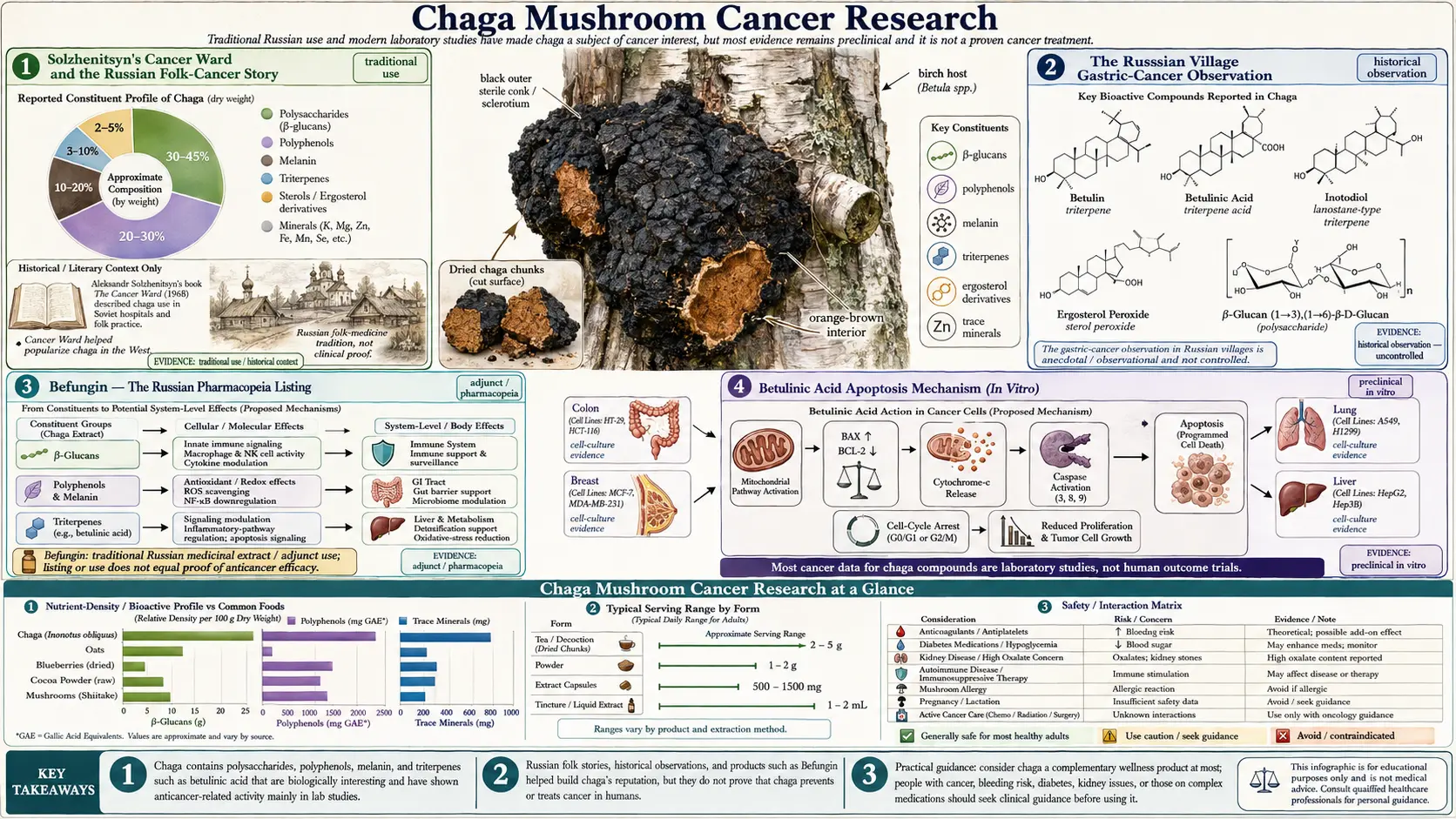
Honest framing first. Chaga (Inonotus obliquus) is not a cancer treatment. The widely circulated claim that chaga "cures cancer" — whether traced to Aleksandr Solzhenitsyn's 1968 novel Cancer Ward, to Russian folk-medical tradition, or to internet supplement marketing — is not supported by clinical evidence. What is supported: betulinic acid (a triterpenoid that chaga extracts from its birch host) induces apoptosis in several tumor cell lines in vitro, crude chaga extracts inhibit tumor growth in mouse xenograft models, and a notably low gastric-cancer rate in birch-rich rural Russian villages may reflect a real (but currently unverifiable) traditional-diet contribution. What is missing: any rigorous randomized controlled trial in human cancer patients. This deep-dive walks through the historical context, the actual cell-culture and animal data, the proposed mechanisms (betulinic acid apoptosis induction, immunomodulatory anti-tumor activity, antioxidant cancer prevention), and the honest framing that should govern any conversation about chaga in oncology.
Table of Contents
- Solzhenitsyn's Cancer Ward and the Russian Folk-Cancer Story
- The Russian Village Gastric-Cancer Observation
- Befungin — The Russian Pharmacopeia Listing
- Betulinic Acid Apoptosis Mechanism (In Vitro)
- Tumor Cell Line Data (Melanoma, Colon, Liver, Breast)
- Mouse Xenograft Studies and Crude Extract Data
- The Immunomodulatory Anti-Tumor Pathway
- The State of Human Evidence (Honest Assessment)
- The Memorial Sloan Kettering Position and Why It Matters
- Patient Counseling: How To Discuss Chaga in Oncology Care
- Key Research Papers
- Connections
- Featured Videos
Solzhenitsyn's Cancer Ward and the Russian Folk-Cancer Story
Aleksandr Solzhenitsyn's semi-autobiographical 1968 novel Cancer Ward (Rakovyy Korpus) drew on his own experience as a Soviet labor-camp survivor diagnosed with seminoma testicular cancer who recovered after treatment at a Tashkent oncology hospital. In one of the novel's recurring threads, characters discuss a peasant remedy from a Russian village — a black mushroom brewed as tea (chai chaga) — and the rumor circulating in the cancer ward that the peasant doctor "Maslennikov" has cured tumors in his rural practice with this remedy.
Solzhenitsyn's text is a literary device, not a medical claim, but the framing carried enormous weight. Cancer Ward was internationally famous, won the Nobel Prize in Literature for Solzhenitsyn in 1970, and was widely read in the West at exactly the moment of growing Western interest in plant-derived cancer treatments (the early vinca alkaloid and taxane discoveries were happening in the same decade). The novel inspired the first wave of Western interest in chaga and the first wave of Soviet-era scientific investigation under Bulatov, Shashkina, and Yefimov at the Komarov Botanical Institute in Leningrad.
Two important caveats on the literary source:
- The "Maslennikov" peasant doctor character is fictional, though Solzhenitsyn based him loosely on real folk-medical practitioners he had heard about.
- Solzhenitsyn's own seminoma cure was achieved with conventional radiation and chemotherapy in a Soviet oncology hospital, not with chaga. He did consume chaga tea after his recovery and remained an advocate for the practice, but he was clear in interviews that the tea was not what cured his cancer.
The fair reading is that Solzhenitsyn dramatized a real folk-medical tradition that had genuine cultural and historical roots, but the literary framing was not a medical endorsement, and the subsequent Western marketing claims that conflate the novel with clinical evidence are not justified.
The Russian Village Gastric-Cancer Observation
The substrate observation that gave rise to the Russian chaga tradition is genuinely interesting and harder to dismiss than the novel-derived claims. Rural birch-forest regions of Russia (the Komi-Permyak republic, parts of Karelia, parts of Western Siberia) had anomalously low gastric and stomach cancer rates compared to nearby urban or non-birch-region populations. The observation goes back at least to the late 19th century and was formalized in Soviet-era cancer registry data showing 2-3 fold lower gastric cancer mortality in chaga-consuming rural districts versus comparison populations.
Three plausible explanations:
- Chaga consumption is genuinely protective — the strongest version of the traditional claim. Biologically plausible via the immunomodulatory and antioxidant mechanisms, but never confirmed by intervention trial.
- Confounding by lifestyle and environment — rural birch-forest populations differ from urban populations in many ways: lower processed-food intake, less industrial pollution, more physical activity, lower nitrosamine exposure (a known gastric carcinogen) from less industrial food processing. Any of these could account for the gastric cancer difference without chaga playing any role.
- Reporting and diagnostic differences — rural populations had less access to medical care, so gastric cancers may have been under-diagnosed in life and under-registered at death. This would deflate apparent rates without any actual protective effect.
Modern epidemiology has not been able to disentangle these explanations because the relevant Soviet-era records are incomplete, the populations have substantially urbanized since the 1970s, and a prospective trial of chaga consumption for gastric cancer prevention is not ethically or logistically feasible. The observation is real but the causal interpretation is not established.
For more on gastric cancer epidemiology and risk factors, see our Gastroenterology category page.
Befungin — The Russian Pharmacopeia Listing
One concrete product of the Soviet-era chaga research is Befungin — a standardized aqueous extract of Inonotus obliquus formulated with small amounts of cobalt sulfate, approved as an over-the-counter pharmaceutical in the Soviet Union (and subsequently the Russian Federation) for adjunctive treatment of chronic gastritis, gastric ulcer, and as a general gastric tonic. Befungin remains available in Russian pharmacies today.
The Russian pharmacopeia entry for Befungin is more conservative than the surrounding folk-medical claims would suggest. It is positioned as a symptomatic adjunct for chronic gastritis and ulcer rather than as a cancer treatment, and the labeling explicitly notes that it should not replace conventional cancer therapy. The "general tonic" indication is the closest the pharmacopeia comes to endorsing the folk-medical broader claim.
Befungin's clinical track record (such as it is, mostly Russian-language and not subjected to Western regulatory standards) suggests reasonable safety in adult outpatient use at recommended doses over months. The Russian pharmacopeia listing is not equivalent to FDA or EMA approval and does not constitute Western clinical-trial-grade evidence, but it does represent the institutional translation of the folk tradition into a regulated pharmaceutical form for a narrow indication.
Betulinic Acid Apoptosis Mechanism (In Vitro)
The most-studied anti-cancer mechanism for chaga is the activity of betulinic acid, a pentacyclic triterpenoid that chaga extracts from its birch host tree. Betulinic acid was identified as a melanoma-selective cytotoxic agent in a landmark 1995 Nature Medicine paper by Pisha and colleagues, working through bioassay-guided fractionation of plant material. Betulinic acid, abundant in white birch bark, emerged as the active compound; in follow-up work in athymic mice carrying human melanoma xenografts, tumor growth was completely inhibited without observed toxicity. That mouse result is the strongest in vivo signal in this entire literature — but it is a result for purified betulinic acid given to mice, not for chaga tea drunk by people.
The proposed apoptosis mechanism involves several molecular events:
- Mitochondrial membrane permeabilization — betulinic acid acts directly on mitochondria of tumor cells, inducing the mitochondrial permeability transition pore opening, releasing cytochrome c into the cytosol, and triggering the intrinsic apoptosis pathway through the caspase-9/caspase-3 cascade.
- P53 independence — importantly, the betulinic acid apoptosis mechanism does not require functional p53, which means it can theoretically target tumor cells that have lost p53 function (a common cancer-driver mutation that confers resistance to many conventional chemotherapy drugs).
- BCL-2 family modulation — betulinic acid downregulates anti-apoptotic BCL-2 and upregulates pro-apoptotic BAX, shifting the apoptotic balance toward cell death.
- NF-kappa-B inhibition — betulinic acid inhibits NF-kappa-B activation in chronically inflamed tumor microenvironments, which can sensitize tumor cells to apoptosis induction.
- Topoisomerase inhibition — some studies show betulinic acid inhibits topoisomerase I and II, the same molecular targets as the chemotherapy drugs irinotecan and etoposide.
These in-vitro mechanisms are biologically real and have been replicated in multiple independent laboratories. The complication is that betulinic acid is poorly bioavailable orally (most of an oral dose is not absorbed) and the in-vitro effective concentrations (micromolar range) are difficult to achieve in vivo from realistic chaga consumption. Pharmaceutical research has explored intravenous betulinic-acid analogs and liposomal formulations to bypass the bioavailability problem, with several phase I trials but no phase III completion as of 2026.
Tumor Cell Line Data (Melanoma, Colon, Liver, Breast)
Beyond the original melanoma findings, betulinic acid and crude chaga extracts have been tested against a wide range of human tumor cell lines, with reasonably consistent in-vitro cytotoxicity:
- Melanoma — original Pisha 1995 finding, replicated in multiple labs. Betulinic acid IC50 in the 1-5 microgram/mL range against MEL-1, MEL-2, MEL-3, MEL-4 melanoma lines, with minimal toxicity to normal melanocytes at the same concentrations.
- Colorectal cancer — HCT-116, HT-29, and SW-480 colorectal cell lines all show dose-dependent growth inhibition and apoptosis induction from crude chaga ethanolic extract and from purified betulinic acid.
- Hepatocellular carcinoma (liver cancer) — HepG2 and Hep3B liver cancer cell lines show apoptosis induction from chaga extracts, with mechanistic studies confirming the mitochondrial-pathway involvement.
- Breast cancer — MCF-7 (estrogen-receptor-positive) and MDA-MB-231 (triple-negative) breast cancer cell lines show growth inhibition from chaga extracts, with the triple-negative line generally more sensitive.
- Cervical cancer — HeLa cells show classical apoptosis induction by chaga extracts at concentrations of 10-50 microgram/mL.
- Glioma (brain cancer) — U87 and U251 glioma cell lines show dose-dependent growth inhibition by betulinic acid; the brain-blood-barrier penetration in vivo is a separate question.
- Leukemia — K562 chronic myelogenous leukemia and HL-60 acute myelogenous leukemia cell lines show apoptosis induction from chaga extracts and from purified betulinic acid.
The breadth of in-vitro cytotoxicity is impressive and suggests that the betulinic acid mechanism (mitochondrial-pathway apoptosis induction in a p53-independent manner) is genuinely broad-spectrum. The in-vivo translation is the harder question.
Mouse Xenograft Studies and Crude Extract Data
Mouse xenograft studies (where human tumor cells are implanted in immunocompromised mice and the tumor growth is tracked over weeks of treatment) bridge the gap between cell-culture work and human clinical trials. Several mouse xenograft studies have tested crude chaga extracts and purified compounds:
- Pisha 1995 — the one unambiguous animal result. Purified betulinic acid in athymic mice bearing human melanoma xenografts completely inhibited tumor growth without observed toxicity. This is purified compound, not chaga.
- Arata 2016 — continuous intake of chaga aqueous extract slowed tumor progression and maintained body temperature in tumor-bearing mice. This is the closest thing to an oral whole-extract animal study, and it is a mouse study.
- Fan 2012 — a purified water-soluble chaga polysaccharide (ISP2a) showed antitumor and immunomodulatory activity in a murine tumor model, consistent with the beta-glucan immune mechanism rather than direct cytotoxicity.
Two studies frequently cited in this section do not belong in it, and the correction matters. Lemieszek et al. (2011) is titled “in vitro studies” and contains no animal data at all — any tumor-volume percentage attributed to it is not in the paper. Burczyk et al. (1996) tested aqueous chaga extract on HeLa cervical cancer cells in culture, not in mice; there is no Ehrlich ascites experiment in it. Sun et al. (2008) measured blood glucose and lipid peroxidation in alloxan-diabetic mice and reports no tumor endpoint whatsoever. We have removed those three claims rather than repeat them, because in-vitro results dressed as in-vivo results are exactly how a modest mechanism becomes a marketing claim.
The honest interpretation of what animal data do exist: oral chaga extract produces modest tumor-growth inhibition in mouse models. The effect size is not in the range that would be expected from a conventional cytotoxic chemotherapy drug; it is in the range that would be expected from a relatively mild immunomodulator or chemopreventive agent. This is consistent with the multifaceted, low-affinity mechanism (beta-glucan immunomodulation plus betulinic acid apoptosis induction plus polyphenol antioxidant/Nrf2 signaling) and is not consistent with the marketing-claim level of "cancer treatment."
The Immunomodulatory Anti-Tumor Pathway
Beyond direct betulinic-acid cytotoxicity, chaga's anti-tumor potential operates through immunomodulation — activation of natural killer (NK) cells, tumor-associated macrophages, and cytotoxic T cells that recognize and kill tumor cells. This is the same mechanism that has been clinically successful for other medicinal mushroom polysaccharide preparations:
- PSK (polysaccharide-K from Turkey Tail mushroom) — approved in Japan as an adjuvant cancer therapy since 1977. Trials and meta-analyses from the 1980s and 1990s reported improved survival when PSK was added to chemotherapy in gastric and colorectal cancer, and the mechanism is immunomodulatory rather than directly cytotoxic. Modern randomized trials have not sustained that picture. The MCSGO-CCTG phase III trial (Miyake 2018, 357 patients) found that adding PSK instead of leucovorin was not non-inferior: 3-year disease-free survival was 72.1% with PSK versus 82.3% without, and 3-year overall survival 90.7% versus 95.4%. A 2024 randomized trial found no significant disease-free survival difference either way. PSK is therefore a weaker precedent than it is usually made to sound. See our Turkey Tail Mushroom page for more detail.
- Lentinan (from Shiitake mushroom) — intravenous adjuvant cancer therapy in Japan, with similar mechanism and modest survival benefit when added to chemotherapy in gastric and lung cancer.
- Schizophyllan (from Schizophyllum commune) — intravenous adjuvant for cervical and head/neck cancer in Japan.
The mechanistic basis for these clinically successful mushroom polysaccharides is the same beta-glucan binding to Dectin-1, TLR-2/4, and complement receptor 3 that we discussed in the Immune Modulation deep-dive. The resulting NK cell activation, macrophage activation, and T-cell priming can contribute to anti-tumor surveillance.
Whether oral chaga consumption achieves clinically meaningful immune activation is the harder question. The Japanese PSK and lentinan protocols use intravenous administration at standardized doses; oral consumption of variable wild-harvested chaga is an entirely different exposure profile. The Japanese trials would not have shown survival benefit with oral administration of crude mushroom material; they required pharmaceutical-grade purified polysaccharide given intravenously.
So the analogy with clinically successful mushroom-derived cancer adjuvants is genuine but should not be over-interpreted. Chaga's biologically plausible immune mechanism does not automatically translate to "chaga has the same effect as PSK" in clinical oncology.
The State of Human Evidence (Honest Assessment)
What we have:
- The traditional Russian observational evidence (low gastric cancer in birch-forest villages) — suggestive but confounded.
- The Befungin Russian pharmacopeia listing for chronic gastritis — a regulatory adjunct indication, not a cancer treatment.
- Small case series and uncontrolled observational reports of chaga use in cancer patients with mixed outcomes — low evidence quality.
- Najafzadeh et al. (2007) took blood from 20 inflammatory-bowel-disease patients and 20 healthy volunteers and added chaga extract to the lymphocytes in the test tube, reporting a 54.9% reduction in hydrogen-peroxide-induced DNA damage. Nobody in that study swallowed any chaga. It is an ex-vivo laboratory result, not a clinical trial and not a pilot of chaga treatment.
- Ongoing small phase I/II trials of betulinic acid analogs (pharmaceutical-grade, intravenous) in melanoma and other solid tumors — these are about the purified compound, not chaga.
What we do not have:
- Any randomized controlled trial of oral chaga consumption in cancer patients with survival or progression-free survival endpoints.
- Any rigorous prospective epidemiologic study correlating chaga consumption with cancer incidence in human populations.
- Any standardized dosing recommendation that has been validated in human clinical trials.
- Any approved indication in any Western regulatory framework (FDA, EMA, Health Canada, TGA) for chaga in oncology.
The intellectually honest position is that chaga has biologically plausible anti-tumor mechanisms supported by in-vitro and animal data, but the human evidence is preliminary and does not support specific clinical claims. Patients considering chaga in the context of cancer should approach it as a traditional adjunct with a plausible biological basis and an established traditional-use safety profile, not as an evidence-based cancer treatment.
For broader context on cancer treatment and prevention, see our Cancer page.
The Memorial Sloan Kettering Position and Why It Matters
Memorial Sloan Kettering Cancer Center (MSKCC) maintains a public herb-drug interaction database (the "About Herbs" project) that is widely consulted by oncology professionals. Their chaga entry is worth quoting because it represents the institutional position of one of the most respected cancer centers in the world:
MSKCC's chaga summary acknowledges the in-vitro and animal data showing anti-tumor activity, notes the long traditional use, and explicitly states that "human data are lacking" and that chaga should not be used as a substitute for conventional cancer therapy. They flag several specific safety concerns:
- The hypoglycemia risk in diabetic patients on insulin or oral hypoglycemics (also discussed in the Adaptogenic Effects deep-dive).
- The bleeding risk from chaga's anti-platelet activity, particularly relevant in cancer patients on anticoagulants or facing surgery.
- The oxalate-induced nephropathy case report (Japanese woman with diabetes consuming 4-5 cups daily for 6+ months).
- The potential interaction with immunosuppressant medications.
- The unknown interaction with chemotherapy agents (no formal interaction studies have been done, and the multifactorial chaga mechanism makes prediction difficult).
The MSKCC position is representative of what mainstream Western oncology says about chaga: biologically plausible, traditionally used, no demonstrated clinical efficacy, several documented safety concerns, and not a replacement for evidence-based cancer treatment. Patients should always disclose chaga use to their oncology team.
Patient Counseling: How To Discuss Chaga in Oncology Care
If you are a cancer patient considering chaga, or a clinician counseling a patient about chaga:
- Always disclose to the oncology team. Chaga use is common among cancer patients (estimates range from 5-20% depending on geography and cancer type). The treating oncology team needs to know to anticipate interactions, to interpret laboratory abnormalities (especially platelet counts and glucose), and to make informed decisions about supportive care.
- Do not substitute chaga for conventional treatment. The biggest harm associated with traditional cancer remedies is not direct toxicity but rather delay or refusal of effective conventional treatment. If you choose to use chaga, use it alongside evidence-based therapy, not instead of it.
- Pause around surgery. The anti-platelet effect of chaga can increase perioperative bleeding. Most surgical guidelines recommend discontinuing chaga (and other herbal supplements) at least 1 week before any scheduled surgical procedure.
- Be cautious during active chemotherapy. The unknown interaction with chemotherapy is a real concern. Many oncologists will recommend pausing chaga during active chemotherapy cycles and resuming during off-treatment periods, if at all.
- Avoid in transplant recipients and on immunosuppressants. The immune-activating effect is plausibly clinically significant for organ-transplant recipients.
- Monitor blood glucose and platelet counts. Especially in diabetic patients or those on anticoagulants.
- Use a quality source. Wild-harvested birch chaga from a documented sustainable source is preferable to cultivated material or unverified internet purchases.
Key Research Papers
- Pisha E, Chai H, Lee IS, et al. (1995). Discovery of betulinic acid as a selective inhibitor of human melanoma that functions by induction of apoptosis. Nature Medicine 1(10):1046-1051. — PubMed
- Fulda S (2008). Betulinic acid for cancer treatment and prevention. International Journal of Molecular Sciences 9(6):1096-1107. — PubMed
- Fulda S, Friesen C, Los M, et al. (1997). Betulinic acid triggers CD95 (APO-1/Fas)- and p53-independent apoptosis via activation of caspases in neuroectodermal tumors. Cancer Research 57(21):4956-4964. — PubMed
- Lemieszek MK, Langner E, Kaczor J, et al. (2011). Anticancer effects of fraction isolated from fruiting bodies of chaga medicinal mushroom, Inonotus obliquus: in vitro studies. International Journal of Medicinal Mushrooms 13(2):131-143. — cell culture only; this paper contains no animal data. — PubMed
- Burczyk J, Gawron A, Slotwinska M, et al. (1996). Antimitotic activity of aqueous extracts of Inonotus obliquus. Bollettino Chimico Farmaceutico 135(5):306-309. — HeLa S3 cervical cancer cells in culture. — PubMed
- Youn MJ, Kim JK, Park SY, et al. (2009). Potential anticancer properties of the water extract of Inonotus obliquus by induction of apoptosis in melanoma B16-F10 cells. Journal of Ethnopharmacology 121(2):221-228. — PubMed
- Youn MJ, Kim JK, Park SY, et al. (2008). Chaga mushroom (Inonotus obliquus) induces G0/G1 arrest and apoptosis in human hepatoma HepG2 cells. World Journal of Gastroenterology 14(4):511-517. — PubMed
- Lee SH, Hwang HS, Yun JW (2009). Antitumor activity of water extract of a mushroom, Inonotus obliquus, against HT-29 human colon cancer cells. Phytotherapy Research 23(12):1784-1789. — PubMed
- Fan L, Ding S, Ai L, Deng K (2012). Antitumor and immunomodulatory activity of water-soluble polysaccharide from Inonotus obliquus. Carbohydrate Polymers 90(2):870-874. — PubMed
- Sun JE, Ao ZH, Lu ZM, et al. (2008). Antihyperglycemic and antilipidperoxidative effects of dry matter of culture broth of Inonotus obliquus in submerged culture on normal and alloxan-diabetes mice. Journal of Ethnopharmacology 118(1):7-13. — a glucose and lipid-peroxidation study; it reports no tumor endpoint. — PubMed
- Arata S, Watanabe J, Maeda M, et al. (2016). Continuous intake of the chaga mushroom (Inonotus obliquus) aqueous extract suppresses cancer progression and maintains body temperature in mice. Heliyon 2(5):e00111. — an animal study, not a human one. — PubMed
- Najafzadeh M, Reynolds PD, Baumgartner A, et al. (2007). Chaga mushroom extract inhibits oxidative DNA damage in lymphocytes of patients with inflammatory bowel disease. BioFactors 31(3-4):191-200. — PubMed
- Zhao Y, Zheng W (2021). Deciphering the antitumoral potential of the bioactive metabolites from medicinal mushroom Inonotus obliquus. Journal of Ethnopharmacology 265:113321. — PubMed
- Miyake Y, Nishimura J, Kato T, et al. (2018). Phase III trial comparing UFT + PSK to UFT + LV in stage IIB, III colorectal cancer (MCSGO-CCTG). Surgery Today 48(1):66-72. — the PSK arm failed to show non-inferiority. — PubMed
- Ogawa H, Shiraishi T, Okada T, et al. (2024). Adjuvant chemotherapy with UFT/LV versus UFT/LV plus PSK in stage II/III colorectal cancer. Anticancer Research 44(2):805-814. — no significant difference in 3-year disease-free survival. — PubMed
PubMed Topic Searches
- PubMed: Inonotus obliquus chaga cancer antitumor
- PubMed: Betulinic acid apoptosis tumor cell
- PubMed: Chaga gastric cancer Russian folk medicine
- PubMed: Medicinal mushroom adjuvant chemotherapy cancer survival
- PubMed: Betulinic acid intravenous phase I trials
- PubMed: Mushroom polysaccharide NK / anti-tumor immunity
Connections
- Chaga Mushroom Overview
- Chaga Benefits Hub
- Chaga Immune Modulation
- Chaga Antioxidant Capacity
- Chaga Adaptogenic Effects
- Cancer
- Gastroenterology
- Turkey Tail Mushroom (PSK)
- Reishi Mushroom
- Lion's Mane Mushroom
- Gerson Therapy Cancer Treatment
- Oxidative Stress
- Immune Boosting
- Quercetin