Zinc Toxicity (Excess Zinc): Weakened Immunity
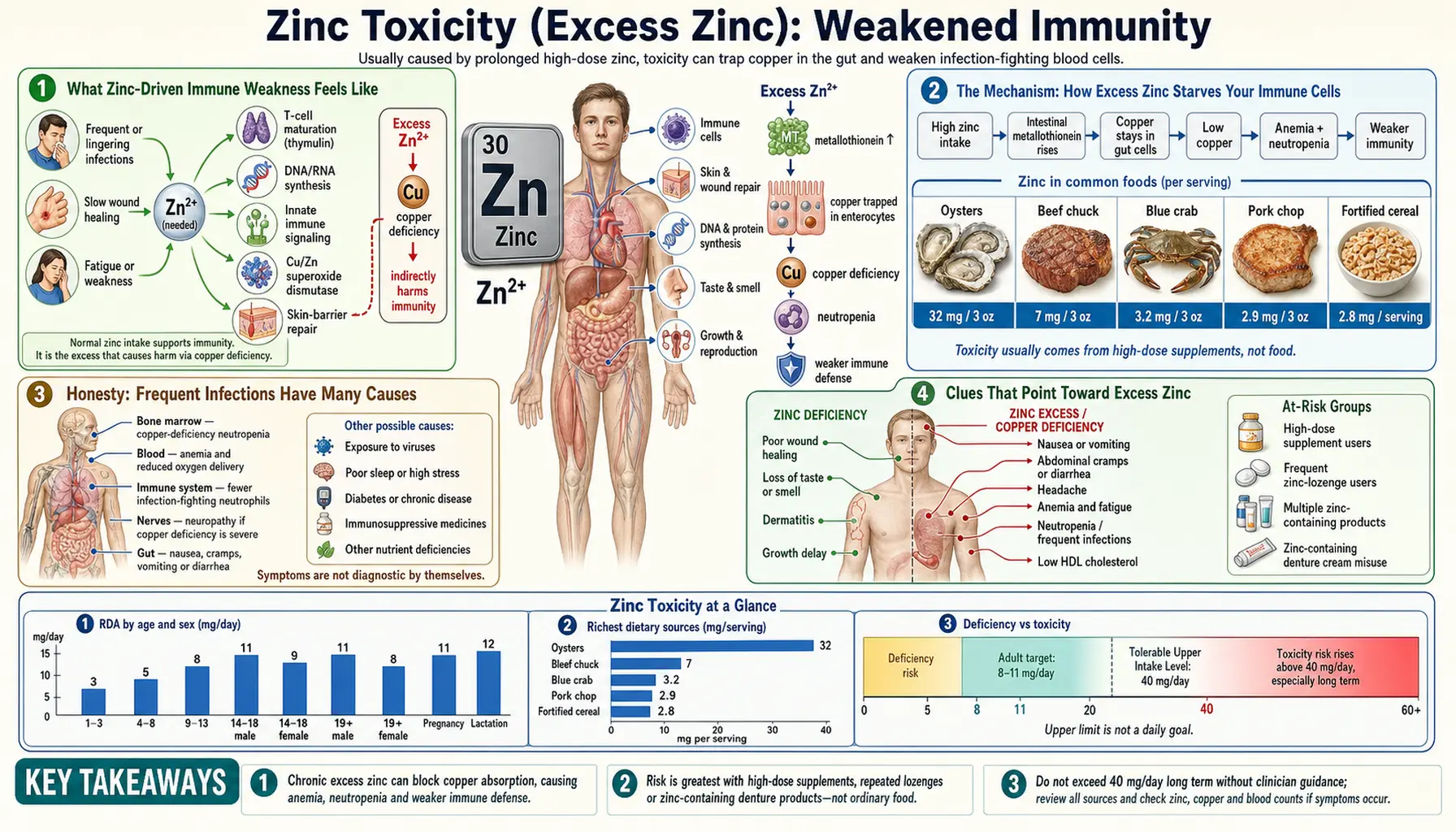
Zinc has a reputation as the “immune mineral,” so it surprises people to learn that taking too much of it, for long enough, can work against the immune system. A 1984 study found that very high doses blunted several immune-cell responses in healthy men, and case reports document a second route: a sustained zinc excess drives down copper, and copper deficiency causes anemia and a low count of neutrophils, the white cells that kill bacteria. The published cases trace the excess mainly to oral supplements, zinc-containing denture adhesive creams and swallowed coins; the Institute of Medicine found no evidence of harm from the zinc that occurs naturally in food. This page describes how a chronic zinc excess weakens immunity, why the picture is easy to misread, the findings that point to it, and what the case reports describe about diagnosis and recovery.
Table of Contents
- What Zinc-Driven Immune Weakness Looks Like
- The Mechanism: How Excess Zinc Weakens Immune Cells
- Honesty: Frequent Infections Have Many Causes
- Clues That Point Toward Excess Zinc
- Where the Excess Zinc Comes From
- How It Is Diagnosed
- How Zinc Excess and Its Immune Effects Are Reversed
- Red Flags Described in the Research
- Key Research Papers
- Connections
- Featured Videos
What Zinc-Driven Immune Weakness Looks Like
This is not a sudden illness. In the published cases, zinc-induced copper deficiency developed over weeks to years of exposure, and several reports recognized it first on blood tests or bone-marrow examination rather than from symptoms. Because the cause is slow, it is easy to miss the connection with a supplement — especially one started to help immunity.
What the case reports and reviews document is mostly laboratory findings, with or without symptoms:
- A low neutrophil count (neutropenia). A 2026 systematic review of 37 published cases found anemia in nearly all of them, most often together with neutropenia and a low total white-cell count; with severe or prolonged exposure, all three blood-cell lines fell (pancytopenia).
- Anemia at the same time. Because the low white-cell and low red-cell counts come from the same copper shortage, they tend to arrive together — see anemia.
- A wide range of how people feel. A 2025 primary-care review notes that people with neutropenia range from having no symptoms at all to being severely ill and needing hospital care.
- Nerve symptoms in some cases. In a 2005 report of three cases, two men had a peripheral neuropathy that had been progressing for 8 and 18 months alongside anemia and severe neutropenia.
Notice what is missing from that list: no symptom says “zinc.” That vagueness is one reason the condition is missed, and why the next section, on other causes, matters.
The Mechanism: How Excess Zinc Weakens Immune Cells
To understand why too much of the immune mineral can weaken immunity, it helps to hold two facts together. First, zinc is essential for immune function: it is required for the activity of more than 300 enzymes, and zinc-deficient people are more susceptible to a range of infections, with effects on neutrophils, natural killer cells, T and B lymphocytes and macrophages. Second, the Institute of Medicine lists suppression of immune response, lower HDL cholesterol and reduced copper status as adverse effects of chronic intake of supplemental zinc. So both too little and too much are harmful, and at the high end two routes are described.
The copper connection. Zinc induces a binding protein called metallothionein in the cells lining the intestine. Brewer and colleagues, who used this effect to treat Wilson disease (an inherited copper overload), describe it this way: intestinal metallothionein blocks the absorption of copper from food and also blocks the reabsorption of the copper the body secretes into saliva, gastric juice and intestinal fluids, producing a negative copper balance. In their words, pharmacological doses of zinc taken without food “will usually lead to copper deficiency.” This is the mechanism of zinc-induced copper deficiency, covered in its own right on the companion page, Zinc Toxicity and Copper Deficiency.
Why a copper shortage hits immunity. A 2025 hematology review describes two effects of copper deficiency on the blood: impaired ferroxidase activity, which hampers the use of iron to make red cells, and reduced neutrophil survival, linked to impairment of the copper enzymes cytochrome c oxidase and superoxide dismutase. The result is neutropenia and anemia, and the same review notes that copper deficiency can look like vitamin B12 deficiency or myelodysplastic syndrome. Fewer neutrophils means fewer front-line defenders against bacteria.
An analogy. Picture the immune system as a fire department, with neutrophils as the firefighters. Copper keeps the firefighters on duty, and zinc, in the right amount, keeps the trucks running. Too much zinc for too long cuts off the station’s copper supply, and the firefighters drop away. When the next fire (an infection) breaks out, there are not enough people to answer the call. In the case reports, once the zinc excess ended and copper was restored, the blood counts recovered over weeks to months.
The direct effect. The direct route rests mainly on one small 1984 study. Chandra gave 11 healthy adult men 150 mg of elemental zinc twice a day (300 mg/day, as zinc sulfate) for six weeks. Lymphocyte responses to a stimulating agent (phytohemagglutinin) fell, and so did chemotaxis and phagocytosis of bacteria by neutrophils (polymorphonuclear leukocytes). HDL cholesterol also fell significantly. The Institute of Medicine’s 2001 report cites this study for impaired immune response at that dose. In the published human case reports, though, the documented pathway to weakened defenses is the copper one.
Honesty: Frequent Infections Have Many Causes
Catching a lot of infections does not mean someone has zinc poisoning. The 2026 systematic review describes zinc-induced blood toxicity as uncommon (though under-recognized): it found 37 individual cases published between 1972 and 2025. Frequent infections and a low white-cell count are non-specific findings with many possible causes, some of them serious.
The 2025 primary-care review groups the acquired causes of neutropenia as:
- Infection-related neutropenia.
- Drug-induced neutropenia, both idiosyncratic reactions and chemotherapy-induced neutropenia.
- Autoimmune neutropenia and chronic idiopathic neutropenia (no cause found).
- Hematologic malignancy — one reason an unexplained low blood count is taken seriously.
- Nutritional deficiency of vitamin B12, folate or copper.
Inherited forms (bone-marrow failure, cyclic neutropenia, severe congenital neutropenia) make up a separate group. True zinc deficiency is the more familiar nutritional link to impaired immunity — the mirror image of this page — and is covered on the zinc deficiency hub.
Excess zinc becomes a likely explanation when the specific findings in the next section are present. It is a real and largely reversible cause, but an uncommon one.
Clues That Point Toward Excess Zinc
Because frequent infections are so non-specific, the published cases pinned down excess zinc only when several findings lined up. The most important is also the most obvious, and it is often overlooked: a history of taking in a lot of zinc. The findings described in the literature include:
- A clear high-zinc exposure. In the 2026 systematic review, the exposures were mostly oral supplements, denture adhesive creams and swallowed coins. Reported daily doses ranged from about 50 mg to more than 1,500 mg of elemental zinc, taken for weeks to years. Heavy, chronic use of a zinc-containing denture adhesive cream is a well-documented and easily missed source.
- Low white and red counts together. Anemia with neutropenia on the same blood count is the usual pattern. A 2005 report describes sideroblastic anemia and neutropenia as the blood picture of copper deficiency, and calls copper deficiency a rare cause that is often not suspected.
- Low copper with high zinc. Serum copper was low in every case in the 2026 review. In a 2016 laboratory study, 15 of 20 patients with a low plasma copper and a high plasma zinc turned out to have zinc-induced copper deficiency; the authors call that combination strongly predictive. A low ceruloplasmin (the main copper-carrying protein) was reported in patients on long-term zinc therapy as early as 1978.
- Neurological symptoms. Copper deficiency can damage the spinal cord. A 2006 Mayo Clinic review describes the most common form as a myelopathy with a spastic gait and prominent sensory ataxia, resembling the spinal-cord damage of vitamin B12 deficiency. The two deficiencies can coexist, and the nerve syndrome can occur without the blood changes.
How someone feels day to day does little to separate this from other causes, because the symptoms overlap. The cases were identified by connecting the exposure to the blood counts and the copper studies. The closely related copper-deficiency story on the companion page fills in the rest, and the same high-dose zinc can also cause nausea and stomach upset.
Where the Excess Zinc Comes From
The Institute of Medicine’s 2001 report found no evidence of adverse effects from zinc that occurs naturally in food. The adverse effects it lists come from chronic intake of supplemental zinc. For context, that report sets the Recommended Dietary Allowance for adults at 8 mg per day for women and 11 mg per day for men. It sets the Tolerable Upper Intake Level (UL) at 40 mg per day for total zinc intake from food, water and supplements, fortified foods included. The UL comes from a lowest-observed-adverse-effect level of 60 mg/day (a 50 mg supplement plus about 10 mg from the diet, which lowered a copper-dependent red-cell enzyme), divided by an uncertainty factor of 1.5. The report notes that the UL is not meant to apply to people receiving zinc under medical supervision. The sources described in the research are:
- High-dose zinc supplements. Oral supplements were the most common source in the 2026 systematic review, at daily doses from about 50 mg upward. Zinc from multivitamins, separate zinc tablets and combination “immune” products all counts toward the total intake the UL covers.
- Zinc lozenges and nasal cold products. Zinc from lozenges is also part of total intake. Intranasal zinc carries a separate, documented harm: loss of smell. A 2006 case series described 17 patients with lost or reduced smell after using an intranasal zinc gluconate gel. All of them reported sniffing deeply when applying it, then an immediate burning sensation, and loss of smell within 48 hours; 7 of the 17 never developed cold symptoms. A 2004 case series found the severe loss of smell appeared to be long-lasting or permanent in some cases. A 2010 analysis of 25 clinic patients applied the Bradford Hill causation criteria and concluded that intranasal zinc gluconate causes reduced smell (hyposmia) and loss of smell (anosmia). A 2009 meta-analysis of the cold trials found no significant harms reported in them, while noting “unquantified concerns about permanent anosmia.”
- Denture adhesive creams. A 2008 report described four patients with low copper, high zinc and neurological disease. All wore dentures and used very large amounts of denture cream chronically, and the two creams tested contained about 17,000–34,000 µg of zinc per gram. In a 2009 series of 11 patients with progressive nerve damage, low copper and high zinc, denture cream was the source in every case. All 11 had ill-fitting dentures and used large amounts, and their copper and zinc levels returned to normal after they stopped using the cream.
- Specialty formulas. Some products deliver large amounts of zinc. For example, the Age-Related Eye Disease Study (AREDS) tested a daily 80 mg of zinc as zinc oxide, given with 2 mg of copper as cupric oxide.
Because the UL covers total intake, the published cases counted zinc from every source — multivitamin, standalone supplement, lozenges, specialty formula and denture cream — not just the product labeled “zinc.” The authors of the 2026 review conclude that routine assessment of zinc exposure and copper status can prevent misdiagnosis.
How It Is Diagnosed
In the published cases, the diagnosis came from linking the exposure history to a small set of blood tests and, often, a bone-marrow examination. No single result proves it; the pattern makes the case.
The work-up described in the literature:
- A complete blood count (CBC) with differential. This measures neutrophils and the other white cells along with red cells and platelets. Adult neutropenia is defined as an absolute neutrophil count below 1,500 per µL: mild at 1,000–1,500, moderate at 500–999 and severe below 500. In zinc-induced copper deficiency, the typical finding is anemia with neutropenia.
- Copper and ceruloplasmin levels. Low serum copper was found in every case in the 2026 review. Low ceruloplasmin was described in patients on long-term zinc therapy.
- A serum or plasma zinc level. A high zinc level alongside a low copper level was strongly predictive of zinc-induced copper deficiency in the 2016 laboratory study.
- A careful exposure history. Supplements, lozenges, specialty formulas and, especially, denture-cream use. The 2008 denture-cream report notes that when a high zinc level is found, its source “often remains elusive.”
- Bone marrow and the mimics. In the 2005 report, the diagnosis was first suggested by bone-marrow examination in all three cases. The 2026 review found vacuolated blood-forming cells and ring sideroblasts in the marrow, which often led to an initial misdiagnosis of myelodysplastic syndrome. A Comprehensive Metabolic Panel and other routine labs are part of the broader picture.
Once the exposure and the copper studies are seen together, the diagnosis points directly to a reversible cause. The diagnostic logic overlaps heavily with the copper-deficiency page, which goes deeper into the copper studies themselves.
How Zinc Excess and Its Immune Effects Are Reversed
What the case reports describe follows logically from the mechanism: end the zinc excess and replace the copper. The 2026 systematic review found that stopping zinc exposure, together with copper supplementation, led to blood-count recovery in most cases, typically within weeks to months.
- Ending the excess zinc. In the 2009 denture-cream series, copper and zinc levels returned to normal after the patients stopped using the cream. In the 2008 series, serum zinc improved in three patients once they stopped.
- Copper replacement. In a 1978 report of an adult with sickle cell anemia given zinc for two years, copper raised the red-cell size and the white-cell count, and the same authors described the low ceruloplasmin they saw in other zinc-treated patients as easily corrected with copper. The 2006 Mayo Clinic review states that copper supplementation resolves the anemia and neutropenia “promptly and completely.”
- Follow-up testing. The case reports tracked recovery with repeat blood counts and copper and zinc levels. In the 2008 series, copper and zinc were rechecked at varying intervals after treatment.
- Nerve damage recovers less well. The blood abnormalities are largely reversible. In the 2026 review, neurological problems improved more slowly and sometimes incompletely. The Mayo review describes improvement, when it occurs, as often subjective and mainly in sensory symptoms. The 2016 laboratory study notes that delayed diagnosis allows severe and usually irreversible neurological symptoms to develop.
The Institute of Medicine’s UL of 40 mg/day applies to total zinc intake from all sources, and the report found no adverse effects from zinc naturally present in food. Decisions about supplements and their doses belong with a clinician.
Red Flags Described in the Research
Frequent infections are usually a nuisance rather than an emergency. The sources on this page single out a few situations, either because a serious cause has to be excluded or because copper deficiency does the most lasting harm when caught late:
- Fever with a low neutrophil count. The 2025 primary-care review calls febrile neutropenia an oncologic emergency that warrants emergent evaluation. It defines febrile neutropenia as a single oral temperature of 101°F or higher, or 100.4°F or higher sustained for one hour, with an absolute neutrophil count below 500 per µL.
- Infections that are unusually frequent, severe or slow to clear, which is a reason a blood count is checked for an underlying problem.
- An unexplained low white-cell count on a routine test, particularly with anemia. The authors of the 2026 review state that excessive zinc exposure should be considered in patients with unexplained anemia and low blood counts, and that checking zinc exposure and copper status can prevent misdiagnosis.
- New numbness, tingling, weakness or unsteady walking, especially with a low blood count and a history of heavy zinc or denture-cream use. This can signal copper-deficiency damage to the spinal cord, which in the reviews above recovered slowly and sometimes incompletely.
A recurring point in the case reports is that the diagnosis depended on someone looking for the zinc source: the 2008 report notes that the source of a high zinc level often remains elusive, and both denture-cream series traced it by examining denture-cream use. A full list of supplements and products in use is part of the history clinicians take for an unexplained low blood count.
Key Research Papers
- Fosmire GJ (1990). Zinc toxicity. The American Journal of Clinical Nutrition;51(2):225-227. — DOI: 10.1093/ajcn/51.2.225. — doi:10.1093/ajcn/51.2.225
- Wessels I, Maywald M, Rink L (2017). Zinc as a Gatekeeper of Immune Function. Nutrients;9(12):1286. — DOI: 10.3390/nu9121286. — doi:10.3390/nu9121286
- Shankar AH, Prasad AS (1998). Zinc and immune function: the biological basis of altered resistance to infection. The American Journal of Clinical Nutrition;68(2):447S-463S. — DOI: 10.1093/ajcn/68.2.447S. — doi:10.1093/ajcn/68.2.447S
- Prasad AS, Beck FWJ, Bao B, et al. (2007). Zinc supplementation decreases incidence of infections in the elderly: effect of zinc on generation of cytokines and oxidative stress. The American Journal of Clinical Nutrition;85(3):837-844. — DOI: 10.1093/ajcn/85.3.837. — doi:10.1093/ajcn/85.3.837
- Fraker PJ, King LE (2004). Reprogramming of the Immune System During Zinc Deficiency. Annual Review of Nutrition;24:277-298. — DOI: 10.1146/annurev.nutr.24.012003.132454. — doi:10.1146/annurev.nutr.24.012003.132454
- Skrajnowska D, Bobrowska-Korczak B (2019). Role of Zinc in Immune System and Anti-Cancer Defense Mechanisms. Nutrients;11(10):2273. — DOI: 10.3390/nu11102273. — doi:10.3390/nu11102273
- McCall KA, Huang CC, Fierke CA (2000). Function and Mechanism of Zinc Metalloenzymes. The Journal of Nutrition;130(5):1437S-1446S. — DOI: 10.1093/jn/130.5.1437S. — doi:10.1093/jn/130.5.1437S
- Kumar N (2006). Copper Deficiency Myelopathy (Human Swayback). Mayo Clinic Proceedings;81(10):1371-1384. — DOI: 10.4065/81.10.1371. — doi:10.4065/81.10.1371
- Willis MS, Monaghan SA, Miller ML, et al. (2005). Zinc-Induced Copper Deficiency: A Report of Three Cases Initially Recognized on Bone Marrow Examination. American Journal of Clinical Pathology;123(1):125-131. — PubMed PMID: 15762288
- Wapnir RA (1998). Copper absorption and bioavailability. The American Journal of Clinical Nutrition;67(5 Suppl):1054S-1060S. — PubMed PMID: 9587151
- National Institutes of Health, Office of Dietary Supplements. Zinc — Health Professional Fact Sheet (toxicity, tolerable upper intake level, and copper interaction). — NIH Office of Dietary Supplements
- Chandra RK (1984). Excessive intake of zinc impairs immune responses. JAMA;252(11):1443-1446. — PubMed PMID: 6471270
- Institute of Medicine, Panel on Micronutrients (2001). Dietary Reference Intakes for Vitamin A, Vitamin K, Arsenic, Boron, Chromium, Copper, Iodine, Iron, Manganese, Molybdenum, Nickel, Silicon, Vanadium, and Zinc. Chapter 12: Zinc. Washington, DC: National Academies Press. — National Academies Press, chapter 12 (Zinc)
- Brewer GJ, Hill GM, Dick RD, et al. (1985). Interactions of trace elements: clinical significance. Journal of the American College of Nutrition;4(1):33-38. — PubMed PMID: 3886759
- Brewer GJ (2001). Zinc acetate for the treatment of Wilson's disease. Expert Opinion on Pharmacotherapy;2(9):1473-1477. — PubMed PMID: 11585025
- Prasad AS, Brewer GJ, Schoomaker EB, et al. (1978). Hypocupremia induced by zinc therapy in adults. JAMA;240(20):2166-2168. — PubMed PMID: 359844
- Takami A, Uchino K (2025). Discovering the hidden link: hematological disorders caused by copper deficiency. International Journal of Hematology;122(3):358-367. — PubMed PMID: 40653562
- Dutta A, Chaudhary V, Kumari S, et al. (2026). Zinc-Induced Hematologic Toxicities: A Systematic Review of Descriptive Studies. Biological Trace Element Research;204(9):6628-6642. — PubMed PMID: 42087025
- Kim MJ, Forlini C, Kremsreiter K (2025). Neutropenia: Evaluation and Management in the Primary Care Setting. American Family Physician;112(6):618-628. — PubMed PMID: 41533406
- Duncan A, Talwar D, Morrison I (2016). The predictive value of low plasma copper and high plasma zinc in detecting zinc-induced copper deficiency. Annals of Clinical Biochemistry;53(Pt 5):575-579. — PubMed PMID: 26586851
- Nations SP, Boyer PJ, Love LA, et al. (2008). Denture cream: an unusual source of excess zinc, leading to hypocupremia and neurologic disease. Neurology;71(9):639-643. — PubMed PMID: 18525032
- Hedera P, Peltier A, Fink JK, et al. (2009). Myelopolyneuropathy and pancytopenia due to copper deficiency and high zinc levels of unknown origin II. The denture cream is a primary source of excessive zinc. Neurotoxicology;30(6):996-999. — PubMed PMID: 19732792
- Jafek BW, Linschoten MR, Murrow BW (2004). Anosmia after intranasal zinc gluconate use. American Journal of Rhinology;18(3):137-141. — PubMed PMID: 15283486
- Alexander TH, Davidson TM (2006). Intranasal zinc and anosmia: the zinc-induced anosmia syndrome. The Laryngoscope;116(2):217-220. — PubMed PMID: 16467707
- D'Cruze H, Arroll B, Kenealy T (2009). Is intranasal zinc effective and safe for the common cold? A systematic review and meta-analysis. Journal of Primary Health Care;1(2):134-139. — PubMed PMID: 20690364
- Davidson TM, Smith WM (2010). The Bradford Hill criteria and zinc-induced anosmia: a causality analysis. Archives of Otolaryngology–Head & Neck Surgery;136(7):673-676. — PubMed PMID: 20644061
- Age-Related Eye Disease Study Research Group (2001). A randomized, placebo-controlled, clinical trial of high-dose supplementation with vitamins C and E, beta carotene, and zinc for age-related macular degeneration and vision loss: AREDS report no. 8. Archives of Ophthalmology;119(10):1417-1436. — PubMed PMID: 11594942