Copper — Benefits Deep Dive
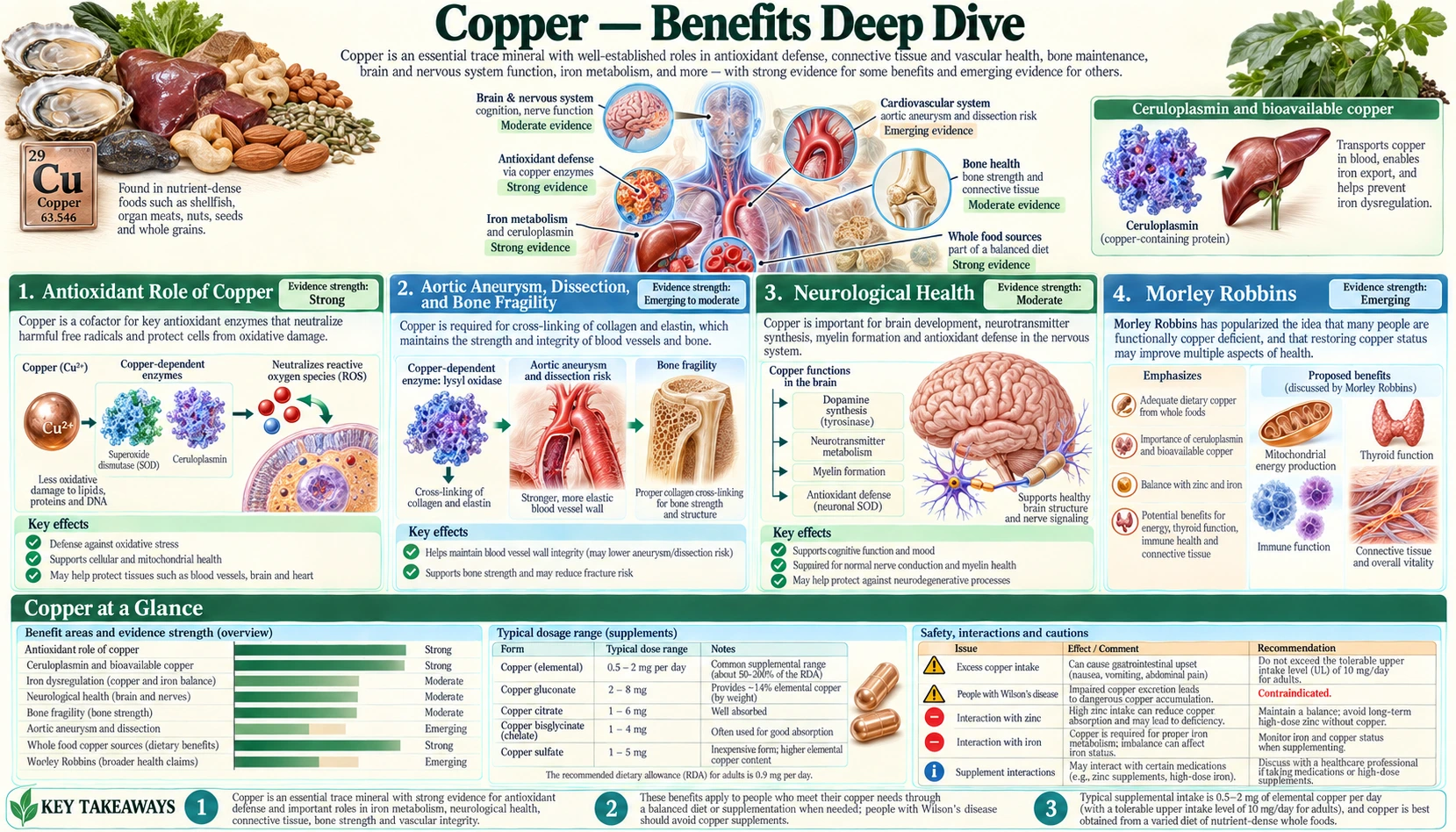
Copper is the redox-active trace metal that quietly underpins iron metabolism, mitochondrial energy production, antioxidant defense, connective-tissue strength, neurotransmitter synthesis, and pigmentation. Every one of these effects traces back to a small family of cuproenzymes — ceruloplasmin, Cu/Zn superoxide dismutase, cytochrome c oxidase, lysyl oxidase, dopamine beta-hydroxylase, and tyrosinase — and the catastrophic monogenic copper disorders Menkes disease (loss of ATP7A) and Wilson disease (loss of ATP7B) demonstrate, in extreme form, what the cuproenzymes do when copper either cannot reach them or accumulates pathologically. Four benefit pages below explore the four organ systems where copper status produces the largest clinical effect — hematology (anemia unresponsive to iron), connective tissue and vasculature (aneurysm, dissection, fragile bone), antioxidant defense (SOD1 and ceruloplasmin's ferroxidase activity), and the nervous system (myelin, dopamine-norepinephrine conversion, copper-deficiency myelopathy).
Deep-Dive Articles
Hemoglobin & Ceruloplasmin
Why iron-deficiency anemia that fails to respond to iron supplementation is often actually copper deficiency in disguise. Ceruloplasmin's ferroxidase activity (Fe²+ → Fe³+) is mandatory for iron to bind transferrin, leave macrophages and enterocytes, and reach the bone marrow for hemoglobin synthesis. Hephaestin, the membrane-bound ferroxidase of the small intestine, performs the same chemistry at the basolateral side of the enterocyte. Without copper, iron is functionally trapped — the textbook microcytic anemia and tissue iron overload coexist in the same patient.
Read the deep dive →Connective Tissue
Lysyl oxidase, a copper-dependent enzyme, cross-links lysine and hydroxylysine residues in collagen and elastin to form the covalent desmosine and isodesmosine bridges that give tendons their tensile strength and aortic elastin its recoil. Copper deficiency — whether dietary, post-bariatric, zinc-overdose-induced, or genetic (Menkes / occipital horn syndrome) — produces aortic aneurysm, spontaneous arterial dissection, fragile bones, kinky/twisted hair (pili torti), loose skin, and bladder diverticula. The vascular fragility is the most clinically lethal.
Read the deep dive →Antioxidant Defense
Cu/Zn superoxide dismutase (SOD1) is the cytosolic first-line defense against superoxide radicals generated by mitochondrial respiration and inflammation. Ceruloplasmin's ferroxidase activity simultaneously oxidizes free Fe²+ before it can drive Fenton-chemistry hydroxyl-radical formation. Copper is therefore antioxidant when properly chaperoned to its target enzymes, but pro-oxidant when free in the cytosol — the same paradox that makes Wilson disease (copper overload) a tissue-destroying oxidative stress condition.
Read the deep dive →Neurological Health
Dopamine beta-hydroxylase — the copper-dependent enzyme that converts dopamine to norepinephrine inside sympathetic neurons and adrenal chromaffin cells — means copper deficiency literally blocks norepinephrine production. Tyrosinase (also copper-dependent) drives the melanin synthesis missing in Menkes disease. Copper-deficiency myelopathy is an acquired syndrome of adults. A 2006 Mayo Clinic review lists its known causes as prior gastric surgery, excessive zinc ingestion, and malabsorption, while noting that often the cause is unclear; bariatric surgery, zinc supplement overdose and long-term use of zinc-containing denture creams are among the reported routes. It mimics Vitamin B12 subacute combined degeneration with dorsal-column and corticospinal-tract dysfunction; the same review notes that copper and vitamin B12 deficiency may coexist, and that the nerve syndrome may be present without the blood changes.
Read the deep dive →Table of Contents
- Deep-Dive Articles
- Why Copper Produces Effects Across So Many Systems
- Research Papers: Hematology & Ceruloplasmin
- Research Papers: Connective Tissue & Vasculature
- Research Papers: Antioxidant Defense (SOD1, Wilson Disease)
- Research Papers: Neurological Health & Myelopathy
- Research Papers: Cross-Cutting (Status, Zinc Interaction, Morley Robbins)
- External Authoritative Resources
- Connections
- Featured Videos
Why Copper Produces Effects Across So Many Systems
Most trace minerals act as a cofactor for a small handful of enzymes. Copper is unusual because it is the active redox center in at least six distinct metalloenzymes, each in a different organ system, and because two of those enzymes (ceruloplasmin and Cu/Zn superoxide dismutase, SOD) participate in iron metabolism and oxidative-stress regulation that touch essentially every tissue in the body. The clinical syndrome of copper deficiency is therefore famously polyphenotypic: a single nutritional defect produces simultaneous anemia, neurologic disease, vascular fragility, hair and skin changes, and immune compromise. The unifying mechanism is the cuproenzymes.
- Ceruloplasmin (ferroxidase, the plasma copper protein carrying ~95% of circulating copper) — oxidizes Fe²+ to Fe³+ so iron can load onto transferrin and reach the bone marrow. This is the mechanism behind copper-deficiency anemia and the basis of the copper-iron axis that Morley Robbins and the Root Cause Protocol have popularized. Loss-of-function (aceruloplasminemia) causes tissue iron overload in brain, liver, and pancreas with diabetes and neurodegeneration.
- Cu/Zn superoxide dismutase (SOD1, cytosolic) — the cytosolic antioxidant enzyme that converts superoxide radical (O2−) to hydrogen peroxide (H2O2), which catalase and glutathione peroxidase then dispose of. SOD1 gain-of-function mutations (not loss-of-function) cause a subset of familial amyotrophic lateral sclerosis (ALS). About 2 percent of all ALS cases are linked to a harmful SOD1 variant. Tofersen, an antisense medicine injected into the spinal fluid that reduces the body's production of SOD1 protein, is described in a 2026 report as "the first and only approved therapy" for adults with SOD1 ALS. In the 108-person VALOR trial it lowered SOD1 in the spinal fluid and neurofilament light chains (a blood marker of nerve damage) over 28 weeks, but the main function score did not differ significantly from placebo (difference 1.2 points, P = 0.97). In the follow-up extension, people who started tofersen about six months earlier showed numerically less decline on that function score over 148 weeks (−9.9 vs −13.5 points). SOD1 is one of the most copper-dependent enzymes in the cell and a major driver of the antioxidant role of copper.
- Lysyl oxidase (LOX) — the extracellular copper-dependent enzyme that oxidatively deaminates lysine and hydroxylysine residues on tropocollagen and tropoelastin, generating the reactive aldehydes that spontaneously cross-link to form desmosine and isodesmosine bridges in elastin and Schiff-base cross-links in collagen. Loss of LOX activity in copper deficiency produces the aortic aneurysm, dissection, and bone fragility that are the lethal complications of severe deficiency.
- Dopamine beta-hydroxylase (DBH) — a copper-dependent enzyme in the synaptic vesicles of noradrenergic neurons and adrenal chromaffin cells that hydroxylates dopamine to norepinephrine. Copper deficiency reduces norepinephrine synthesis, with autonomic and cognitive consequences explored in the neurological health page.
- Tyrosinase — the copper-dependent oxidase in melanocytes that catalyzes the rate-limiting step of melanin synthesis (tyrosine → 3,4-dihydroxyphenylalanine (DOPA) → dopaquinone). Loss-of-function tyrosinase mutation causes oculocutaneous albinism type 1; severe copper deficiency in Menkes disease produces depigmented "kinky" hair and pale skin.
- Cytochrome c oxidase (COX, complex IV of the mitochondrial electron transport chain) — the terminal enzyme of oxidative phosphorylation, containing two copper centers (CuA and CuB) plus heme a and heme a3. COX transfers electrons from cytochrome c to molecular oxygen, generating water and pumping protons that drive adenosine triphosphate (ATP) synthesis. Copper deficiency reduces COX activity, impairs adenosine triphosphate production, and contributes to the fatigue, exercise intolerance, and skeletal muscle weakness of copper deficiency.
The Root Cause Protocol: a practitioner's framework. Morley Robbins created the Root Cause Protocol; his publisher's author page describes him as holding a BA in biology and an MBA in healthcare administration and as a certified health coach. His work centres on the proposition that bioavailable copper deficiency — rather than iron deficiency — underlies a large fraction of modern chronic disease. The argument is that serum copper measurements (which capture total copper bound to ceruloplasmin) are normal or elevated in many patients whose actual ceruloplasmin enzyme activity is low, leaving them functionally copper-deficient despite normal lab values. The protocol proposes whole-food copper from beef liver, oysters, bee pollen, dark chocolate, and (controversially) bovine adrenal cortex, paired with magnesium and retinol-form Vitamin A, which Robbins argues are required for proper ceruloplasmin synthesis. The conventional medical literature has not fully validated this framework. Part of it draws on the ceruloplasmin biochemistry in the list above (ceruloplasmin as the ferroxidase that lets iron reach transferrin, and tissue iron overload when ceruloplasmin is missing); the claim that magnesium and retinol are required for hepatic ceruloplasmin synthesis is Robbins's own argument. The framework is set out in full on the site's pages on Morley Robbins, Ceruloplasmin and Bioavailable Copper, Copper-Iron Dysregulation, and Whole Food Copper Sources. The Featured Videos on the main Copper page include several long-form interviews with Robbins where he develops the case in detail.
The therapeutic complication is the same in copper as in iron — both deficiency and excess produce serious clinical disease. Wilson disease (autosomal recessive ATP7B mutation, preventing biliary excretion of copper) causes hepatic copper overload with cirrhosis, neuropsychiatric Wilson syndrome with parkinsonian-dystonic movements, and Kayser-Fleischer corneal rings. Practice guidance updated in 2022 by the American Association for the Study of Liver Diseases (AASLD) stresses that Wilson disease, often thought of as a disease of children and young adults, "affects patients of all ages", that older patients need regular long-term follow-up, and that it is still associated with "considerable disability and death", in part because of delays in diagnosis. Menkes disease (X-linked ATP7A mutation, preventing intestinal copper absorption) is the mirror image — severe systemic copper deficiency from infancy with intractable seizures, hypotonia, kinky hair, hypothermia, and, without treatment, death typically by age 3. In January 2026 the U.S. Food and Drug Administration (FDA) approved copper histidinate, a copper replacement given as a daily injection under the skin (people with Menkes disease cannot absorb copper from the gut), as the first approved treatment for Menkes disease in children. Early detection draws on the copper enzyme dopamine beta-hydroxylase described above: when it works poorly, blood plasma shows an abnormal pattern of dopamine, norepinephrine and their breakdown products. In a National Institutes of Health study of 81 at-risk infants this blood test had high sensitivity and specificity for Menkes disease. Of 12 newborns who screened positive and began copper injections within 22 days of birth, 92 percent were alive at a median follow-up of 4.6 years, compared with 13 percent at a median 1.8 years in a historical group of 15 patients diagnosed and treated late. These genetic conditions, while rare, prove the absolute requirement for tight copper homeostasis.
Research Papers: Hematology & Ceruloplasmin
- Ceruloplasmin ferroxidase activity and Fe²+ oxidation — PubMed: Ceruloplasmin ferroxidase
- Copper-deficiency anemia mechanism and clinical presentation — PubMed: Copper deficiency anemia
- Hephaestin and basolateral iron export from enterocytes — PubMed: Hephaestin enterocyte export
- Aceruloplasminemia, brain iron overload, and neurodegeneration (Harris ZL et al.) — PubMed: Aceruloplasminemia
- Ferroportin and ceruloplasmin co-regulation in iron export — PubMed: Ferroportin and ceruloplasmin
- Copper deficiency myeloneuropathy and hematologic abnormalities (Kumar N et al., Mayo Clin Proc) — PubMed: Kumar myeloneuropathy
- Sideroblastic anemia in copper deficiency — PubMed: Sideroblastic anemia and copper
- Cohen MM, Cartwright GE classic copper-deficiency anemia in infants — PubMed: Cartwright classic anemia studies
- Anemia of post-bariatric copper deficiency — PubMed: Bariatric copper deficiency
- Zinc-induced copper deficiency anemia (denture cream, supplement overdose) — PubMed: Zinc-induced copper deficiency
Research Papers: Connective Tissue & Vasculature
- Lysyl oxidase, collagen, and elastin cross-linking (Kagan HM, Trackman PC) — PubMed: Lysyl oxidase cross-linking
- Aortic aneurysm and dissection in copper deficiency — PubMed: Aortic aneurysm and copper
- Menkes disease ATP7A mutation, clinical features, mortality (Kaler SG) — PubMed: Menkes ATP7A Kaler
- Occipital horn syndrome (mild Menkes / Ehlers-Danlos type 9 archaic) — PubMed: Occipital horn syndrome
- Copper-deficient elastin desmosine and isodesmosine reduction — PubMed: Desmosine/isodesmosine
- Pili torti, kinky hair, and Menkes disease pathognomonic feature — PubMed: Pili torti and Menkes
- Copper deficiency and bone loss / fracture risk — PubMed: Bone loss and copper
- Lox knockout mouse aortic aneurysm and perinatal mortality — PubMed: LOX knockout aortic
- Copper supplementation and rescue of lysyl oxidase activity — PubMed: Copper and LOX rescue
- Skin elasticity, wound healing, and copper-peptide topical formulations — PubMed: GHK copper peptide
Research Papers: Antioxidant Defense (SOD1, Wilson Disease)
- Cu/Zn superoxide dismutase (SOD1) structure, function, and copper requirement — PubMed: SOD1 structure and function
- SOD1 mutations and familial amyotrophic lateral sclerosis (ALS) — PubMed: SOD1 and familial ALS
- Copper chaperone for SOD (CCS) and copper delivery to SOD1 — PubMed: CCS copper chaperone
- Ceruloplasmin antioxidant activity beyond ferroxidase — PubMed: Ceruloplasmin antioxidant
- Wilson disease ATP7B mutation, hepatic copper overload (Brewer GJ) — PubMed: Wilson disease Brewer
- Kayser-Fleischer corneal rings in Wilson disease — PubMed: Kayser-Fleischer rings
- D-penicillamine, trientine, and zinc therapy for Wilson disease — PubMed: Wilson disease chelation therapy
- Free copper, Fenton chemistry, and hydroxyl radical generation — PubMed: Copper Fenton chemistry
- Glutathione, metallothionein, and copper buffering inside cells — PubMed: Glutathione and metallothionein
- Copper, oxidative stress, and Alzheimer disease beta-amyloid — PubMed: Copper and Alzheimer disease
- Miller TM, Cudkowicz ME, Genge A, Shaw PJ, Sobue G, Bucelli RC, Chiò A, Van Damme P, Ludolph AC, Glass JD, et al.; VALOR and OLE Working Group (2022). Trial of Antisense Oligonucleotide Tofersen for SOD1 ALS. New England Journal of Medicine, 387(12), 1099–1110. — PubMed PMID: 36129998
- Miller TM, Cudkowicz ME, Shaw PJ, Genge A, Sobue G, Bucelli RC, Chiò A, Van Damme P, Ludolph AC, Glass JD, et al.; VALOR and OLE Working Group (2026). Long-Term Tofersen in SOD1 Amyotrophic Lateral Sclerosis. JAMA Neurology, 83(2), 115–125. — PubMed PMID: 41661214
- Schilsky ML, Roberts EA, Bronstein JM, Dhawan A, Hamilton JP, Rivard AM, Washington MK, Weiss KH, Zimbrean PC (2023). A multidisciplinary approach to the diagnosis and management of Wilson disease: Executive summary of the 2022 Practice Guidance on Wilson disease from the American Association for the Study of Liver Diseases. Hepatology, 77(4), 1428–1455. — PubMed PMID: 36152019
- Alkhouri N, Gonzalez-Peralta RP, Medici V (2023). Wilson disease: a summary of the updated AASLD Practice Guidance. Hepatology Communications, 7(6), e0150. — PubMed PMID: 37184530
Research Papers: Neurological Health & Myelopathy
- Dopamine beta-hydroxylase (DBH) copper requirement and norepinephrine synthesis — PubMed: DBH copper requirement
- Copper-deficiency myelopathy and clinical presentation (Jaiser SR, Winston GP) — PubMed: Copper myelopathy review
- Subacute combined degeneration mimic of B12 deficiency (Kumar N) — PubMed: Copper subacute combined degeneration mimic
- Zinc supplement overdose causing copper-deficiency myelopathy — PubMed: Zinc overdose myelopathy
- Zinc-containing denture creams and zinc-induced copper deficiency — PubMed: Denture cream copper deficiency
- Menkes disease neurology, intractable seizures, and copper-histidine therapy — PubMed: Menkes copper-histidine
- Tyrosinase, melanin synthesis, and oculocutaneous albinism — PubMed: Tyrosinase and albinism
- Copper transport ATP7A and ATP7B in the central nervous system — PubMed: ATP7A/B in the central nervous system
- Copper, cuproptosis, and a novel form of programmed cell death (Tsvetkov P et al., Science 2022) — PubMed: Cuproptosis
- Copper deficiency, demyelination, and peripheral neuropathy — PubMed: Copper and demyelination
- Kumar N (2006). Copper deficiency myelopathy (human swayback). Mayo Clinic Proceedings, 81(10), 1371–1384. — PubMed PMID: 17036563
- Kaler SG, Holmes CS, Goldstein DS, Tang J, Godwin SC, Donsante A, Liew CJ, Sato S, Patronas N (2008). Neonatal diagnosis and treatment of Menkes disease. New England Journal of Medicine, 358(6), 605–614. — PubMed PMID: 18256395
- Blair HA (2026). Copper Histidinate: Pediatric First Approval. Paediatric Drugs, 28(4), 441–445. — PubMed PMID: 42018271
Research Papers: Cross-Cutting (Status, Zinc Interaction, Morley Robbins)
- Serum copper vs ceruloplasmin enzyme activity (bioavailable copper measurement) — PubMed: Bioavailable copper measurement
- Copper-zinc ratio and clinical implications — PubMed: Copper-zinc ratio
- Vitamin A retinol requirement for ceruloplasmin synthesis — PubMed: Vitamin A and ceruloplasmin
- Magnesium and copper-iron-magnesium interactions (Morley Robbins framework) — PubMed: Mineral interactions
- ATP7A and ATP7B copper-transporting ATPases (Lutsenko S et al.) — PubMed: ATP7A/B Lutsenko
- Hepatic copper homeostasis and biliary excretion — PubMed: Hepatic copper homeostasis
- Copper transporter CTR1 and intestinal copper uptake — PubMed: CTR1 copper uptake
- Copper deficiency in malnutrition, parenteral nutrition, and clinical settings — PubMed: Parenteral nutrition copper
- Cytochrome c oxidase (COX) deficiency and mitochondrial disease — PubMed: COX deficiency
- Linus Pauling Institute comprehensive copper review — PubMed: Linus Pauling Institute copper review
External Authoritative Resources
- Linus Pauling Institute — Copper Micronutrient Information Center — the single most authoritative scientific summary of copper biology, regularly updated
- U.S. National Institutes of Health (NIH) Office of Dietary Supplements — Copper Fact Sheet (Health Professionals)
- MedlinePlus — Copper
- NCBI Bookshelf — Copper (Dietary Reference Intakes)
- PubMed — All research on copper / ceruloplasmin / nutrition
Connections
- All Minerals
- Copper (Main Page)
- Copper for Hemoglobin and Ceruloplasmin
- Copper for Connective Tissue
- Copper for Antioxidant Defense
- Copper for Neurological Health
- Iron
- Zinc
- Magnesium
- Morley Robbins
- Ceruloplasmin and Bioavailable Copper
- Copper-Iron Dysregulation
- Whole Food Copper Sources
- Root Cause Protocol
- Anemia
- Organ Meats (Beef Liver)
- Dark Chocolate
- Vitamin A
- Vitamin C
- Complete Blood Count
- Deficiency
- Toxicity
- History
- Sources