Fructosamine Test
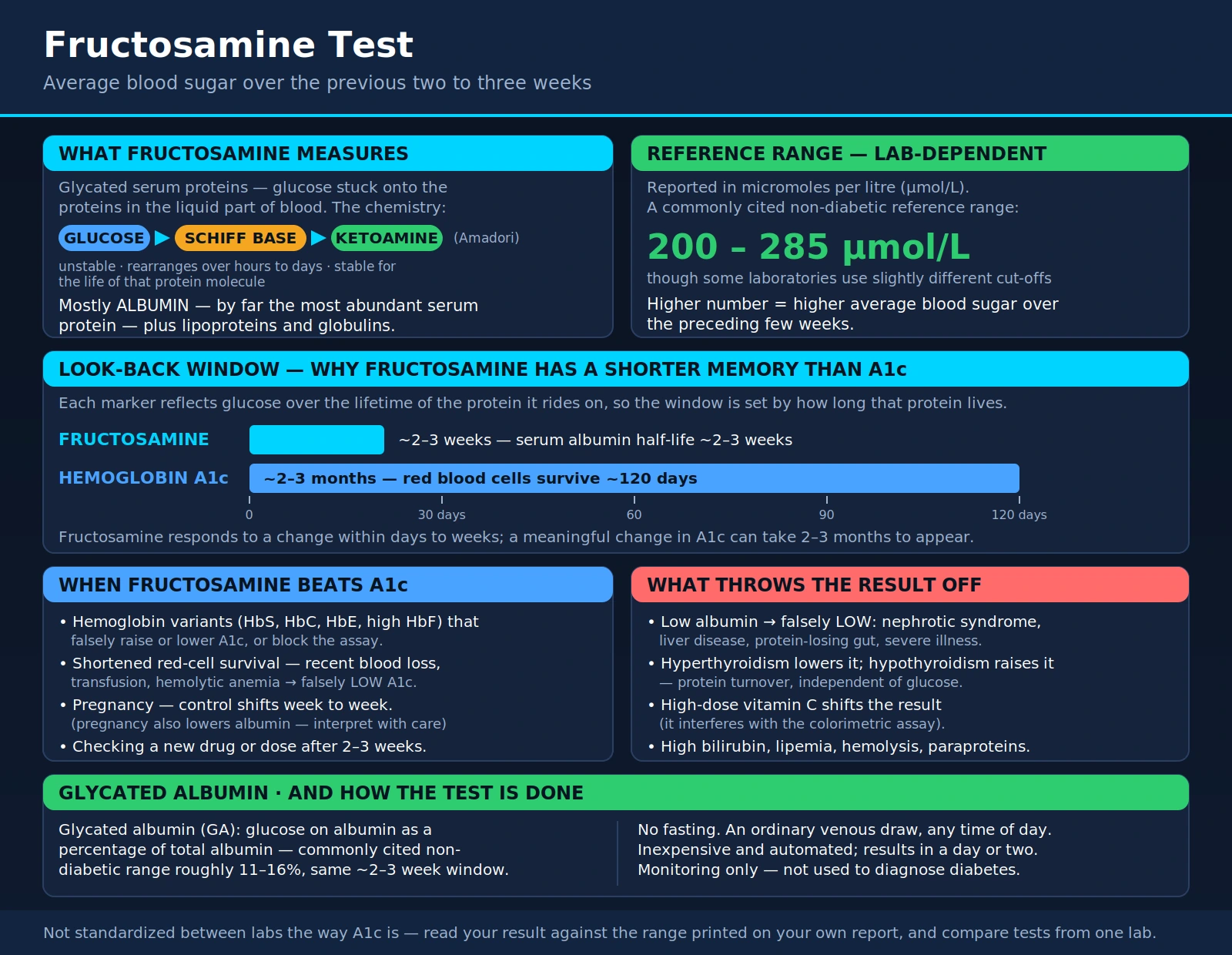
The fructosamine test is a simple blood test that estimates your average blood sugar over the previous two to three weeks. Think of it as a shorter-memory cousin of the more familiar hemoglobin A1c test, which looks back about three months. Because it captures a more recent window, fructosamine is especially handy when blood sugar is changing quickly — after starting or adjusting a diabetes medication, during pregnancy, or when something about a person's blood makes the standard A1c test unreliable. It is inexpensive, needs no fasting, and gives a useful "recent average" that a single finger-stick glucose reading simply cannot. This page explains what fructosamine actually measures, when it is more informative than A1c, where it falls short, and how to make sense of the number on your report.
Interactive Visualization Glycation & HbA1c — sugar-coat a red cell and watch the number lag Coat red blood cells in glucose for 120 days and watch HbA1c emerge as their average — then normalize the sugar today and see why the number takes months to follow. Launch →
Table of Contents
- What Fructosamine Is
- What the Test Measures: Your Last 2–3 Weeks
- Fructosamine vs. Hemoglobin A1c
- When Fructosamine Is More Useful Than A1c
- What Can Throw the Result Off
- Glycated Albumin: A Related, Newer Test
- Reference Ranges & Reading Your Result
- How the Test Is Done & How to Prepare
- Research Papers
- Connections
- Featured Videos
What Fructosamine Is
"Fructosamine" is a general name for glycated serum proteins — proteins floating in the liquid part of your blood that have had glucose (sugar) molecules stick to them. This sticking happens slowly and automatically, without your body directing it, whenever protein and glucose share the same space over time. The more glucose in the blood, the more of it attaches, so the amount of glycated protein rises and falls with your average blood sugar.
The chemistry has a name worth knowing because it explains what the lab is actually counting. When glucose first touches a protein it forms a loose, unstable bond (a Schiff base). Over hours to days that bond rearranges into a more stable structure called a ketoamine, or Amadori product. It is this stable ketoamine that has the chemical form of a "fructosamine," and it is what the standard test measures. Once formed, it stays put for the life of that protein molecule — which is the key to why the test reflects a stretch of time rather than a single moment.
Here is the most important detail: the protein most responsible for the fructosamine reading is albumin. Albumin is by far the most abundant protein in blood serum, so most of the glucose-tagged protein the test detects is glycated albumin, with smaller contributions from other serum proteins like lipoproteins and globulins. That is why anything affecting your albumin level — not just your blood sugar — can move the result, a point we return to under limitations.
What the Test Measures: Your Last 2–3 Weeks
Every marker of "average" blood sugar works the same basic way: sugar attaches to a protein, and that protein sticks around for a while, so the amount of tagged protein reflects how much sugar was present during the protein's lifetime. The length of the look-back window therefore depends entirely on how long the protein lives before the body replaces it.
This is the whole reason fructosamine has a shorter memory than A1c:
- Hemoglobin (measured by the A1c test) lives inside red blood cells, which survive roughly 120 days. So A1c reflects average glucose over about the past 2–3 months (weighted toward the most recent weeks).
- Serum albumin (the main protein behind fructosamine) turns over much faster, with a half-life of only about two to three weeks. So fructosamine reflects average glucose over roughly the past 2–3 weeks.
That faster turnover is a feature, not a flaw. It means fructosamine responds to a change in blood sugar within days to weeks, long before A1c would budge. If you tighten your diet or start a new medication, a fructosamine drawn three weeks later can already show whether it is working — whereas a meaningful change in A1c can take two to three months to appear. The trade-off is that fructosamine tells you about the recent past only; it says nothing about how things looked two months ago.
Fructosamine vs. Hemoglobin A1c
Hemoglobin A1c is the workhorse of diabetes care. It is highly standardized worldwide, reported as a simple percentage, and it is one of the criteria doctors use to diagnose diabetes and to set long-term targets. For most people, most of the time, A1c is the right tool. Fructosamine is not a replacement for it — it is a complementary test that shines in specific situations.
The main differences:
- Time window. A1c looks back ~3 months; fructosamine looks back ~2–3 weeks. Fructosamine catches recent changes sooner.
- What it depends on. A1c depends on red blood cells and hemoglobin; fructosamine depends on serum proteins, mostly albumin. Each is vulnerable to a different set of interferences, which is exactly why one can rescue the other.
- Standardization and use. A1c is rigorously standardized and is an accepted diagnostic test for diabetes. Fructosamine is not part of the standard diagnostic criteria and is less uniformly standardized between laboratories, so it is used mainly for monitoring, not diagnosis.
- Preparation. Neither requires fasting. Both are ordinary blood draws.
A useful way to picture it: A1c is the season-long batting average, while fructosamine is the average over the last few games. When the two disagree — a mismatch clinicians sometimes call a "glycation gap" — it is often a clue that something is interfering with one of the tests, or that blood sugar has recently shifted. Researchers have documented that A1c and fructosamine can genuinely diverge in the same person, and that the discordance itself can carry information about health risks.
When Fructosamine Is More Useful Than A1c
Because A1c relies on hemoglobin inside red blood cells, anything that changes red blood cells or hemoglobin can make A1c misleading — too high, too low, or simply unmeasurable. In those situations fructosamine, which does not touch hemoglobin at all, becomes the more trustworthy read. The classic scenarios:
Hemoglobinopathies and variant hemoglobins
Millions of people carry a variant form of hemoglobin — sickle cell trait (HbS), hemoglobin C, hemoglobin E, or elevated fetal hemoglobin (HbF), among others. Depending on the specific variant and the specific A1c method a lab uses, these can falsely raise or lower the A1c result, or interfere so much that the assay cannot report a value at all. Fructosamine sidesteps the problem entirely because it never looks at hemoglobin.
Shortened red-cell survival: recent blood loss, transfusion, or hemolytic anemia
A1c assumes red blood cells live a normal ~120 days. When they don't, the average is thrown off. Recent significant blood loss, a recent blood transfusion, or hemolytic anemia (a condition where red cells are destroyed early) all leave cells less time to accumulate glucose, which falsely lowers A1c and can hide poor control. (The reverse is also true: conditions that lengthen red-cell survival, such as iron-deficiency or B12-deficiency anemia, can falsely raise A1c.) Fructosamine, tied to protein rather than red cells, gives a cleaner picture in these cases.
Pregnancy
Pregnancy is a moving target: insulin needs and blood sugar can shift week to week, and pregnancy itself speeds up red-cell turnover and changes iron status, all of which can make A1c lag behind reality or read low. Fructosamine's shorter 2–3 week window can track rapidly changing control more responsively, which is why it is sometimes used alongside glucose monitoring in pregnancy. One honest caveat: pregnancy also lowers albumin, which can pull fructosamine down independent of glucose, so results still need thoughtful interpretation rather than being taken at face value.
Judging a recent medication or lifestyle change
When a doctor starts a new diabetes drug or changes a dose, waiting three months for A1c to confirm whether it worked is frustrating and slow. A fructosamine drawn two to three weeks later can show the early effect of that change, allowing quicker course-correction. It is a practical "is this working yet?" check.
What Can Throw the Result Off
Fructosamine's great strength — that it measures glucose stuck to serum proteins — is also its great weakness. Anything that changes how much protein you have, or how fast it turns over, will move the number even if your blood sugar hasn't changed. Because albumin drives the reading, the biggest interferences involve albumin:
- Low albumin / rapid protein loss. Nephrotic syndrome (large amounts of protein lost in the urine), advanced liver disease (the liver makes less albumin), protein-losing gut disorders, and severe illness all lower serum protein and can make fructosamine read falsely low — underestimating true blood sugar.
- Fast or slow protein turnover from thyroid disease. An overactive thyroid (hyperthyroidism) speeds protein turnover and tends to lower fructosamine; an underactive thyroid (hypothyroidism) slows turnover and can raise it — in both cases independent of glucose.
- High-dose vitamin C (ascorbic acid). Large supplemental doses of vitamin C can chemically interfere with the common colorimetric fructosamine assay and shift the result. It is worth telling the lab or your provider if you take high-dose vitamin C.
- Other lab interferences. Very high bilirubin, marked lipemia (fatty blood), breakdown of the sample (hemolysis), and certain abnormal proteins (paraproteins) can also affect the colorimetric measurement.
Two broader limitations round out the picture. First, fructosamine is not standardized between laboratories as tightly as A1c, so results are best compared within the same lab over time rather than across different labs. Second, it is not used to diagnose diabetes — the major diabetes guidelines rely on glucose and A1c for that. Fructosamine's role is monitoring, and specifically monitoring in the situations where A1c can't be trusted.
Glycated Albumin: A Related, Newer Test
Since albumin does most of the work behind a fructosamine result, researchers developed a more refined version of the test that measures glucose bound to albumin specifically and expresses it as a percentage of total albumin — the glycated albumin (GA) test. Reporting a ratio rather than a raw amount is clever: by dividing glycated albumin by total albumin, the test partly corrects for how much albumin a person has, making it less easily fooled by a simple low-albumin state than raw fructosamine.
Glycated albumin shares fructosamine's short, roughly 2–3 week window, since it tracks the same protein. It is measured with a specific enzymatic method and has been studied extensively, particularly in Japan and in kidney-disease and dialysis populations, where red-cell abnormalities make A1c especially unreliable. It is not yet a routine test in most of the United States, but it represents where this family of "shorter-window" glucose markers is heading. It is worth knowing that glycated albumin, while smarter about albumin concentration, is still affected by conditions that change albumin turnover — thyroid disease, cirrhosis, and nephrotic syndrome among them — so it is a refinement, not a cure-all.
Reference Ranges & Reading Your Result
Fructosamine is reported in micromoles per liter (µmol/L). Reference ranges differ from lab to lab and depend on the exact method used, so always read your result against the range printed on your own report rather than a number from the internet. That caveat matters more for fructosamine than for A1c precisely because it is less standardized.
With that said, as a rough orientation:
- A commonly cited non-diabetic reference range is roughly 200–285 µmol/L, though some laboratories use slightly different cut-offs.
- Higher numbers indicate higher average blood sugar over the preceding few weeks; the value climbs as glucose control worsens.
- People with diabetes aiming for good control are generally guided toward the lower end of the diabetic range, but there is no single universal target the way there is for A1c — goals are individualized.
Approximate formulas exist to translate a fructosamine value into an "estimated A1c," and your report or clinician may mention one. Treat these conversions as ballpark only: they vary by method and by the individual, and they should not be used to diagnose diabetes. Glycated albumin, when used, is reported as a percentage, with a commonly cited non-diabetic range of roughly 11–16% — again, lab-dependent.
Most importantly, a fructosamine value is interpreted in context: alongside your glucose readings, your A1c, and any conditions (kidney, liver, thyroid, low albumin) that could be pushing the number up or down. A single value in isolation means less than the trend over several tests done at the same laboratory.
How the Test Is Done & How to Prepare
Fructosamine is one of the easier tests to have done.
- No fasting needed. Unlike a fasting glucose test, you do not have to skip meals. Because fructosamine reflects weeks of average sugar, a single recent meal does not meaningfully change it, so the blood can be drawn at any time of day.
- It is a standard blood draw. A small sample is taken from a vein in the arm, the same as most routine blood work. There is no special preparation and no radiation or imaging involved.
- It is inexpensive and automated, which is part of its appeal as a monitoring tool that can be repeated fairly often to watch a trend.
- Tell your provider a few things beforehand: whether you take high-dose vitamin C, and whether you have thyroid disease, liver disease, kidney disease, or any condition that lowers your blood protein — all of which help them interpret the result correctly.
Results usually return within a day or two. As with any lab test, the value is a tool for a conversation with your clinician, not a verdict on its own — especially given the interferences described above.
Research Papers
- Danese E, Montagnana M, Nouvenne A, Lippi G. Advantages and pitfalls of fructosamine and glycated albumin in the diagnosis and treatment of diabetes. Journal of Diabetes Science and Technology. 2015;9(2):169–176. doi:10.1177/1932296814567227 — A clear review of where these shorter-window markers help and where they mislead, including the albumin-turnover pitfalls.
- Armbruster DA. Fructosamine: structure, analysis, and clinical usefulness. Clinical Chemistry. 1987;33(12):2153–2163. doi:10.1093/clinchem/33.12.2153 — The classic foundational review explaining the ketoamine chemistry the test measures and its clinical role.
- Selvin E, Rawlings AM, Grams M, Klein R, Sharrett AR, Steffes M, et al. Fructosamine and glycated albumin for risk stratification and prediction of incident diabetes and microvascular complications: a prospective cohort analysis of the ARIC study. The Lancet Diabetes & Endocrinology. 2014;2(4):279–288. doi:10.1016/S2213-8587(13)70199-2 — A large community study showing fructosamine and glycated albumin predicted future diabetes and eye and kidney complications, comparably to A1c.
- Cohen RM, Holmes YR, Chenier TC, Joiner CH. Discordance between HbA1c and fructosamine: evidence for a glycosylation gap and its relation to diabetic nephropathy. Diabetes Care. 2003;26(1):163–167. doi:10.2337/diacare.26.1.163 — Documents that A1c and fructosamine can genuinely diverge in the same person (the "glycation gap") and that the gap tracks with kidney complications.
- Juraschek SP, Steffes MW, Miller ER, Selvin E. Alternative markers of hyperglycemia and risk of diabetes. Diabetes Care. 2012;35(11):2265–2270. doi:10.2337/dc12-0787 — Found fructosamine and glycated albumin were each associated with the later development of diabetes, supporting their value as glycemic markers.
- Parrinello CM, Selvin E. Beyond HbA1c and glucose: the role of nontraditional glycemic markers in diabetes diagnosis, prognosis, and management. Current Diabetes Reports. 2014;14(11):548. doi:10.1007/s11892-014-0548-3 — A practical review of when to reach for fructosamine and glycated albumin instead of, or alongside, A1c.
- Koga M, Kasayama S. Clinical impact of glycated albumin as another glycemic control marker. Endocrine Journal. 2010;57(9):751–762. doi:10.1507/endocrj.K10E-138 — Explains why the glycated-albumin refinement is useful, and the conditions (thyroid, liver, kidney) that still affect it.
- Freitas PAC, Ehlert LR, Camargo JL. Glycated albumin: a potential biomarker in diabetes. Archives of Endocrinology and Metabolism. 2017;61(3):296–304. doi:10.1590/2359-3997000000272 — Reviews glycated albumin's strengths and its remaining limitations relative to fructosamine and A1c.
- Rondeau P, Bourdon E. The glycation of albumin: structural and functional impacts. Biochimie. 2011;93(4):645–658. doi:10.1016/j.biochi.2010.12.003 — The underlying biochemistry of how glucose attaches to albumin — the molecular basis of the fructosamine test.
- Herman WH, Cohen RM. Racial and ethnic differences in the relationship between HbA1c and blood glucose: implications for the diagnosis of diabetes. The Journal of Clinical Endocrinology & Metabolism. 2012;97(4):1067–1072. doi:10.1210/jc.2011-1894 — Illustrates a real-world reason A1c can mislead across individuals, part of why a hemoglobin-independent marker like fructosamine has a place.
Connections
- All Lab Tests
- Glycation & HbA1c: What That Number Actually Measures — interactive animation
- Hemoglobin A1c
- Fasting Insulin
- Albumin
- Continuous Glucose Monitoring
- Vitamin C