PSA Test: Prostate-Specific Antigen Screening and Results

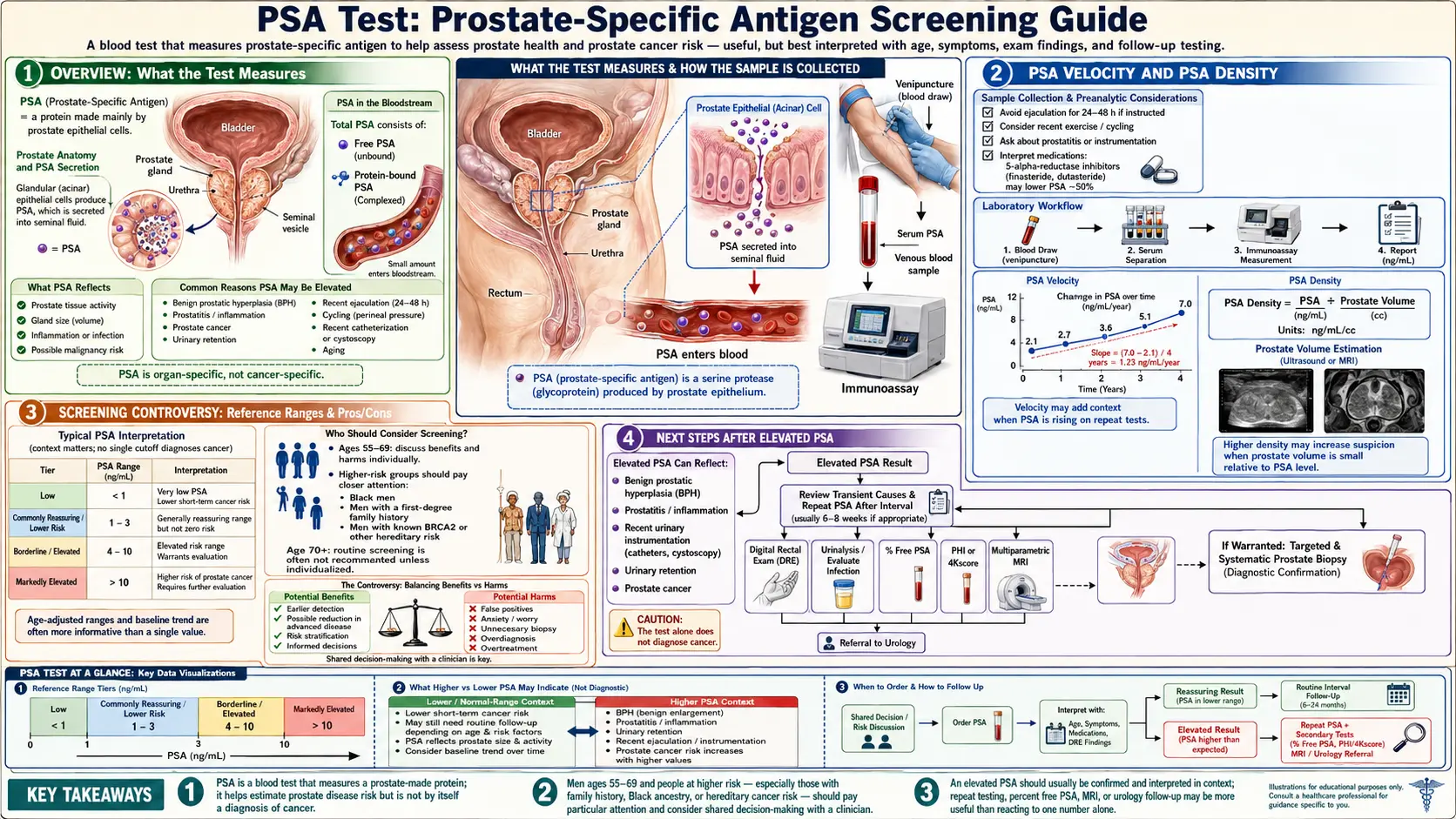
The prostate-specific antigen (PSA) test is a blood test that measures PSA, a protein made by the prostate (MedlinePlus: PSA Test). According to the National Cancer Institute, PSA is produced by both normal and cancerous prostate cells, and prostate cancer as well as several benign conditions, particularly benign prostatic hyperplasia (BPH) and prostatitis, can raise its level in the blood (NCI PSA fact sheet). MedlinePlus notes that a PSA test cannot show what is causing an abnormal level. This page summarizes what PSA is, how results have been read, and what the major screening trials and the US Preventive Services Task Force (USPSTF) report about benefits and harms.
Table of Contents
Overview
In 1985 Lilja purified the 33-kD glycoprotein known as prostate-specific antigen from human seminal plasma, identified it as a serine protease whose structure places it in the glandular kallikrein family, and found that it rapidly cleaves the main structural protein of the seminal coagulum, which suggested that protein is its natural substrate (Lilja 1985). MedlinePlus notes that the prostate makes the fluid part of semen and that a low level of PSA in the blood is normal.
PSA circulates in more than one form. A 1991 study that used three different assays found that PSA bound in a complex with the protease inhibitor alpha-1-antichymotrypsin was the predominant fraction of PSA in blood, and a smaller, uncomplexed form was the minor fraction (Lilja 1991). The uncomplexed form is called free PSA; MedlinePlus lists "total PSA" and "free PSA" as other names for the test. The percentage of free PSA is covered under Cut-offs and Reference Values.
The NCI describes three uses of the test: monitoring the progression of prostate cancer in men already diagnosed, following up prostate symptoms (such as painful or frequent urination, blood in urine or semen, and pelvic or back pain), and screening men who have no symptoms. It reports that the test was used for routine screening for several decades beginning in the late 1980s, and that by around 2008, as more was learned about the benefits and harms, many professional medical organizations began to caution against routine population screening (NCI PSA fact sheet).
When the Test Is Used — Screening Statements by Age
Statements on who is offered PSA screening differ between organizations. The NCI reports that most organizations now recommend that individuals considering PSA screening first discuss its risks and benefits with their doctors before deciding.
The USPSTF 2018 statement
- Age 55–69: the USPSTF states that the decision to undergo periodic PSA-based screening "should be an individual one" and should include a discussion of the potential benefits and harms with a clinician (a C recommendation). The statement adds that clinicians should not screen men who do not express a preference for screening (USPSTF 2018).
- Age 70 and older: the USPSTF recommends against PSA-based screening (a D recommendation), concluding with moderate certainty that the potential benefits do not outweigh the expected harms (USPSTF 2018).
Men at Higher Risk
- The USPSTF notes that African American men and men with a family history of prostate cancer have an increased risk compared with other men, and its evidence review examined screening in these groups (USPSTF 2018). The NCI states that the USPSTF recommendation applies both to the general population and to those at increased risk because of race/ethnicity or family history.
- The NCI reports that some organizations recommend routine PSA testing beginning at age 40 or 45 for men at higher risk, whom it describes as Black men, men with inherited variants in BRCA2 (and to a lesser extent BRCA1), and men whose father or brother had prostate cancer.
- MedlinePlus states that prostate cancer risk increases after age 50, and that prostate cancer is more common in Black men, who also have a higher risk of developing it at a younger age and of having more serious disease.
Testing Outside Screening
- Symptoms of a prostate condition: MedlinePlus lists painful, slow or frequent urination, blood in urine or semen, pelvic or back pain, and urinary incontinence.
- Diagnosing the cause of prostate conditions that are not cancer, and monitoring treatment of a prostate condition, including cancer (MedlinePlus).
- After surgery or radiation therapy for prostate cancer: the NCI reports that a rising PSA may be the first sign of a recurrence (a "biochemical relapse"), typically appearing months or years before symptoms, and that a single raised value does not always mean the cancer has come back, so doctors may look for a trend over time.
Cut-offs and Reference Values
There is no single PSA level that separates a normal from an abnormal result. MedlinePlus states that there is no specific normal or abnormal level for PSA in blood: in general, the higher the level, the more likely cancer is, but it is possible to have a high PSA without prostate cancer or a low PSA with it. The NCI likewise states that there is no single threshold, in part because there is no specific PSA level that means someone has prostate cancer.
The Historical 4.0 ng/mL Cut-off
A total PSA of 4.0 ng/mL is the cut-off historically used to call a result abnormal. Writing in 2004, the Prostate Cancer Prevention Trial (PCPT) investigators described levels of 4.0 ng/mL or less as "generally thought to be in the normal range" and stated that the optimal upper limit of the normal range was unknown (Thompson 2004). The NCI states that, in general, a level above 4.0 ng/mL is considered abnormal and may lead to a recommendation for biopsy, and adds that because PSA rises with age some doctors apply a higher cut-off (such as 5 ng/mL) for older men and a lower one (such as 2.5 ng/mL) for younger men, and that a lower cut-off is used for men taking finasteride or dutasteride, which lower PSA.
Cancer Found Below 4.0 ng/mL: the Prostate Cancer Prevention Trial
In the placebo group of the PCPT, 2,950 men aged 62 to 91 who never had a PSA above 4.0 ng/mL or an abnormal digital rectal examination (DRE) during the trial had a biopsy after seven years. Prostate cancer was found in 449 of them (15.2%), and 67 of those 449 cancers (14.9%) had a Gleason score of 7 or higher. The prevalence of cancer rose with PSA: 6.6% at up to 0.5 ng/mL, 10.1% at 0.6–1.0, 17.0% at 1.1–2.0, 23.9% at 2.1–3.0 and 26.9% at 3.1–4.0 ng/mL. The authors concluded that biopsy-detected prostate cancer, including high-grade cancer, is not rare among men with PSA levels of 4.0 ng/mL or less (Thompson 2004).
Age-Specific Ranges Proposed in 1993
A 1993 community-based study of 471 healthy men aged 40 to 79 in Olmsted County, Minnesota, with no evidence of prostate cancer found that PSA correlated with both age and prostate volume. Its authors proposed age-specific reference ranges (the 95th percentile in that population): 0.0–2.5 ng/mL at ages 40–49, 0.0–3.5 at 50–59, 0.0–4.5 at 60–69 and 0.0–6.5 at 70–79 (Oesterling 1993). These figures are that study's proposal for one population, not a universal standard.
Percentage of Free PSA
In a 1998 prospective study at seven university medical centers of 773 men aged 50 to 75 with a total PSA of 4.0 to 10.0 ng/mL and a prostate that felt benign on examination, a lower percentage of free PSA was associated with a higher risk of cancer, with individual risk ranging from 8% to 56%. A cut-off of 25% free PSA detected 95% of cancers while avoiding 20% of unnecessary biopsies, and the authors recommended that cut-off for men in that PSA range (Catalona 1998).
PSA Velocity, Doubling Time and Density
PSA Velocity (PSAV)
PSA velocity is the rate at which PSA changes over time. A 1992 case-control study within the Baltimore Longitudinal Study of Aging compared serum samples taken 7 to 25 years before diagnosis in 16 men without prostate disease, 20 men with BPH and 18 men with prostate cancer. Five years before diagnosis, when PSA levels did not yet differ between the BPH and cancer groups, the rate of change in PSA (reported as 0.75 micrograms per litre per year) was significantly greater in the men with prostate cancer than in the other two groups, and rate of change distinguished the men with cancer from those with BPH and from controls with a specificity of 90% and 100% respectively. The authors proposed rate of change as a possible early marker of prostate cancer (Carter 1992).
PSA Doubling Time (PSADT)
PSA doubling time expresses how quickly PSA is rising. In a retrospective cohort of 379 men whose PSA rose again after radical prostatectomy, a shorter doubling time (analysed in groups of under 3.0, 3.0–8.9, 9.0–14.9 and 15.0 or more months), a pathological Gleason score of 8–10, and a recurrence within 3 years of surgery were each significant risk factors for death from prostate cancer. Median survival had not been reached 16 years after the PSA recurrence (Freedland 2005).
PSA Density (PSAD)
PSA density is serum PSA divided by prostate volume (Oesterling 1993). In 533 men whose prostate volume was measured by transrectal ultrasound, Benson and colleagues used PSA density to build nomograms for men with intermediate PSA levels (4.1–10 ng/mL), giving an estimated cancer risk ranging from 3% to 100%; cancer prevalence in the whole group was 18.4% (Benson 1992). In the 1993 Olmsted County study, PSA density was only weakly correlated with age (Oesterling 1993).
Screening Controversy
Two large randomized trials, the European Randomized Study of Screening for Prostate Cancer (ERSPC) and the US Prostate, Lung, Colorectal and Ovarian (PLCO) Cancer Screening Trial, reported different results on whether PSA screening lowers the risk of dying from prostate cancer.
Findings Reported in Favour of Screening
- ERSPC, 2009 report: in the core group of 162,243 men aged 55–69, at a median follow-up of 9 years, the rate ratio for death from prostate cancer was 0.80 (95% CI 0.65–0.98), a 20% reduction. The absolute difference was 0.71 deaths per 1,000 men: 1,410 men would need to be screened and 48 additional cases treated to prevent one death, and the authors noted a high risk of overdiagnosis (Schröder 2009).
- ERSPC at 13 years: rate ratio 0.79 (0.69–0.91); the absolute reduction was 1.28 deaths per 1,000 men randomised, equivalent to one prostate-cancer death averted per 781 men invited or per 27 additional cancers detected (Schröder 2014).
- ERSPC at 16 years: rate ratio 0.80 (0.72–0.89). The absolute difference in prostate-cancer mortality grew from 0.14% at 13 years to 0.18% at 16 years, and the number of men needed to be invited to prevent one death fell from 742 to 570; the authors described a larger absolute benefit with longer follow-up (Hugosson 2019).
- The USPSTF found that PSA-based screening programs in men aged 55 to 69 may prevent about 1.3 deaths from prostate cancer over about 13 years per 1,000 men screened, and about 3 cases of metastatic prostate cancer per 1,000 (USPSTF 2018).
- A 2017 modelling analysis that accounted for differences in how the two trials were carried out concluded that ERSPC and PLCO provide compatible evidence that screening reduces prostate-cancer mortality, estimating 25%–31% and 27%–32% lower risk of prostate-cancer death with screening as performed in the ERSPC and PLCO screening groups, respectively, compared with no screening (Tsodikov 2017).
Findings Reported Against Routine Screening
- PLCO, 2009 report: 76,693 men were randomized to annual screening or usual care. PSA testing in the control group rose from 40% in the first year to 52% in the sixth, and after 7 to 10 years the death rate from prostate cancer was very low and did not differ significantly between the groups (Andriole 2009).
- PLCO at a median of about 15 years: 255 prostate-cancer deaths in the screening arm and 244 in the control arm (rate ratio 1.04, 95% CI 0.87–1.24). An estimated 86% of control-arm men had some PSA testing during the trial, and the authors wrote that the result can be viewed as showing no benefit of organized over opportunistic screening (Pinsky 2017).
- Overdiagnosis: the evidence review for the USPSTF estimated that overdiagnosis occurs in 20.7% to 50.4% of screen-detected cancers (Fenton 2018).
- False positives and biopsy: of 61,604 men screened in the European trial, 17.8% received false-positive results, and in three cohorts complications requiring hospitalization occurred in 0.5% to 1.6% of men having a biopsy after an abnormal screen (Fenton 2018). The NCI reports that about 6%–7% of men have a false-positive PSA test on any given screening round, that only about 25% of men who have a biopsy because of an elevated PSA are found to have prostate cancer, and that possible side effects of biopsy include serious infections, pain and bleeding.
- Treatment harms: the USPSTF reports that about 1 in 5 men who undergo radical prostatectomy develop long-term urinary incontinence and 2 in 3 experience long-term erectile dysfunction (USPSTF 2018). In a randomized trial of 1,643 men with screen-detected prostate cancer included in the USPSTF review, neither radical prostatectomy nor radiation therapy significantly reduced prostate-cancer mortality compared with active monitoring, although each was associated with a significantly lower risk of metastatic disease (Fenton 2018).
- The NCI summarizes the USPSTF estimates for every 1,000 men aged 55 to 69 screened over 13 years: about 240 would have a positive PSA result, many of them false positives; 100 would be diagnosed with prostate cancer, of whom 80 would be treated with surgery or radiation (immediately or after a period of active surveillance), with 50 experiencing sexual dysfunction and 15 urinary incontinence; and 5 would die from prostate cancer despite screening, diagnosis and treatment.
The USPSTF 2018 Conclusion
The USPSTF concluded with moderate certainty that the net benefit of PSA-based screening in men aged 55 to 69 is small for some men, and that how each man weighs the specific benefits and harms determines whether the overall net benefit is small. For men 70 and older it concluded with moderate certainty that the potential benefits do not outweigh the expected harms (USPSTF 2018).
What Elevated PSA Means
MedlinePlus states that a PSA test cannot tell the difference between raised levels caused by prostate cancer and those caused by noncancerous conditions, and that a prostate biopsy is the only way to find out whether the cause is cancer.
Other Causes of a Raised PSA
- Benign prostatic hyperplasia (BPH): an enlarged prostate is listed as a cause of high PSA by both MedlinePlus and the NCI. In the 1993 Olmsted County study, PSA correlated with prostate volume (Oesterling 1993).
- Prostatitis and urinary tract infections: MedlinePlus lists both. The NCI reports that an infection or inflammation of the prostate can keep PSA raised for a month or two.
- Recent prostate biopsy: the NCI reports that a recent biopsy can raise PSA for a month or two.
- Ejaculation: MedlinePlus states that releasing semen can increase PSA and gives a 24-hour interval without sex or masturbation before the test; the NCI lists ejaculation among activities that raise PSA transiently and reports that people are generally recommended to avoid such activities for 2 days before testing.
- Vigorous exercise: the NCI names vigorous exercise, such as cycling, as a cause of a transient rise.
- Medicines: MedlinePlus lists certain medicines as a cause of high PSA and others as affecting results. The NCI reports that finasteride and dutasteride, used to treat BPH, lower the PSA level, and that a lower cut-off for an abnormal result is used in men taking them.
Cancer-Related PSA Elevation
MedlinePlus states that, in general, the higher the PSA level, the more likely cancer is. The NCI reports that only about 25% of men who have a biopsy because of an elevated PSA are found to have prostate cancer. In the 1998 free-PSA study of men with a total PSA of 4.0 to 10.0 ng/mL, the free-PSA percentage was a stronger independent predictor of cancer than total PSA within that range (Catalona 1998).
What Can Follow a Raised PSA Result
The NCI and MedlinePlus describe the evaluation that may follow a raised screening result. It is a sequence of possible tests rather than an immediate biopsy for everyone.
Waiting Out Temporary Causes
The NCI reports that people are generally recommended to wait until any condition that can change the PSA level has resolved before testing. MedlinePlus lists a urine test for infection among the tests that may follow a high result.
Repeat PSA Testing and Observation
The NCI reports that after an abnormal screening result the doctor may recommend another PSA test in 6 to 8 weeks to confirm it, and, if PSA is still raised, continued observation with repeat PSA tests and digital rectal exams to watch for change. MedlinePlus notes that PSA levels go up and down, so it can help to see whether they change over time.
Additional Blood and Urine Tests
The percentage of free PSA (Catalona 1998, above) is one blood measure used in the 4.0–10.0 ng/mL range. The NCI lists other tests under study: blood tests that measure different characteristics of PSA, to help decide whether a biopsy is needed or to estimate the risk of a high-grade or aggressive cancer, and urine tests measuring markers such as PCA3 mRNA, the TMPRSS2-ERG gene fusion, and HOXC6 and DLX1 mRNA. The NCI states that none of these tests has yet been proven to decrease the risk of death from prostate cancer.
Prostate MRI
In the PRECISION trial, 500 men with a clinical suspicion of prostate cancer and no previous biopsy were randomized to MRI, followed by a targeted biopsy only if the MRI was suggestive of cancer, or to a standard 10-to-12-core transrectal ultrasound-guided biopsy. In the MRI group 71 of 252 men (28%) had MRI results not suggestive of cancer and did not have a biopsy. Clinically significant cancer was detected in 38% of the MRI group and 26% of the standard-biopsy group, and fewer men in the MRI group were diagnosed with clinically insignificant cancer (adjusted difference −13 percentage points) (Kasivisvanathan 2018). Prostate MRI is commonly reported with the PI-RADS system, whose version 2 provides assessment categories summarizing the level of suspicion for clinically significant cancer (Weinreb 2016).
Prostate Biopsy and Grading
The NCI describes biopsy as collecting multiple tissue samples with hollow needles inserted through the wall of the rectum (transrectal) or through the perineum (transperineal), guided by ultrasound, with MRI-guided biopsy for suspicious areas seen on MRI; a pathologist then examines the tissue. MedlinePlus states that a biopsy is the only way to diagnose cancer. In 2014 an International Society of Urological Pathology consensus conference adopted five prognostic Grade Groups, used together with the Gleason score (Gleason 3+3=6 is Grade Group 1); its report notes that the lowest grade becoming 1 rather than 6 has the potential to reduce overtreatment of indolent cancer (Epstein 2016).
Key Research Papers
Peer-reviewed sources for the statements on this page, each checked against its PubMed record, followed by live PubMed topic searches.
- US Preventive Services Task Force; Grossman DC, Curry SJ, Owens DK, Bibbins-Domingo K, et al. Screening for Prostate Cancer: US Preventive Services Task Force Recommendation Statement. JAMA. 2018;319(18):1901–1913. — PubMed PMID: 29801017
- Fenton JJ, Weyrich MS, Durbin S, Liu Y, et al. Prostate-Specific Antigen-Based Screening for Prostate Cancer: Evidence Report and Systematic Review for the US Preventive Services Task Force. JAMA. 2018;319(18):1914–1931. — PubMed PMID: 29801018
- Schröder FH, Hugosson J, Roobol MJ, Tammela TL, et al. Screening and Prostate-Cancer Mortality in a Randomized European Study. New England Journal of Medicine. 2009;360(13):1320–1328. — PubMed PMID: 19297566
- Schröder FH, Hugosson J, Roobol MJ, Tammela TL, et al. Screening and Prostate Cancer Mortality: Results of the European Randomised Study of Screening for Prostate Cancer (ERSPC) at 13 Years of Follow-up. The Lancet. 2014;384(9959):2027–2035. — PubMed PMID: 25108889
- Hugosson J, Roobol MJ, Månsson M, Tammela TLJ, et al. A 16-yr Follow-up of the European Randomized Study of Screening for Prostate Cancer. European Urology. 2019;76(1):43–51. — PubMed PMID: 30824296
- Andriole GL, Crawford ED, Grubb RL 3rd, Buys SS, et al. Mortality Results from a Randomized Prostate-Cancer Screening Trial. New England Journal of Medicine. 2009;360(13):1310–1319. — PubMed PMID: 19297565
- Pinsky PF, Prorok PC, Yu K, Kramer BS, et al. Extended Mortality Results for Prostate Cancer Screening in the PLCO Trial with Median Follow-up of 15 Years. Cancer. 2017;123(4):592–599. — PubMed PMID: 27911486
- Tsodikov A, Gulati R, Heijnsdijk EAM, Pinsky PF, et al. Reconciling the Effects of Screening on Prostate Cancer Mortality in the ERSPC and PLCO Trials. Annals of Internal Medicine. 2017;167(7):449–455. — PubMed PMID: 28869989
- Thompson IM, Pauler DK, Goodman PJ, Tangen CM, et al. Prevalence of Prostate Cancer among Men with a Prostate-Specific Antigen Level ≤4.0 ng per Milliliter. New England Journal of Medicine. 2004;350(22):2239–2246. — PubMed PMID: 15163773
- Oesterling JE, Jacobsen SJ, Chute CG, Guess HA, et al. Serum Prostate-Specific Antigen in a Community-Based Population of Healthy Men: Establishment of Age-Specific Reference Ranges. JAMA. 1993;270(7):860–864. — PubMed PMID: 7688054
- Catalona WJ, Partin AW, Slawin KM, Brawer MK, et al. Use of the Percentage of Free Prostate-Specific Antigen to Enhance Differentiation of Prostate Cancer from Benign Prostatic Disease: A Prospective Multicenter Clinical Trial. JAMA. 1998;279(19):1542–1547. — PubMed PMID: 9605898
- Lilja H, Christensson A, Dahlén U, Matikainen MT, et al. Prostate-Specific Antigen in Serum Occurs Predominantly in Complex with Alpha 1-Antichymotrypsin. Clinical Chemistry. 1991;37(9):1618–1625. — PubMed PMID: 1716536
- Lilja H. A Kallikrein-like Serine Protease in Prostatic Fluid Cleaves the Predominant Seminal Vesicle Protein. Journal of Clinical Investigation. 1985;76(5):1899–1903. — PubMed PMID: 3902893
- Carter HB, Pearson JD, Metter EJ, Brant LJ, et al. Longitudinal Evaluation of Prostate-Specific Antigen Levels in Men with and without Prostate Disease. JAMA. 1992;267(16):2215–2220. — PubMed PMID: 1372942
- Benson MC, Whang IS, Olsson CA, McMahon DJ, et al. The Use of Prostate Specific Antigen Density to Enhance the Predictive Value of Intermediate Levels of Serum Prostate Specific Antigen. Journal of Urology. 1992;147(3 Pt 2):817–821. — PubMed PMID: 1371555
- Freedland SJ, Humphreys EB, Mangold LA, Eisenberger M, et al. Risk of Prostate Cancer-Specific Mortality Following Biochemical Recurrence after Radical Prostatectomy. JAMA. 2005;294(4):433–439. — PubMed PMID: 16046649
- Kasivisvanathan V, Rannikko AS, Borghi M, Panebianco V, et al. MRI-Targeted or Standard Biopsy for Prostate-Cancer Diagnosis. New England Journal of Medicine. 2018;378(19):1767–1777. — PubMed PMID: 29552975
- Weinreb JC, Barentsz JO, Choyke PL, Cornud F, et al. PI-RADS Prostate Imaging – Reporting and Data System: 2015, Version 2. European Urology. 2016;69(1):16–40. — PubMed PMID: 26427566
- Epstein JI, Egevad L, Amin MB, Delahunt B, et al. The 2014 International Society of Urological Pathology (ISUP) Consensus Conference on Gleason Grading of Prostatic Carcinoma: Definition of Grading Patterns and Proposal for a New Grading System. American Journal of Surgical Pathology. 2016;40(2):244–252. — PubMed PMID: 26492179
PubMed Topic Searches
- PSA screening USPSTF — PubMed literature search
- PSA prostate cancer mortality — PubMed literature search
- ERSPC PSA screening trial — PubMed literature search
- PLCO screening trial prostate — PubMed literature search
- Free PSA ratio — PubMed literature search
- PSA velocity density — PubMed literature search
- Active surveillance prostate cancer — PubMed literature search
- MRI-targeted prostate biopsy — PubMed literature search
- Kallikrein-panel blood tests for prostate cancer — PubMed literature search
- PSA overdiagnosis — PubMed literature search
External Authoritative Resources
Connections
- All Lab Tests
- Tumor Markers — where PSA sits in the full marker landscape
- Prostate Conditions
- Benign Prostatic Hyperplasia
- Erectile Dysfunction
- Testosterone
- Hormone Panel
- DHEA-S
- Cancer
- Saw Palmetto
- Zinc
- Selenium and Cancer Prevention
- Full Body MRI
- Low Testosterone & TRT
- Prostate Cancer — the disease PSA screening is meant to detect early, and how it is staged and treated.
Featured Videos