Coltsfoot: History and Traditional Use
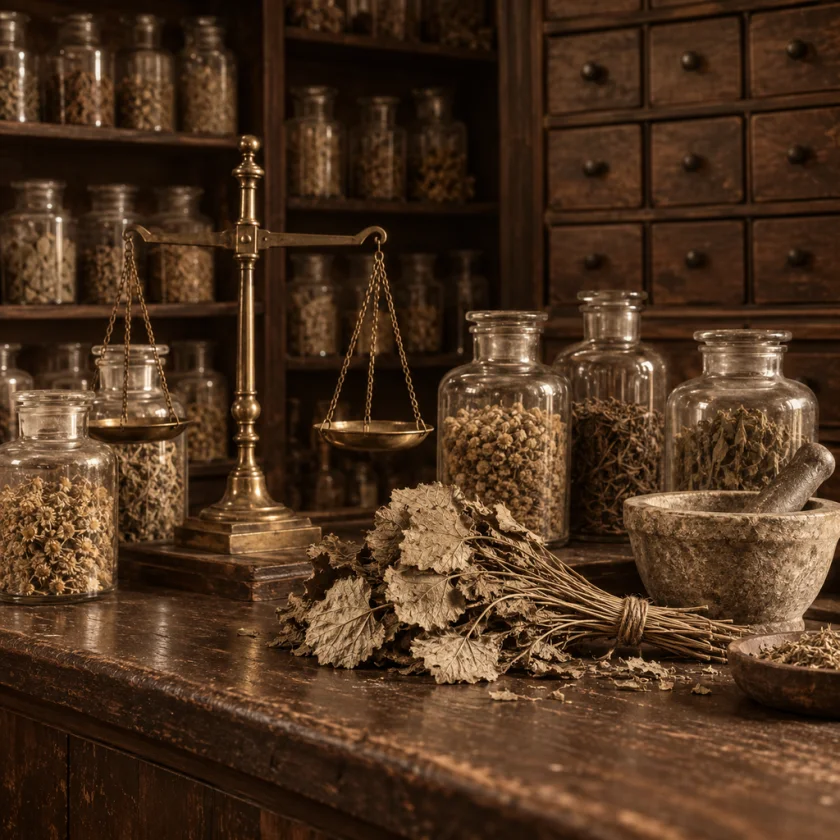
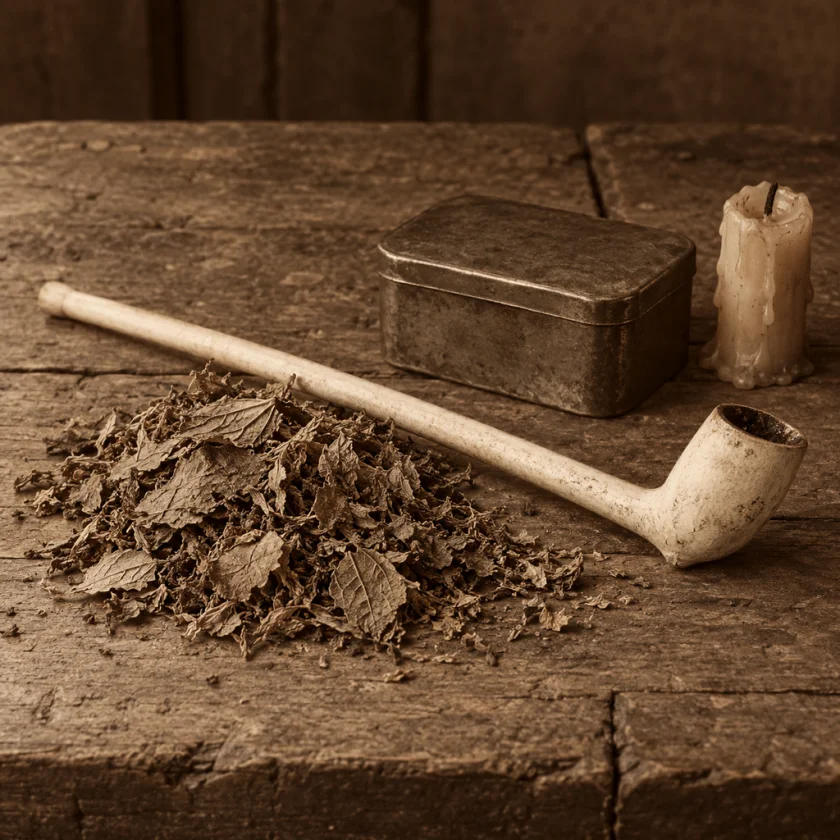
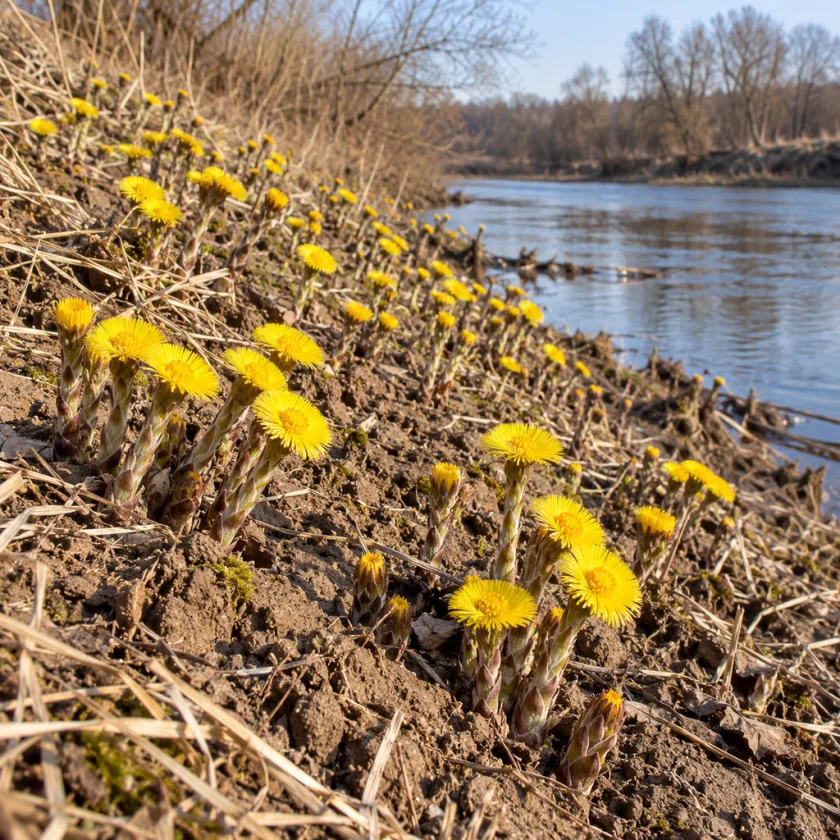
For almost two thousand years coltsfoot (Tussilago farfara) was the cough herb of Europe. Dioscorides and Pliny told their readers to burn its dried leaves and breathe the smoke; the Latin name means, roughly, "cough-chaser"; its golden flower was painted on apothecaries' doors; and in the British Isles it survived into the twentieth century as a boiled sweet and a herbal tobacco. Then, between 1976 and 1995, chemists and paediatricians showed that the same plant makes pyrrolizidine alkaloids — liver poisons that also cause tumours in animals — and two infants were harmed by teas their parents believed were coltsfoot. This article tells both halves of that story in order: the long tradition, the science that overturned it, and the regulation and plant-breeding that followed. Where something is folklore or a single author's report, we say so.
Table of Contents
- Origins, Botany and the Name
- Bechion: Dioscorides, Pliny and the Smoke Cure
- The English Herbals: Gerard, Parkinson and Culpeper
- Syrups, Coltsfoot Rock and Herbal Tobacco
- Kuan Dong Hua in Chinese Medicine
- The Chemistry Turns: Pyrrolizidine Alkaloids, 1920–1981
- Two Infants and the Wrong-Plant Problem, 1988 and 1995
- Regulation and the PA-Free Cultivar, 1992 Onward
- Tradition, Evidence and Coltsfoot Today
- Key Research Papers
- Connections
- Featured Videos
Origins, Botany and the Name
Coltsfoot is a low perennial of the daisy family (Asteraceae), native to Europe, North Africa and a broad belt of western and central Asia, from Scandinavia and Morocco eastward to China and the Russian Far East. Naturalised in North America, it is everywhere a pioneer of clay banks, railway cuttings, roadsides and disturbed ground, spreading by deep white underground stems. Pliny wrote that people searching for water took wild coltsfoot as a sure sign of a spring below.
Its most famous habit is to flower before it leafs. In late winter the scaly, reddish flower stalks push up bare, each carrying a single golden, dandelion-like head; only after those have withered do the broad, hoof-shaped, white-felted leaves unfold. That reversal of the usual order earned the plant the old Latin name filius ante patrem, "the son before the father", a name recorded by the English herbalist Maud Grieve in 1931 and still repeated in folk names such as "son-before-father". It also explains why Pliny could declare the plant "destitute of stem, blossom, and seed": he was describing the leaf stage and had missed the brief flowering weeks before.
The names are a small history in themselves. Tussilago is built on the Latin tussis, "cough", and is already used by Pliny in the first century; traditional herbals gloss it as "cough dispeller". Farfara is an old Latin plant name of uncertain meaning; Dioscorides records that some Romans called the plant pharpharia. The English "coltsfoot" arrived in the sixteenth century as a translation of medieval Latin pes pulli, "foal's foot", for the shape of the leaf; the same idea gives Latin ungula caballina ("horse's hoof"), German Huflattich, French pas d'âne and the English country names Culpeper lists in 1653: "Coughwort, Foal's-foot, Horse-hoof, and Bull's-foot".
Two relatives matter later in this story because they are easily mistaken for coltsfoot once the flowers are gone: butterbur (Petasites hybridus), whose larger, rounder leaves Grieve warned "must not be collected in error", and the alpine Adenostyles alliariae. Both are also pyrrolizidine-alkaloid plants.
Bechion: Dioscorides, Pliny and the Smoke Cure
The earliest surviving descriptions of coltsfoot as a medicine come from the first century CE, and they already contain the remedy that would define the plant for the next eighteen hundred years: inhaling its smoke. The Greek physician Dioscorides, writing his De Materia Medica around 50–70 CE, lists the plant as bechion (from the Greek for cough) in Book 3. The dried plant, he writes, "is burned, and the smoke from it is inhaled through a funnel to cure those troubled with a dry cough or difficult breathing: opening the mouth wide they take the smoke in at the mouth and swallow it down". He adds that the pounded fresh leaves were applied to erysipelas and inflamed skin.
A generation later the Roman encyclopaedist Pliny the Elder covered the same plant in Book 26 of his Natural History (chapter 16 in the 1855 Bostock and Riley translation, among the remedies for cough). He knew it as bechion "also tussilago" and gave the instruction later herbalists would quote for centuries: "The smoke of this plant in a dry state, inhaled by the aid of a reed and swallowed, is curative, they say, of chronic cough; it is necessary, however, at each inhalation to take a draught of raisin wine." The translators' own footnote, written in Victorian London, adds that dried coltsfoot "is still smoked by some persons for affections of the chest".
Galen, the second-century physician whose system dominated European medicine for a millennium, is also traditionally named among the ancients who recommended the smoke; Grieve lists him beside Dioscorides and Pliny. We have not checked Galen's own text, so treat that as the herbal tradition's claim. What is certain is that antiquity handed the Middle Ages a cough herb in two forms — a smoke for the chest and a leaf poultice for inflamed skin — and that neither the texts nor the centuries of repetition are evidence that either worked.
The English Herbals: Gerard, Parkinson and Culpeper
By the time printing arrived, coltsfoot was so thoroughly domesticated in European medicine that the great illustrated herbals had a practical problem with it. Because the plant looks like two different species in February and in June, John Gerard's Herball (1597) and John Parkinson's Theatrum Botanicum (1640) each printed two woodcuts, one titled "Tussilago florens, Coltsfoot in floure" and the other "the leaves of Coltsfoot" or "Tussilago herba sine flore" — coltsfoot without its flower. Grieve records the double illustrations.
Nicholas Culpeper's Complete Herbal (1653) gives the fullest English account of how the plant was actually used in a seventeenth-century household. He places it, in the astrological framework he applied to every herb, "under Venus", and then turns practical: "the fresh leaves or juice, or a syrup thereof is good for a hot dry cough, or wheezing, and shortness of breath. The dry leaves are best for those that have thin rheums and distillations upon their lungs, causing a cough, for which also the dried leaves taken as tobacco, or the root is very good." Culpeper's "taken as tobacco" is Pliny's reed with a pipe. He also recommends a distilled water of the leaves for fevers, burns and St Anthony's fire (erysipelas) — the external use Dioscorides had described sixteen centuries earlier. Elsewhere in the book coltsfoot appears in the College of Physicians' official pectoral decoction, "chiefly appropriated to the lungs", and in a Syrup of Coltsfoot.
The medical theory behind these uses was humoral: coltsfoot was classed as cooling and slightly drying, suited to a "hot" dry cough and to catarrh "distilling" from the head onto the lungs. That framework is what those physicians believed, not an explanation. What a modern reader can recognise underneath it is the texture of the remedy: every part of the plant is rich in mucilage, a slippery, water-swelling carbohydrate, and a mucilage tea does coat an irritated throat. The 1898 King's American Dispensatory still described coltsfoot in exactly those terms — "emollient, demulcent, and slightly tonic" — and listed mucilage, tannin, a bitter glycoside and a trace of volatile oil as all the chemistry then known.
Syrups, Coltsfoot Rock and Herbal Tobacco
Coltsfoot's popularity in Britain and France in the eighteenth, nineteenth and early twentieth centuries was of the everyday, shop-counter kind. Grieve, writing in 1931, records that "in Paris, the Coltsfoot flowers used to be painted as a sign on the doorpost of an apothecarie's shop" — the golden flower serving as the pharmacist's emblem. We have found this detail only in Grieve and in later authors repeating her, so read it as tradition rather than documented civic custom.
Its official standing is better documented. The flower stalks, Grieve notes, were "directed by the British Pharmacopoeia to be employed in the preparation of Syrup of Coltsfoot", recommended for chronic bronchitis, and the leaves were combined with horehound, marshmallow and ground ivy in the standard pectoral teas. Coltsfoot was, in her phrase, "one of the most popular of cough remedies".
Two products carried it into the modern era. The first is coltsfoot rock, a hard, brittle stick of boiled sugar flavoured with coltsfoot extract, which Grieve describes as having "long been a domestic remedy for coughs" and which is still made in Lancashire today as a nostalgic sweet. The second is herbal tobacco. Linnaeus, Grieve reports, said the Swedes of his day smoked coltsfoot for coughs, and the leaves became "the basis of the British Herb Tobacco, in which Coltsfoot predominates", blended with buckbean, eyebright, betony, rosemary, thyme, lavender and chamomile and sold to asthmatics as a smoke that, its makers claimed, carried none of the harms of real tobacco. That confidence, in 1931, was forty-five years ahead of the discovery of coltsfoot's own toxic alkaloids. Grieve also records the humbler country uses: the felted leaf-down, soaked in saltpetre, was tinder before matches.
Kuan Dong Hua in Chinese Medicine
Coltsfoot's range reaches across Asia to northern and western China, and Chinese medicine arrived at a very similar use of it by an independent route — with one difference of emphasis. Where Europe used mainly the leaf, China used the unopened flower bud, gathered in winter before it breaks the frozen ground. The drug is kuan dong hua (款冬花), Farfarae Flos in the modern pharmacopoeia. Chinese pharmacological reviews trace its first written record to the Shennong Bencao Jing, the earliest surviving Chinese materia medica, compiled in roughly its present form in the first or second century CE, and describe more than two thousand years of continuous use for coughs, wheezing and phlegm.
Traditional processing is distinctive: the buds are commonly honey-fried — stir-heated with honey — a step held in that system to make the drug better at "moistening the lung" and stopping cough, and they are prescribed almost always in combination with other herbs. That is the framework and vocabulary of the tradition, recorded here as history.
The Chinese leg of the story matters to the modern science in two ways. It was Chinese material that yielded tussilagone, the sesquiterpene that Chinese pharmacologists studied in the 1980s for its effects on blood pressure and circulation and that the Chinese Pharmacopoeia adopted as the quality marker for Farfarae Flos. China is also where the plant remains most widely used and cultivated, which is why much of the recent chemistry and quality-control literature is Chinese. The 2021 review by Chen and colleagues in the Journal of Ethnopharmacology, drawing on both Chinese and European sources, catalogues well over a hundred compounds from the plant — flavonoids, sesquiterpenes, phenolic acids, mucilage polysaccharides — and, unavoidably, its alkaloids.
The Chemistry Turns: Pyrrolizidine Alkaloids, 1920–1981
The scientific chapter of coltsfoot's history begins far from any cough. In 1920 two South African physicians, F. C. Willmot and G. W. Robertson, published in The Lancet a description of "Senecio disease": cirrhosis of the liver in people who had eaten bread made from wheat contaminated with ragwort seed. Veterinarians already knew ragworts poisoned the livers of cattle; this was the first clear account of the same poisoning in humans. Over the following decades the responsible compounds were isolated and named pyrrolizidine alkaloids (PAs), a family of several hundred related molecules that certain plants — ragworts, groundsels, comfrey, heliotropes, rattlepods — make as a chemical defence against insects. The characteristic injury — a blockage of the liver's smallest veins, now called hepatic veno-occlusive disease or sinusoidal obstruction syndrome — was documented in Jamaican children given "bush teas" of PA plants, and mass poisonings from contaminated grain in Afghanistan in 1974–75 and Tajikistan in 1993 showed the scale the problem could reach.
Coltsfoot belongs botanically to the Senecioneae, the ragwort tribe of the daisy family, and in retrospect that was the clue. In 1976 the Australian chemist C. C. J. Culvenor and colleagues, working with the Japanese pathologist Iwao Hirono, reported in the Australian Journal of Chemistry the occurrence in Tussilago farfara of senkirkine, a PA already known from other Senecioneae. The same year Hirono, Mori and Culvenor published in the Japanese cancer journal Gan the experiment that changed coltsfoot's reputation for good. Rats were fed diets containing dried young coltsfoot flowers; of twelve on the highest dose, eight developed haemangioendothelial sarcoma of the liver, a malignant tumour of the liver's blood-vessel lining; one of ten rats on an 8 per cent diet developed the tumour and none did at 4 per cent. Their chemical work pointed to senkirkine as the most probable cause.
In 1981 Erhard Röder, Helmut Wiedenfeld and their colleagues in Bonn reported a second, structurally unusual PA from the plant, which they named tussilagine, and later analytical work added senecionine and its N-oxide. Quantities are small — parts per million in the dried herb, varying with plant part, region and season — but the pharmacology of these molecules makes "small" a poor comfort. The 1,2-unsaturated PAs, senkirkine and senecionine among them, are harmless until the liver's own enzymes convert them into reactive pyrroles, which then bind to proteins and DNA in the liver's vessel walls. Toxicologists therefore treat them as genotoxic carcinogens with no demonstrable safe dose, and the injury is cumulative.
Two Infants and the Wrong-Plant Problem, 1988 and 1995
The first was published in The Journal of Pediatrics in March 1988 by Michel Roulet and colleagues at the university hospital in Lausanne, Switzerland. A newborn developed fatal hepatic veno-occlusive disease; the mother had drunk one cup a day, throughout her pregnancy, of a herbal tea, and pyrrolizidine alkaloids were identified in it. The infant had never taken the tea — the alkaloids had crossed the placenta — and the report became the founding case for PA harm to the unborn child. The tea was taken as a coltsfoot tea; later toxicological handbooks report that the plant material was probably not coltsfoot at all but a related PA-rich species, butterbur being the one usually named. Whichever plant it was, the case established that a PA-containing herbal tea drunk by a pregnant woman could kill her child.
The second appeared in the European Journal of Pediatrics in 1995, from Wolfgang Sperl and colleagues at the University of Innsbruck in Austria. An eighteen-month-old boy had been given, since his third month of life, a home-made tea of peppermint and what his parents believed to be coltsfoot, gathered themselves in the belief that it aided healthy development. He developed veno-occlusive disease with severe ascites. Analysis of the tea found large amounts of the PA seneciphylline and its N-oxide — the child had swallowed an estimated 60 micrograms per kilogram of body weight every day for fifteen months — and examination of the leaves showed that the parents had picked Adenostyles alliariae, the Alpine "Alpendost", in place of coltsfoot. "The two plants," the authors noted, "can easily be confused especially after the flowering period." The boy recovered completely within two months.
Read together, the two cases say something uncomfortable about coltsfoot that no laboratory finding could. It is the archetypal wrong-plant herb: leaf-stage coltsfoot is a plain hoof-shaped leaf, its most dangerous relatives look like it, it is gathered by hand from waste places, and it is given, of all things, as a gentle tea to children and pregnant women. Grieve's 1931 warning about butterbur leaves had been prophetic. The infant cases are why modern guidance on coltsfoot is stricter than its measured alkaloid content alone would suggest.
Regulation and the PA-Free Cultivar, 1992 Onward
Germany moved first. In 1992 the Federal Health Office (Bundesgesundheitsamt) published, in the Bundesanzeiger, a graduated-plan decision on medicines containing pyrrolizidine alkaloids that set the limits every later European rule has been measured against: a herbal medicine could deliver at most 1 microgram of 1,2-unsaturated PAs a day and be used for no more than six weeks a year, and only 0.1 microgram a day if used longer. Ordinary coltsfoot cannot reliably meet those numbers, so the decision in effect removed the crude herb from the German medicines market; Austria excluded PA-containing products altogether. In the following decades the European Medicines Agency's herbal committee adopted a limit of 0.35 microgram of PAs per day for lifelong exposure, and the European Food Safety Authority concluded in 2011 that no tolerable daily intake could be set for these genotoxic compounds, recommending instead that exposure be kept as low as reasonably achievable.
The plant breeders' response is one of the more interesting footnotes in herbal history. Because coltsfoot's alkaloid content varies greatly between individual plants, pharmacognosists in Vienna built a collection of coltsfoot clones in tissue culture, screened them, and selected one in which no pyrrolizidine alkaloids could be detected. Propagated vegetatively, it was field-grown through the 1990s and registered as the cultivar Tussilago farfara 'Wien' — named for the city. Wawrosch, Kopp and Wiedenfeld described in 2000 the permanent monitoring programme that checks each harvest against the Austrian and German requirements; 'Wien' is the reason a legal coltsfoot product can exist at all in those countries. It is also a guarantee that reaches only as far as the supply chain can be verified: a wild-gathered, imported or home-picked leaf is ordinary coltsfoot — or, as the Innsbruck case showed, something worse. Herbal-safety reviews now converge on the same advice: no internal use in pregnancy, breastfeeding or childhood, no long-term use by anyone, and a preference for PA-free material or, more simply, for a different herb.
Tradition, Evidence and Coltsfoot Today
How should the two halves of this history be weighed against each other? The traditional half is genuine and unusually well documented: the same plant for the same complaint from Dioscorides to a Lancashire sweet shop, with an independent Chinese tradition arriving at the same organ. Some of its physical basis is real: mucilage does coat a raw throat, and laboratory work has given the old reputation a modern vocabulary: in 2009 Hwangbo and colleagues showed that tussilagone quiets inflammatory signalling in mouse immune cells by inducing the protective enzyme haem oxygenase-1, and later cell and animal studies have explored its effects on airway inflammation and lung injury.
But that is where the modern evidence stops. There are no rigorous clinical trials showing that coltsfoot relieves cough in people better than a placebo, let alone better than safer demulcents such as marshmallow root or mullein. Two thousand years of use is a reason to study a plant, not a result. And the scientific half is unambiguous about the cost: a natural constituent that causes liver tumours in animals, damages DNA, crosses the placenta, and has been implicated — directly or through look-alikes — in the death of one infant and the near-death of another. Since 1976 the honest summary of coltsfoot has been that its modest, unproven benefit is available elsewhere and its risk is not worth carrying.
Coltsfoot today therefore lives three quite different lives. In China the honey-fried flower buds remain a pharmacopoeial drug, cultivated at scale and monitored for alkaloids. In Austria and Germany a single PA-free clone, 'Wien', keeps a small legal market alive under continuous testing. And in the English-speaking world the plant has largely retreated from the medicine cabinet to the roadside and the confectioner's jar — a golden flower in February, and a name, coughwort, that tells you what our ancestors hoped from it. The history is worth keeping because it shows something rarer than a folk remedy vindicated: one examined, found dangerous, and set aside. For the site's full account of the toxicity and of what to use instead, see the Coltsfoot hub and its pyrrolizidine-alkaloid article.
Key Research Papers
The list covers the modern ethnobotanical review of coltsfoot, the genuine landmarks of pyrrolizidine-alkaloid chemistry and toxicology as they touched this plant, the two infant case reports, the PA-free cultivar, and the modern pharmacology of tussilagone. Historical primary texts (Dioscorides, Pliny, Culpeper, Grieve) are named in the article, not cited here.
- Chen S, Dong L, Quan H, et al. (2021). A review of the ethnobotanical value, phytochemistry, pharmacology, toxicity and quality control of Tussilago farfara L. (coltsfoot). Journal of Ethnopharmacology. 267:113478. — doi:10.1016/j.jep.2020.113478
- Willmot FC, Robertson GW (1920). Senecio disease, or cirrhosis of the liver due to Senecio poisoning. The Lancet. 196:848-849. — doi:10.1016/s0140-6736(01)00020-4
- Culvenor CCJ, Edgar JA, Smith LW, Hirono I (1976). The occurrence of senkirkine in Tussilago farfara. Australian Journal of Chemistry. 29(1):229-230. — doi:10.1071/CH9760229
- Hirono I, Mori H, Culvenor CC (1976). Carcinogenic activity of coltsfoot, Tussilago farfara L. Gan. 67(1):125-129. — PubMed PMID: 1269853
- Röder E, Wiedenfeld H, Jost EJ (1981). Tussilagin — ein neues Pyrrolizidinalkaloid aus Tussilago farfara. Planta Medica. 43:99-102. — doi:10.1055/s-2007-971485
- Roulet M, Laurini R, Rivier L, Calame A (1988). Hepatic veno-occlusive disease in newborn infant of a woman drinking herbal tea. The Journal of Pediatrics. 112(3):433-436. — doi:10.1016/s0022-3476(88)80330-5
- Sperl W, Stuppner H, Gassner I, Judmaier W, Dietze O, Vogel W (1995). Reversible hepatic veno-occlusive disease in an infant after consumption of pyrrolizidine-containing herbal tea. European Journal of Pediatrics. 154:112-116. — doi:10.1007/BF01991912
- Wawrosch C, Kopp B, Wiedenfeld H (2000). Permanent monitoring of pyrrolizidine alkaloid content in micropropagated Tussilago farfara L.: a tool to fulfill statutory demands for the quality of coltsfoot in Austria and Germany. Acta Horticulturae. 530. — doi:10.17660/actahortic.2000.530.55
- Hwangbo C, Lee HS, Park J, Choe J, Lee JH (2009). The anti-inflammatory effect of tussilagone, from Tussilago farfara, is mediated by the induction of heme oxygenase-1 in murine macrophages. International Immunopharmacology. 9(13-14):1578-1584. — doi:10.1016/j.intimp.2009.09.016
- Moreira R, Pereira DM, Valentão P, Andrade PB (2018). Pyrrolizidine alkaloids: chemistry, pharmacology, toxicology and food safety. International Journal of Molecular Sciences. 19(6):1668. — doi:10.3390/ijms19061668
PubMed Topic Searches
- PubMed: Coltsfoot ethnobotany and traditional use
- PubMed: Coltsfoot pyrrolizidine alkaloids and liver toxicity
- PubMed: Tussilagone pharmacology
External Authoritative Resources
- Pliny the Elder, Natural History Book 26, chapter 16 — Bostock & Riley translation (Perseus Digital Library)
- Dioscorides, De Materia Medica — Osbaldeston translation, entry 3-126 Bechion (Internet Archive)
- Culpeper, The Complete Herbal (1653) — Project Gutenberg
- Kew Plants of the World Online — Tussilago farfara
- PubMed — All research on Tussilago farfara